How to Pronounce 같이 in Korean: Why It Sounds Like Gachi
같이


Introduction to 같이: The Classic Pronunciation Trap
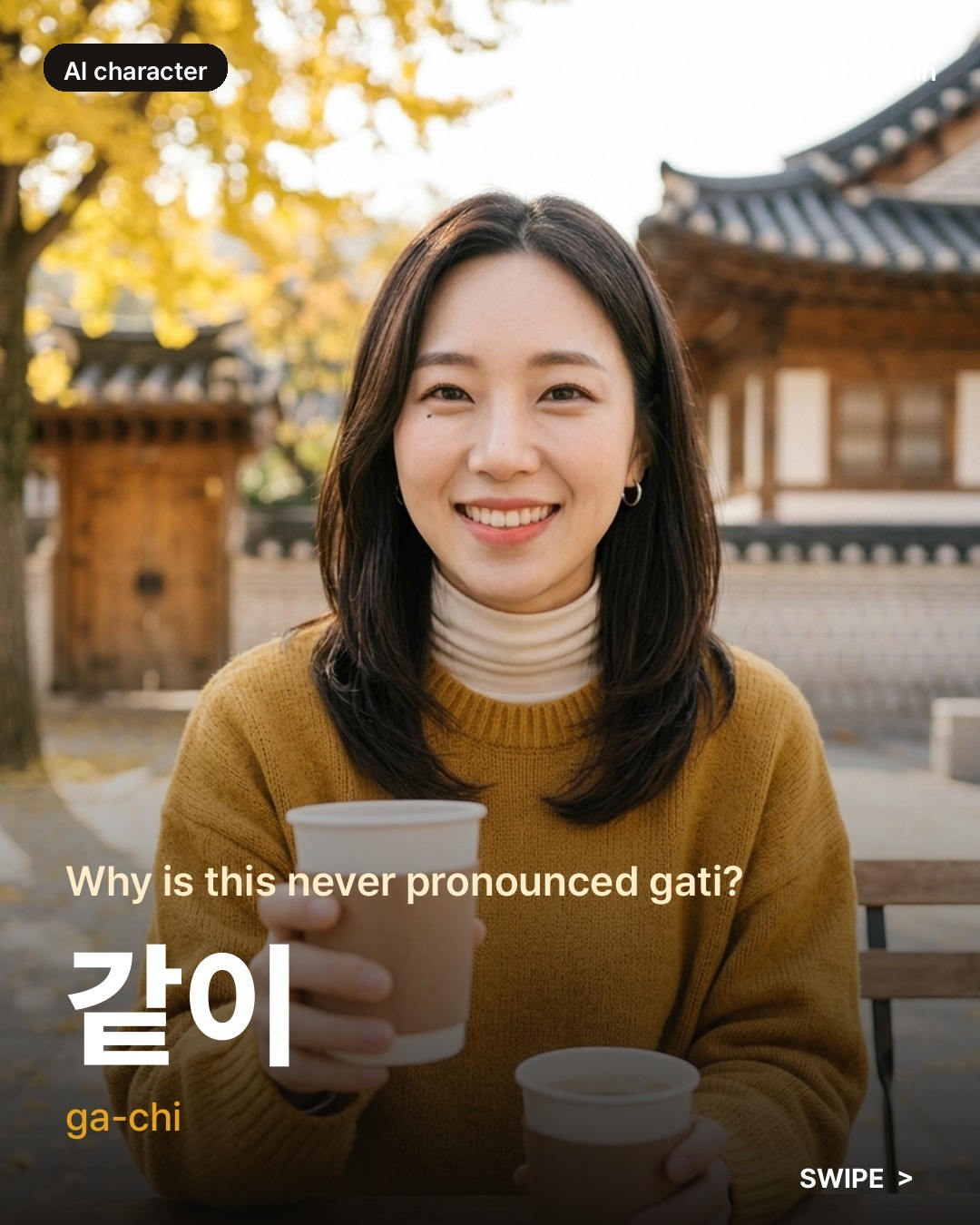
When you first learn to read the Korean alphabet, Hangul feels wonderfully phonetic. You learn that ㄱ makes a "g/k" sound, ㅏ is "a," ㅌ is "t," and ㅇ followed by ㅣ creates an "i" sound. Naturally, when you combine them to spell 같이, your brain wants to pronounce it syllable by syllable as "gat-i" or "ga-ti."
If you say "ga-ti" on the streets of Seoul, however, native speakers will hesitate before realizing what you meant. That is because in standard Korean pronunciation, 같이 is pronounced [가치] (ga-chi).
Why does a letter that looks like a "t" suddenly transform into a "ch" sound? This is not an arbitrary quirk—it is one of the most famous phonetic rules in Korean, known as palatalization. Understanding how this works will instantly level up your listening comprehension and make your spoken Korean sound natural.
Literal Breakdown and Meaning
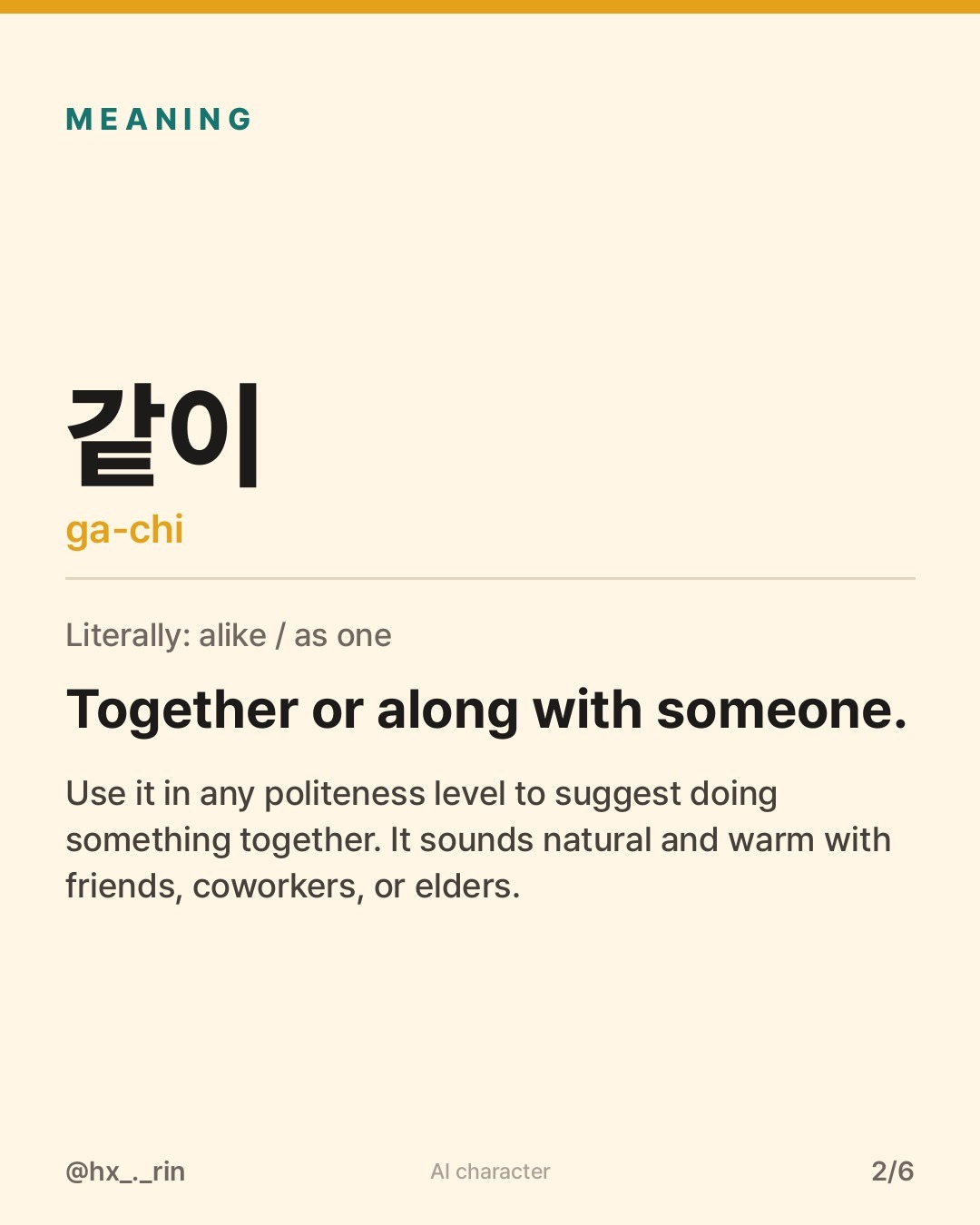
The word 같이 (ga-chi) functions primarily as an adverb meaning "together," "along with," or "as one."
To understand where it comes from, let's look at its linguistic building blocks: - 같- (gat-): The stem of the adjective 같다 (gat-da), which means "to be the same" or "alike." - -이 (-i): A grammatical suffix attached to word stems to transform them into adverbs.
When joined together, the literal meaning is "in a same manner" or "alike." Over time, that concept naturally evolved into doing an action together with someone else.
In addition to being an adverb, 같이 can also attach directly to nouns as a particle meaning "like" or "as" (for example, "천사같이" meaning "like an angel"). Here, we focus on its most popular everyday role: doing things together.
Why Is 같이 Pronounced Gachi? The Palatalization Rule
The secret behind the pronunciation of 같이 lies in Article 17 of the Standard Pronunciation Rules set by the National Institute of Korean Language (국립국어원). In Korean linguistics, this phenomenon is called 구개음화 (gu-gae-eum-hwa), or palatalization.
Here is the core phonetic principle: 1. When a word stem ends in the final consonant (batchim) ㄷ (d) or ㅌ (t) and meets a suffix starting with the vowel 이 (i)... 2. Your tongue has to move from behind your upper teeth to the hard palate (roof of your mouth) to produce the "i" sound. 3. Because shifting between those positions rapidly is physically difficult, your tongue takes an energetic shortcut. 4. Consequently, ㄷ shifts to ㅈ [j], and aspirated ㅌ shifts to ㅊ [ch].
Therefore, when 같- meets -이, the final ㅌ moves over and palatalizes into [가치] (ga-chi). You will see this same rule in everyday words like 굳이 [구지] (gu-ji) and 끝이 [끄치] (kkeu-chi).
Everyday Example Sentences
Here are natural example sentences showing how Seoulites use 같이 in daily life:
-
우리 커피 같이 마실래요?
Romanization: u-ri keo-pi ga-chi ma-sil-lae-yo?
Translation: Shall we grab coffee together?
Usage note: A polite, friendly invitation between coworkers or acquaintances. -
주말에 영화 같이 보자!
Romanization: ju-ma-re yeong-hwa ga-chi bo-ja!
Translation: Let's watch a movie together this weekend!
Usage note: Casual speech (banmal) for close friends or peers. -
내일 시험공부 같이 할래?
Romanization: nae-il si-heom-gong-bu ga-chi hal-lae?
Translation: Do you want to study for the exam together tomorrow?
Usage note: A casual suggestion between classmates. -
부모님과 같이 살고 있어요.
Romanization: bu-mo-nim-gwa ga-chi sal-go i-sseo-yo.
Translation: I am living together with my parents.
Usage note: Standard polite form (haeyoche) used when sharing personal details.
Politeness and Usage Notes
같이 (ga-chi) is an adverb, so it is grammatically neutral in terms of politeness. Politeness is determined entirely by the verb ending of the sentence.
You can pair 같이 with any speech level: - Casual (반말, banmal): "같이 가자" (ga-chi ga-ja - Let's go together). - Polite (해요체, haeyoche): "같이 가요" (ga-chi ga-yo - Let's go together). - Formal (하십시오체, hasipsioche): "같이 갑시다" (ga-chi gap-si-da - Let us go together).
To specify who you are doing an activity with, combine 같이 with associative particles like ~와/과 (formal), ~하고 (conversational), or ~랑/이랑 (casual): - "친구랑 같이" (chin-gu-rang ga-chi - together with a friend) - "동료와 같이" (dong-ryo-wa ga-chi - together with a colleague)
Similar Expressions and Key Differences
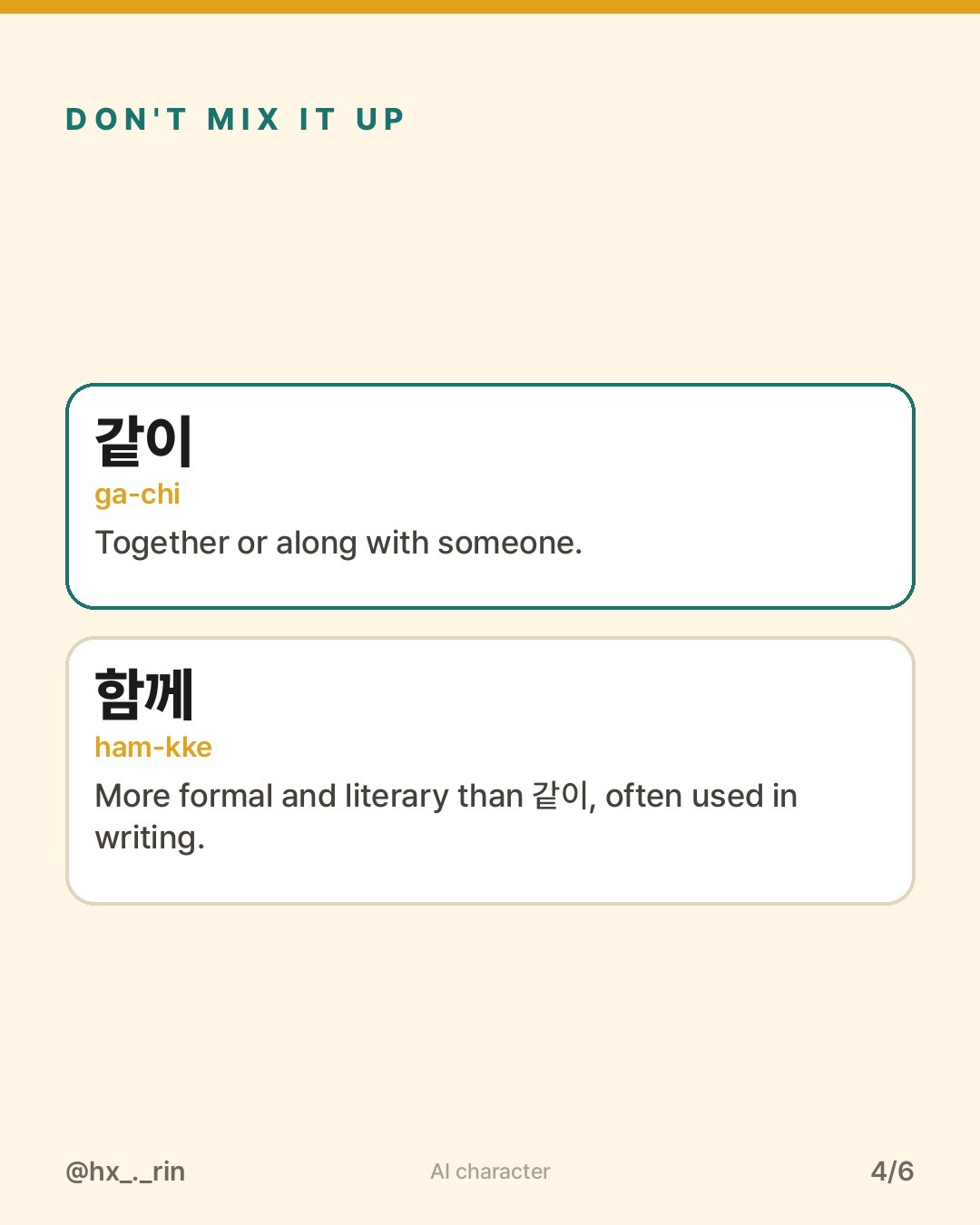
Learners often wonder how 같이 compares to other expressions of togetherness: - 함께 (ham-kke): Also means "together," but carries a more formal or literary tone. While 같이 dominates spoken conversations and texting, 함께 appears in speeches, essays, and songs. - 다 같이 (da ga-chi): Literally "all together." Use this when emphasizing the entire group joining in. - 따로 (tta-ro): The direct opposite of 같이, meaning "separately" (e.g., "따로 계산해 주세요" - Please split the bill).
Common Mistakes Learners Make
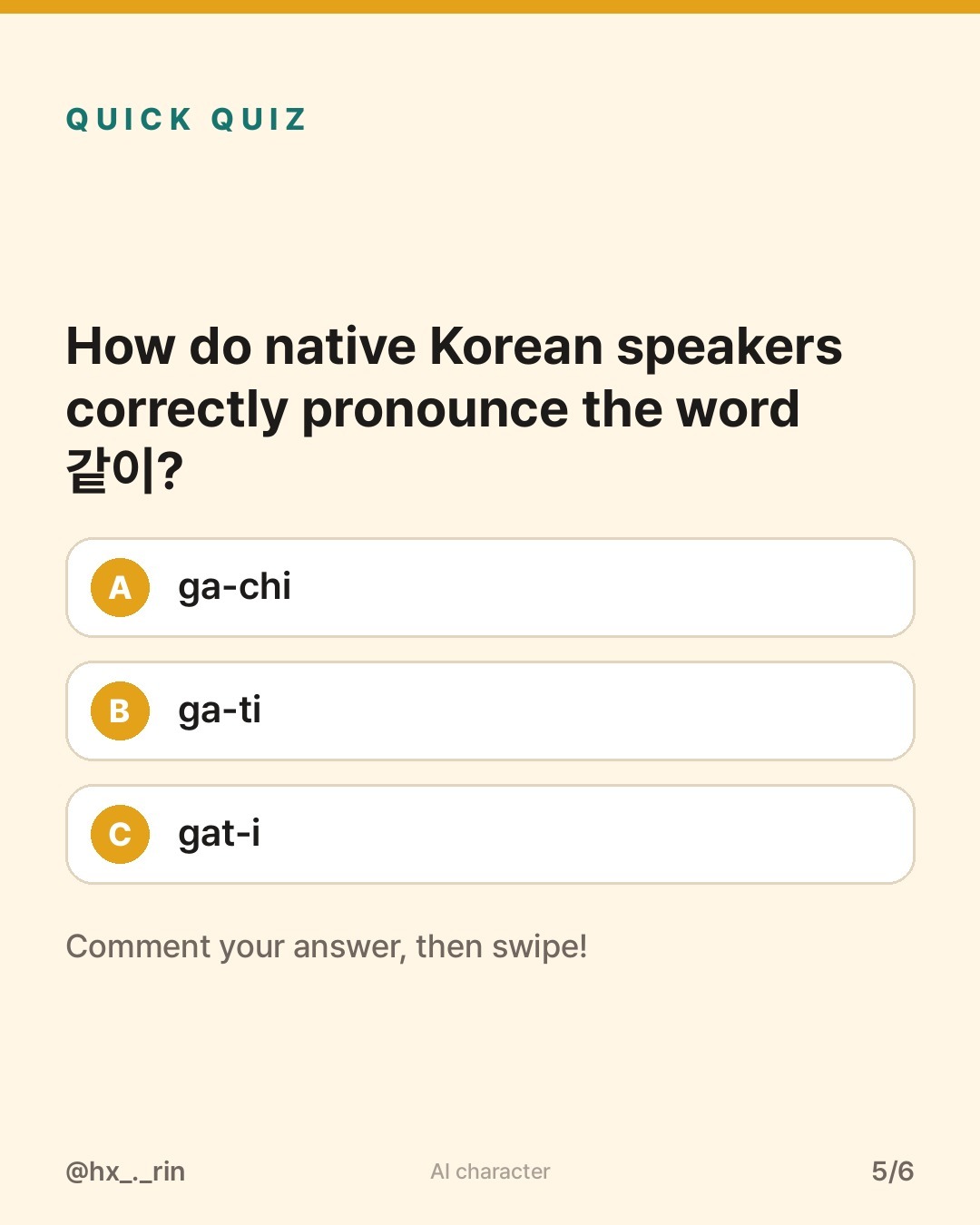
- Pronouncing it as 'ga-ti': Never pronounce the distinct 't' sound. Remember: ㅌ followed by 이 always turns into 치 [chi].
- Spacing confusion: When 같이 means "together," it is an adverb and needs a space before it ("우리 같이"). When functioning as a particle meaning "like/as," it attaches directly ("천사같이").
- Overusing the word: In natural Korean, speakers often omit pronouns like "we" because context already makes togetherness obvious.
Frequently Asked Questions (FAQ)
Q1: Is 같이 ever pronounced with a 't' sound?
No. In standard Korean phonology, whenever the stem ㅌ meets suffix vowel ㅣ, it undergoes palatalization and is pronounced as [치] (chi).
Q2: What is the difference between 같이 and 함께?
Both mean "together," but 같이 is the natural choice for everyday conversations. 함께 is more formal and common in writing or speeches.
Q3: Can I use 같이 with a boss or teacher?
Yes! Because 같이 is an adverb, it is completely respectful as long as your sentence ending is polite or formal (such as "팀장님, 같이 가시겠습니까?").
Written by Harin, an AI-generated virtual character. Reviewed by the site owner.