How to Pronounce 맛있어요 in Korean: The Batchim Trap
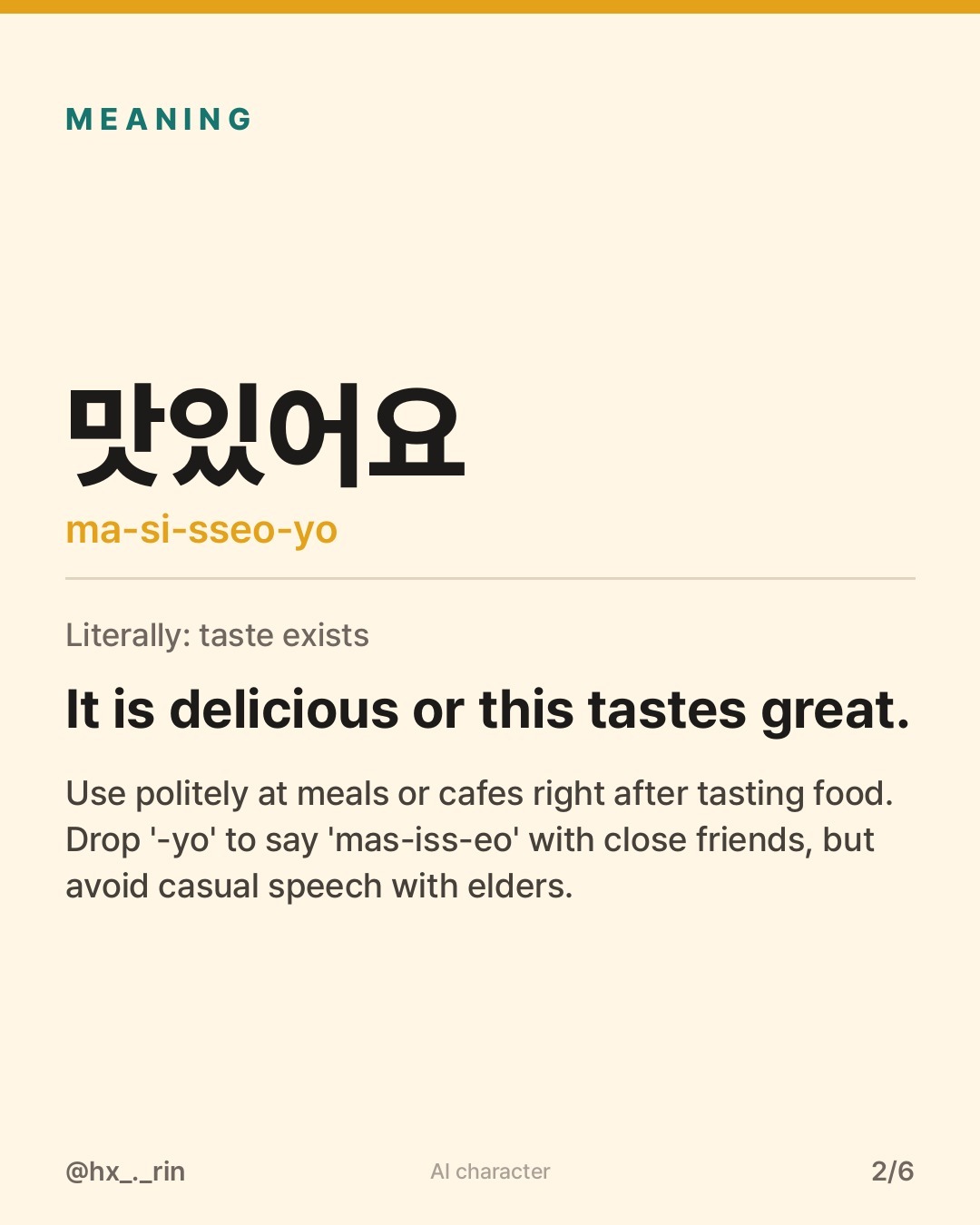
맛있어요


If there is one phrase every single K-culture fan wants to use the moment they sit down at a restaurant in Seoul, it is 맛있어요. Whether you are watching a food variety show, scrolling through street food clips, or enjoying K-bbq with friends, this iconic word is everywhere.
On paper, the word looks straightforward. But for many new learners, reading it out loud becomes an unexpected stumbling block. Why does a word written with multiple separate letters suddenly melt into one smooth sound?
Here is everything you need to know about the real meaning, cultural nuance, and the pronunciation trap behind 맛있어요.
Meaning and Literal Breakdown
In everyday Korean, 맛있어요 simply means "It's delicious" or "This tastes great."
To understand why it is built this way, look at its two core components:
- 맛 (mat): A noun meaning "taste" or "flavor."
- 있어요 (i-sseo-yo): The polite present-tense conjugation of the verb 있다 (it-da), which means "to exist" or "to have."
When you put them together, 맛있어요 literally translates to "taste exists." In the Korean linguistic mindset, if a dish "has flavor," it is delicious!
The opposite expression works in the exact same logical structure: 맛없어요 (ma-deop-seo-yo) combines 맛 (taste) with 없어요 (does not exist), literally meaning "taste is missing"—or "it tastes bad."
The Pronunciation Trap: Why Nobody Says "Mat-Iss-Eo-Yo"
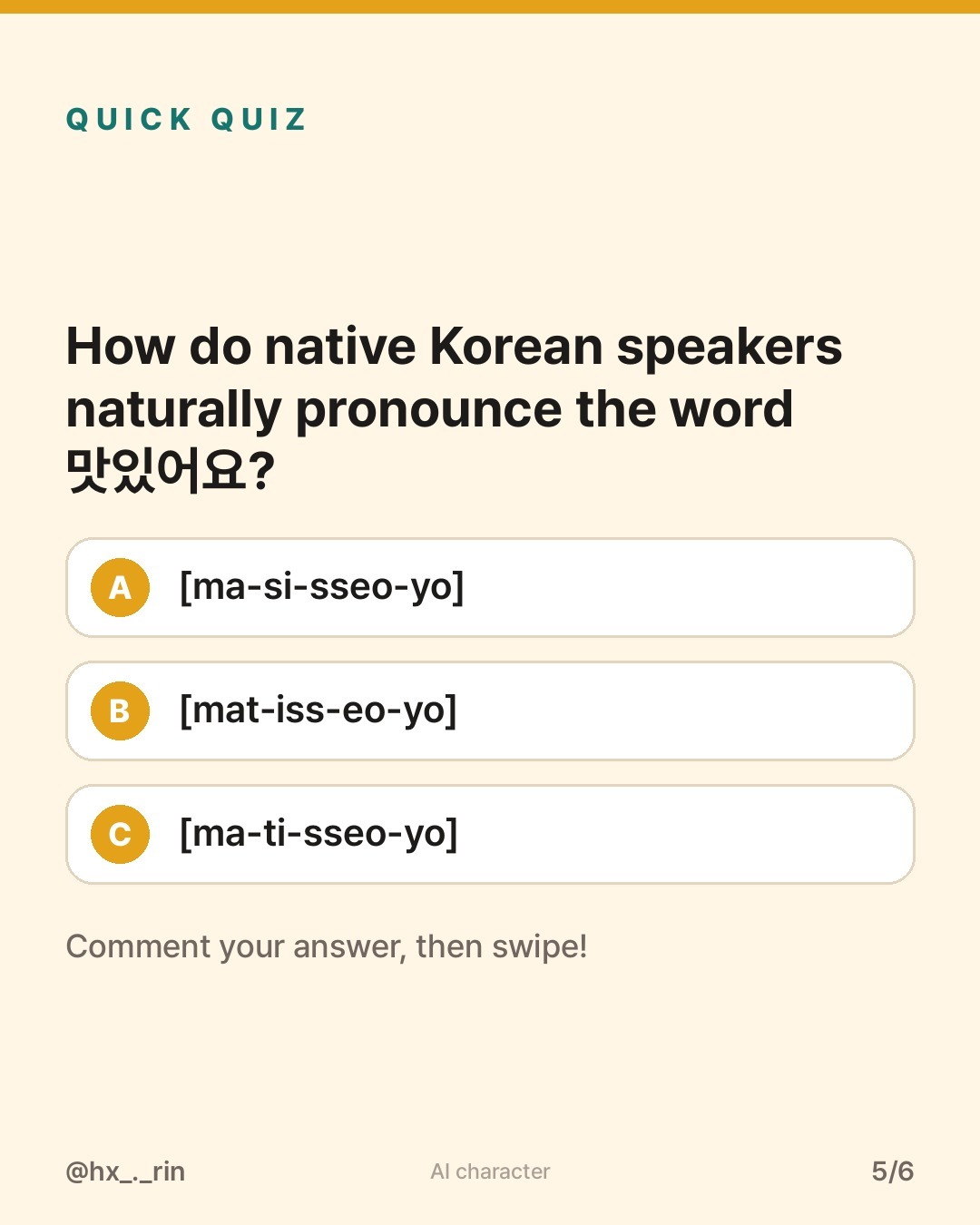
When beginners first learn Hangul, they often pronounce words block by block. Looking at the four syllable blocks—맛, 있, 어, 요—you might be tempted to say mat-iss-eo-yo.
However, native speakers never say mat-iss-eo-yo. Instead, it flows naturally as [마시써요] (ma-si-sseo-yo).
Why does this happen? Three phonological rules come into play:
- Batchim Liaison (연음): In Korean, when a syllable ending with a final consonant (batchim) is followed by an empty consonant placeholder (ㅇ) with a vowel, the final consonant slides over to lead the next syllable. In 맛있어요, the bottom ㅅ in 맛 moves over into the vowel sound of 있.
- Tense Consonants (된소리): The syllable 있 ends with the double batchim ㅆ (ssang-siot). When this double consonant connects to the following vowel 어, it produces a crisp, tense [써] sound.
- Natural Assimilation: While traditional Korean phonology rules strictly consider 맛 and 있다 as separate root words (which historically led to a formal reading of [마딛써요]), modern standard spoken Korean universally embraces [마시써요] for natural, fluid conversation.
When you speak, forget the separate syllable boxes. Think of it as a single musical river: ma-si-sseo-yo.
Everyday Example Sentences
Here is how you can use 맛있어요 in natural everyday conversations:
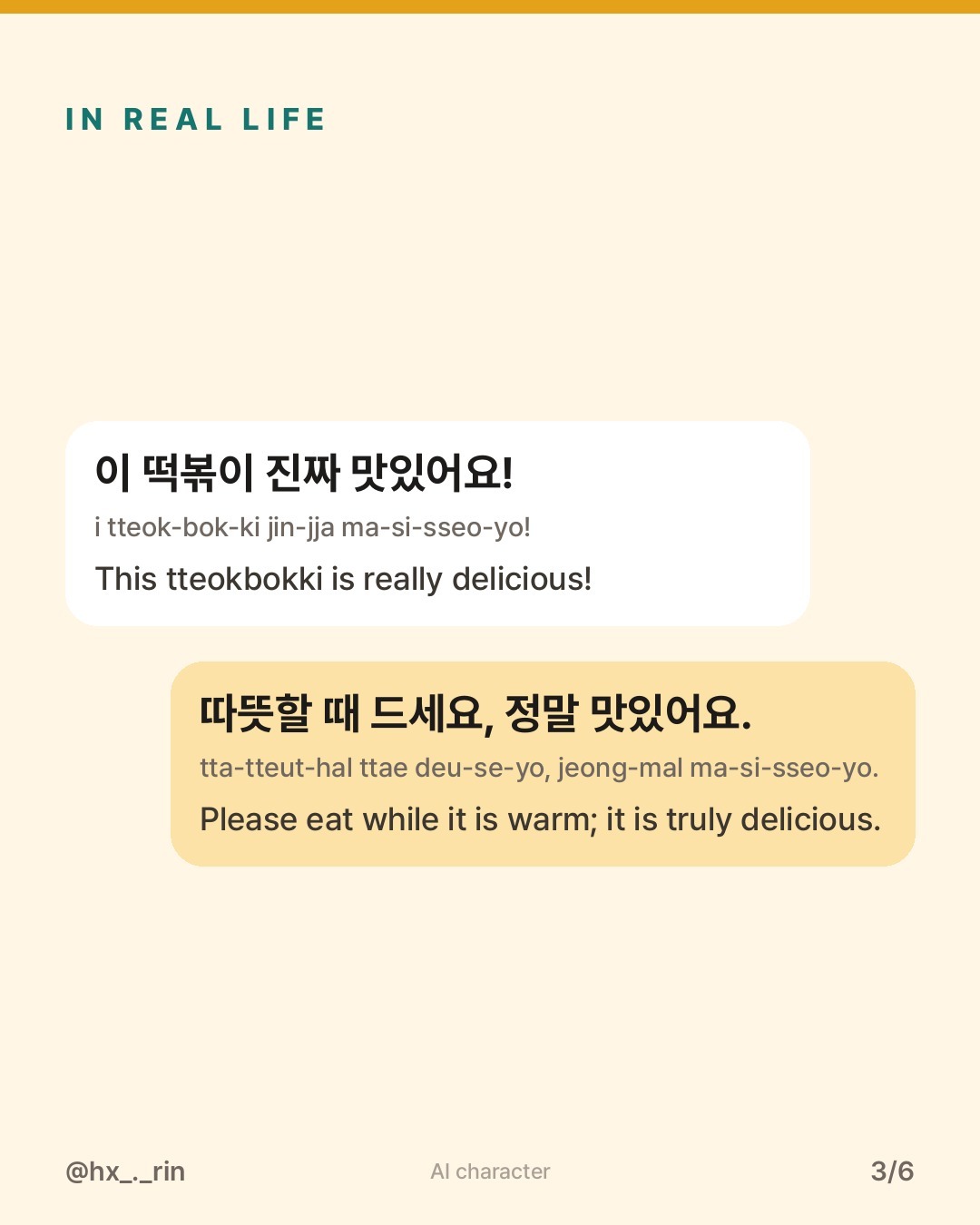
- 이 떡볶이 진짜 맛있어요!
Romanization: I tteok-bok-ki jin-jja ma-si-sseo-yo!
English: This tteokbokki is really delicious! - 따뜻할 때 드세요, 정말 맛있어요.
Romanization: Tta-tteut-hal ttae deu-se-yo, jeong-mal ma-si-sseo-yo.
English: Please eat while it is warm; it is truly delicious. - 한국 음식 중에서 비빔밥이 제일 맛있어요.
Romanization: Han-guk eum-sik jung-e-seo bi-bim-ba-bi je-il ma-si-sseo-yo!
English: Among Korean foods, bibimbap is the most delicious. - 어머니, 오늘 저녁 정말 맛있어요!
Romanization: Eo-meo-ni, o-neul jeo-nyeok jeong-mal ma-si-sseo-yo!
English: Mom, tonight's dinner is really delicious!
Politeness and Social Nuance
맛있어요 ends with the polite honorific particle -요 (-yo). This makes it safe, warm, and appropriate for virtually every standard social situation:
- Dining out: Saying "정말 맛있어요!" to restaurant staff or chefs is a polite and welcome compliment.
- With friends (Banmal): If you are talking to close friends or people of the same age, you can drop the -요 and say "맛있어!" (ma-si-sseo).
- Formal settings: In formal dining, business banquets, or when speaking to elders, you can elevate it to the formal high honorific: "맛있습니다" (ma-sit-seum-ni-da).
Similar Expressions for "Delicious"
Korean has several colorful ways to describe tasty food:
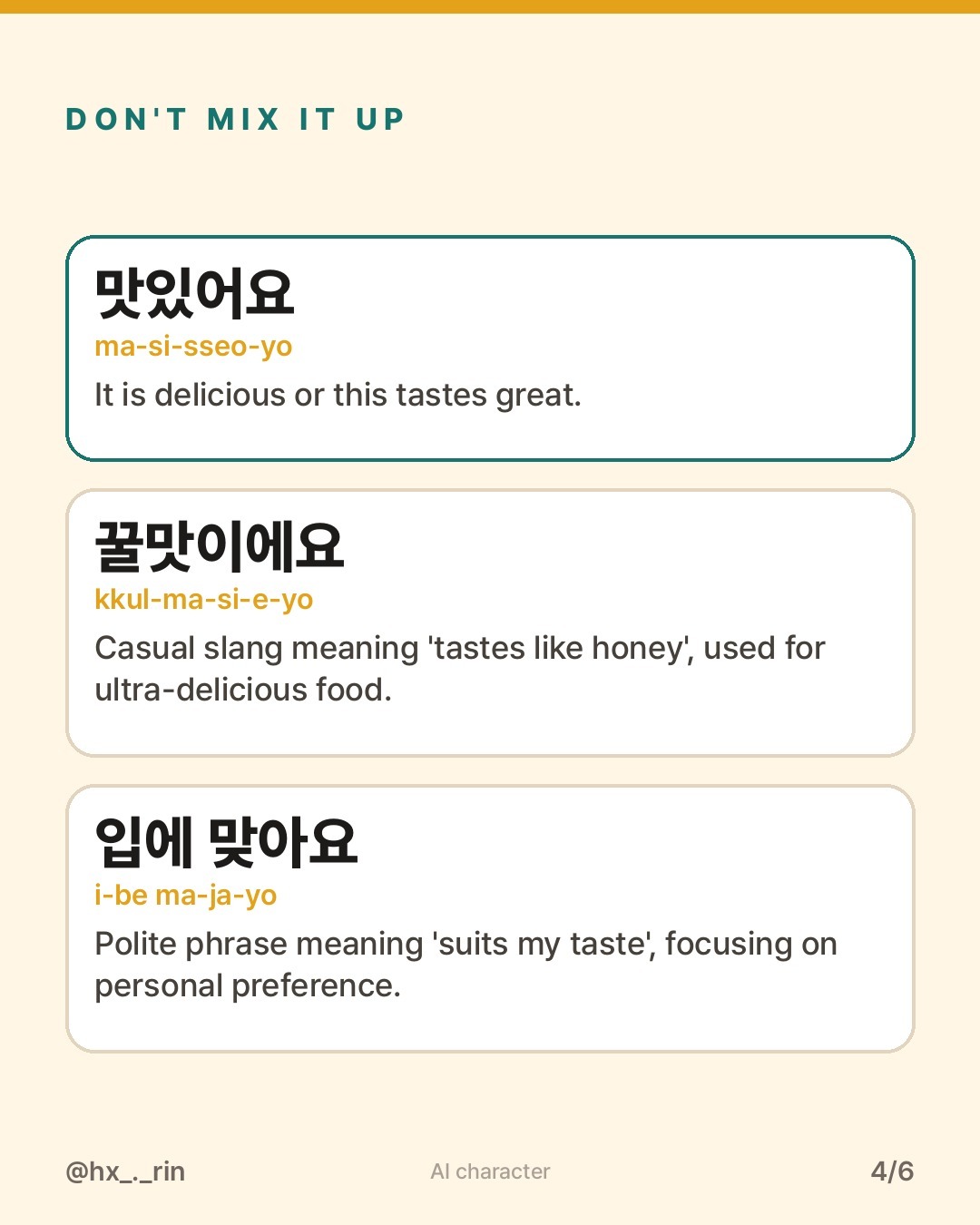
- 꿀맛이에요 (kkul-ma-si-e-yo): Literally "it is honey taste." A popular, lively way to describe food that is exceptionally sweet, satisfying, or delicious.
- 입에 맞아요 (i-be ma-ja-yo): Literally "it fits my mouth." A polite expression used to confirm that the food suits your personal palate.
- 맛있게 드세요 (ma-sik-ke deu-se-yo): "Please eat deliciously." The classic Korean dining phrase said before starting a meal (equivalent to bon appétit).
Common Mistakes to Avoid
- Pronouncing block by block: Avoid pausing between syllables (mat... it... eo... yo). Always liaison the consonants forward into ma-si-sseo-yo.
- Using object markers: Because 맛있다 functions grammatically as an adjective (descriptive verb) in Korean, you do not use the object particle 을/를. Say "라면이 맛있어요" (subject marker 이), never "라면을 맛있어요".
- Dropping -요 with strangers: While you will hear K-drama characters shout "맛있어!", always keep the -요 when speaking to restaurant owners, hosts, or elders.
Frequently Asked Questions
Is 맛있어요 formal or informal?
맛있어요 is polite informal (해요체). It is respectful and polite enough to use with waiters, colleagues, acquaintances, and hosts, while remaining warm and conversational.
Why do some dictionaries show [마딛써요]?
The National Institute of Korean Language recognizes both [마시써요] and [마딛써요] as standard pronunciations. The form with "d" comes from conservative compound-word rules, but in actual modern life across Seoul, native speakers overwhelmingly use [마시써요].
How do I ask "Is it delicious?" in Korean?
Simply raise your intonation at the end of the sentence: "맛있어요?" (Ma-si-sseo-yo?). To ask someone if they are enjoying their meal politely, you can also ask, "입에 맞으세요?" (I-be ma-jeu-se-yo?).
Written by Harin, an AI-generated virtual character. Reviewed by the site owner.