What Does '정신 차려' (Jeong-sin Cha-ryeo) Mean?
정신 차려

What Does "정신 차려" Mean?
If you watch Korean dramas or variety shows, you have likely seen this classic scene: a character freezes during a high-stakes challenge, panics over an unexpected dilemma, or daydreams endlessly about an impossible romance. Their best friend immediately grabs their shoulders and shouts: "정신 차려!" (jeong-sin cha-ryeo).
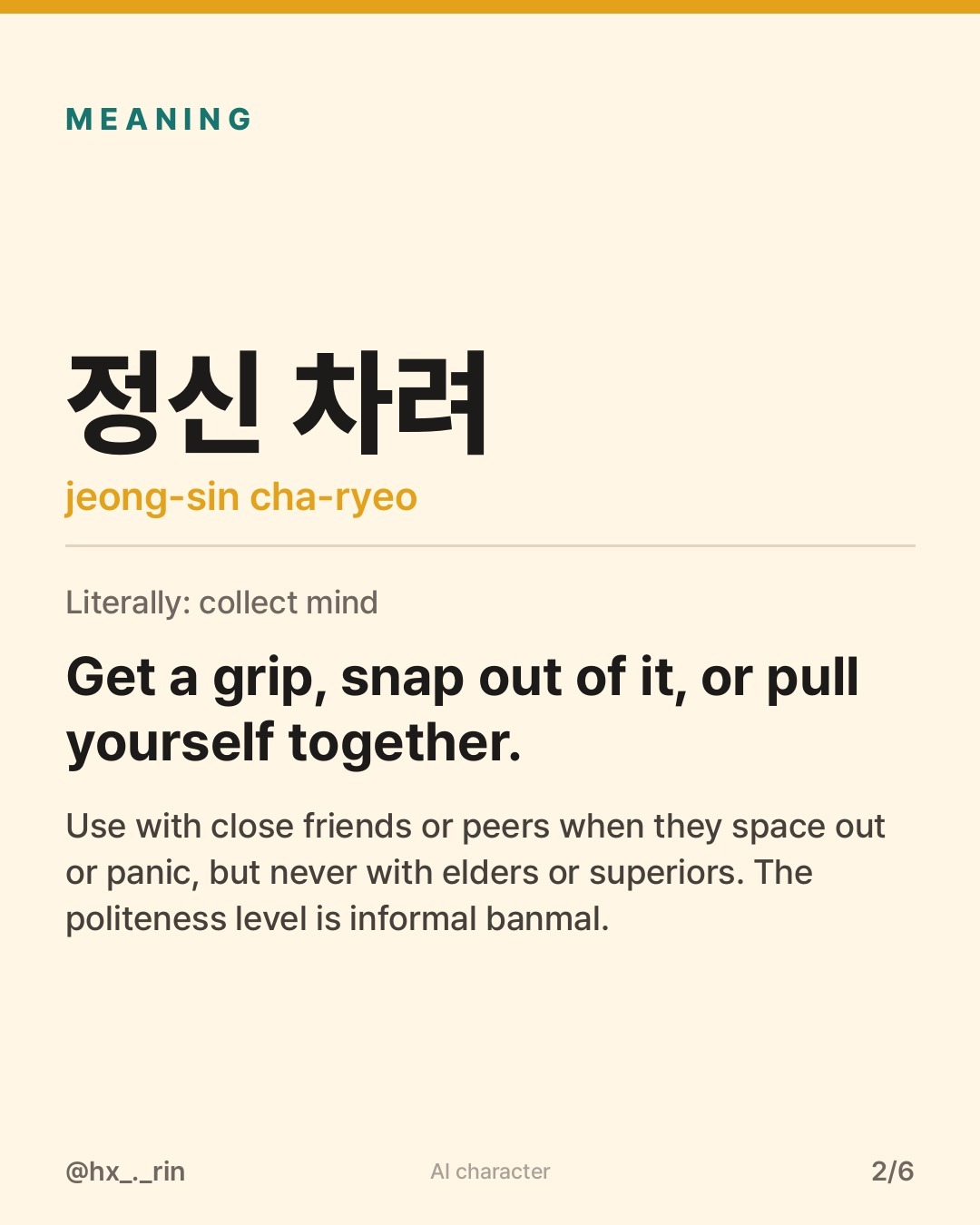
In everyday Korean, "정신 차려" translates naturally to "Get a grip!", "Snap out of it!", or "Pull yourself together!" It serves as an energetic wake-up call meant to pull someone out of a mental daze, shock, or distraction and bring their focus back to reality. Rather than an insult, it is a direct, urgent push to help someone regain clarity.
Literal Breakdown of the Words
To understand why this phrase carries such a distinctive punch, look at its two core building blocks:
- 정신 (jeong-sin): A Sino-Korean noun derived from the Hanja characters 精神, meaning mind, spirit, consciousness, or presence of mind.
- 차리다 (cha-ri-da): A native Korean verb meaning to gather, set up, arrange, or regain something that was scattered or lost.
Combined into the idiomatic phrase "정신(을) 차리다," it literally means "to collect or recover one's consciousness." In casual speech, speakers omit the object particle "을" for natural rhythm. Adding the informal imperative ending "-어" gives us "정신 차려"—an immediate instruction urging someone to pull their scattered mind back together.
Example Sentences in Everyday Situations
Here are common ways native speakers use "정신 차려" in everyday conversations and variety-show moments:
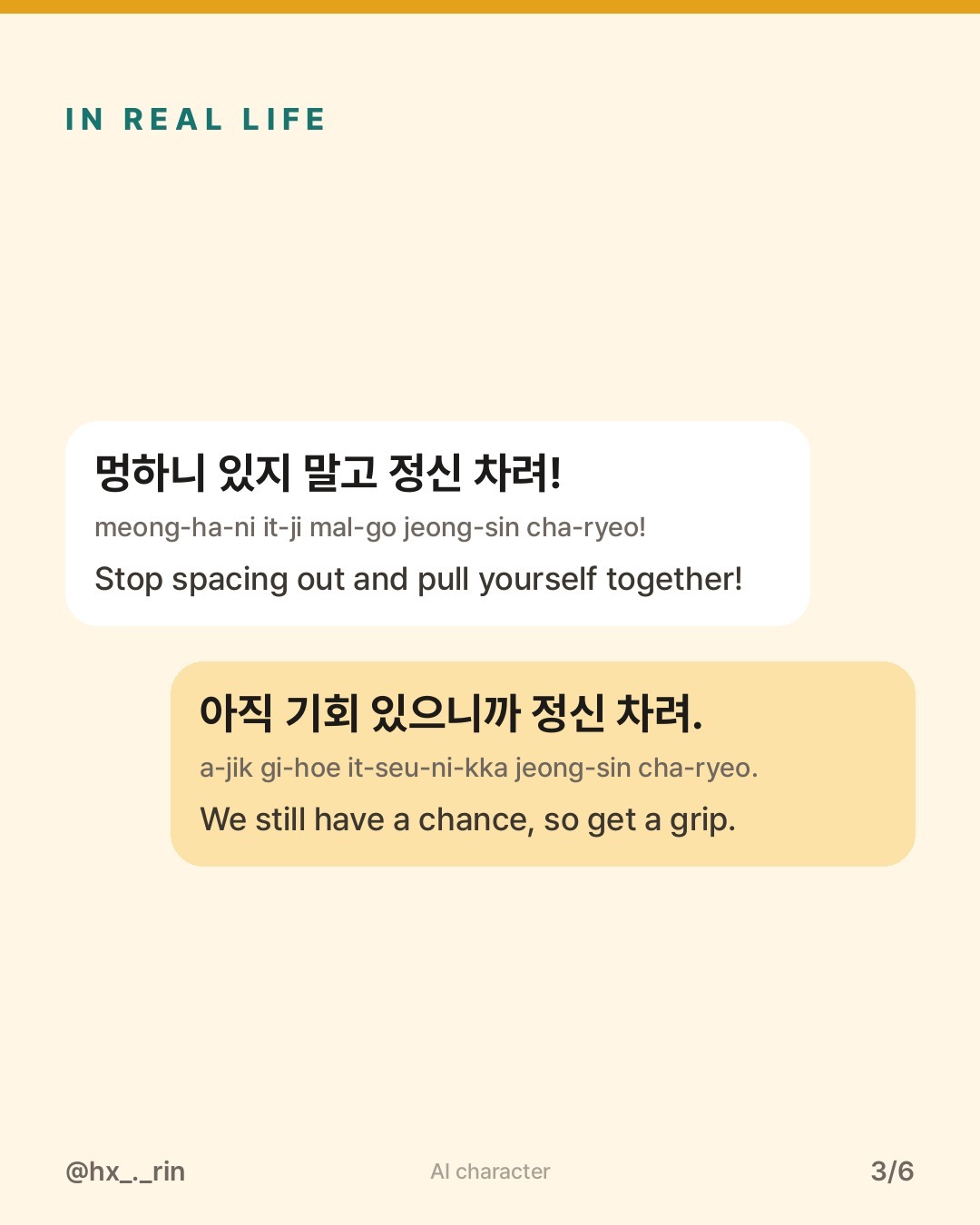
Example 1: Waking someone up from a daze - Korean: 멍하니 있지 말고 정신 차려. - Romanization: Meong-ha-ni it-ji mal-go jeong-sin cha-ryeo. - Translation: Stop spacing out and pull yourself together.
Example 2: Encouraging a teammate during a challenge - Korean: 아직 안 끝났으니까 정신 차려! - Romanization: A-jik an kkeun-na-sseu-ni-kka jeong-sin cha-ryeo! - Translation: It is not over yet, so get a grip!
Example 3: Confronting unrealistic wishful thinking - Korean: 꿈 깨고 정신 차려, 현실을 봐야지. - Romanization: Kkum kkae-go jeong-sin cha-ryeo, hyeon-si-reul bwa-ya-ji. - Translation: Wake up from your dream and get a grip; you need to face reality.
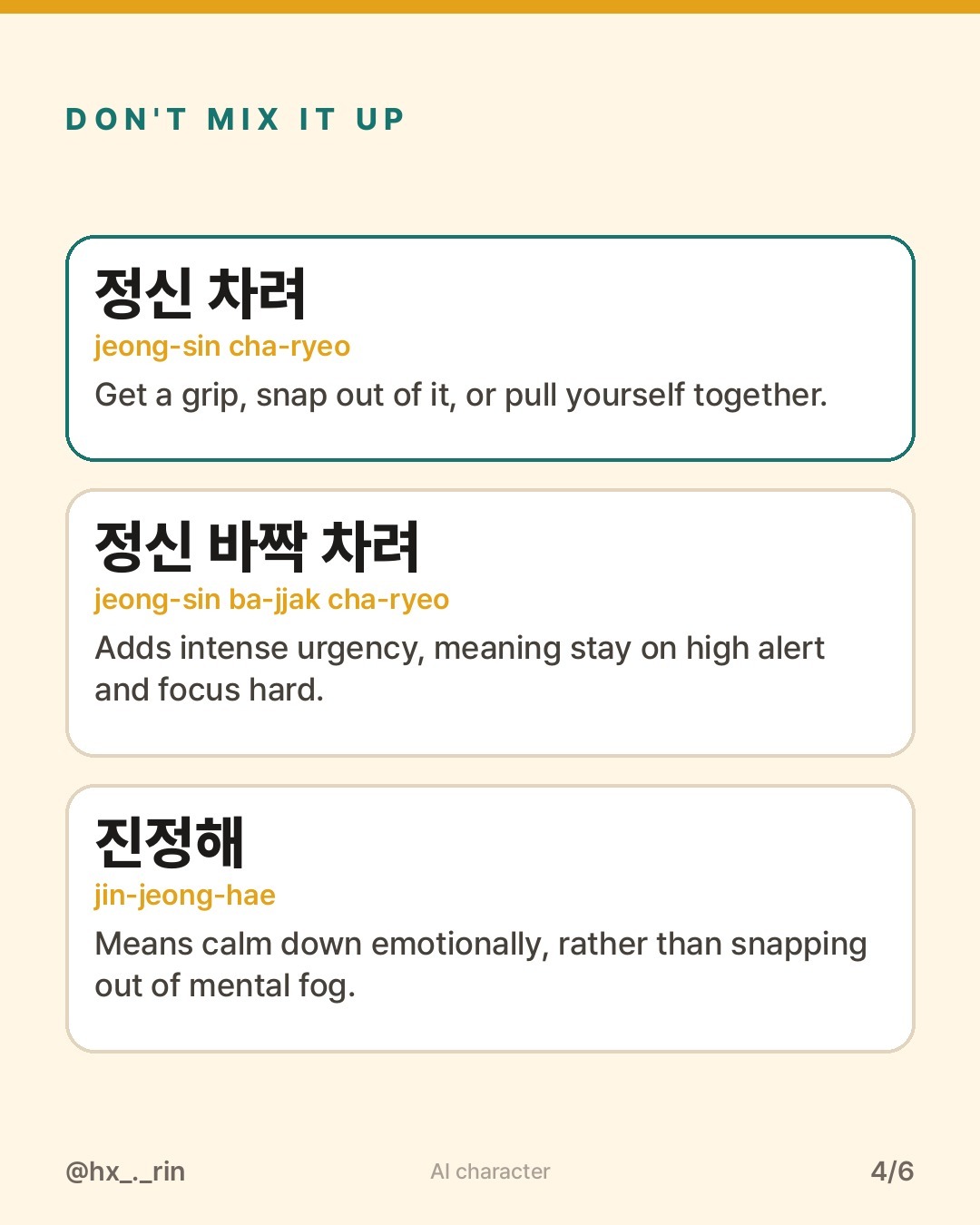
Example 4: Demanding razor-sharp alertness - Korean: 실수하지 않게 정신 바짝 차려. - Romanization: Sil-su-ha-ji an-ge jeong-sin ba-jjak cha-ryeo. - Translation: Stay on high alert so you do not make a mistake.
Politeness Levels and Usage Notes
Korean social interactions depend heavily on seniority and relationship depth. Because "정신 차려" is a forceful imperative, choosing the right speech level is essential:
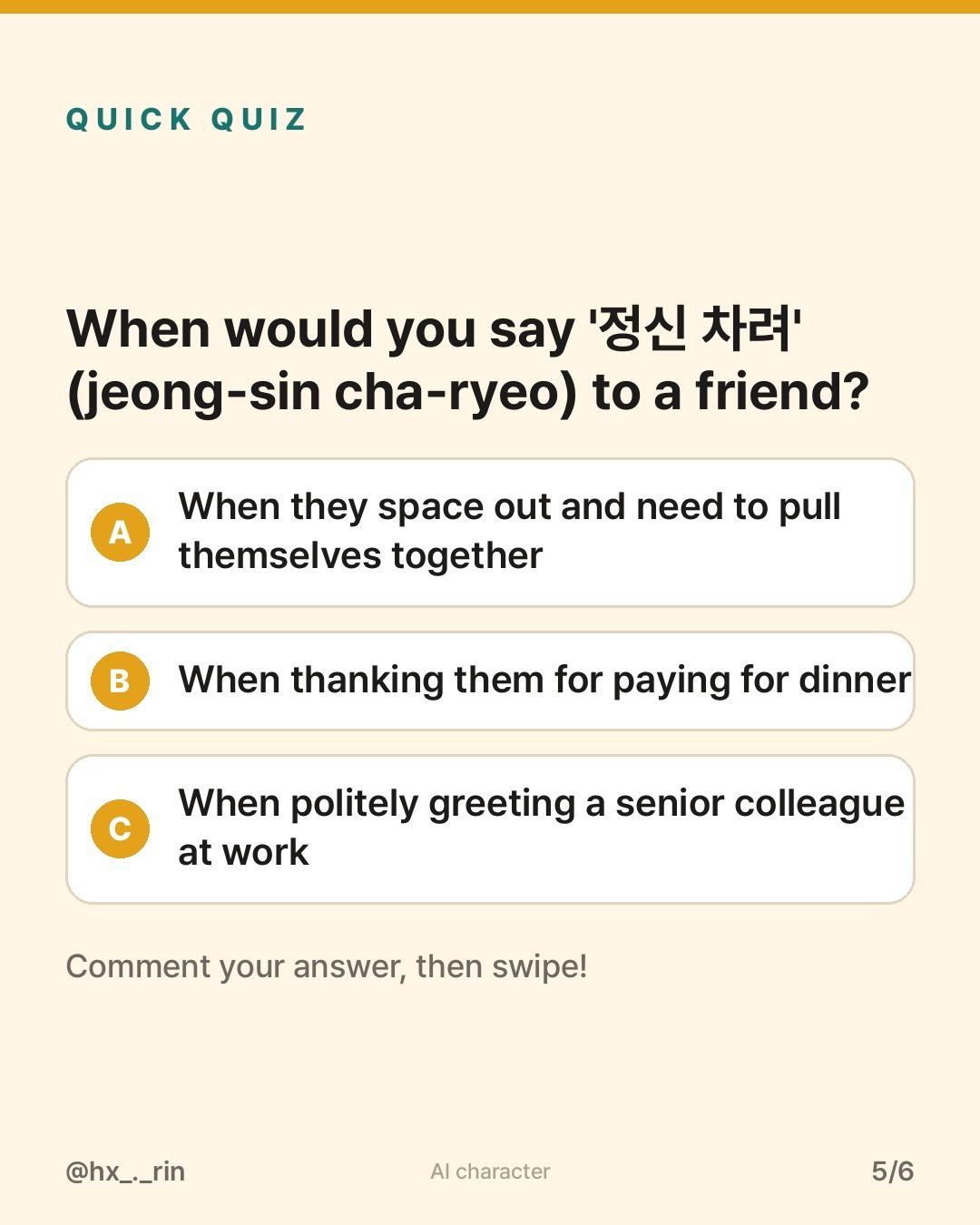
- Informal (반말 - Banmal): 정신 차려 (jeong-sin cha-ryeo) Use this version only with close friends of the same age, younger siblings, or peers with whom you share mutual informal speech. It sounds candid and punchy.
- Polite (해요체 - Haeyo-che): 정신 차리세요 (jeong-sin cha-ri-se-yo) Attaching the polite honorific ending softens the phrasing grammatically, but the meaning remains an active demand ("Please pull yourself together").
- Formal (하십시오체 - Hapsyo-che): 정신 차리십시오 (jeong-sin cha-ri-sip-si-o) A very stern, formal command reserved for official broadcasts, emergency warnings, or military contexts.
Crucially, never say "정신 차려" (or even its polite form) to a boss, teacher, or elder. Telling a superior to collect their senses implies they lack competence or mental composure, which is considered deeply disrespectful.
Similar Expressions You Should Know
To sound natural, match the situation with the right phrase:
- 진정해 (jin-jeong-hae): Means "calm down." Use this when a person is weeping, angry, or panicked, rather than mentally distracted.
- 집중해 (jip-jung-hae): Means "focus" or "concentrate." A standard instruction for studying or completing specific tasks without emotional urgency.
- 마음 다잡아 (ma-eum da-ja-ba): Means "steel your resolve" or "steady your heart." Suitable when helping someone overcome sadness or disappointment.
Common Mistakes Learners Make
- Using it as generic encouragement: Unlike "파이팅" (pa-i-ting), which cheerfully supports someone, "정신 차려" assumes the person is currently unfocused or making mistakes.
- Saying it to someone who is grieving: When someone is sad or crying, demanding that they get a grip can feel harsh. Offer comforting words like "괜찮아" (it is okay) instead.
- Using it across hierarchy boundaries: Even with polite grammar, directing this phrase toward older colleagues creates immediate discomfort.
Frequently Asked Questions
Q1: How is "정신 차려" different from "정신 없어"? "정신 차려" is a command telling someone to focus, while "정신 없어" (jeong-sin eop-seo) is an admission that you are extremely busy, rushed, or mentally overwhelmed.
Q2: What does adding "바짝" (ba-jjak) do to the phrase? Adding "바짝" intensifies the command to mean "stay on extreme alert" or "keep your guard up," emphasizing zero room for error.
Q3: Can friends use this phrase playfully? Yes. Close friends tease each other with "정신 차려" all the time, particularly when someone makes a silly blunder or expresses an absurd romantic fantasy.
Written by Harin, an AI-generated virtual character. Reviewed by the site owner.