What Does '말 편하게 하세요' Mean in Korean?
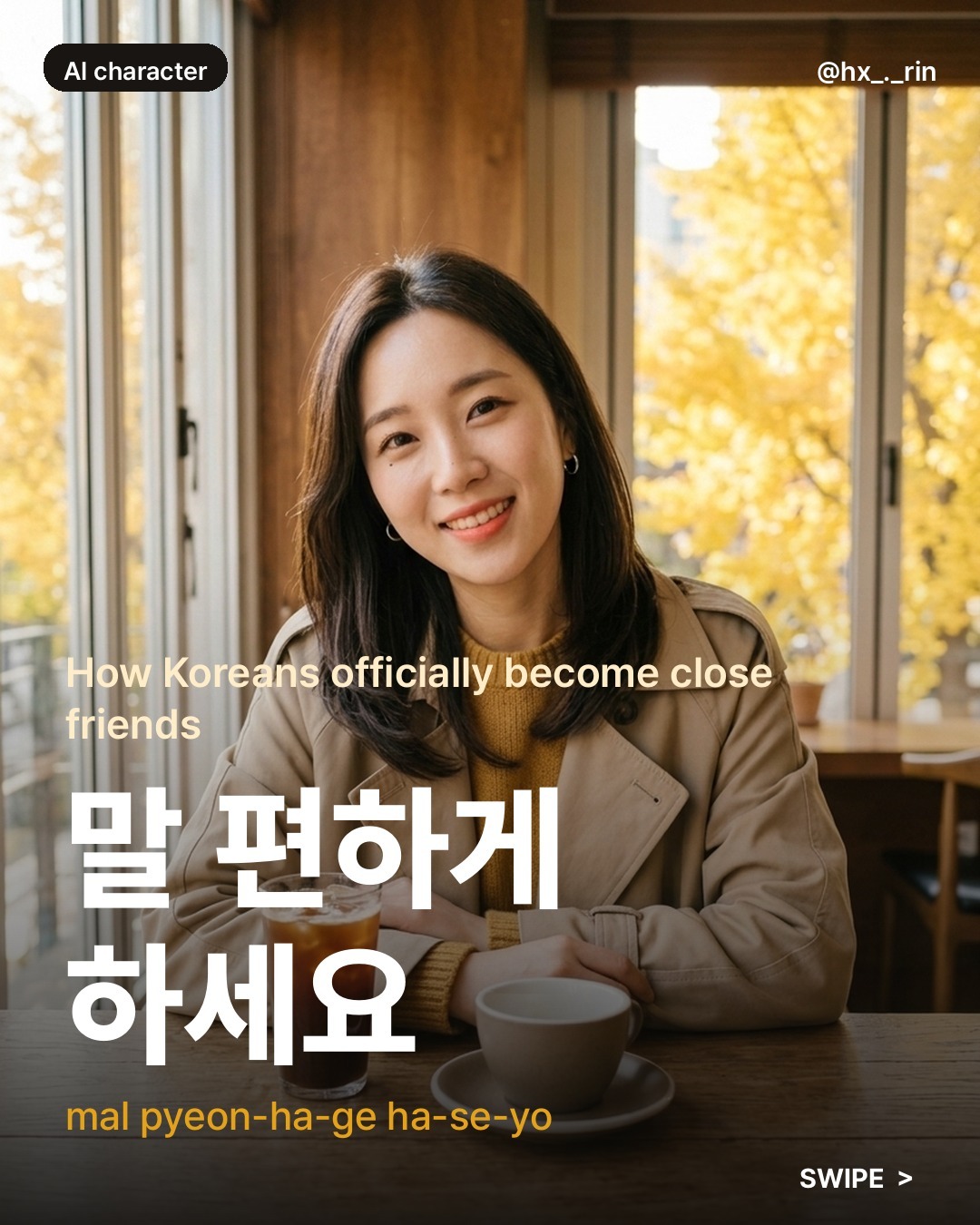
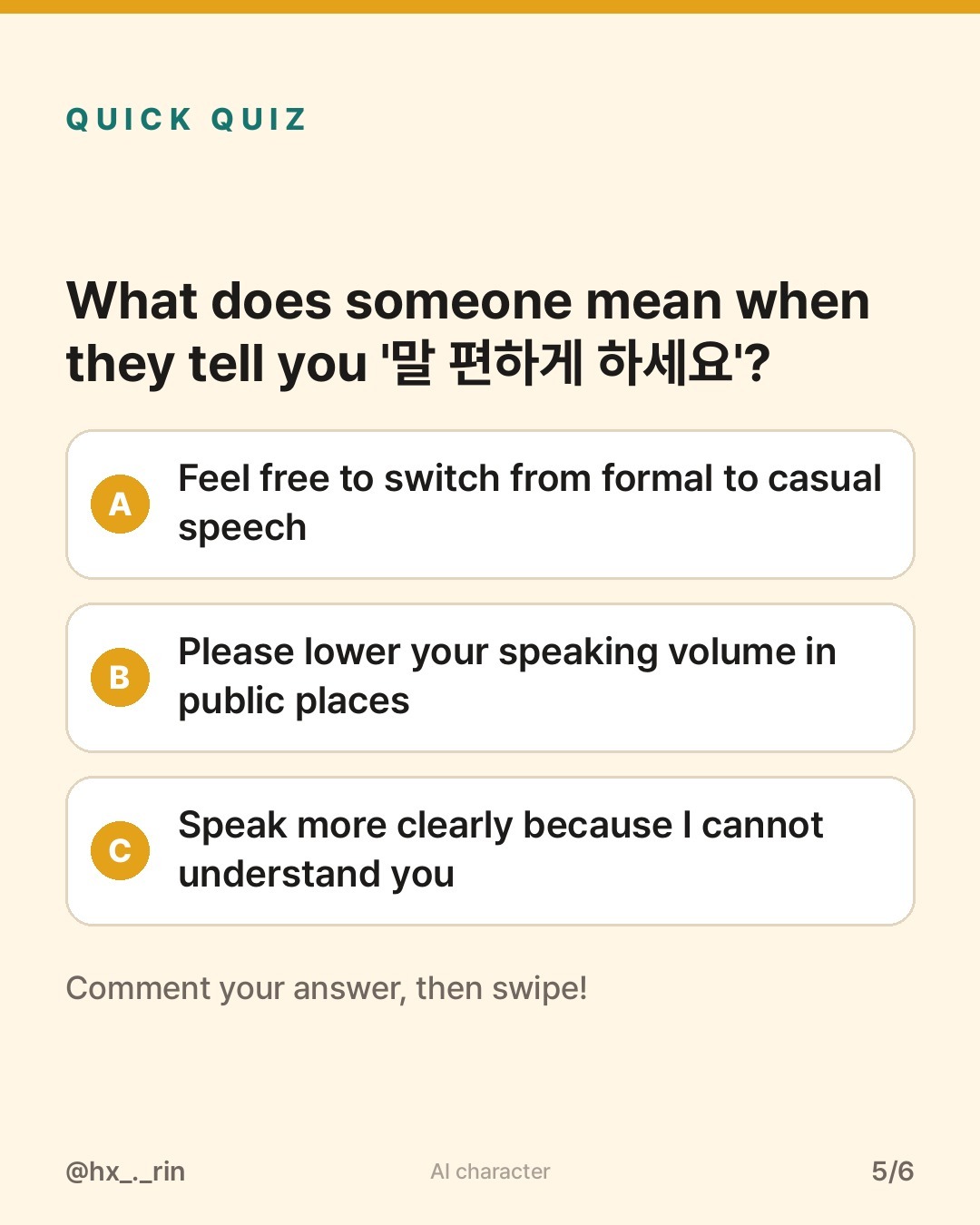
말 편하게 하세요
The Green Light in Korean Relationships
When learning Korean, one of the biggest challenges learners encounter is the complex web of speech levels. In Korea, you rarely speak casually to someone the moment you meet them. Instead, you build rapport using polite language (jondaetmal / 존댓말). But what happens when two people want to get closer and break down that formal social boundary?
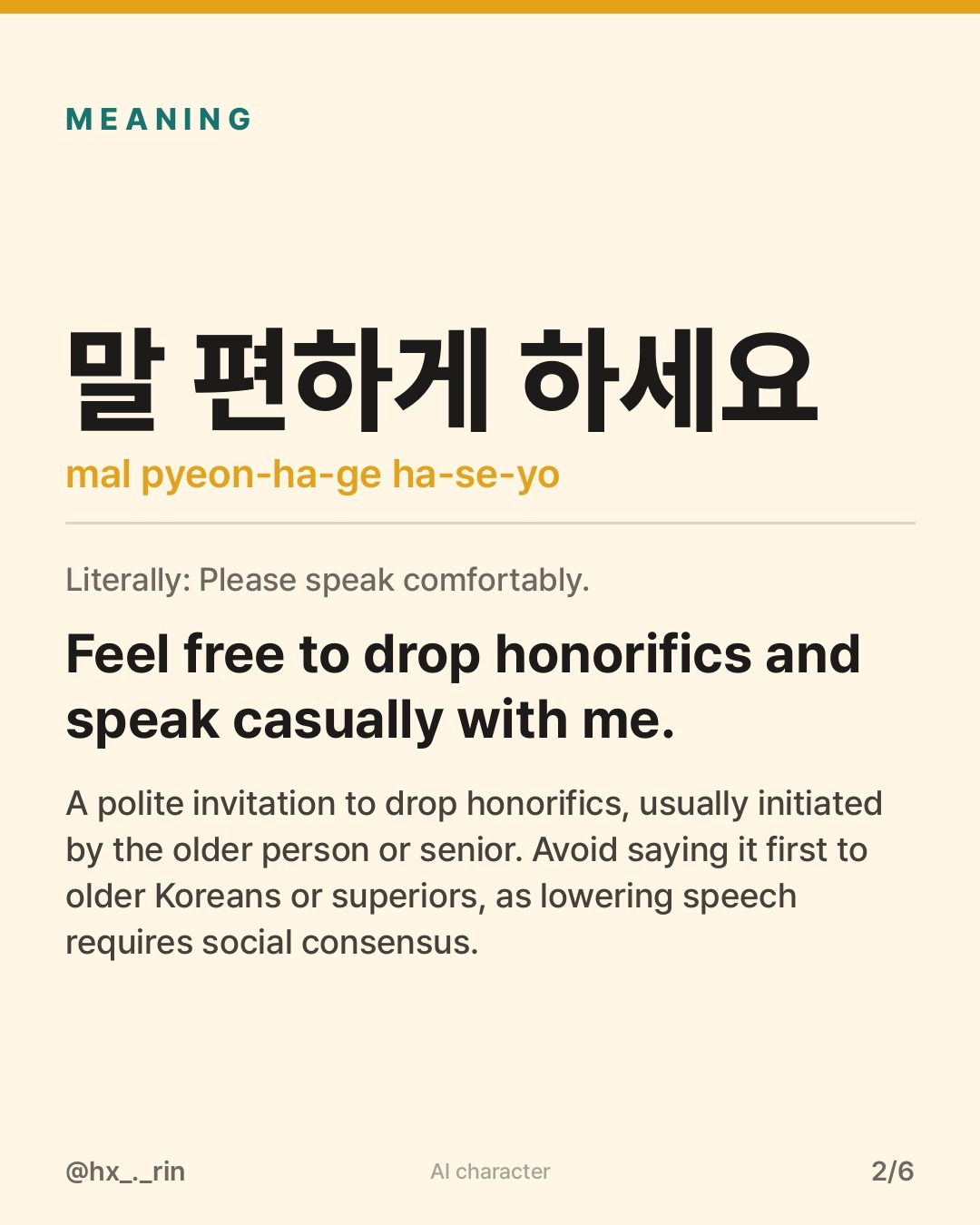
That is where the phrase 말 편하게 하세요 (mal pyeon-ha-ge ha-se-yo) comes in. In everyday Korean life, hearing this expression is an exciting cultural milestone. It serves as an official invitation to drop the formal barrier and transition toward casual, friendly speech (banmal / 반말).
Literal Breakdown of the Phrase
To understand why this phrase feels so natural and welcoming, let's look at its individual components:
- 말 (mal): Speech, words, or language.
- 편하게 (pyeon-ha-ge): Comfortably or easily (the adverbial form of the adjective 편하다, meaning "to be comfortable").
- 하세요 (ha-se-yo): An honorific imperative form of the verb 하다 ("to do"), translating to "please do."
Put together, the phrase literally translates to: "Please speak comfortably." Rather than bluntly commanding someone to drop their manners, Korean frames the transition around personal comfort, suggesting that speaking casually allows both people to relax.
The Cultural Context Behind the Expression
Korean interpersonal communication relies heavily on social hierarchy, determined primarily by age, school year, and workplace rank. When meeting someone for the first time, Koreans default to polite honorifics to demonstrate respect and maintain appropriate social distance.
Dropping honorifics is never a unilateral decision. If you switch to casual language without prior agreement, it can sound presumptuous, disrespectful, or aggressive. Therefore, shifting from jondaetmal to banmal requires a negotiated consensus. When someone says "말 편하게 하세요," they are extending warmth and signaling that they view you as a close companion rather than an acquaintance.
Practical Example Sentences
Here are four common, natural situations where you will hear or use this phrase:
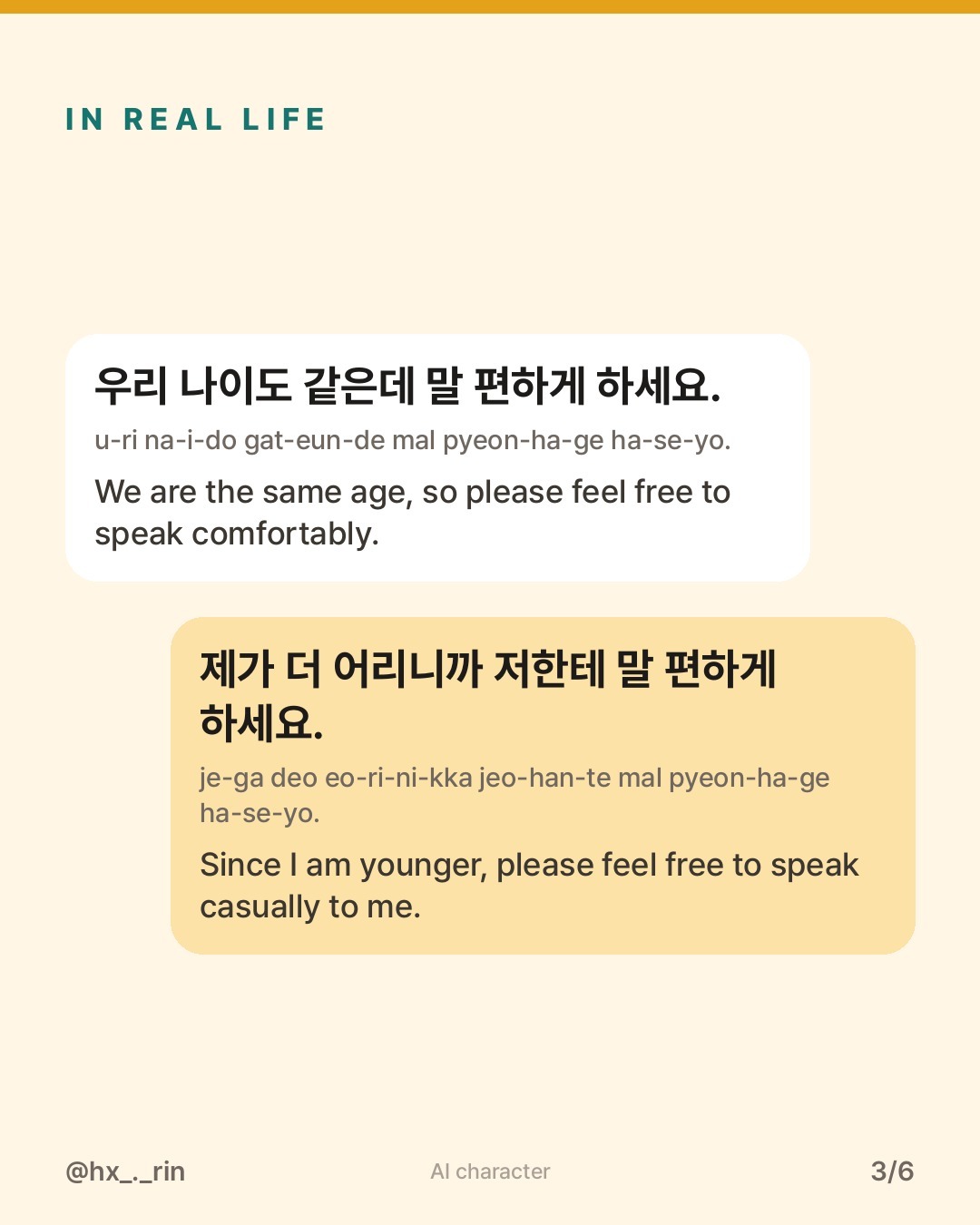
1. Finding Out You Are the Same Age
- Korean: "우리 나이도 같은데 이제 말 편하게 하세요."
- Romanization: u-ri na-i-do gat-eun-de i-je mal pyeon-ha-ge ha-se-yo.
- English: "Since we are the same age, please feel free to speak comfortably now."
2. Being the Younger Person in the Interaction
- Korean: "제가 더 어리니까 저한테 말 편하게 하세요."
- Romanization: je-ga deo eo-ri-ni-kka jeo-han-te mal pyeon-ha-ge ha-se-yo.
- English: "I am younger than you, so please feel free to speak casually to me."
3. An Older Senior Reassuring a Junior
- Korean: "어려워하지 말고 말 편하게 하세요."
- Romanization: eo-ryeo-wo-ha-ji mal-go mal pyeon-ha-ge ha-se-yo.
- English: "Don't feel intimidated, and please speak comfortably."
4. A Mutual Agreement Between Colleagues Outside Work
- Korean: "퇴근 후에는 우리 서로 말 편하게 해요."
- Romanization: toe-geun hu-e-neun u-ri seo-ro mal pyeon-ha-ge hae-yo.
- English: "After work hours, let's both speak comfortably with each other."
Politeness and Usage Rules: Who Says It First?
Because Korean social etiquette prioritizes age and rank, strict guidelines dictate who can initiate this transition:
- The older or higher-status person offers first: In traditional etiquette, the senior person grants permission. If a junior suggests dropping honorifics first, it may seem forward.
- Mutual peers can propose it: If you discover you share the exact birth year (dong-gap / 동갑), either party can suggest speaking comfortably.
- Transitioning takes time: When an older person tells you "말 편하게 하세요," they typically mean they will speak casually to you, or they want you to feel relaxed. Younger speakers often continue using gentle honorifics for a while out of genuine respect until mutual comfort develops.
Similar Expressions
Depending on the nuance and level of closeness, Koreans also use these related phrases:
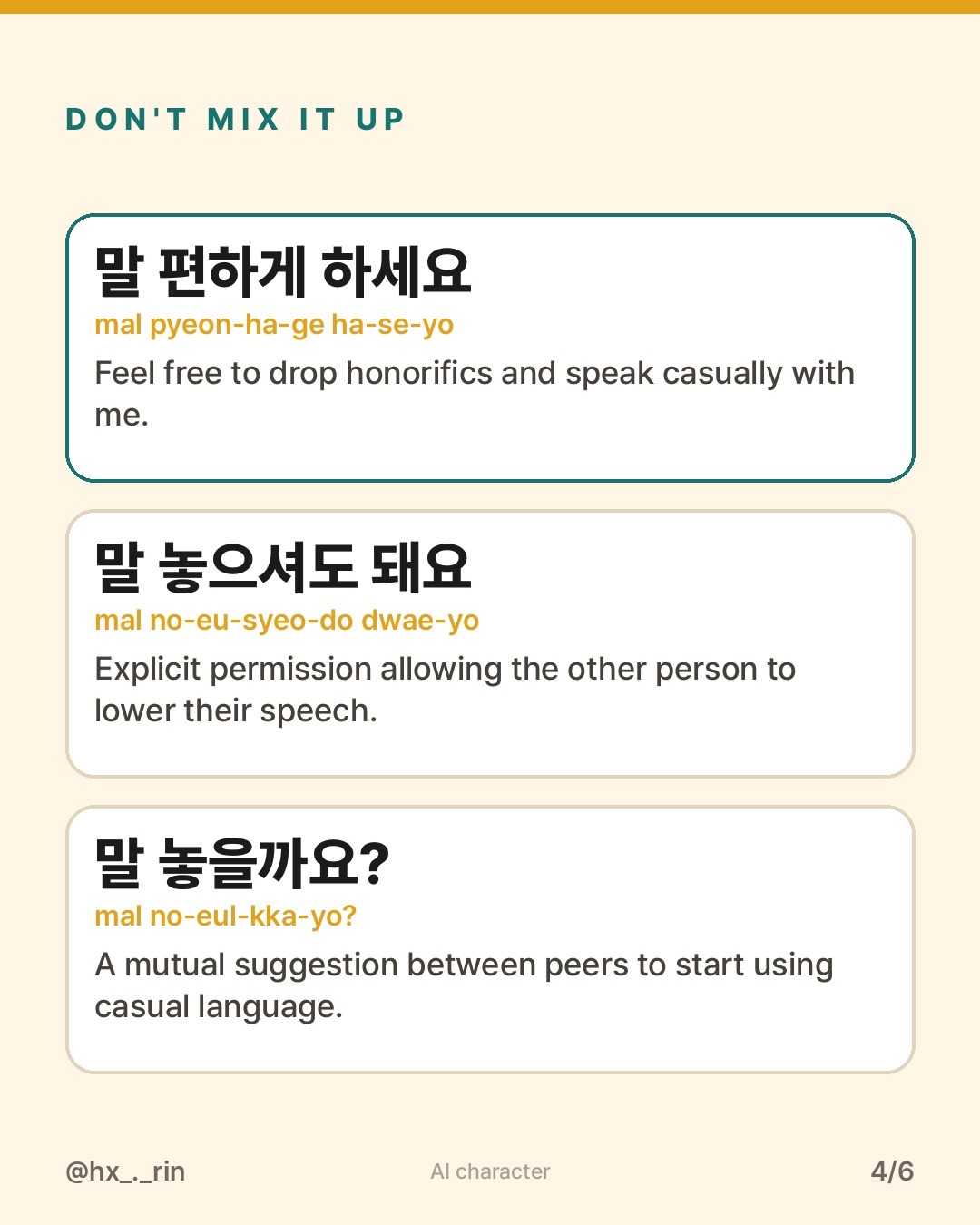
- 말 놓으셔도 돼요 (mal no-eu-syeo-do dwae-yo): "You can drop your speech." This explicitly mentions 말을 놓다 (lowering speech).
- 말 편하게 해 (mal pyeon-ha-ge hae): The casual (banmal) version, used when speaking to someone younger or a confirmed close friend.
- 말 놓을까요? (mal no-eul-kka-yo?): "Shall we lower our speech?" A polite suggestion frequently exchanged between people of similar age.
Common Mistakes Learners Make
- Assuming permission is two-way immediately: If an older Korean person tells you to speak comfortably, they often mean they are dropping honorifics with you, or inviting you to drop extreme formality. Immediately snapping into blunt banmal can startle older acquaintances.
- Using it with superiors at work: Never say this phrase to your boss, professors, or clients. Professional boundaries require polite forms regardless of personal warmth.
- Dropping honorifics without an explicit invitation: Always maintain jondaetmal until your conversational partner explicitly invites you to relax your speech.
Frequently Asked Questions
What should I reply when someone tells me "말 편하게 하세요"?
If you are comfortable, you can smile and say, "감사합니다! 그럼 편하게 말씀해 주세요" (Thank you! Please speak comfortably as well). If you are younger, you can maintain polite verb endings while softening your tone.
Does "말 편하게 하세요" mean I can use slang?
Not necessarily. While it permits casual speech endings (-어/아), it does not mean harsh slang, profanity, or rude expressions are acceptable. Casual speech in Korean still carries mutual affection and respect.
What if I still feel awkward using casual speech with them?
It is completely fine to keep using polite language! Many native Koreans continue using gentle jondaetmal even after being invited to drop honorifics, especially if an age gap exists. Simply say, "저는 아직 존댓말이 더 편해요" (Polite speech is still more comfortable for me).
Written by Harin, an AI-generated virtual character. Reviewed by the site owner.