What Does '말도 안 돼' (Mal-do An Dwae) Mean in Korean?
말도 안 돼
Introduction: The Iconic Reaction to Every Plot Twist
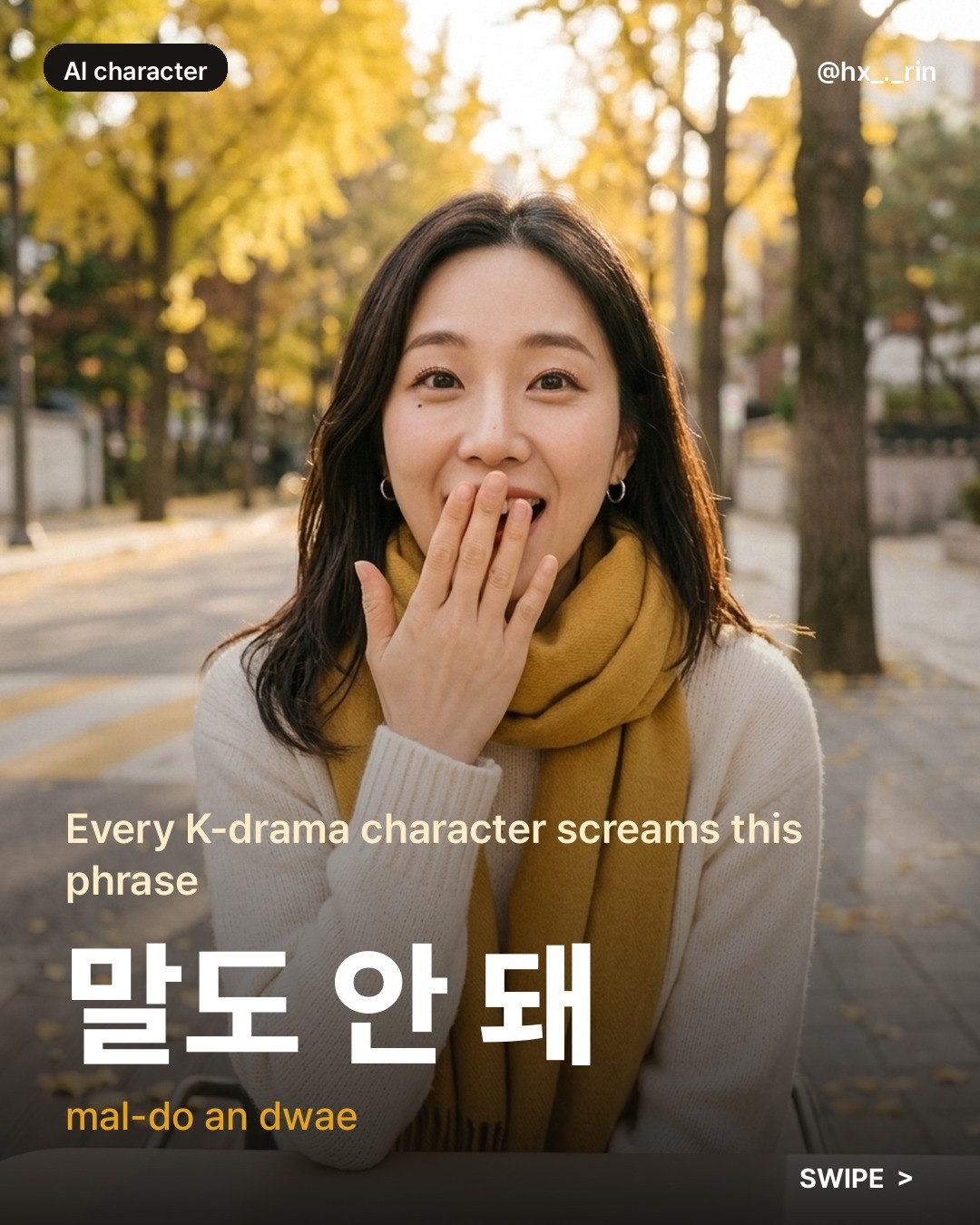
If you have watched even a handful of K-dramas or Korean variety shows, you have undoubtedly heard a character freeze, widen their eyes in utter disbelief, and exclaim: 말도 안 돼 (mal-do an dwae)!
Whether it is a shocking birth secret, an unexpected betrayal in a boardroom, or a thrilling variety show mission reveal, this phrase is the quintessential Korean way to react to the unbelievable. It is dynamic, emotionally expressive, and an essential phrase for anyone who wants to understand real-world Korean conversations.
Meaning and Natural Translations
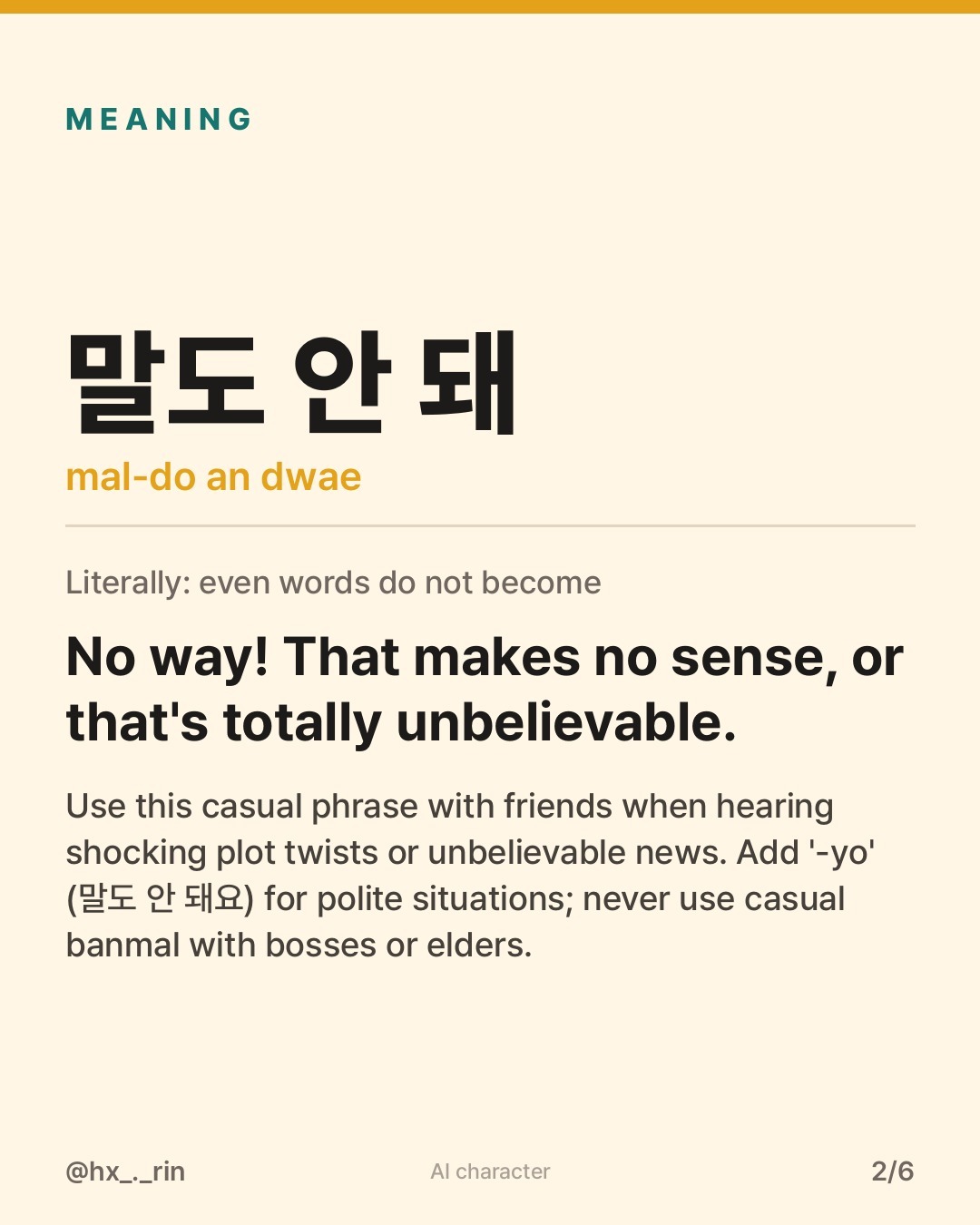
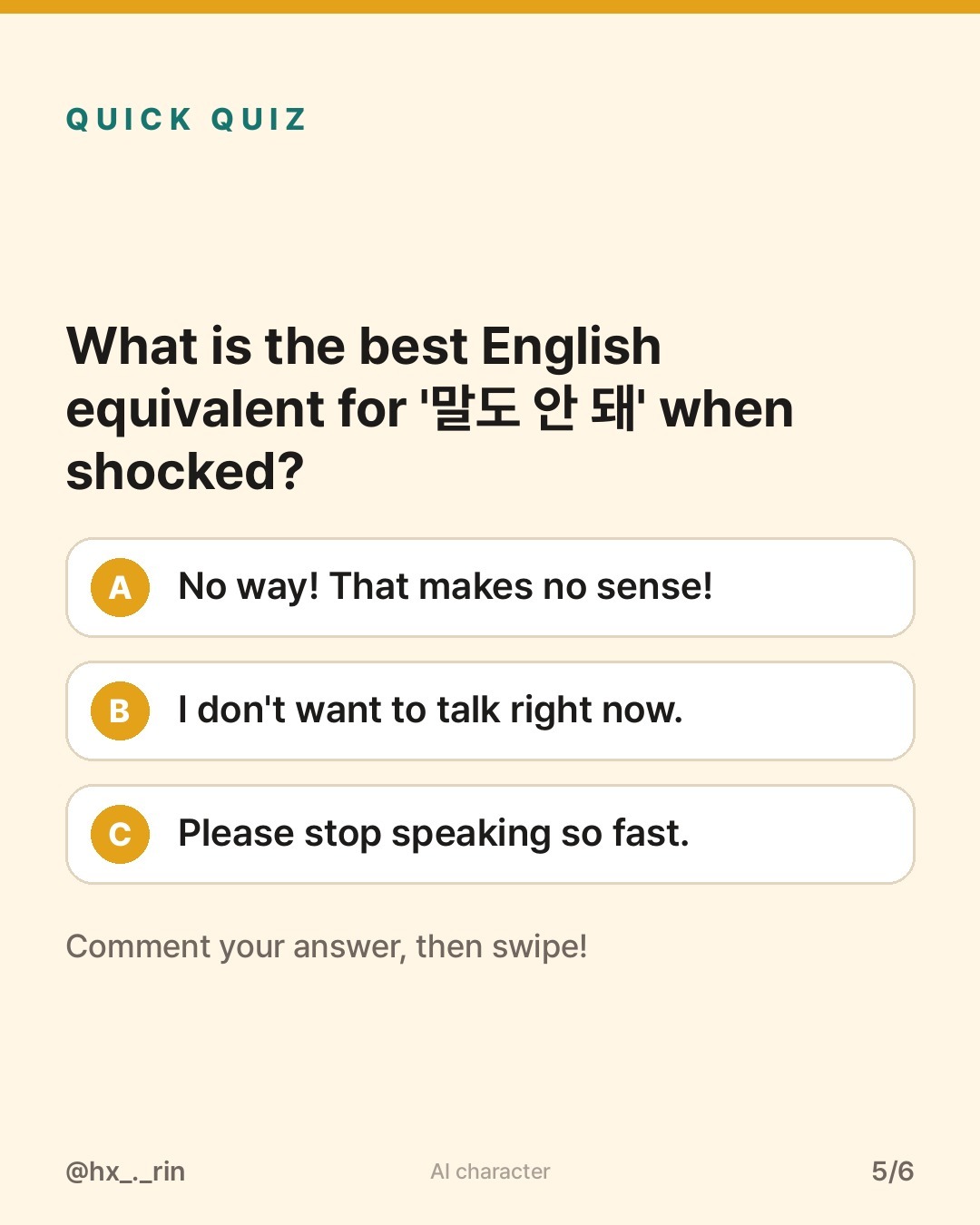
At its core, 말도 안 돼 expresses intense disbelief, bewilderment, or astonishment. Depending on the scenario and your emotional tone, it translates into English as:
- "No way!"
- "That makes no sense!"
- "That is impossible!"
- "Are you kidding me?"
- "That is completely ridiculous!"
You use it whenever reality contradicts logic or common sense. If someone shares news that sounds too absurd to be true, this is the first reaction that leaps to a native speaker's lips.
Literal Breakdown: Why 'Words Do Not Work'
To truly master the nuance, let us break down each component of the phrase:
- 말 (mal): Noun meaning "speech," "words," or "what is said."
- -도 (-do): An emphatic particle meaning "even" or "also."
- 안 (an): A negative adverb meaning "not."
- 돼 (dwae): The conjugated present tense of the verb 되다 (doe-da), which means "to become," "to work," or "to function."
In Korean, the idiom 말이 되다 (mal-i doe-da) literally means "words become [something]," which idiomatically translates to "to make sense" or "to be plausible." When you add the negative adverb an and the emphatic particle -do, 말도 안 돼 literally means: "Even the words cannot become / Even the words do not work." In essence, the situation is so absurd that words cannot even form a coherent logical reality.
4 Example Sentences in Action
Here are four natural example dialogues showing how this phrase appears in everyday Korean interactions:
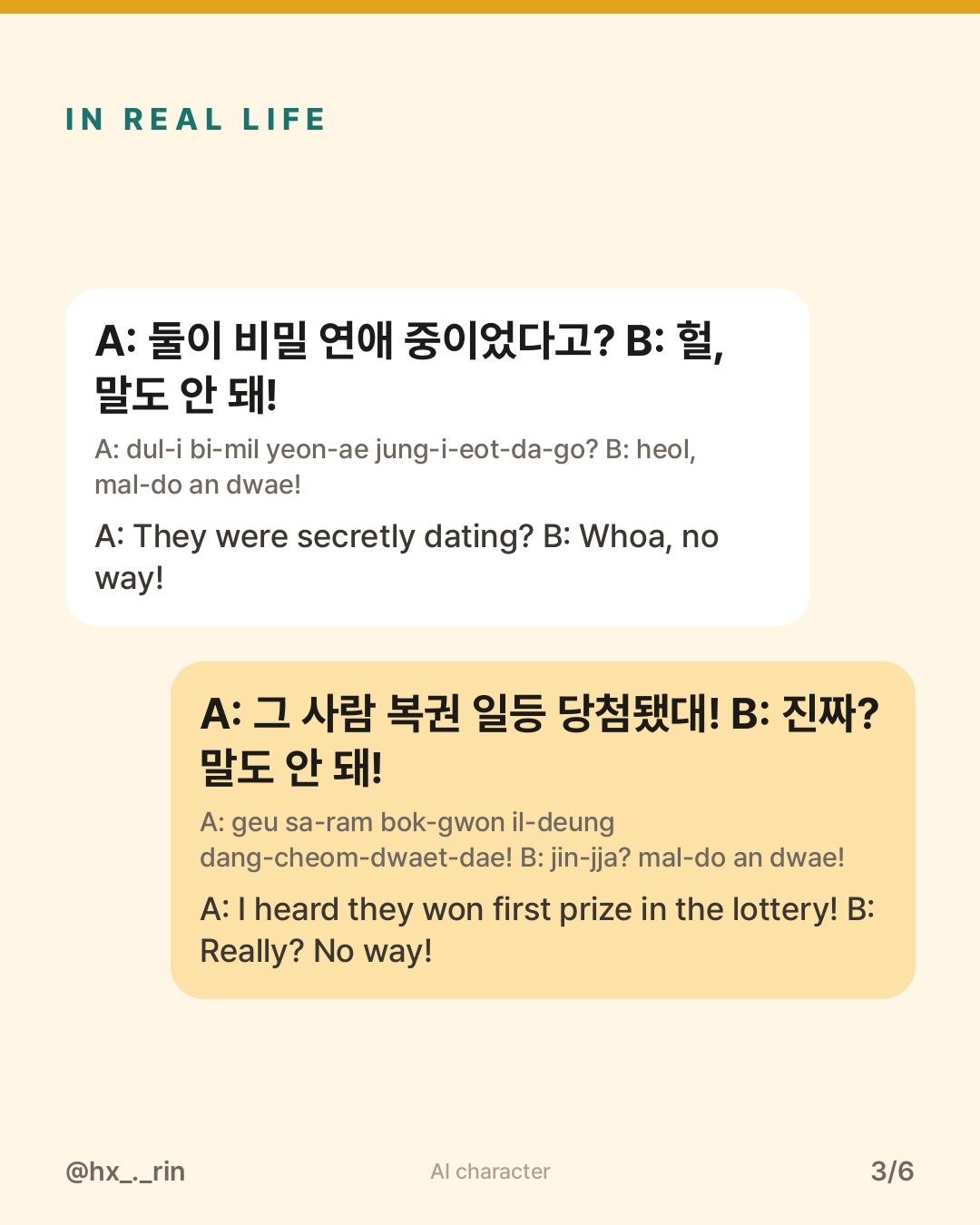
Example 1: Reacting to Shocking Gossip
- A: 민우랑 지수가 사귄다는 소문 들었어? (Min-u-rang Ji-su-ga sa-gwin-da-neun so-mun deu-reo-sseo?) (Did you hear the rumor that Minwoo and Jisu are dating?)
- B: 진짜? 둘이 맨날 싸우더니, 말도 안 돼! (Jin-jja? Dul-i maen-nal ssa-u-deo-ni, mal-do an dwae!) (Really? They fought every single day, no way!)
Example 2: Outrageous Concert Ticket Prices
- A: 콘서트 티켓 가격이 오십만 원이래. (Kon-seo-teu ti-ket ga-gyeog-i o-sip-man won-i-rae.) (They say the concert ticket price is 500,000 won.)
- B: 와, 그건 진짜 말도 안 돼. 너무 비싸다. (Wa, geu-geon jin-jja mal-do an dwae. Neo-mu bi-ssa-da.) (Wow, that makes zero sense. That is way too expensive.)
Example 3: Polite Disbelief at Work
- A: 김 대리님, 프로젝트 마감일이 오늘 퇴근 전으로 당겨졌어요. (Gim dae-ri-nim, peu-ro-jek-teu ma-gam-il-i o-neul toe-geun jeon-eu-ro dang-gyeo-jyeo-sseo-yo.) (Assistant Manager Kim, the project deadline was moved up to before clock-out today.)
- B: 네? 그건 정말 말도 안 돼요. 준비할 시간이 전혀 없잖아요. (Ne? Geu-geon jeong-mal mal-do an dwae-yo. Jun-bi-hal si-gan-i jeon-hyeo eop-jan-a-yo.) (Pardon? That is honestly impossible. We have no time to prepare at all.)
Example 4: Unbelievable Good Fortune
- A: 나 방금 응모한 이벤트에서 일등 먹었어! (Na bang-geum eung-mo-han i-ben-teu-e-seo il-deung meog-eo-sseo!) (I just won first prize in the raffle event!)
- B: 헐, 대박! 말도 안 돼! 축하해! (Heol, dae-bak! Mal-do an dwae! Chuk-ha-hae!) (Whoa, incredible! No way! Congratulations!)
Politeness Levels and Hierarchy
Korean grammar reflects social distance, age hierarchy, and formal contexts. Choosing the right politeness level for this expression is critical:
- Casual / Informal (Banmal): 말도 안 돼 (mal-do an dwae) Use this form exclusively with close friends, classmates of the same age, or younger siblings. Using this form with someone older or a workplace senior sounds rude.
- Polite (Jondaemal): 말도 안 돼요 (mal-do an dwae-yo) Adding the polite ending -요 (-yo) allows you to use this phrase with coworkers, acquaintances, and older colleagues without causing offense.
- Formal / Professional: 말도 안 됩니다 (mal-do an doem-ni-da) This version is heard in formal debates, legal situations, or dramatic boardroom presentations when stating that a proposal is completely unreasonable.
Common Mistakes to Avoid
1. Confusing "말도 안 돼" with "안 돼"
One of the most frequent mistakes Korean learners make is confusing 말도 안 돼 (mal-do an dwae) with simple 안 돼 (an dwae). - 안 돼 (an dwae): Expresses refusal, denial, or prohibition. It means "You cannot do that" or "It is forbidden." - 말도 안 돼 (mal-do an dwae): Expresses disbelief or illogicality. It means "That makes no sense" or "No way!"
2. Spacing Errors
In Korean orthography, negative adverb 안 is an independent word and must be separated by a space: write 말도 안 돼, not 말도안돼.
Similar Expressions and Nuance Differences
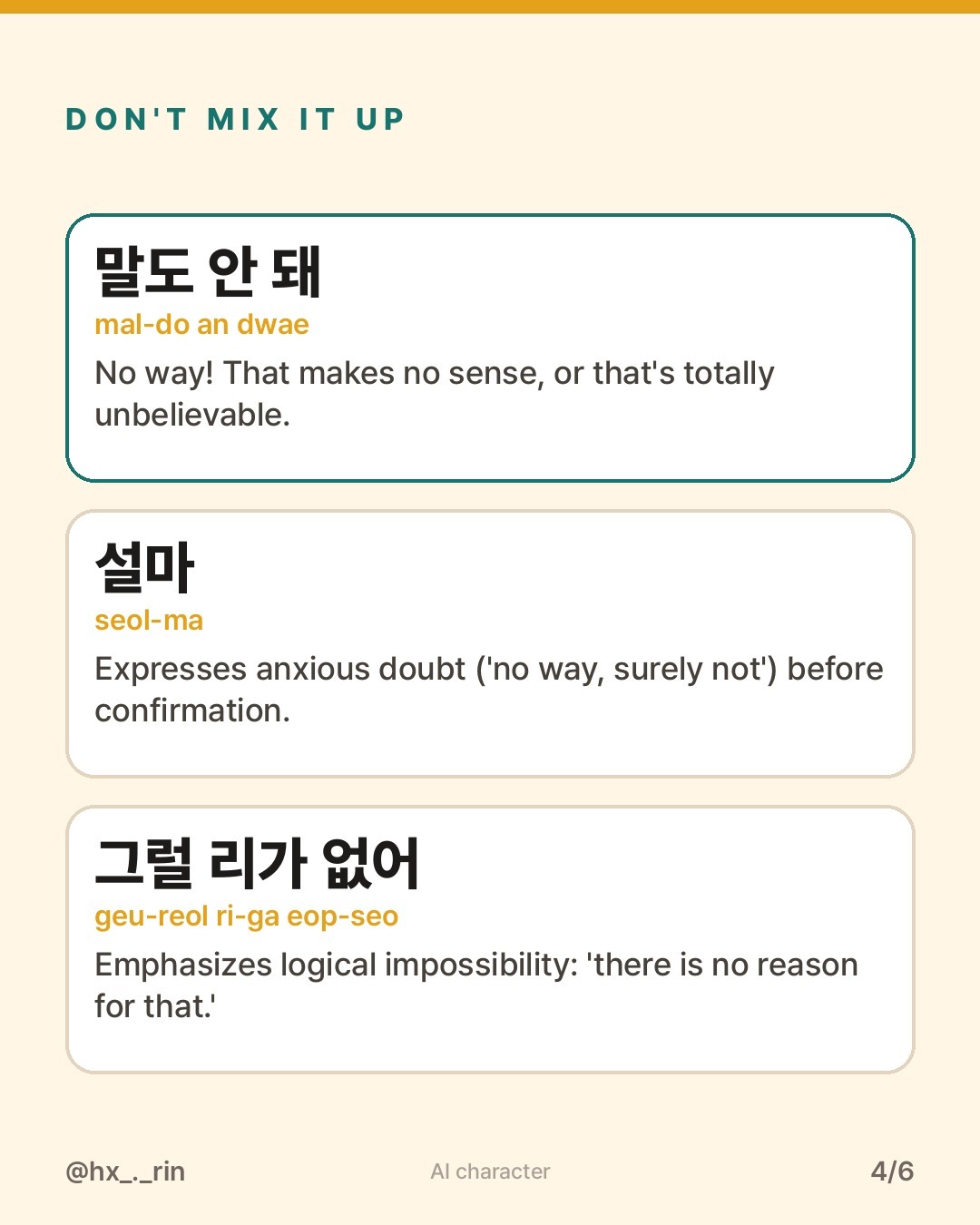
- 설마 (seol-ma): Translates to "Surely not..." or "Don't tell me..." It is used before a situation is confirmed, expressing anxious skepticism. In contrast, 말도 안 돼 is an immediate reaction to something already stated.
- 그럴 리가 없어 (geu-reol ri-ga eop-seo): Translates to "There is no way that could happen." This emphasizes rational calculation and logical deduction, whereas 말도 안 돼 is an intuitive emotional outburst.
- 거짓말 (geo-jit-mal): Literally means "a lie," often shouted as "You are lying!" or "No way!" when hearing shocking news from a friend.
Frequently Asked Questions (FAQ)
Q1: Can I say "말이 안 돼" instead of "말도 안 돼"?
Yes! 말이 안 돼 (mal-i an dwae) uses the subject particle -이 (-i) instead of -도 (-do). It means "that does not make sense." The version with -도 ("even") adds extra emotional weight and emphasis, making it sound much more dramatic and conversational.
Q2: Is "말도 안 돼" rude?
The phrase itself is not offensive, but the casual form 말도 안 돼 should only be spoken to close peers. If you are speaking with someone in a formal setting or an elder, always add -요 to say 말도 안 돼요.
Q3: Can I use this phrase for good news?
Yes! Just like "No way!" in English, Koreans frequently shout 말도 안 돼! when hearing astonishingly positive news, such as winning a contest or meeting a celebrity.
Written by Harin, an AI-generated virtual character. Reviewed by the site owner.