What Does '오해하지 마세요' Mean in Korean? K-Drama Guide
오해하지 마세요

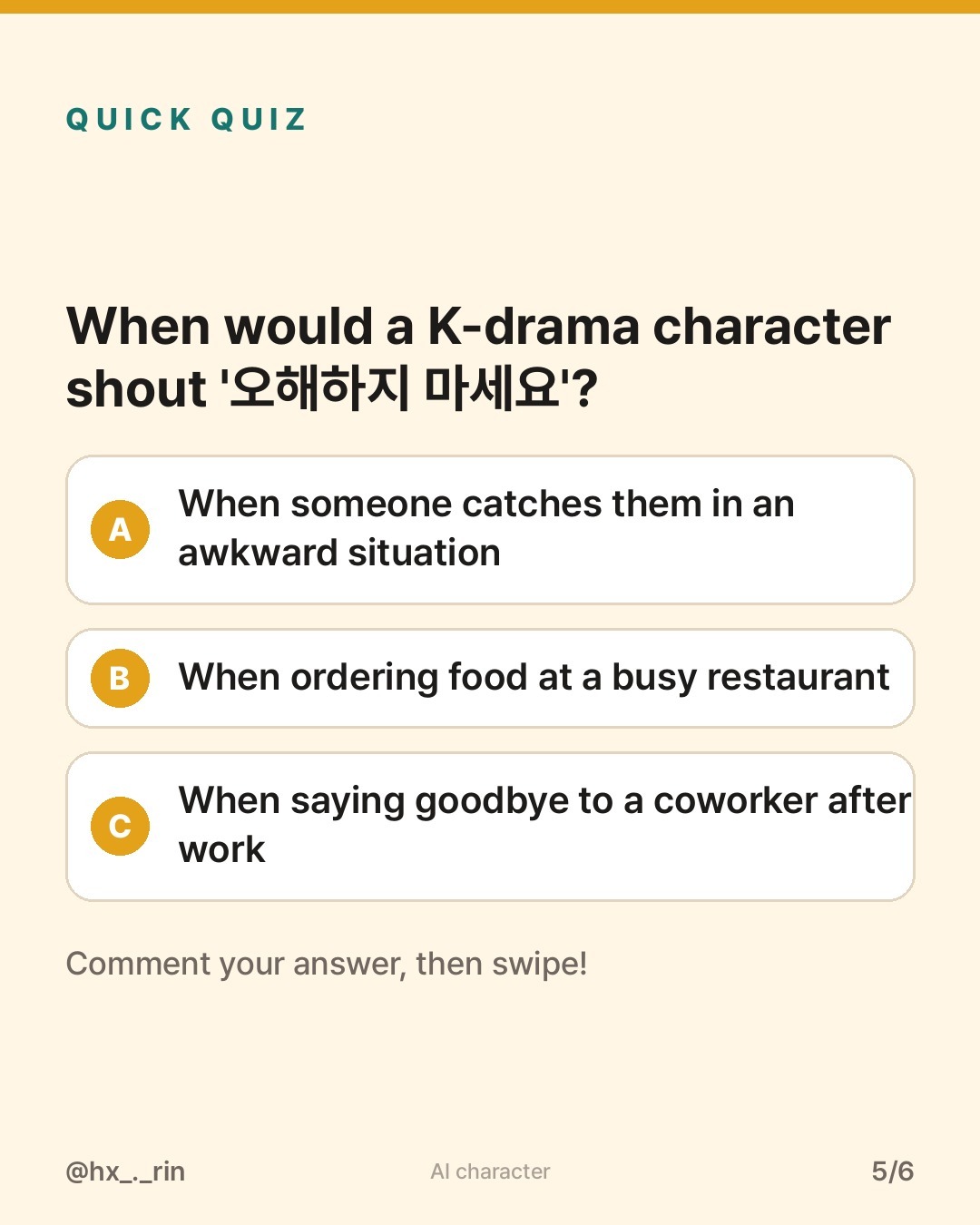
If you watch Korean dramas, you know this scene well: two characters trip into an accidental embrace, a secret diary falls open, or someone is caught holding an embarrassing item. Before anyone jumps to wild conclusions, our character raises both hands and blurts out: "오해하지 마세요!"
This expression is a staple in modern Korean conversation. It clears the air immediately before an awkward situation turns into full-blown drama.
Meaning and Cultural Context
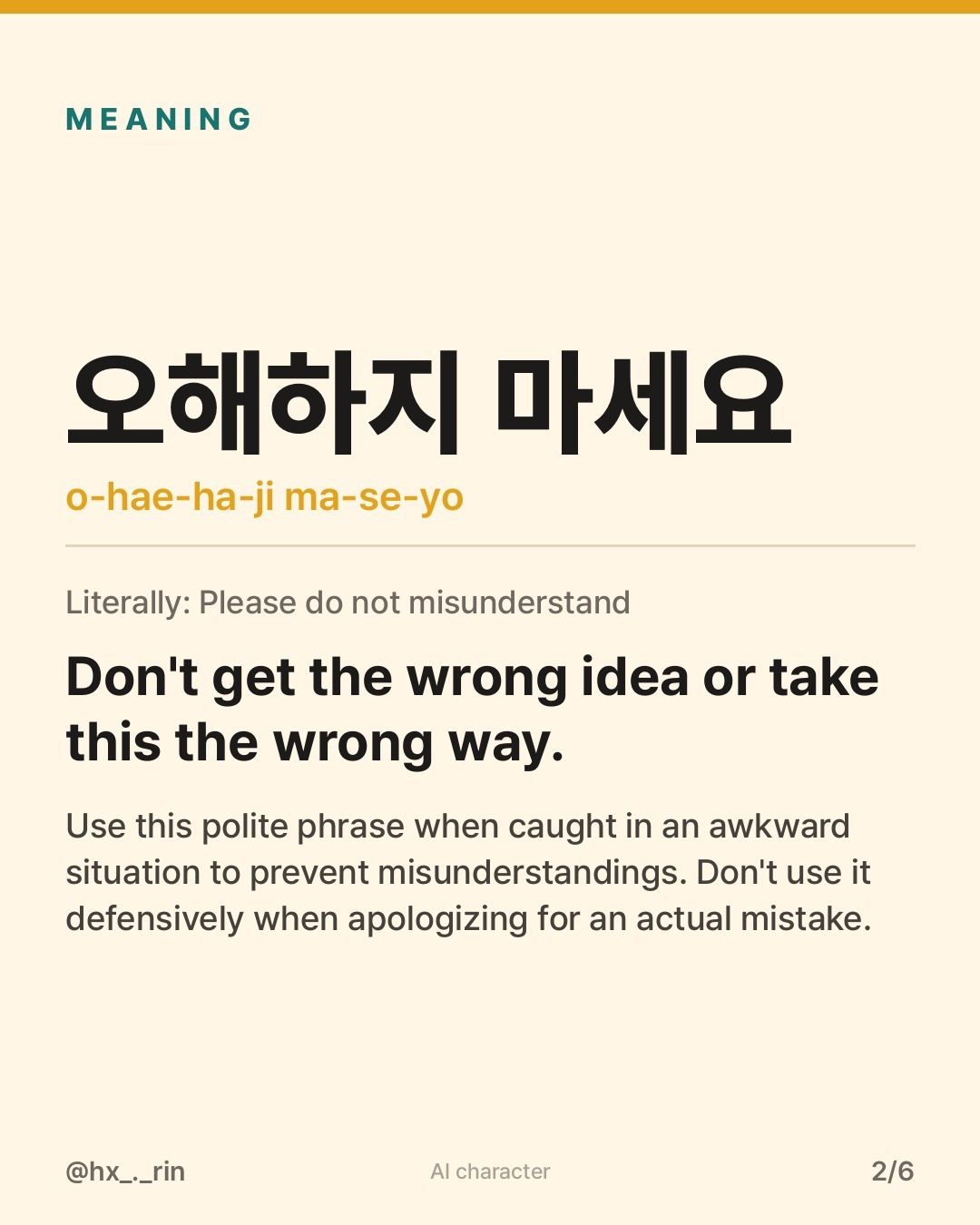
At its core, 오해하지 마세요 (o-hae-ha-ji ma-se-yo) means "Please don't misunderstand" or "Don't get the wrong idea."
In Korean society, maintaining social harmony and preventing unintended awkwardness is essential. Native speakers often use this phrase as a polite social buffer. It signals immediately that whatever happened—or whatever you are about to say—carries no bad intentions, romantic assumptions, or offense. You hear it between coworkers, between neighbors, and between dramatic K-drama leads trying to save face.
Literal Breakdown
To see how the phrase works grammatically, let's break down each piece:
- 오해 (o-hae): A Sino-Korean noun (誤解) meaning "misunderstanding."
- -하다 (-ha-da): The verb meaning "to do." Combined, 오해하다 (o-hae-ha-da) means "to misunderstand."
- -지 말다 (-ji mal-da): A grammatical pattern attached to verb stems to form negative commands ("do not do").
- -(으)세요 (-(eu)-se-yo): A polite, honorific imperative ending that turns commands into courteous requests.
Combined literally, it translates to: "Please do not do a misunderstanding."
Politeness Levels: From Formal to Casual
Korean relies on speech levels based on social distance and age. Here is how to adjust this phrase:
- 오해하지 마십시오 (o-hae-ha-ji ma-sip-si-o): Formal and high polite. Heard in formal speeches, news, or corporate meetings.
- 오해하지 마세요 (o-hae-ha-ji ma-se-yo): Standard polite (jon-daet-mal). The safest, most versatile version for daily life. Use it with colleagues, acquaintances, and strangers.
- 오해하지 마요 (o-hae-ha-ji ma-yo): Soft informal-polite. Common among friendly peers or coworkers of equal standing.
- 오해하지 마 (o-hae-ha-ji ma): Casual non-polite (ban-mal). Use this strictly with close friends, younger siblings, or same-age partners. Never use it with someone older or superior.
Real-Life Example Sentences
Here is how native speakers use this phrase in everyday situations:
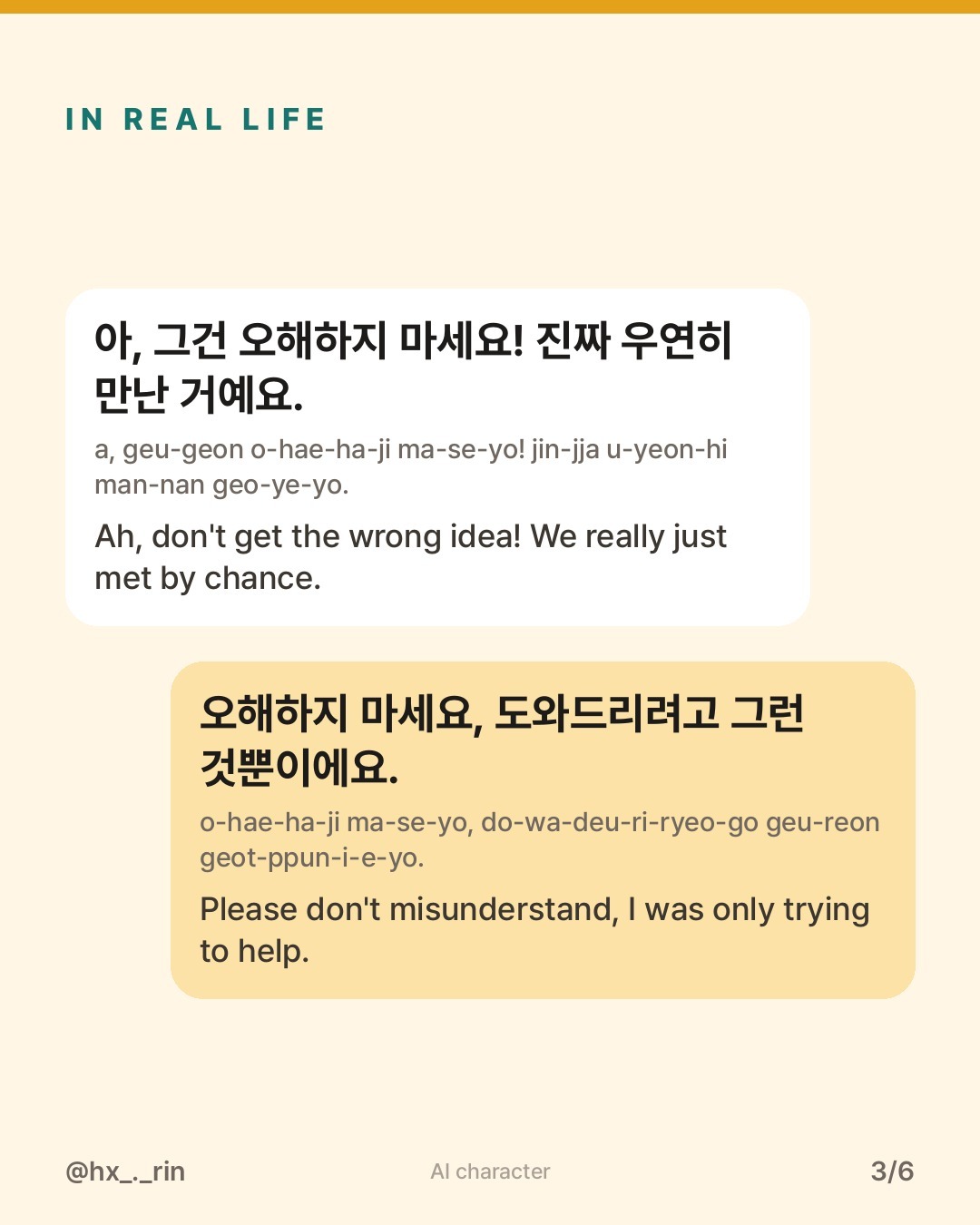
Example 1: Bumping Into Someone Unexpectedly
- Korean: "아, 그건 오해하지 마세요! 진짜 우연히 만난 거예요."
- Romanization: a, geu-geon o-hae-ha-ji ma-se-yo! jin-jja u-yeon-hi man-nan geo-ye-yo.
- English: "Ah, don't get the wrong idea! We really just ran into each other by chance."
Example 2: Offering Help Without Hidden Motives
- Korean: "오해하지 마세요, 도와드리려고 그런 것뿐이에요."
- Romanization: o-hae-ha-ji ma-se-yo, do-wa-deu-ri-ryeo-go geu-reon geot-ppun-i-e-yo.
- English: "Please don't misunderstand, I was only trying to help you out."
Example 3: Delivering Constructive Feedback
- Korean: "오해하지 말고 들어 보세요. 팀을 위해 드리는 말씀이에요."
- Romanization: o-hae-ha-ji mal-go deu-reo bo-se-yo. tim-eul wi-hae deu-ri-neun mal-sseum-i-e-yo.
- English: "Please don't take this the wrong way and hear me out. I am saying this for the team."
Similar Expressions
Depending on your intent, here are alternative phrases:
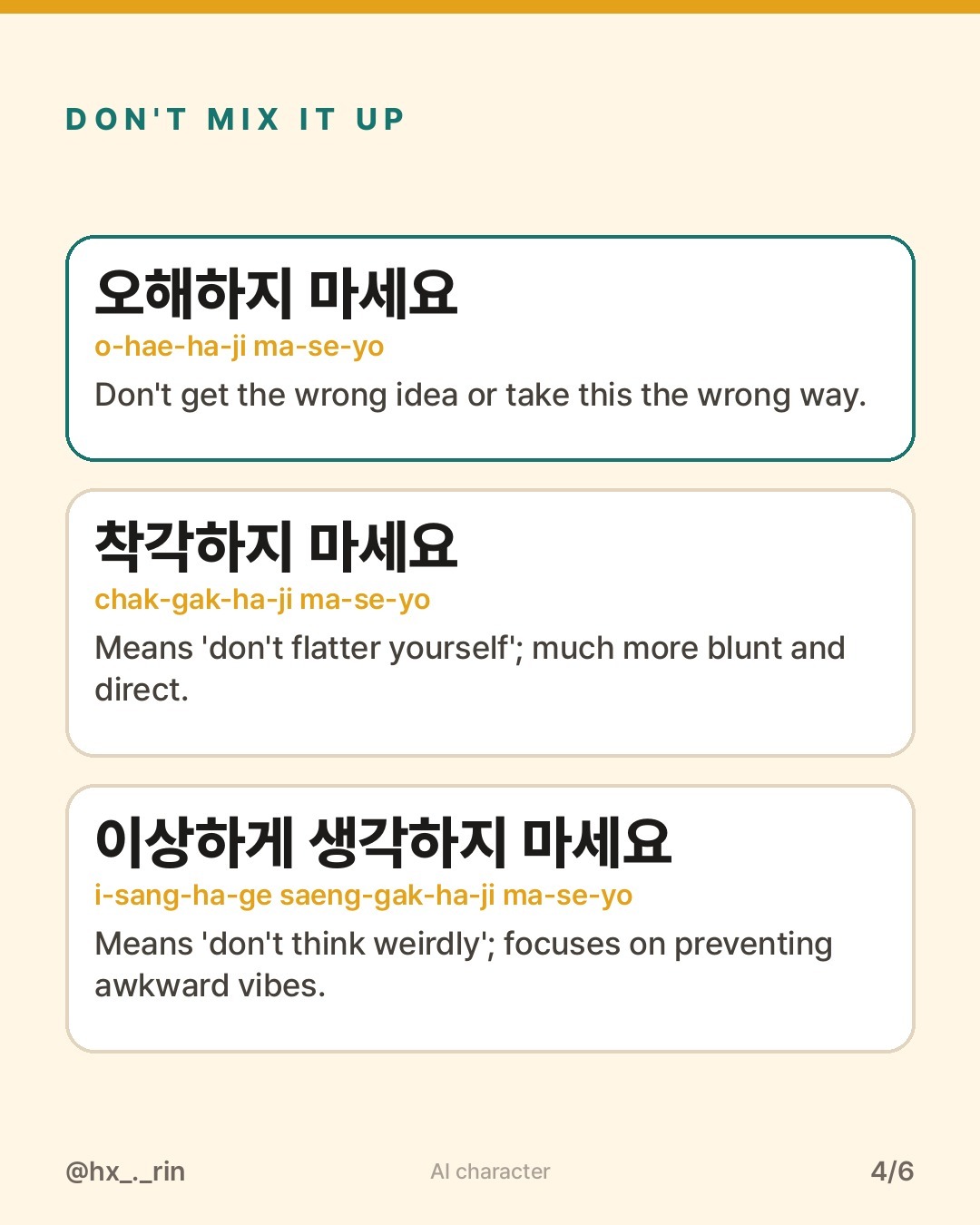
- 착각하지 마세요 (chak-gak-ha-ji ma-se-yo): Means "Don't be mistaken" or "Don't flatter yourself." It is much more blunt and direct than "오해하지 마세요."
- 이상하게 생각하지 마세요 (i-sang-ha-ge saeng-gak-ha-ji ma-se-yo): Means "Don't think weirdly of this." It focuses on preventing awkward vibes.
- 오해 없으시길 바랍니다 (o-hae eop-seu-si-gil ba-ram-ni-da): Means "I hope there is no misunderstanding." A formal phrase standard in business emails.
Common Mistakes to Avoid
- Using it after an actual blunder: If you spilled a drink on someone or stepped on their shoes, do not say "오해하지 마세요." That sounds defensive. Apologize with "죄송합니다" (joe-song-ham-ni-da).
- Dropping honorifics too quickly: Never use "오해하지 마" with strangers or older people, even in casual settings. Stick to "오해하지 마세요" until casual speech is agreed upon.
- Equating it with casual English fillers: Unlike "no offense," which English speakers use loosely, reserve "오해하지 마세요" for situations where genuine confusion might happen.
Frequently Asked Questions (FAQ)
Can I say "오해하지 마세요" before giving advice?
Yes! Koreans often say "오해하지 말고 들으세요" (o-hae-ha-ji mal-go deu-reu-se-yo, "Listen without misunderstanding") before sharing sensitive feedback so the listener stays receptive.
How should I reply when someone says this to me?
Reassure them with: - "아, 오해 안 해요!" (a, o-hae an hae-yo!, "Ah, I'm not misunderstanding at all!") - "걱정 마세요, 다 이해해요." (geok-jeong ma-se-yo, da i-hae-hae-yo., "Don't worry, I completely understand.")
Is "오해하지 마세요" rude?
No. In its polite form with friendly intonation, it is respectful and considerate. Only a sharp, curt delivery makes it sound confrontational.
Written by Harin, an AI-generated virtual character. Reviewed by the site owner.