What Does 수고하셨습니다 Mean in Korean? (Usage & Etiquette)
수고하셨습니다


If you have ever watched the final moments of a K-pop dance rehearsal, a behind-the-scenes drama video, or an episode of a Korean variety show, you have definitely heard everyone bowing and repeating one phrase: 수고하셨습니다 (su-go-ha-syeot-seum-ni-da).
In Korean society, this is one of the most essential daily phrases. People say it at the end of meetings, after a long shift at work, and when wrapping up exhausting collaborative projects. But beneath its polite surface lies a fascinating cultural rule about age, hierarchy, and Korean social etiquette.
Here is everything you need to know about what 수고하셨습니다 means, how to use it naturally, and the one mistake you must avoid.
What Does 수고하셨습니다 Mean?
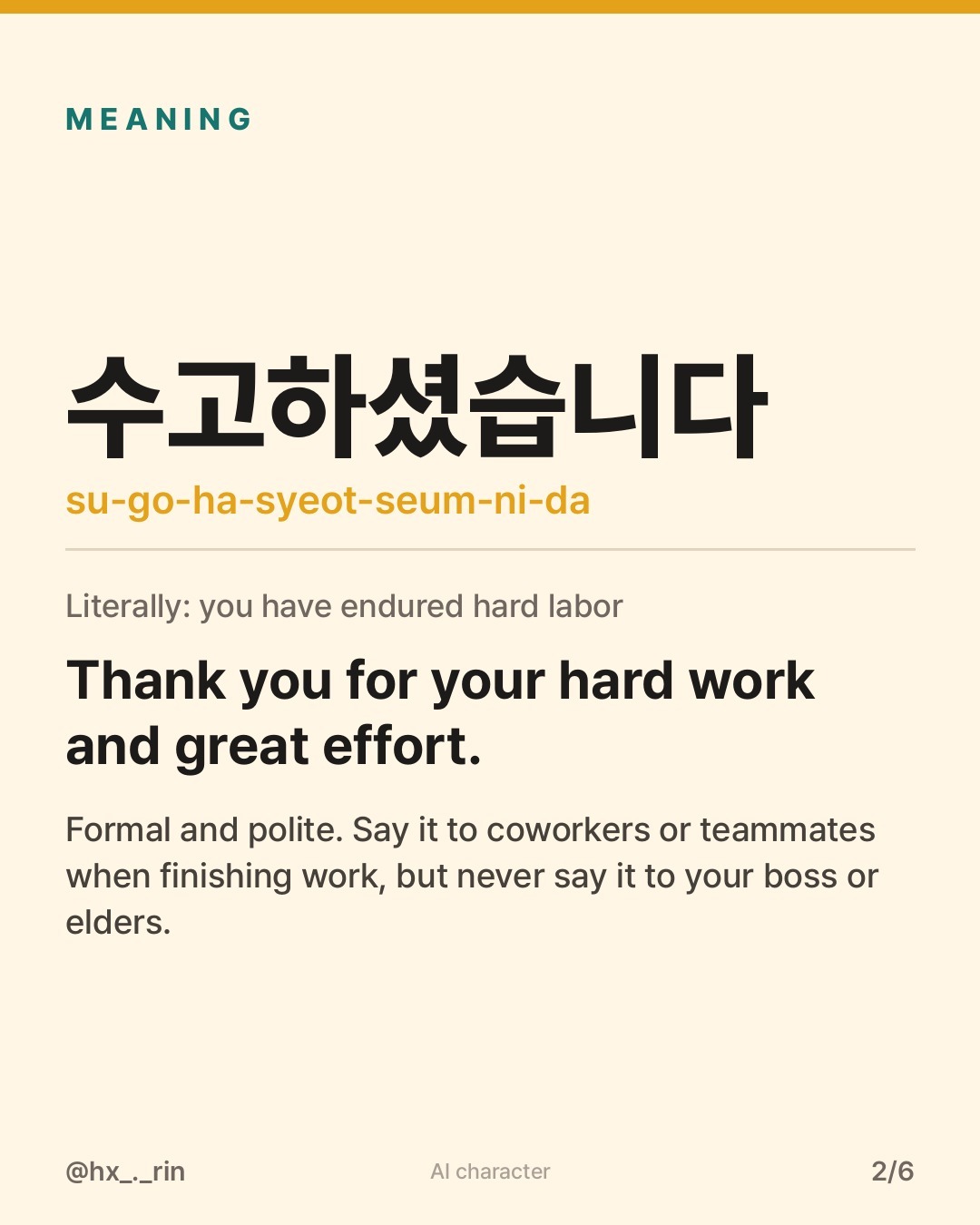
At its core, 수고하셨습니다 translates naturally to 'Thank you for your hard work' or 'Great job today.'
It is a formal, polite phrase used to acknowledge and validate the effort someone put into a shared task. Koreans do not wait for massive achievements to say this; any completed labor deserves recognition. Whether you just wrapped up a two-hour lecture, a photoshoot, or an eight-hour office day, saying this phrase signals mutual respect and camaraderie.
Literal Breakdown of the Phrase
To understand why this phrase carries so much cultural weight, look at how the word is constructed:
- 수고 (受苦 / su-go): The root noun literally means 'trouble,' 'pains,' or 'hard labor.' It originally conveyed the idea of enduring hardship or physical toil to get something done.
- 하 (ha): From the verb 하다 (ha-da), meaning 'to do.'
- 시 / 셨 (si / syeot): The honorific infix that shows respect to the person performing the action, combined with the past tense marker -었-.
- 습니다 (seum-ni-da): The highest standard level of formal politeness (하십시오체 / ha-sip-si-o-che).
When you put these components together, the literal meaning is: 'You have honorably endured trouble and hard work.'
Example Sentences in Daily Life
Here are practical, everyday scenarios where you will hear and use this expression:
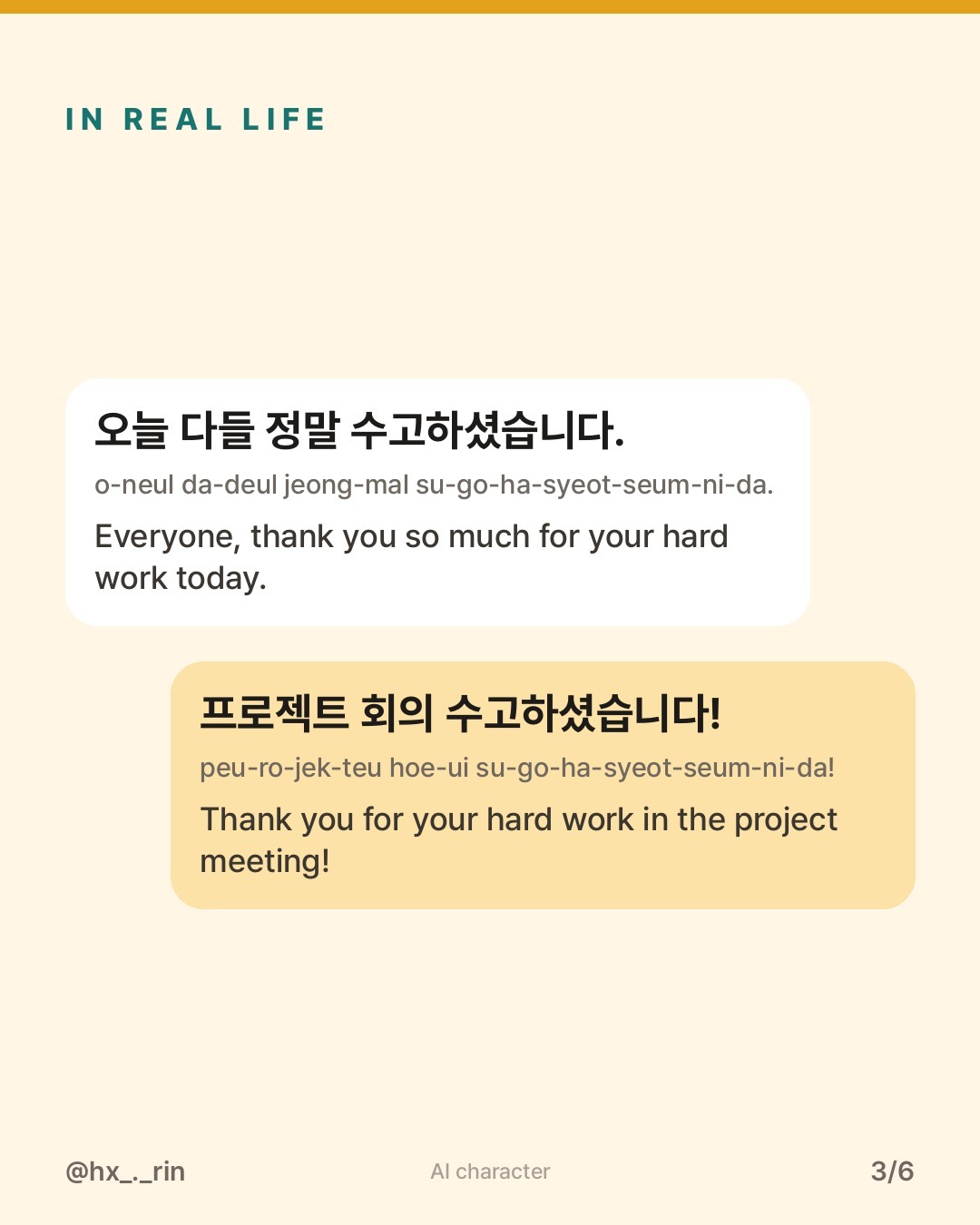
1. Wrapping Up a Team Project
- Korean: 오늘 프로젝트 회의 다들 정말 수고하셨습니다.
- Romanization: o-neul peu-ro-jek-teu hoe-ui da-deul jeong-mal su-go-ha-syeot-seum-ni-da.
- English: Everyone, thank you so much for your hard work in today's project meeting.
2. Ending a Video Shoot or Practice Session
- Korean: 오늘 촬영 무사히 끝났네요. 다들 수고하셨습니다!
- Romanization: o-neul chwal-yeong mu-sa-hi kkeun-nat-ne-yo. da-deul su-go-ha-syeot-seum-ni-da!
- English: Today's shoot finished smoothly. Great job everyone!
3. Leaving Work with Colleagues
- Korean: 벌써 퇴근 시간이네요. 오늘도 수고하셨습니다.
- Romanization: beol-sseo toe-geun si-gan-i-ne-yo. o-neul-do su-go-ha-syeot-seum-ni-da.
- English: It is already time to leave. Thank you for your hard work today as well.
4. Finishing a Group Study Session
- Korean: 시험공부 하느라 다들 수고하셨습니다.
- Romanization: si-heom-gong-bu ha-neu-ra da-deul su-go-ha-syeot-seum-ni-da.
- English: Thank you all for your hard work studying for the exam.
Politeness and Usage: The Hierarchy Trap
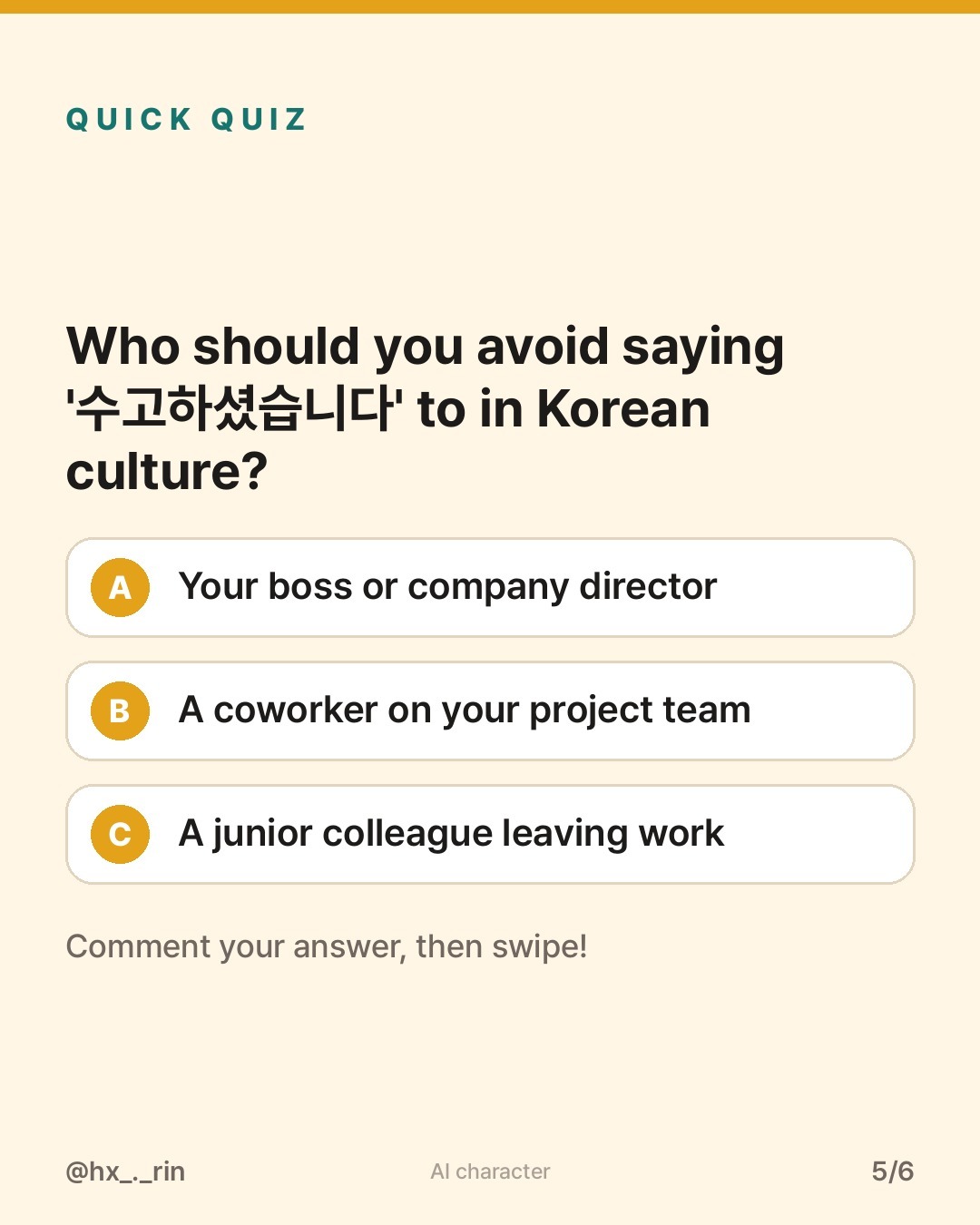
While 수고하셨습니다 is grammatically honorific and polite, Korean cultural etiquette introduces a major trap for learners: you should never say it to your boss, professor, or elders.
According to the National Institute of Korean Language (국립국어원), the word 수고 inherently carries the nuance of evaluating or acknowledging someone's labor. In traditional Korean hierarchy, only someone of equal or higher status has the social authority to evaluate another person's effort.
When a junior says 수고하셨습니다 or 수고하세요 to a superior, it can unintentionally sound like: 'You did an acceptable job under my assessment.'
To stay respectful with superiors, use these alternatives: * To thank a superior for their guidance: 감사합니다 (gam-sa-ham-ni-da, 'Thank you') or 고맙습니다 (go-map-seum-ni-da). * When leaving the office before your boss: 먼저 들어가 보겠습니다 (meon-jeo deu-reo-ga bo-get-seum-ni-da, 'I will head out first') or 내일 뵙겠습니다 (nae-il boep-get-seum-ni-da, 'See you tomorrow').
Similar Expressions You Should Know
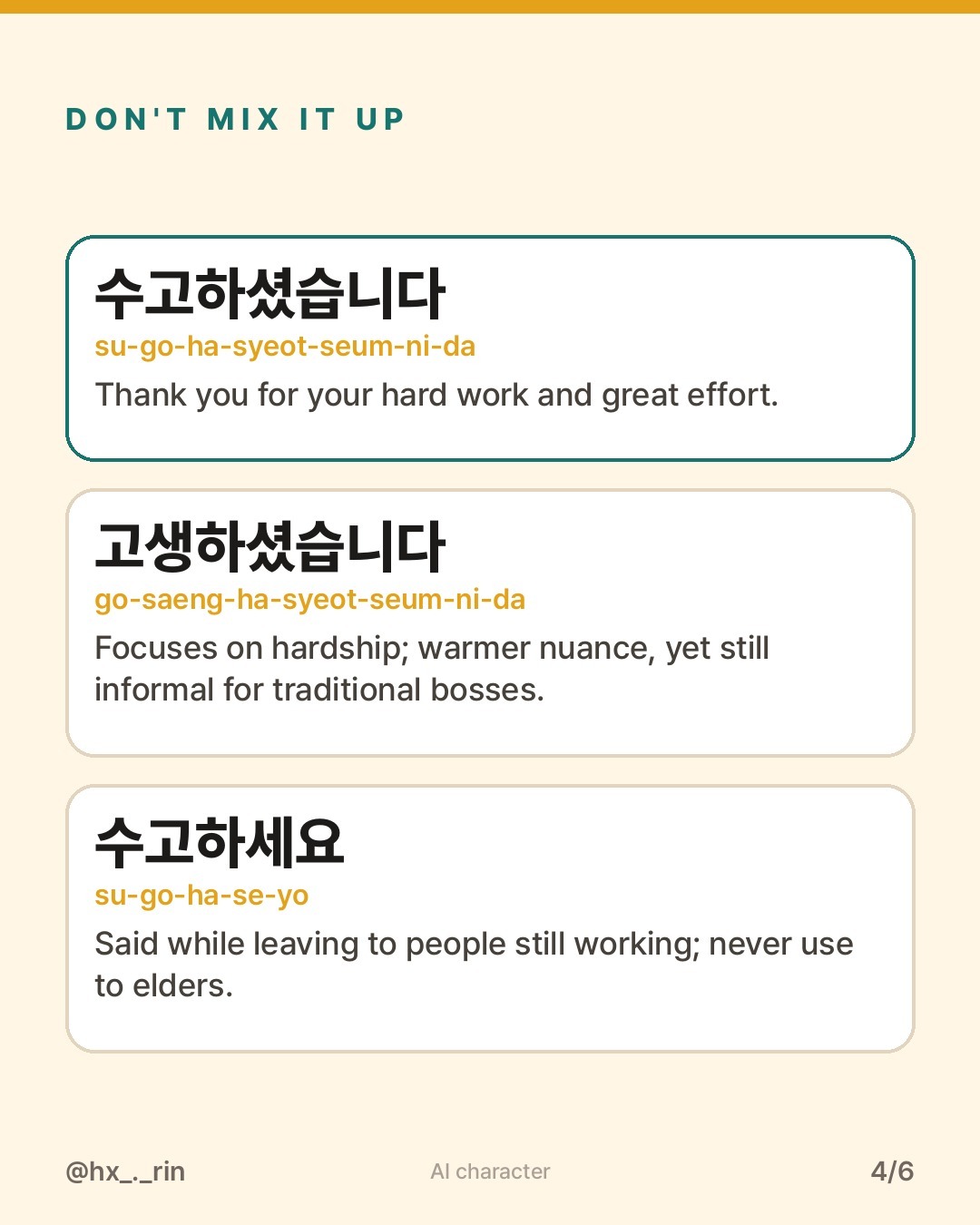
1. 고생하셨습니다 (go-saeng-ha-syeot-seum-ni-da)
Literally meaning 'You suffered hardship,' this phrase expresses deeper empathy for grueling physical or emotional effort. It is slightly warmer than 수고하셨습니다, though strict traditionalists still avoid saying it up the corporate ladder.
2. 수고하세요 (su-go-ha-se-yo)
This is the present imperative form ('Keep up the good work'). You say this when leaving a store or office while others continue working. Remember: only use this with peers, clerks, or juniors.
3. 수고했어 (su-go-haet-seo)
The informal, casual form (반말 / ban-mal). You can only use this with close friends of the same age or people younger than you.
Common Mistakes Learners Make
- Greeting people with it: 수고하셨습니다 is an exit greeting or task-completion phrase. Never say it when you first arrive or meet someone.
- Saying 수고하세요 to taxi drivers or elders: While many modern Koreans overlook this, traditional etiquette recommends saying 감사합니다 (gam-sa-ham-ni-da) instead.
- Using informal 수고했어 with colleagues: Even if you feel friendly with a coworker, keep the polite 수고하셨습니다 unless you have mutually agreed to drop honorifics.
Frequently Asked Questions
Can I say 수고하셨습니다 to my Korean professor after class?
No, it is safer to say 감사합니다, 교수님 (gam-sa-ham-ni-da, gyo-su-nim, 'Thank you, professor') or 오늘 수업 감사했습니다 (o-neul su-eop gam-sa-haet-seum-ni-da). Professors are respected elders in Korean society, so evaluating their labor with 수고 is considered improper.
What should I reply when someone says 수고하셨습니다 to me?
You can smile, bow slightly, and return the compliment: 네, 수고하셨습니다! (ne, su-go-ha-syeot-seum-ni-da!). If you are speaking to a senior who praised you, reply with 감사합니다! (gam-sa-ham-ni-da!).
What is the text abbreviation for this phrase?
Korean texters frequently abbreviate the phrase as ㅅㄱ (from the initial consonants of 수고). In online gaming and casual chats with friends, you will often see ㅅㄱㅇ (su-go-yo) or ㅅㄱㅎㅅㅇ (su-go-haet-seo-yo). Never use these abbreviations in professional emails.
Written by Harin, an AI-generated virtual character. Reviewed by the site owner.