What Does '여기서 내려 주세요' Mean in Korean?
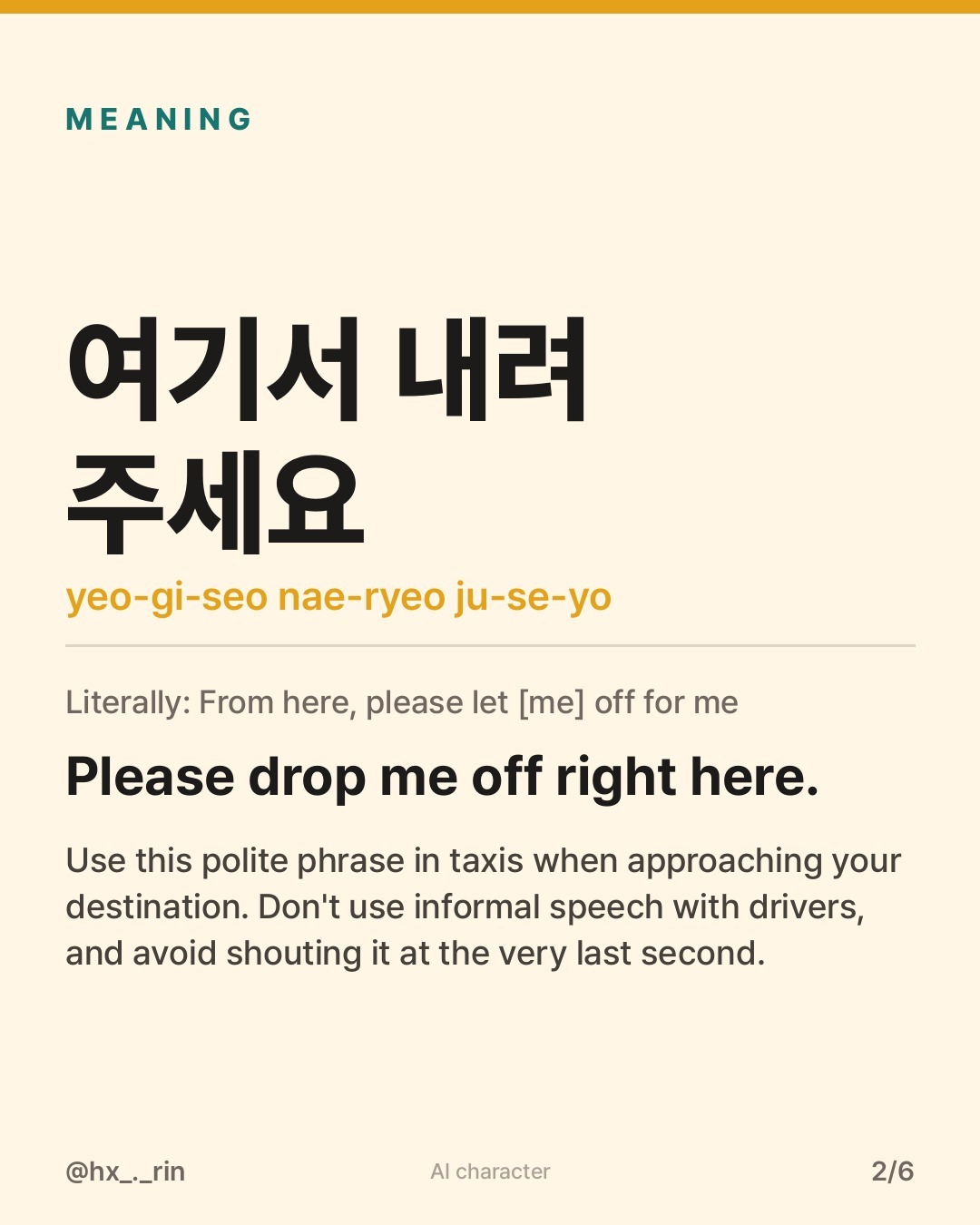
여기서 내려 주세요

Navigating Seoul is famously smooth and efficient. Subways run on time, buses reach every neighborhood, and hailing a taxi is straightforward. Yet for many travelers and Korean learners, the most stressful part of a taxi ride comes right at the end: telling the driver exactly where to stop.
That is where an essential survival phrase comes in: 여기서 내려 주세요 (yeo-gi-seo nae-ryeo ju-se-yo).
Whether you are returning to your hotel or hopping off near a subway station, this phrase helps you exit politely and accurately.
What Does 여기서 내려 주세요 Mean?
In natural English, 여기서 내려 주세요 (yeo-gi-seo nae-ryeo ju-se-yo) means "Please let me off here" or "Please drop me off right here."
It is the standard, polite expression passengers use in taxis or cars when reaching their stop. It tells the driver two things clearly: the location where you want to stop, and a respectful request to exit.
Literal Word-by-Word Breakdown
Breaking down each component helps you understand how the phrase works:
- 여기 (yeo-gi): "Here" or "this place."
- -서 (-seo): A contraction of the location marker 에서 (e-seo), meaning "at" or "from." So 여기서 means "from here" or "at this spot."
- 내려 (nae-ryeo): The conjugated stem of the verb 내리다 (nae-ri-da), which means "to get off" or "to alight" from a vehicle.
- 주세요 (ju-se-yo): The polite honorific form of 주다 (ju-da, "to give"). Paired with a verb stem via -a/eo ju-da, it creates a polite request meaning "please do this for me."
Literally, it translates to: "From here, please let [me] off for me."
Real-Life Example Sentences
Here are three practical examples showing how to use the phrase naturally:
- 기사님, 저 앞 신호등에서 여기서 내려 주세요.
- Romanization: gi-sa-nim, jeo ap sin-ho-deung-e-seo yeo-gi-seo nae-ryeo ju-se-yo.
-
English: Driver, please let me off right here at the traffic light ahead.
-
지하철역 입구 앞이니까 여기서 내려 주세요.
- Romanization: ji-ha-cheol-yeok ip-gu ap-i-ni-kka yeo-gi-seo nae-ryeo ju-se-yo.
-
English: It is right in front of the subway station entrance, so please let me off here.
-
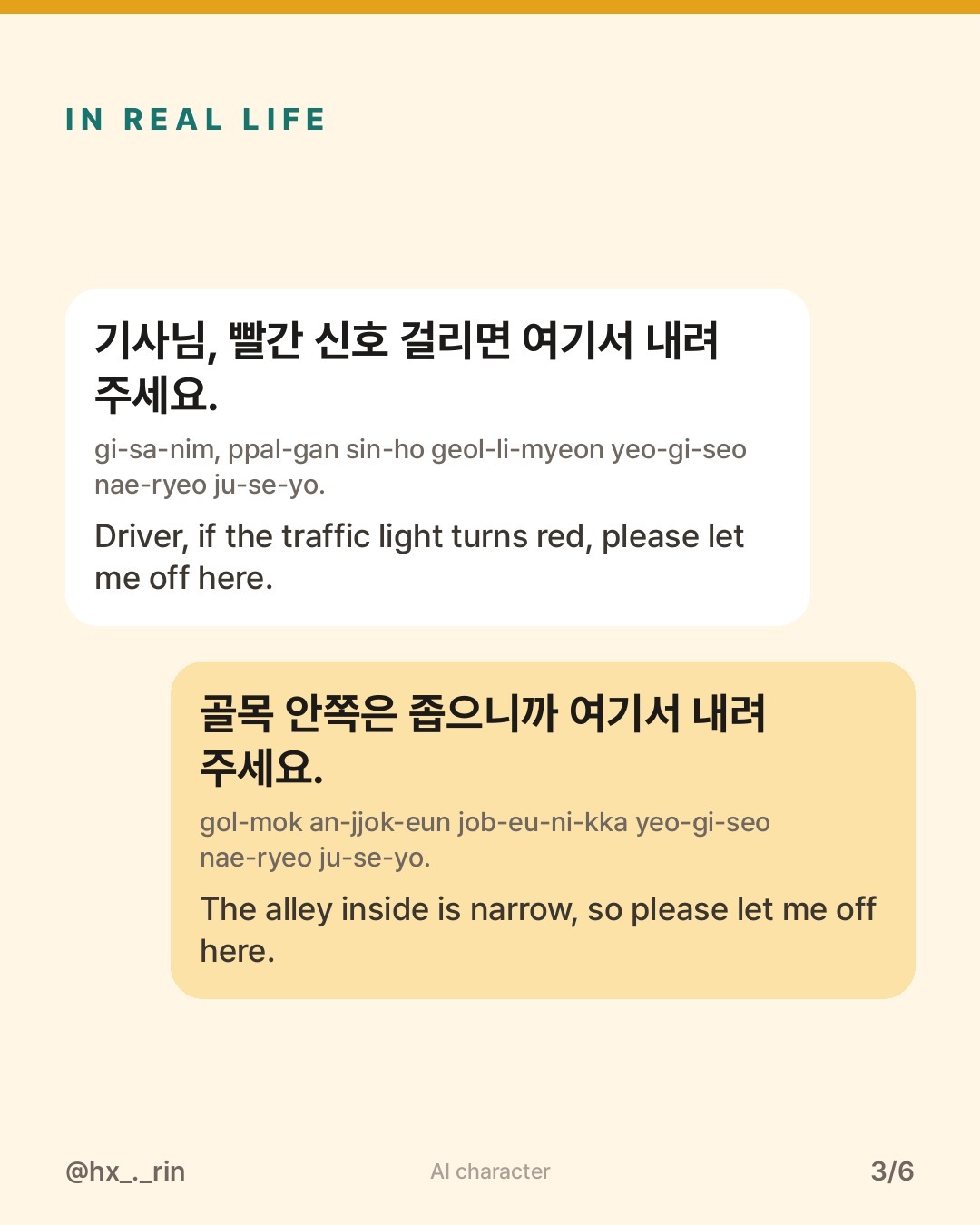
골목 안쪽은 좁으니까 여기서 내려 주세요.
- Romanization: gol-mok an-jjok-eun job-eu-ni-kka yeo-gi-seo nae-ryeo ju-se-yo.
- English: The alley is narrow, so please let me off here.
Politeness Level and Practical Usage Notes
Korean social etiquette requires speaking politely to service professionals.
- Politeness Level: 여기서 내려 주세요 uses the standard polite informal style (haeyo-che) with the honorific suffix -si-. This is respectful, friendly, and appropriate for passengers of any age.
- Calling the Driver: Address the driver politely as 기사님 (gi-sa-nim). Starting your sentence with gisa-nim catches their attention courteously.
- Give Advance Notice: Seoul traffic moves fast. Say this phrase 50 to 100 meters before your stop so the driver can safely signal and pull up to the curb.
- Saying Goodbye: When getting out, it is customary to say 감사합니다 (gam-sa-ham-ni-da, "Thank you") or 수고하세요 (su-go-ha-se-yo, "Thank you for your hard work").
Similar Expressions You Should Know
Here are other useful phrases you might encounter:
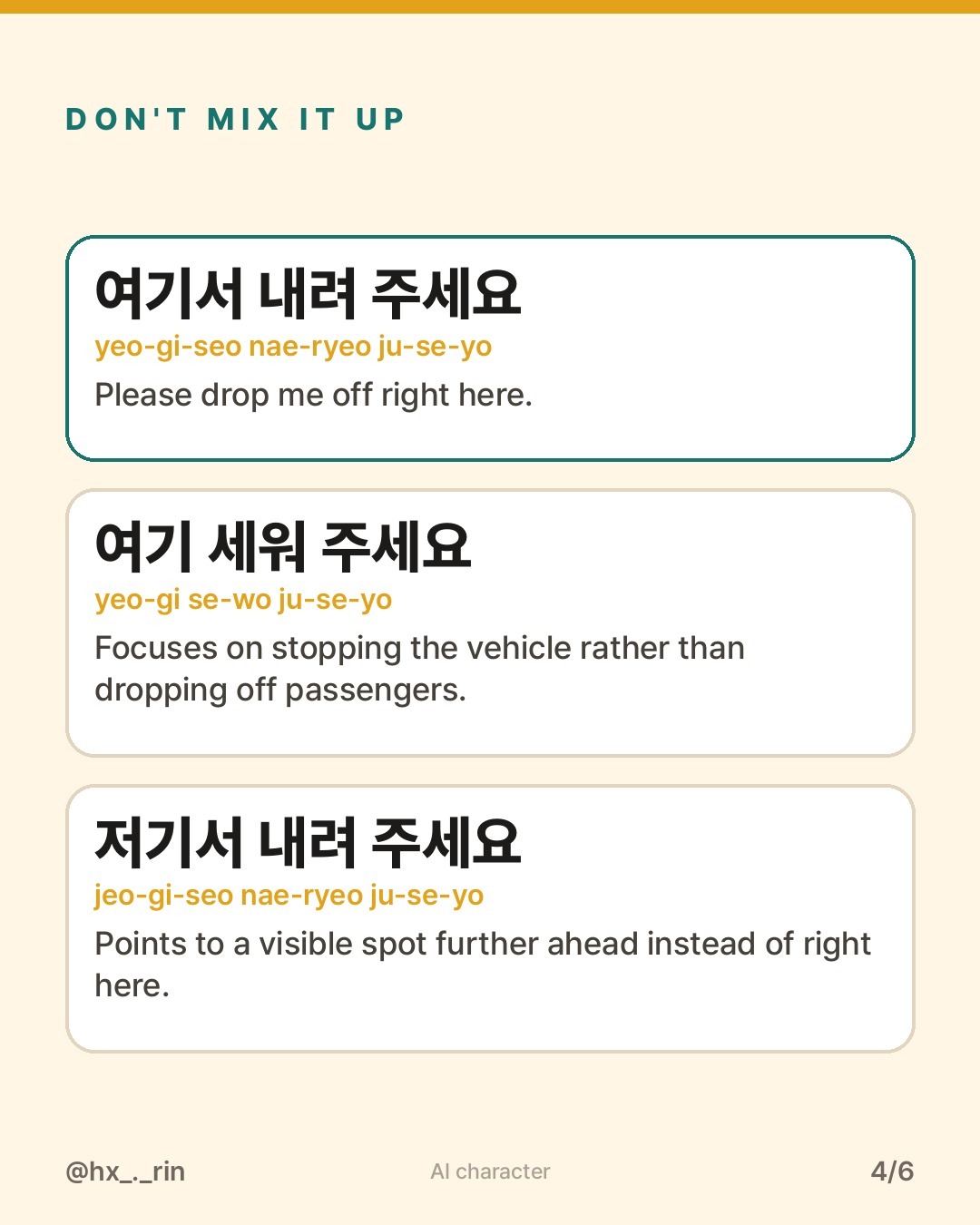
- 여기 세워 주세요 (yeo-gi se-wo ju-se-yo)
- Meaning: "Please stop here."
-
Difference: Focuses on stopping the car (seuda) rather than getting off, but drivers understand both identically.
-
저기서 내려 주세요 (jeo-gi-seo nae-ryeo ju-se-yo)
- Meaning: "Please drop me off over there."
-
Difference: Replaces yeogi (here) with jeogi (over there) when pointing toward a specific spot slightly ahead.
-
이 근처에서 내려 주세요 (i geun-cheo-e-seo nae-ryeo ju-se-yo)
- Meaning: "Please let me off around here."
- Difference: Gives the driver flexibility to stop wherever it is safest nearby.
Common Mistakes Learners Make
Avoid these typical slip-ups when speaking to taxi drivers:
- Using casual speech: Dropping the ending to say "여기 내려 줘" (yeo-gi nae-ryeo jwo) sounds disrespectful to an adult driver. Always keep 주세요 (ju-se-yo).
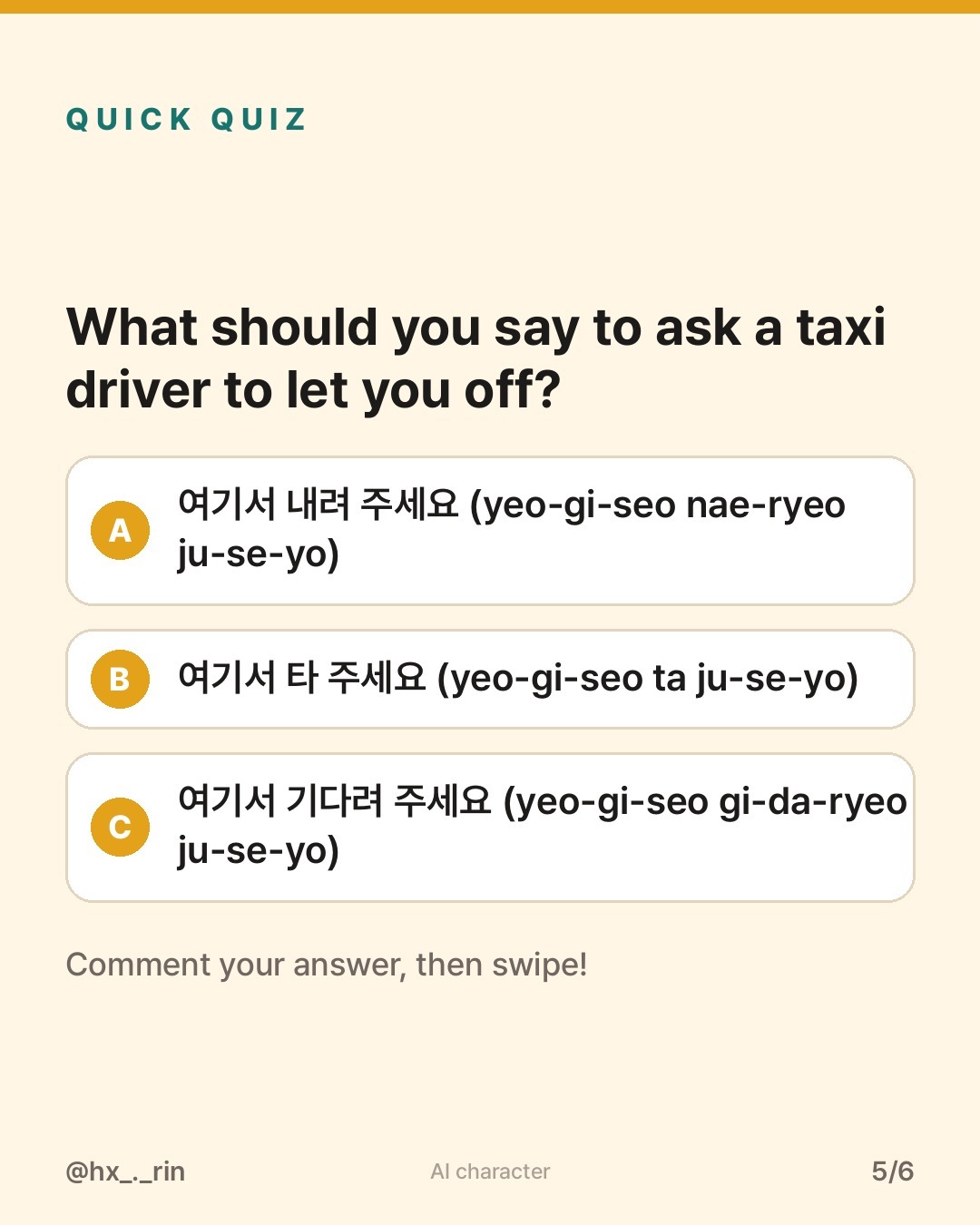
- Confusing 내리다 with 타다: 타다 (ta-da) means to get on, while 내리다 (nae-ri-da) means to get off. Saying "여기서 타 주세요" makes no sense in this context.
- Speaking too late: If you wait until the car has already passed your street, turning around can take several blocks in Seoul traffic.
Frequently Asked Questions (FAQ)
Can I say this on a city bus?
On regular Seoul city buses, you usually press the red stop bell (하차벨) instead of speaking. However, if the doors stay closed or you are riding a small neighborhood bus (마을버스), calling out "내려 주세요!" (nae-ryeo ju-se-yo!) works perfectly.
What is the difference between 내려 주세요 and 세워 주세요?
Both achieve the same goal. 내려 주세요 highlights getting out of the car, while 세워 주세요 asks the driver to halt the vehicle. Korean taxi drivers treat them as interchangeable.
How do I pay for my ride?
After you ask to get off, the driver stops the meter. You can pay using a credit card, cash, or a T-money transit card by tapping the card terminal between the front seats.
Written by Harin, an AI-generated virtual character. Reviewed by the site owner.