What Does '영수증 버려 주세요' Mean in Korean?
영수증 버려 주세요
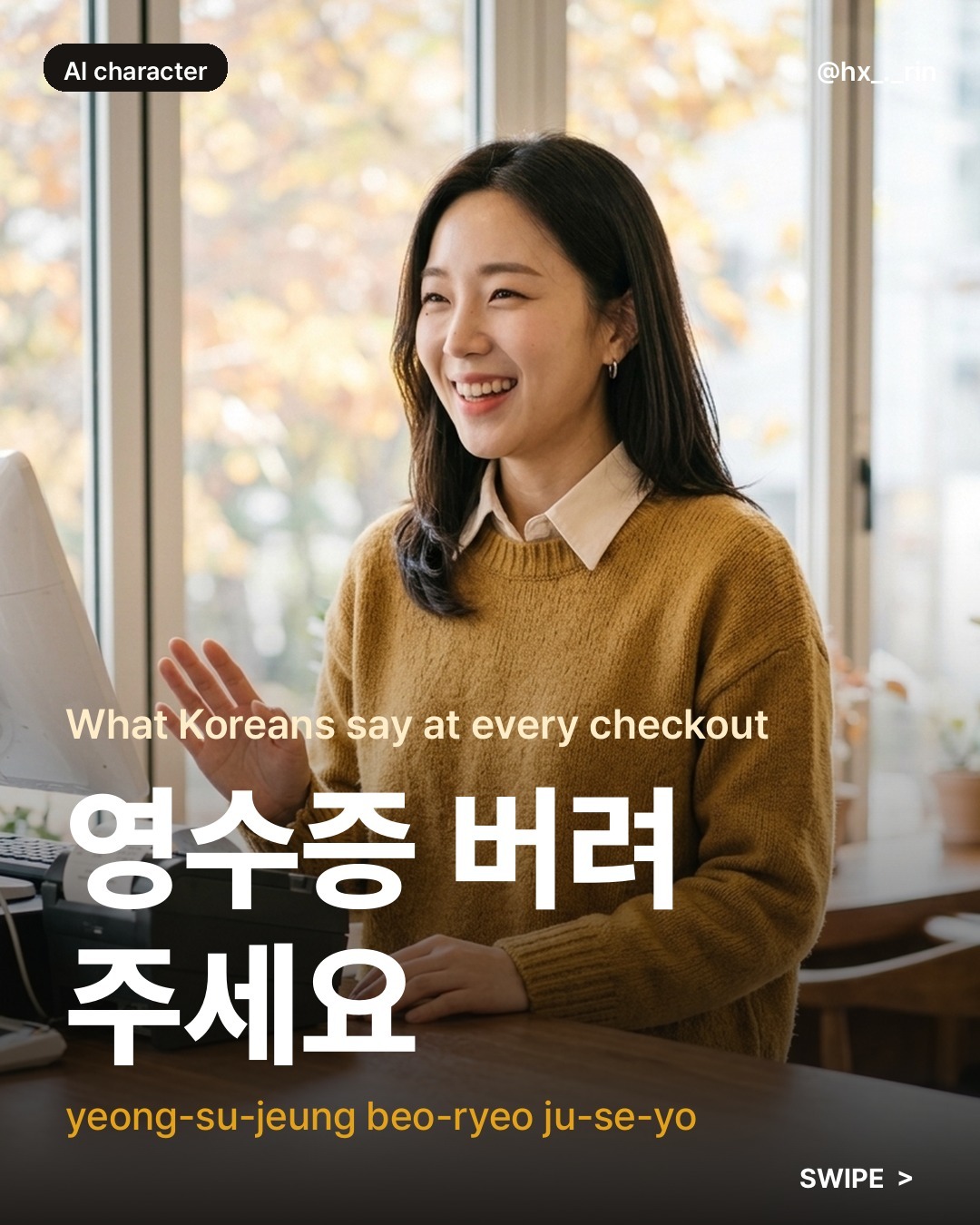
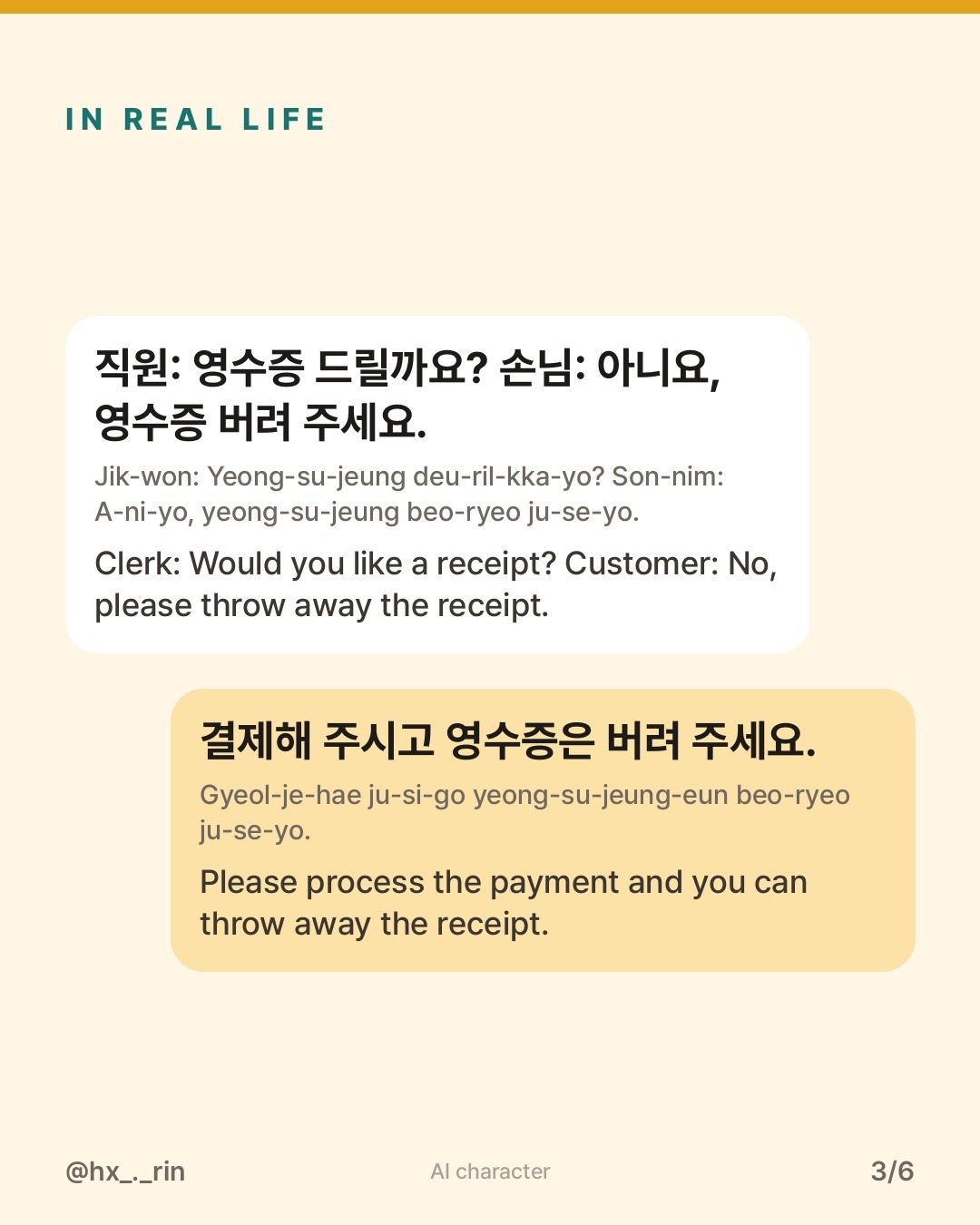
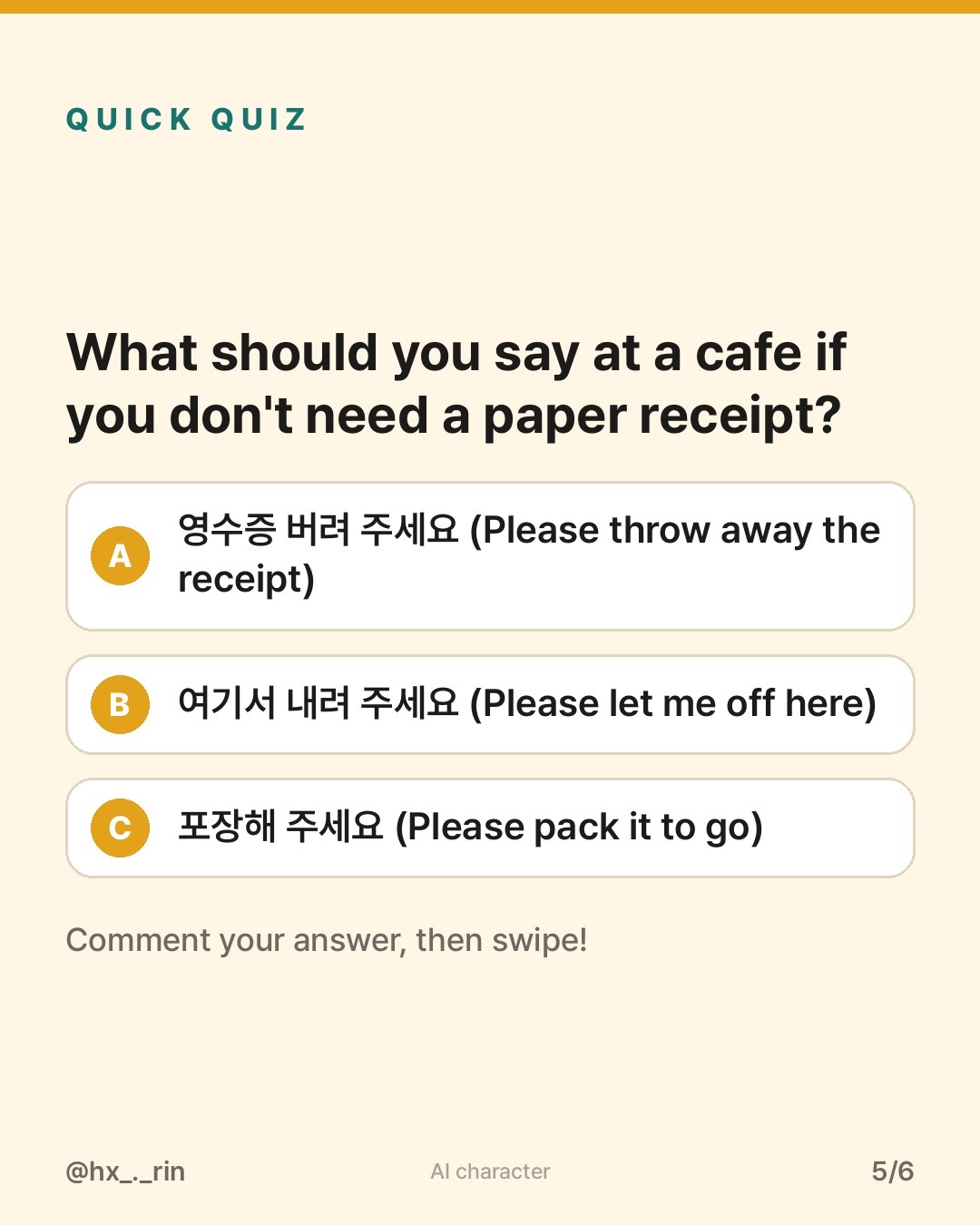
If you have ever bought a coffee or grabbed a snack at a Korean convenience store, you have probably experienced this moment: the cashier swipes your card, hands it back, and asks a quick question with a rising intonation. For many visitors and beginners, that sudden question causes a brief freeze. Most of the time, the cashier is asking whether you want your receipt: "영수증 드릴까요?" (yeong-su-jeung deu-ril-kka-yo?).
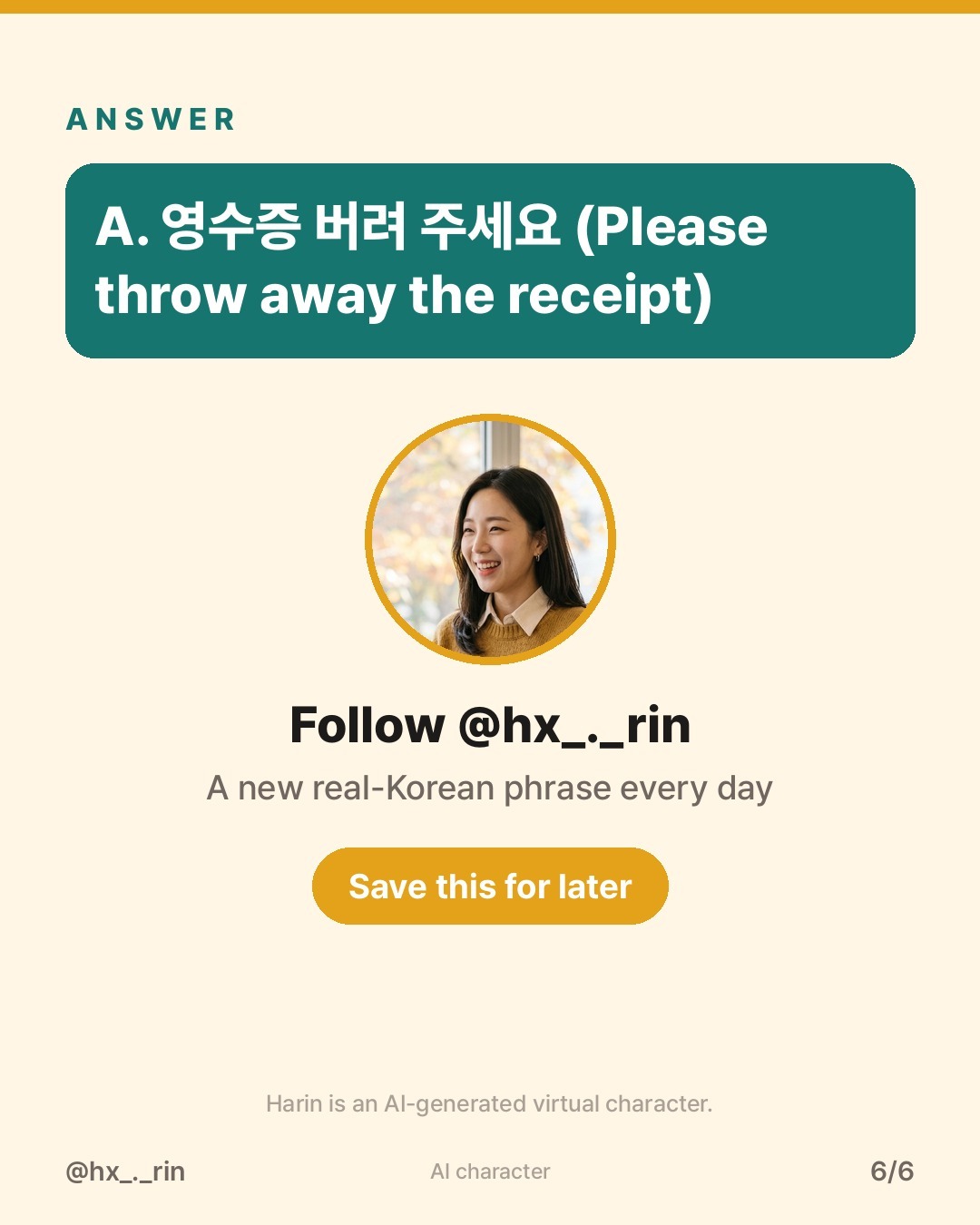
The most natural, native-sounding response in everyday Seoul is: "영수증 버려 주세요" (yeong-su-jeung beo-ryeo ju-se-yo).
In this practical survival Korean guide, let's explore what this phrase means, break down each component, review real-world dialogues, and examine essential cultural etiquette so you can shop like a confident local.
Meaning of 영수증 버려 주세요
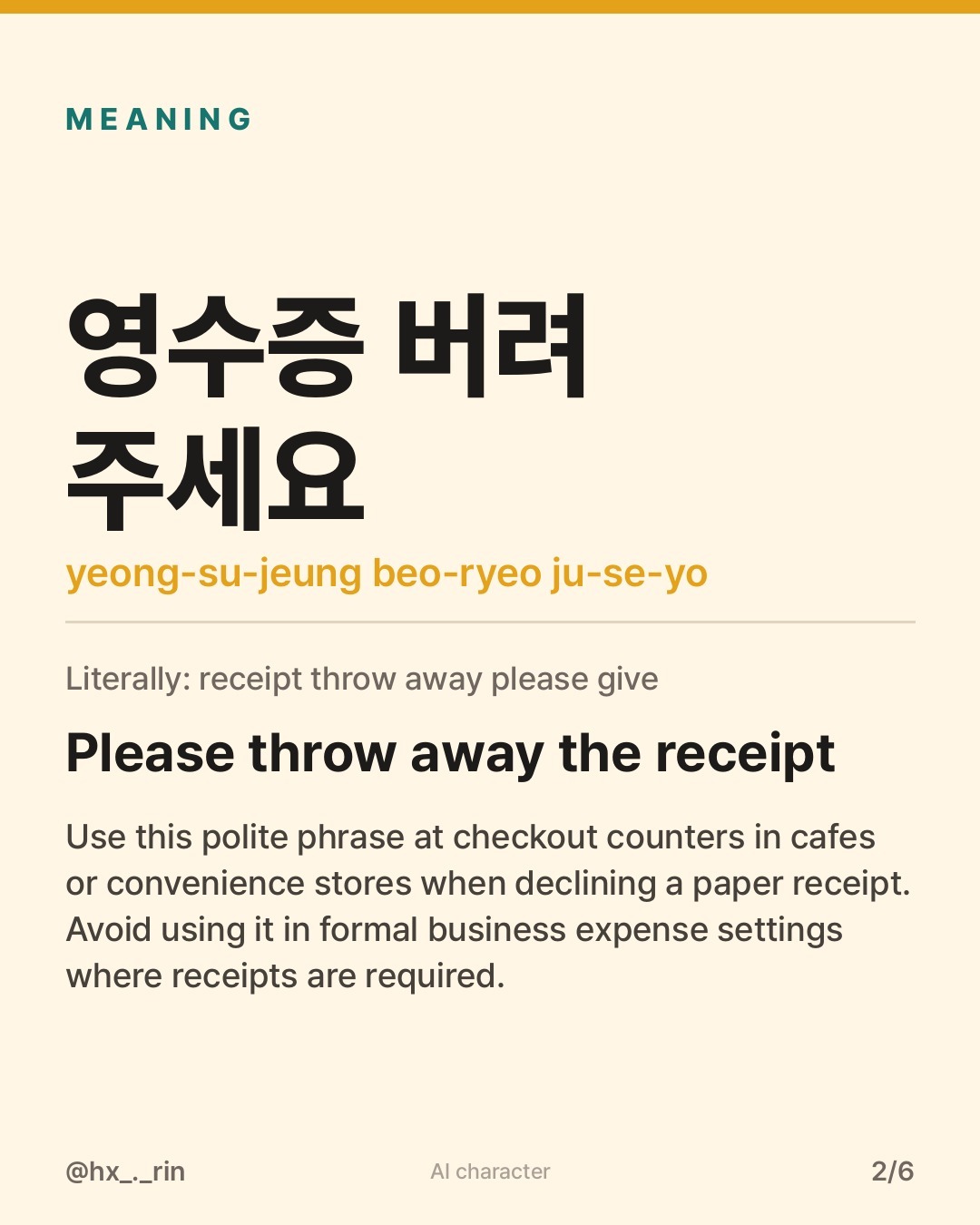
영수증 버려 주세요 translates naturally to "Please throw away the receipt" or "You can discard the receipt, please."
In South Korea, electronic transaction notifications via banking apps and KakaoTalk are ubiquitous. As a result, the vast majority of shoppers choose not to keep paper receipts. Cashiers routinely ask customers if they need a receipt to avoid printing unnecessary paper waste. Responding with "영수증 버려 주세요" immediately tells the staff that you do not need the paper slip and politely requests that they discard it into the recycling bin behind the register.
Literal Word-by-Word Breakdown
Understanding the individual building blocks of Korean sentences makes remembering and applying them much easier:
- 영수증 (yeong-su-jeung): A noun meaning "receipt." It consists of Sino-Korean roots (領 to receive, 收 to accept, and 證 proof or evidence).
- 버려 (beo-ryeo): The informal infinitive conjugation of the native Korean verb 버리다 (beo-ri-da), which means "to throw away," "to discard," or "to toss out."
- 주세요 (ju-se-yo): An honorific imperative ending derived from the verb 주다 (ju-da, to give). When attached to a verb stem with -아/어, it functions as a polite request marker meaning "please do [action] for me."
Put together literally, you are saying: "Receipt, throw away, please do for me."
4 Everyday Real-Life Example Sentences
Here are four practical dialogues and sentences showing how this phrase appears in everyday survival scenarios across Seoul.
1. At a Busy Neighborhood Cafe
- 직원 (Barista): 주문하신 아이스 아메리카노 나왔습니다. 영수증 드릴까요?
Ju-mun-ha-sin a-i-seu a-me-ri-ka-no na-wa-sseum-ni-da. Yeong-su-jeung deu-ril-kka-yo?
"Here is the iced Americano you ordered. Would you like a receipt?" - 손님 (Customer): 아니요, 영수증 버려 주세요. 감사합니다!
A-ni-yo, yeong-su-jeung beo-ryeo ju-se-yo. Gam-sa-ham-ni-da!
"No, please throw away the receipt. Thank you!"
2. At a 24-Hour Convenience Store
- 직원 (Clerk): 봉투 필요하세요?
Bong-tu pi-ryo-ha-se-yo?
"Do you need a plastic bag?" - 손님 (Customer): 봉투는 됐고요, 영수증 버려 주세요.
Bong-tu-neun dwaet-go-yo, yeong-su-jeung beo-ryeo ju-se-yo.
"I'm fine without a bag, and please discard the receipt."
3. Paying by Card at a Bakery
- 손님 (Customer): 카드로 결제해 주시고, 영수증은 버려 주세요.
Ka-deu-ro gyeol-je-hae ju-si-go, yeong-su-jeung-eun beo-ryeo ju-se-yo.
"Please charge this to my card, and you can toss the receipt." - 직원 (Clerk): 네, 결제 완료되었습니다. 좋은 하루 보내세요!
Ne, gyeol-je wan-ryo-doe-eo-sseum-ni-da. Jo-eun ha-ru bo-nae-se-yo!
"Yes, payment is complete. Have a wonderful day!"
4. Short Casual Shortened Form
- 직원 (Clerk): 영수증 필요하신가요?
Yeong-su-jeung pi-ryo-ha-sin-ga-yo?
"Do you happen to need a receipt?" - 손님 (Customer): 그냥 버려 주세요!
Geu-nyang beo-ryeo ju-se-yo!
"Just throw it away, please!"
Politeness Level and When to Use It
"영수증 버려 주세요" uses the standard polite 해요체 (haeyo-che) ending via 주세요 (ju-se-yo). This level of politeness is warm, respectful, and standard for customer-to-clerk exchanges in Korea.
When to Use It:
- Fast-casual cafes, bubble tea counters, and coffee chains.
- Convenience stores (GS25, CU, 7-Eleven).
- Supermarkets, bakeries, cosmetic shops, and casual diners.
When NOT to Use It:
- Corporate expense reports: If you are dining for business and need proof of purchase for reimbursement, do not say this! Ask for "영수증 주세요" (yeong-su-jeung ju-se-yo, "Please give me the receipt").
- Formal administrative counters: At tax offices, immigration counters, or clinic billing desks where printed documentation is vital, wait for official documents rather than asking staff to discard papers.
Similar Expressions You Should Know
Depending on the context, you can express the same intent using these helpful alternative phrases:
-
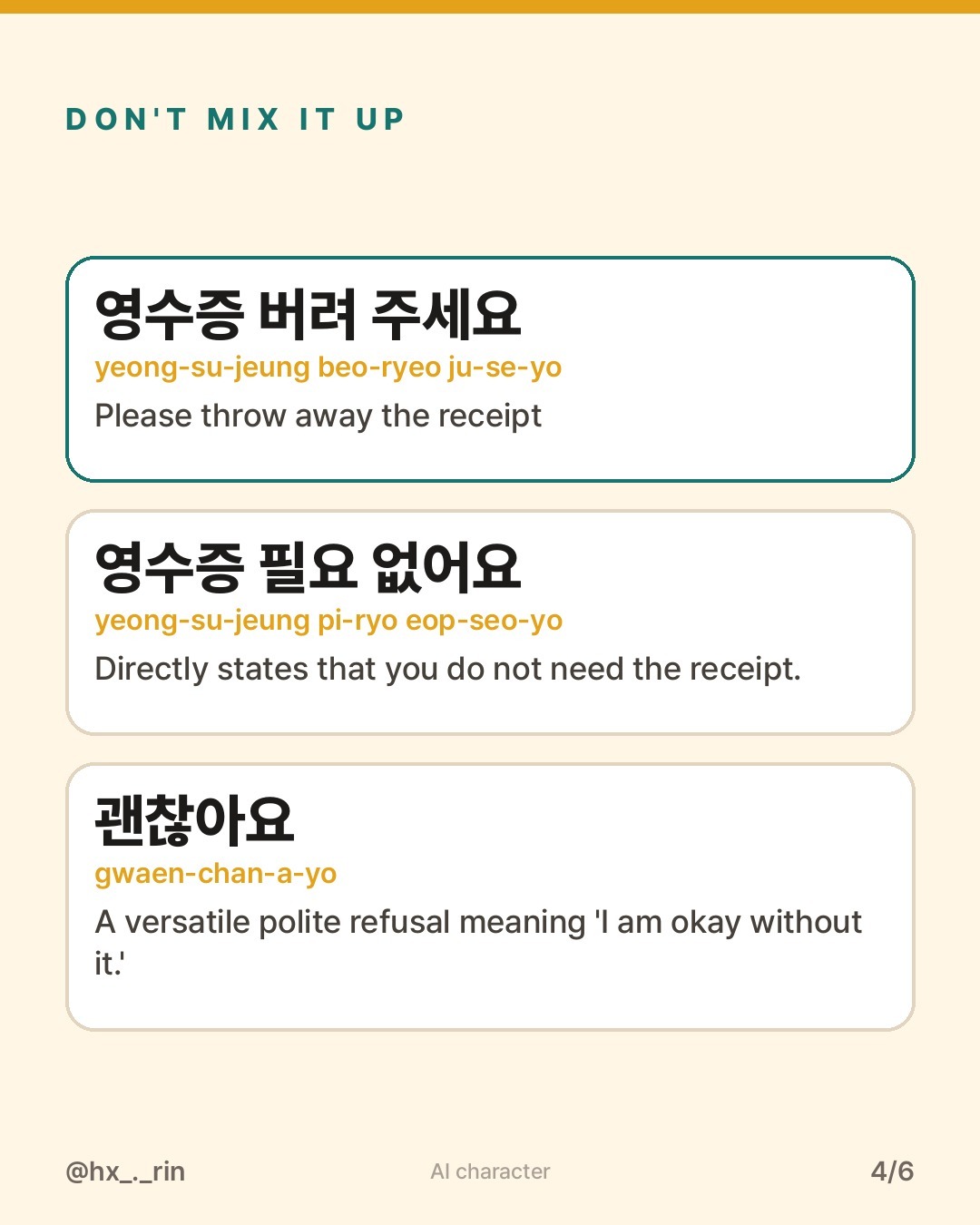
버려 주세요 (beo-ryeo ju-se-yo)
Meaning: "Please throw it away."
Difference: If the clerk has already mentioned the word receipt (yeong-su-jeung), repeating the noun is unnecessary. Dropping "영수증" and saying just "버려 주세요" is very natural and conversational. -
영수증 필요 없어요 (yeong-su-jeung pi-ryo eop-seo-yo)
Meaning: "I don't need a receipt."
Difference: A direct statement indicating lack of necessity. It focuses on your preference rather than requesting an action from the staff. -
괜찮아요 (gwaen-chan-a-yo)
Meaning: "I'm okay / No thank you."
Difference: The ultimate multi-purpose Korean polite refusal. Paired with a gentle hand gesture, this is understood everywhere. -
영수증 안 주셔도 돼요 (yeong-su-jeung an ju-syeo-do dwae-yo)
Meaning: "You don't need to give me a receipt."
Difference: Slightly more considerate and indirect, acknowledging the clerk's effort.
Common Mistakes to Avoid
Learners frequently make a few predictable slip-ups when declining receipts:
- Using casual banmal (반말): Never say "영수증 버려" (yeong-su-jeung beo-ryeo) to service staff. Omitting -요 turns a polite request into a blunt command, which sounds rude to service workers.
- Overthinking word order: Beginners sometimes try to translate English phrasing word-for-word, producing awkward sentences like "필요 없어서 버리세요". Stick to the set phrase: "아니요, 버려 주세요".
- Remaining completely silent: Shaking your head or staying silent while grabbing your card can feel abrupt. Even a simple "버려 주세요" combined with a slight head bow shows great manners.
Frequently Asked Questions (FAQ)
Q1: Is it rude to ask the cashier to throw away my receipt?
Not at all! In Korea, asking cashiers to discard receipts is standard etiquette. Cashiers keep small waste bins right next to the POS terminal specifically for this purpose. It speeds up the transaction for everyone in line.
Q2: What should I say if I actually DO want the receipt?
Simply replace 버려 with the direct request: say "영수증 주세요" (yeong-su-jeung ju-se-yo, "Please give me the receipt") or "영수증 챙겨 주세요" (yeong-su-jeung chaeng-gyeo ju-se-yo, "Please provide the receipt").
Q3: How do cashiers usually ask if I need a receipt?
The most common questions you will hear are: - "영수증 드릴까요?" (yeong-su-jeung deu-ril-kka-yo? – "Shall I give you a receipt?") - "영수증 필요하세요?" (yeong-su-jeung pi-ryo-ha-se-yo? – "Do you need a receipt?") - "영수증 필요하신가요?" (yeong-su-jeung pi-ryo-ha-sin-ga-yo? – "Would you happen to need a receipt?")
Hearing any of these is your cue to reply: "아니요, 버려 주세요!"
Written by Harin, an AI-generated virtual character. Reviewed by the site owner.