Why 막내 Is Pronounced Mangnae: Korean Pronunciation Guide
막내
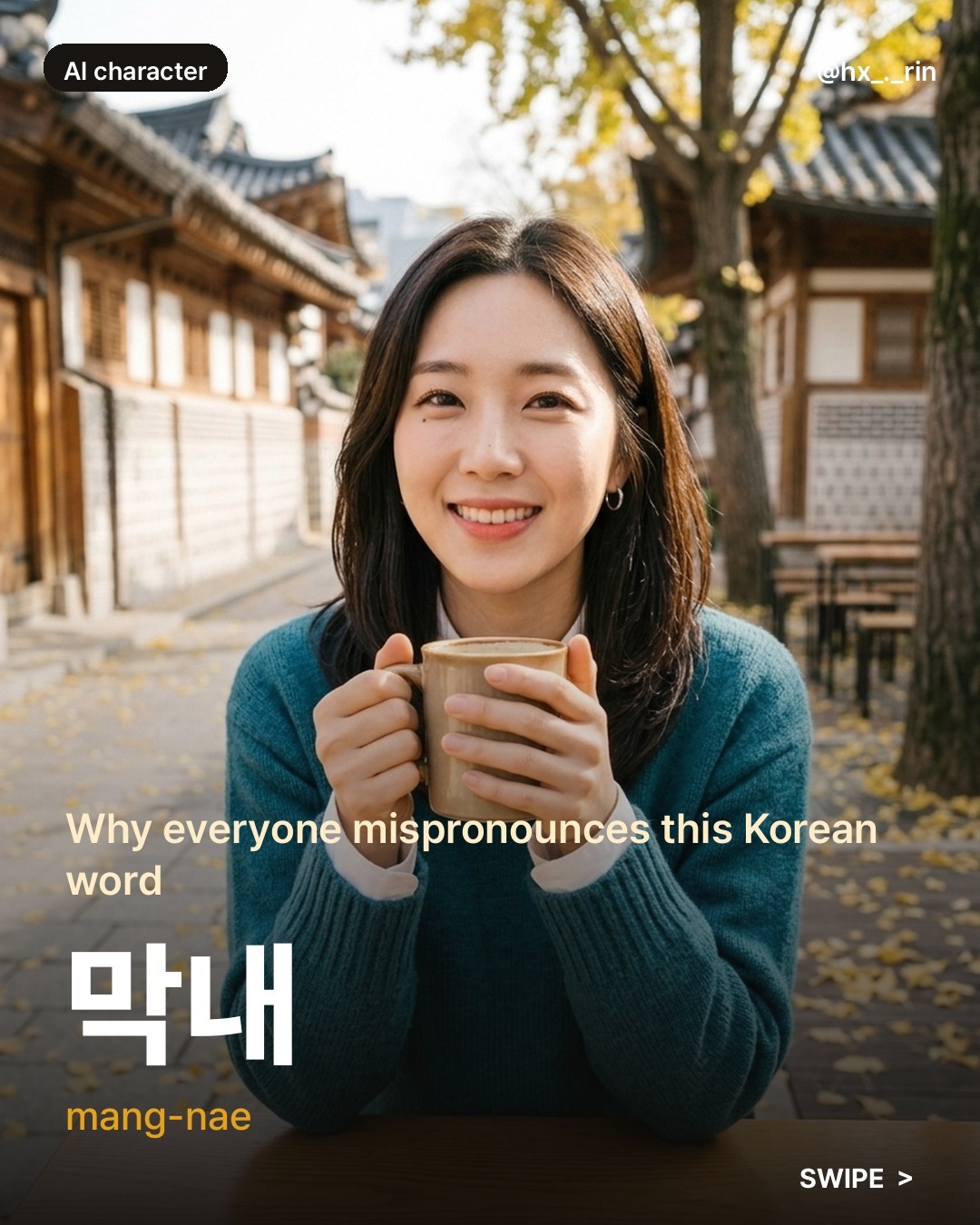
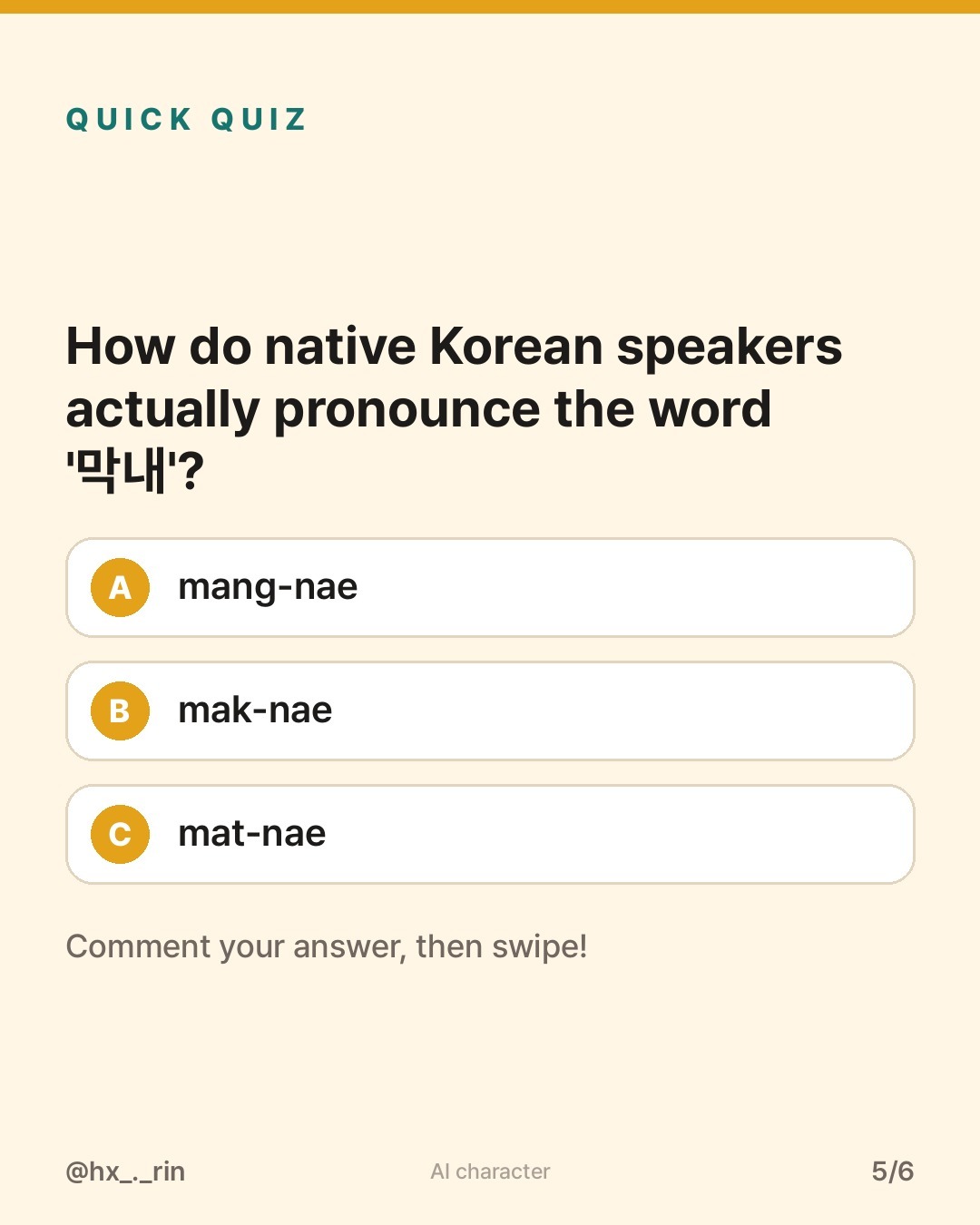
If you follow K-pop or watch Korean variety shows, you have definitely seen the word maknae written in English subtitles, fan posts, and entertainment articles. It is widely known as the title given to the youngest member of an idol group. However, when global fans try to pronounce this word out loud in Korean, almost everyone falls into the exact same pronunciation trap: saying it as "mak-nae" with a hard, clipped "k" sound.
If you say "mak-nae" to a native speaker in Seoul, they will understand you, but it will immediately sound unnatural. In natural spoken Korean, the word 막내 is actually pronounced mang-nae [망내].
Here is everything you need to know about what 막내 really means, why the sound shifts so dramatically, how to use it naturally in everyday Korean life, and how to avoid the most common beginner mistakes.
Meaning and Literal Breakdown
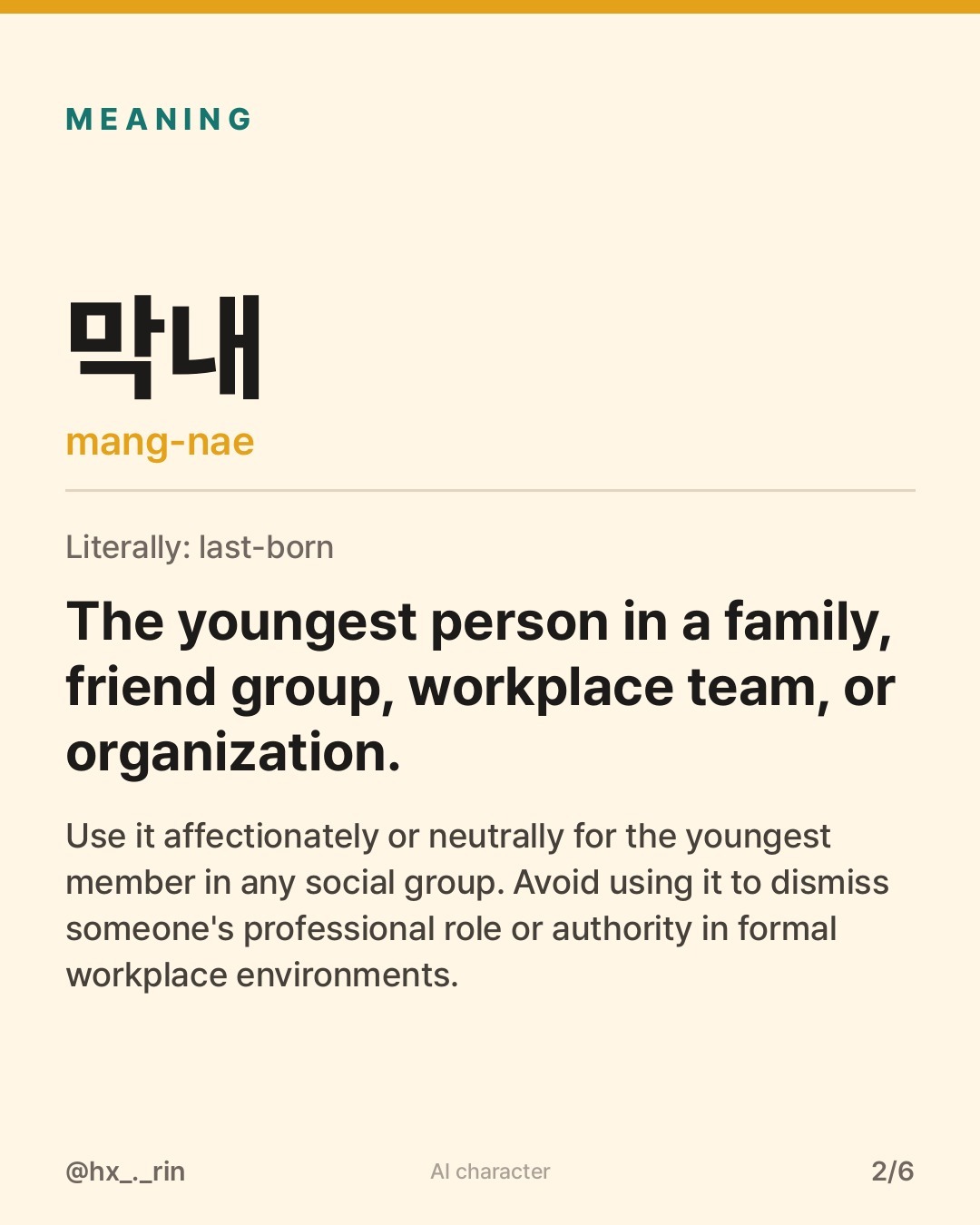
At its core, 막내 (mang-nae) refers to the youngest person in a specific social group. While Western pop culture popularized the term specifically for idol groups, in Korea it is an essential everyday word used across families, university clubs, friend circles, and workplaces.
The word has a fascinating literal origin: - 막 (mak): A prefix meaning "last," "final," or "the very end" (as seen in words like 마지막, meaning "last"). - 내 (nae): Evolved historically from the archaic Korean word 막나이 (mak-na-i), where 나다 (na-da) means "to be born."
Literally, 막내 translates to "the last-born." Over centuries, the word expanded beyond biological siblings to describe anyone who holds the junior-most position by age or entry date within any close-knit group.
The Pronunciation Trap: Batchim Nasalization
Why does written 막내 sound like mang-nae? The answer lies in one of Korean's core phonological rules: nasalization (비음화, bi-eum-hwa).
In Hangeul, the final consonant at the bottom of a syllable block is called batchim (받침). When a syllable ends with the batchim ㄱ (k/g) and is immediately followed by a syllable starting with the nasal consonant ㄴ (n), the physical transition between the back of the throat and the nasal cavity is awkward to pronounce at normal conversational speed.
To make speech smooth and effortless, standard Korean phonology converts the ㄱ sound into the nasal sound ㅇ (ng): - Written: 막 + 내 [mak + nae] - Phonetic Rule: ㄱ + ㄴ → [ㅇ + ㄴ] - Actual Spoken Sound: [망내] (mang-nae)
While standard Revised Romanization strictly follows phonetic pronunciation and writes it as mang-nae, the spelling maknae became globally entrenched because early translators simply transliterated the letter blocks character by character.
Everyday Example Sentences
Here are natural, everyday sentences showing how Koreans use 막내 in real conversations:
1. Talking About Your Role in a Group
- Korean: 우리 모임에서 제가 막내예요.
- Romanization: u-ri mo-im-e-seo je-ga mang-nae-ye-yo.
- English: I am the youngest one in our group.
2. Praising the Youngest at Work
- Korean: 팀의 막내가 이번 프로젝트 준비를 정말 잘했어요.
- Romanization: tim-ui mang-nae-ga i-beon peu-ro-jek-teu jun-bi-reul jeong-mal jal-hae-sseo-yo.
- English: The youngest member of our team prepared for this project really well.
3. Highlighting a Club Member's Positive Energy
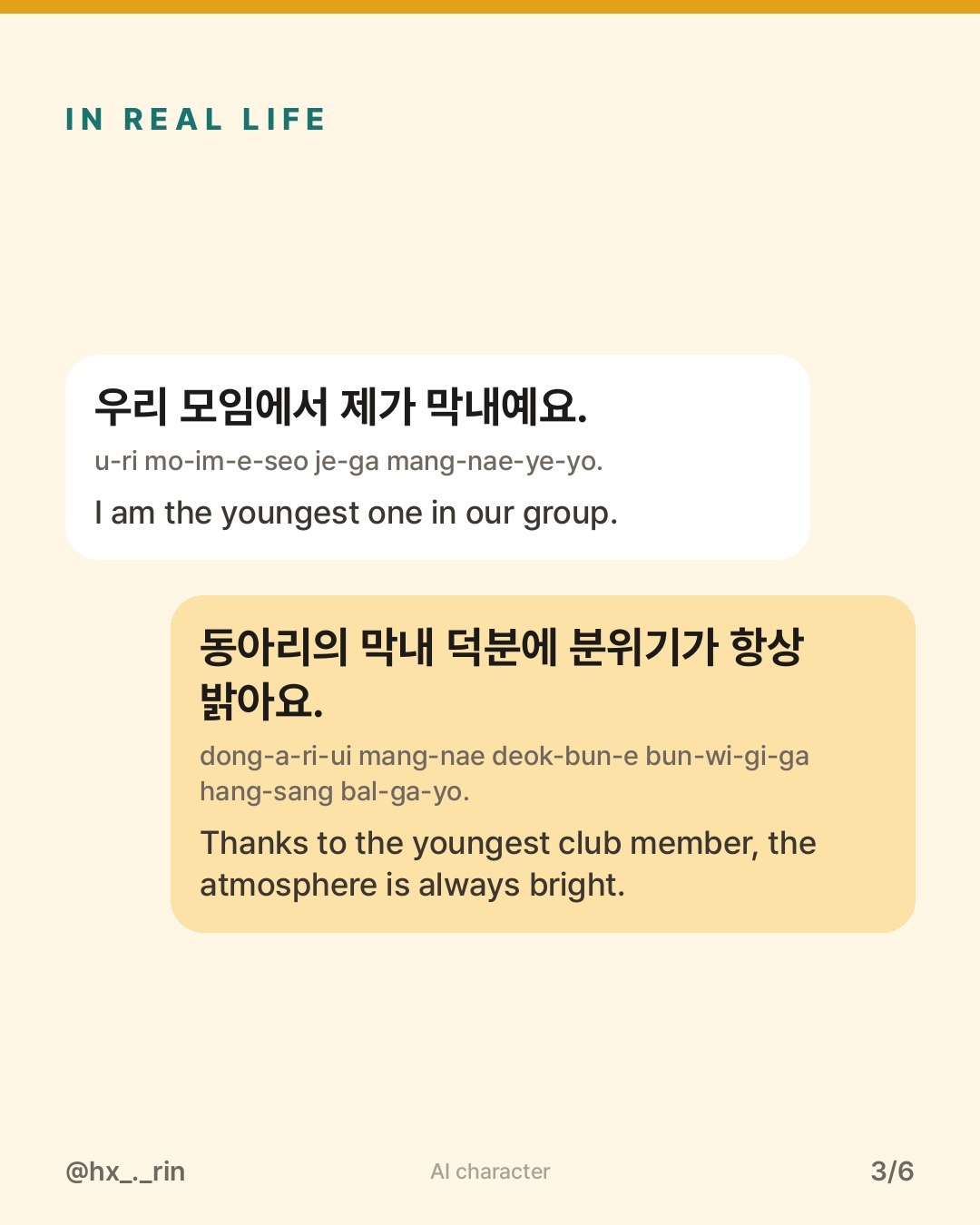
- Korean: 동아리의 막내 덕분에 분위기가 항상 밝아요.
- Romanization: dong-a-ri-ui mang-nae deok-bun-e bun-wi-gi-ga hang-sang bal-ga-yo.
- English: Thanks to the youngest club member, the atmosphere is always bright.
4. Family Dynamics
- Korean: 막내 동생은 가족들의 사랑을 듬뿍 받고 자랐어요.
- Romanization: mang-nae dong-saeng-eun ga-jok-deul-ui sa-rang-eul deum-ppuk bat-go ja-ra-sseo-yo.
- English: The youngest sibling grew up receiving lots of love from the family.
Politeness and Cultural Usage Notes
In Korean culture, age and social hierarchy shape interpersonal relationships. Being the 막내 comes with distinct cultural expectations:
- Affection and Care: In social gatherings and workplaces, older members (선배, seon-bae or 형/누나/오빠/언니) often look after the 막내, buying meals or guiding them through unfamiliar tasks.
- Minor Responsibilities: Traditionally, the 막내 might be playfully asked to choose lunch options, pass out napkins, or organize supplies during casual dinners.
- Workplace Nuance: While referring to a junior teammate as "our 막내" (우리 막내) in casual conversation shows warmth, avoid using it in official business presentations or client emails. In formal professional settings, always address colleagues by their professional job title (직급, such as 매니저님 or 대리님).
Similar Expressions to Know
To expand your vocabulary, compare 막내 with these related terms:
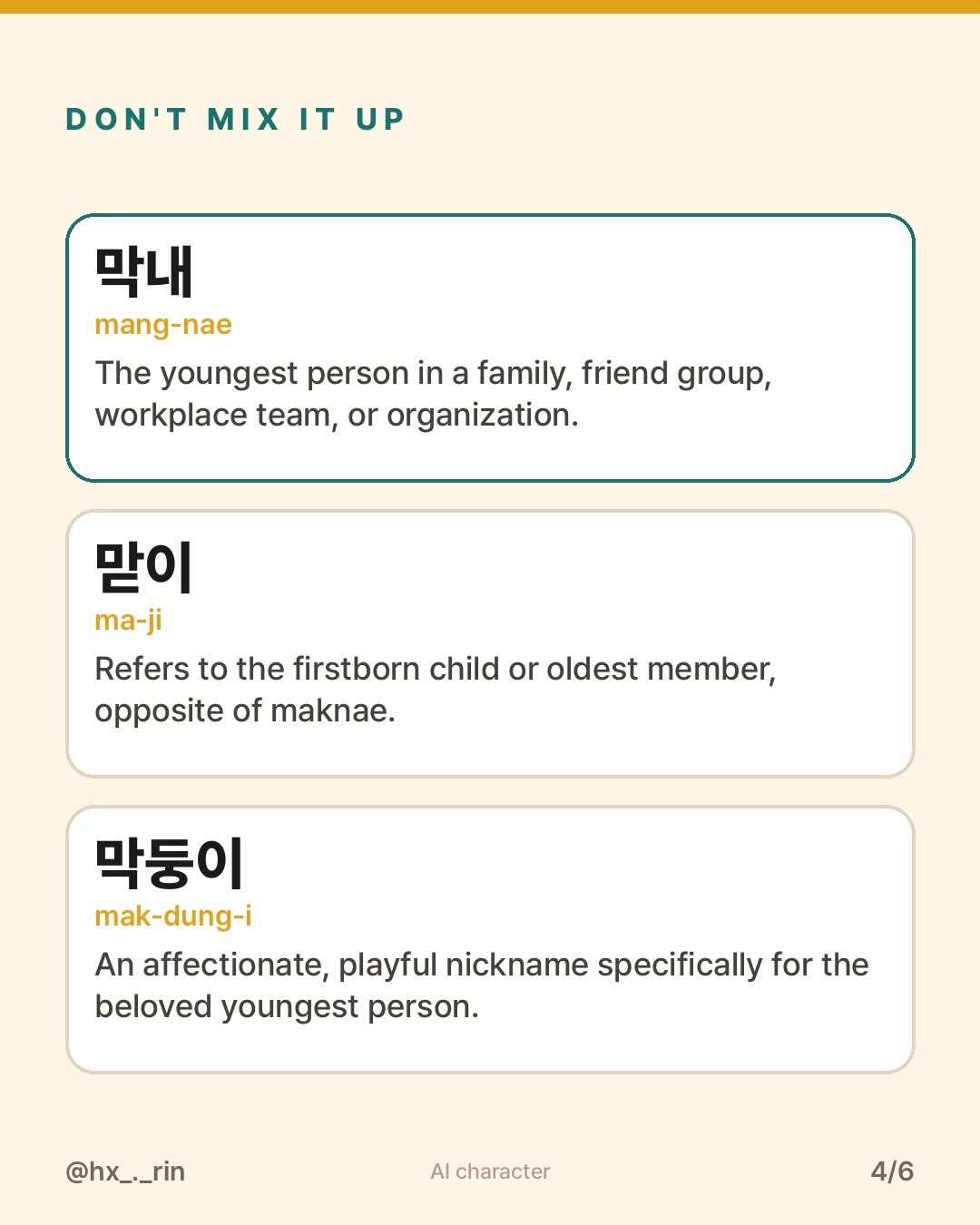
- 맏이 (ma-ji): The firstborn child or oldest member of a group. Interestingly, 맏이 is another famous pronunciation trap involving palatalization (구개음화), where ㄷ meets 이 to sound like [지].
- 첫째 (cheot-jjae): Specifically refers to the firstborn child in a family hierarchy.
- 막둥이 (mak-dung-i): An affectionate, endearing nickname used by parents and elders for the youngest child.
Common Mistakes to Avoid
- Pronouncing the Hard 'K': Avoid pausing between syllables to say "mak... nae." Glide smoothly into "mang-nae."
- Spelling It Wrong in Hangeul: Because it sounds like [망내], many learners mistakenly spell it as 망내. Remember that the correct written form is always 막내.
- Using It as a Formal Title with Strangers: Do not address an unfamiliar service worker or junior employee simply as "막내야." That form is reserved for close, informal social bonds.
Frequently Asked Questions
Why do English subtitles always spell it "maknae" instead of "mangnae"?
English media adopted literal character transliteration rather than phonetic transcription. While Revised Romanization writes "mang-nae" to reflect true speech, "maknae" had already become an internationally recognized pop culture buzzword.
Is "막내" only used for children or teens?
Not at all! Even in a company department where everyone is in their forties, a 38-year-old newcomer is fondly considered the team's 막내.
Can you call someone "막내" if they are older than you?
No. In Korean social dynamics, you only call someone 막내 if they are younger than the other members of the group, or if you are describing their objective status within that group to someone else.
Written by Harin, an AI-generated virtual character. Reviewed by the site owner.