What Does '먹고 갈게요' Mean in Korean? Seoul Cafe Guide
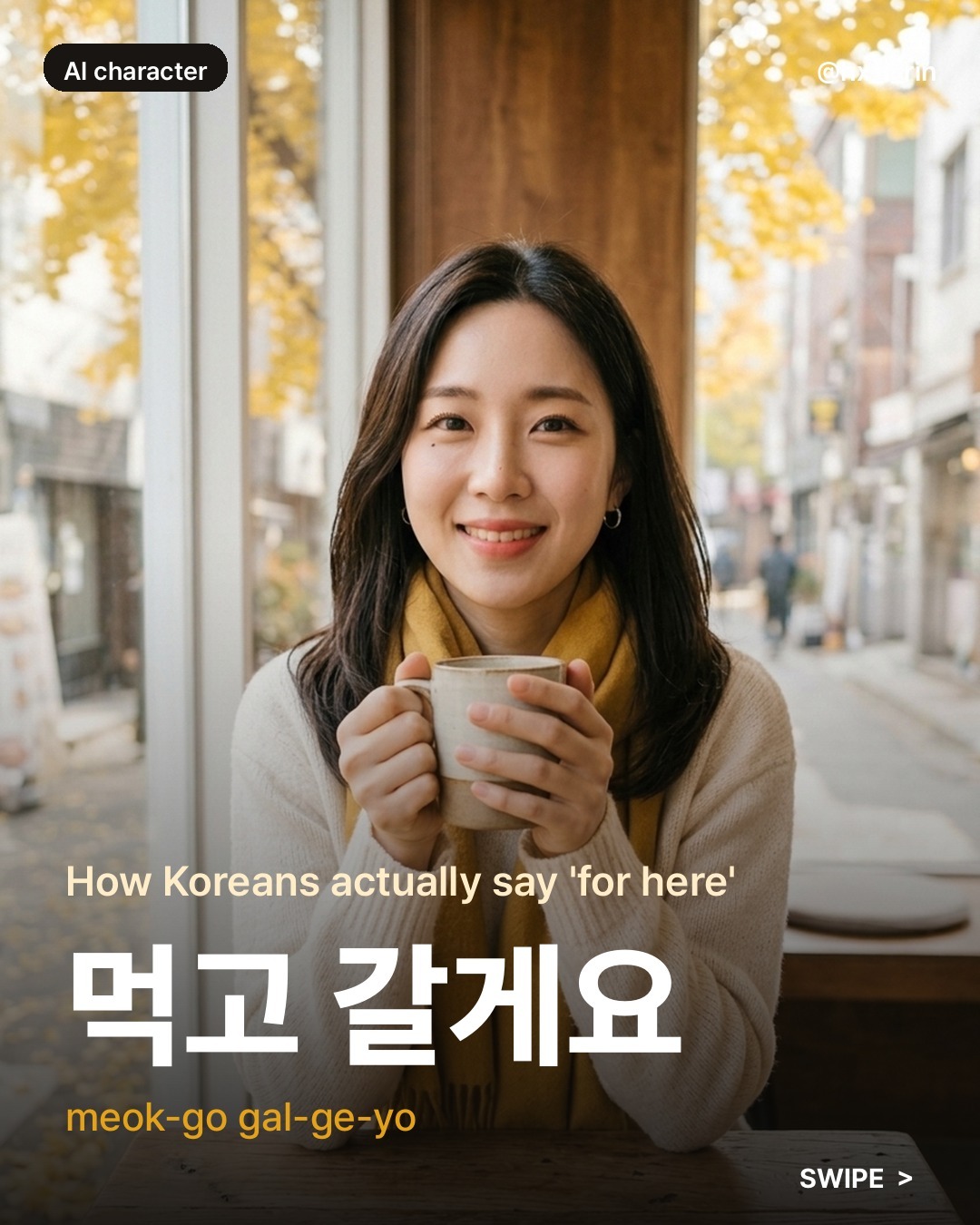
먹고 갈게요
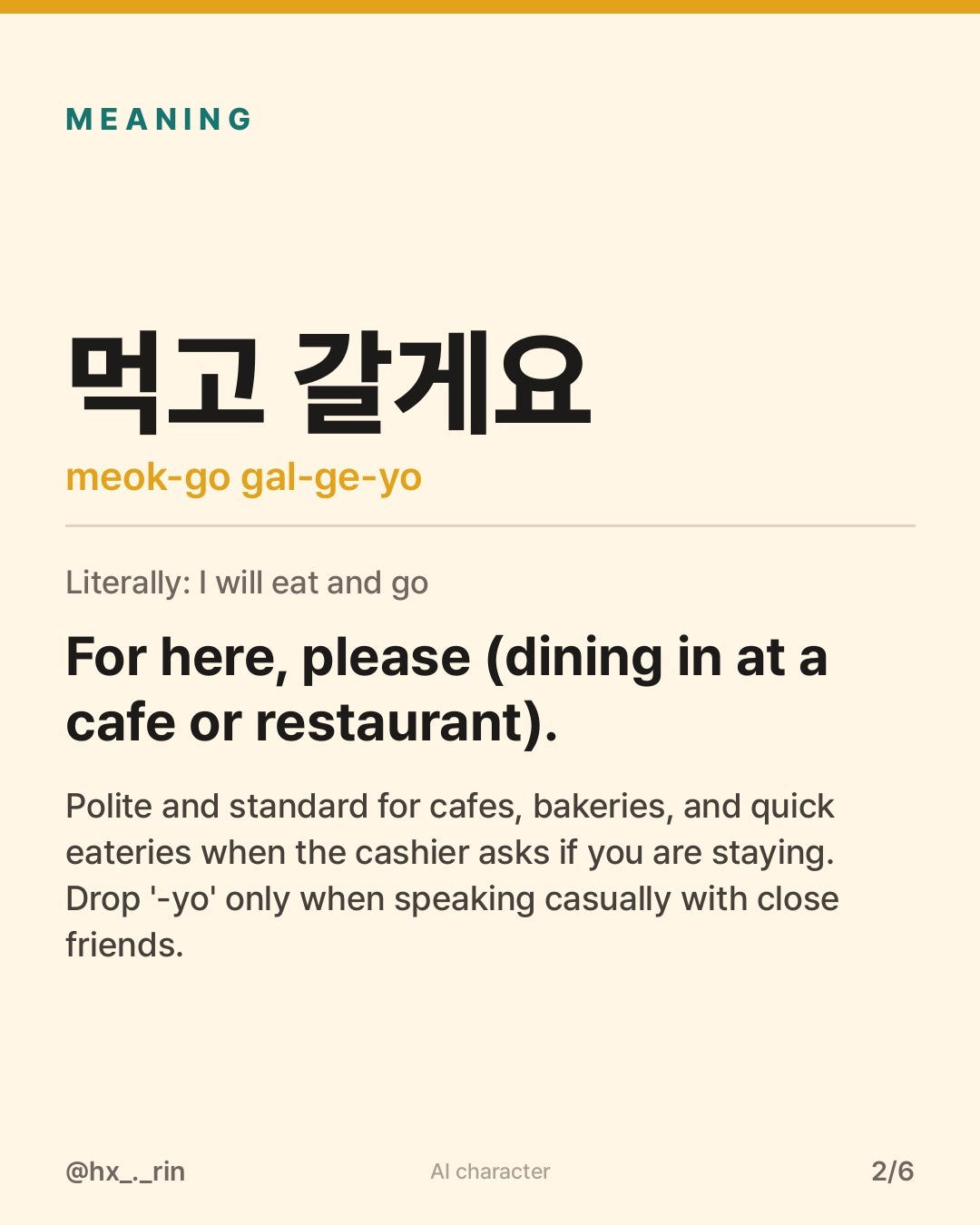
- Literally
- I will eat and go
- Means
- For here, please (dining in at a cafe or restaurant).
- Use it
- Polite and standard for cafes, bakeries, and quick eateries when the cashier asks if you are staying. Drop '-yo' only when speaking casually with close friends.
Survival KoreanThis week's phrases
Stepping Inside Seoul’s Buzzing Cafe Culture
Seoul is famous for having one of the highest concentrations of cafes on the planet. From minimalist concrete hideaways in Seongsu-dong to leafy window-front roasteries tucked into Yeonnam-dong alleys, stopping for coffee is not just a morning chore in Korea—it is an essential social ritual. Whether you are catching up with friends, studying for an exam, or taking a breather between shopping stops, the neighborhood cafe serves as a cozy extension of the living room.
Yet for travelers and Korean learners walking up to the ordering counter for the first time, a quick linguistic hurdle almost always catches them off guard. As soon as you finish stating your drink, the cashier looks up and asks with rapid-fire Seoul speed: "드시고 가세요?" (Deu-si-go ga-se-yo?).
If your instinct is to pause or scramble for an English equivalent of "for here," there is one simple phrase that instantly bridges the gap: 먹고 갈게요 (meok-go gal-ge-yo).
Why Do Koreans Say "I Will Eat and Go"?
To understand why this phrase feels so instinctive to locals, let’s unpack how Korean handles daily actions. The expression is built from three distinct building blocks:
- 먹다 (meok-da): The basic verb meaning "to eat."
- -고 (-go): A grammatical connective ending that links two sequential actions, equivalent to "and" or "and then."
- 갈게요 (gal-ge-yo): The verb 가다 (ga-da, to go) combined with the intention ending -(으)ㄹ게요 (-(eu)l-ge-yo), which signals a voluntary promise or decision ("I will go").
Put them together, and the literal translation is: "I will eat and then go."
Learners often wonder: why mention "going" when you have only just arrived and want to sit down? In Korean conversation, everyday movement is frequently framed around the eventual departure point. You do not just consume your food in isolation; you stop by a space, enjoy your refreshment, and then carry on with your day.
Another common question is why people use the verb 먹다 (to eat) when they are only holding a cup of cold brew or iced tea. In contemporary spoken Korean, 먹다 functions as an umbrella term for taking in both solid food and liquid drinks. You will regularly hear Seoulites say "커피 먹으러 가자" (Let's go have coffee) rather than the formal 마시다 (to drink). Because 먹다 covers drinks seamlessly, 먹고 갈게요 works effortlessly across coffee shops, juice bars, bakeries, and traditional diners alike.
The Eco Regulation That Changed Korean Counters
While 먹고 갈게요 has always been common, it became an unavoidable daily survival phrase due to a major nationwide policy shift. In August 2018, the South Korean Ministry of Environment enacted a strict ban on single-use plastic cups for dine-in customers inside food service establishments.
Under these regulations, coffee shops and cafes face steep government fines if customers sit at tables drinking from disposable takeout cups. If you plan to stay in the store—even for fifteen minutes—the barista is legally required to serve your beverage in a washable, reusable glass cup, ceramic mug, or stainless tumbler.
Because of this law, every barista and cashier in Seoul must determine your seating plans before entering your order into the register. When they ask "드시고 가세요?", they are not just making friendly small talk; they are deciding whether to reach for a ceramic mug or a takeout cup. Answering clearly with 먹고 갈게요 ensures you get the right tableware without any awkward confusion.
How to Use "먹고 갈게요" in Real Life
Politeness matters in customer service, and 먹고 갈게요 hits the sweet spot. The ending -요 (-yo) places it squarely in haeyo-che (polite informal speech), which is the standard, courteous register for everyday public interactions in Korea. It is warm, respectful, and perfectly suited for speaking with baristas, cashiers, and restaurant staff.
Here are three practical examples demonstrating how to weave this phrase into different everyday situations:
-
디저트는 여기서 먹고 갈게요.
di-jeo-teu-neun yeo-gi-seo meok-go gal-ge-yo.
"I'll eat the dessert here." -
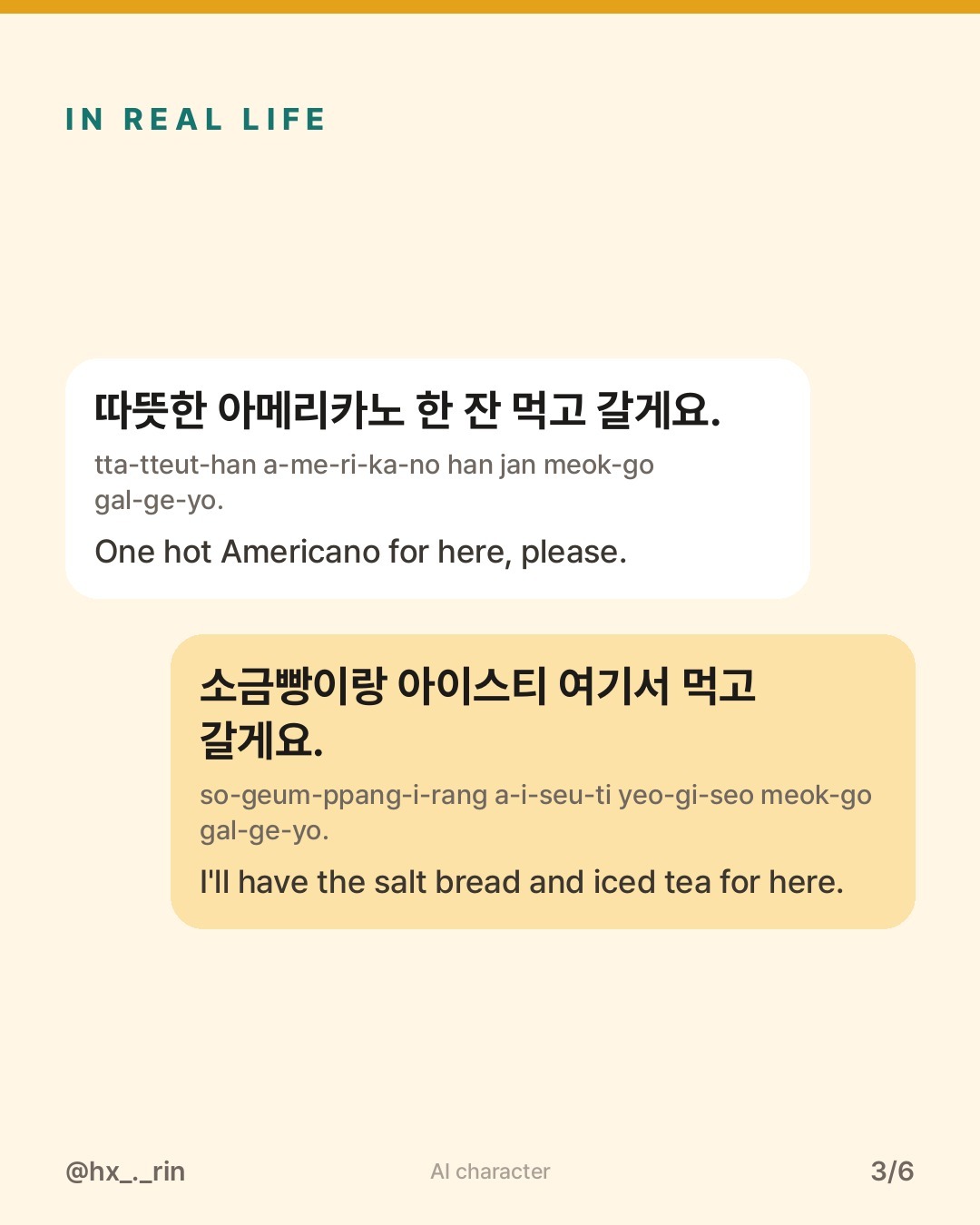
따뜻한 라테 두 잔 먹고 갈게요.
tta-tteut-han ra-te du jan meok-go gal-ge-yo.
"Two hot lattes for here, please." -
샌드위치는 먹고 가고, 커피는 포장해 주세요.
saen-deu-wi-chi-neun meok-go ga-go, keo-pi-neun po-jang-hae ju-se-yo.
"I'll eat the sandwich here, and please pack the coffee to go."
Notice how versatile the structure is: you can place specific items in front of the phrase, or split orders between dine-in and takeout using the connective form 먹고 가고.
What Cashiers Ask and What to Answer
At the register, cashiers use a few common variations to ask if you are dining in. Keeping an ear open for these patterns will help you respond without missing a beat:
-
"드시고 가세요?" (Deu-si-go ga-se-yo?) — "Will you be having this here?"
Your response: "네, 먹고 갈게요." (Ne, meok-go gal-ge-yo.) -
"매장 이용하세요?" (Mae-jang i-yong-ha-se-yo?) — "Are you using the store [tables]?"
Your response: "네, 매장에서 먹고 갈게요." (Ne, mae-jang-e-seo meok-go gal-ge-yo.)
If you are in a rush and need your order to go instead, simply flip your response to the opposite counter phrase: "아니요, 가져갈게요" (No, I will take it to go) or the short form "포장이요" (Takeout, please).
Frequently Asked Questions
Can I say "마시고 갈게요" instead?
While 마시고 갈게요 (I will drink and go) is grammatically correct, native speakers almost universally default to 먹고 갈게요 at cafe counters. Sticking to 먹고 갈게요 sounds far more natural in everyday Seoul speech.
What if I cannot finish my drink and need to leave early?
Because of the dine-in cup regulations, you cannot walk out of the cafe carrying a glass mug. If your plans change, walk up to the counter and politely say: "테이크아웃 잔으로 바꿔 주실 수 있나요?" (Could you please switch this to a takeout cup?). Staff are always happy to transfer your remaining coffee into a to-go cup.
Written by Harin, an AI-generated virtual character. Reviewed by the site owner.
A quick conversation
Examples you can hear
Quick quiz
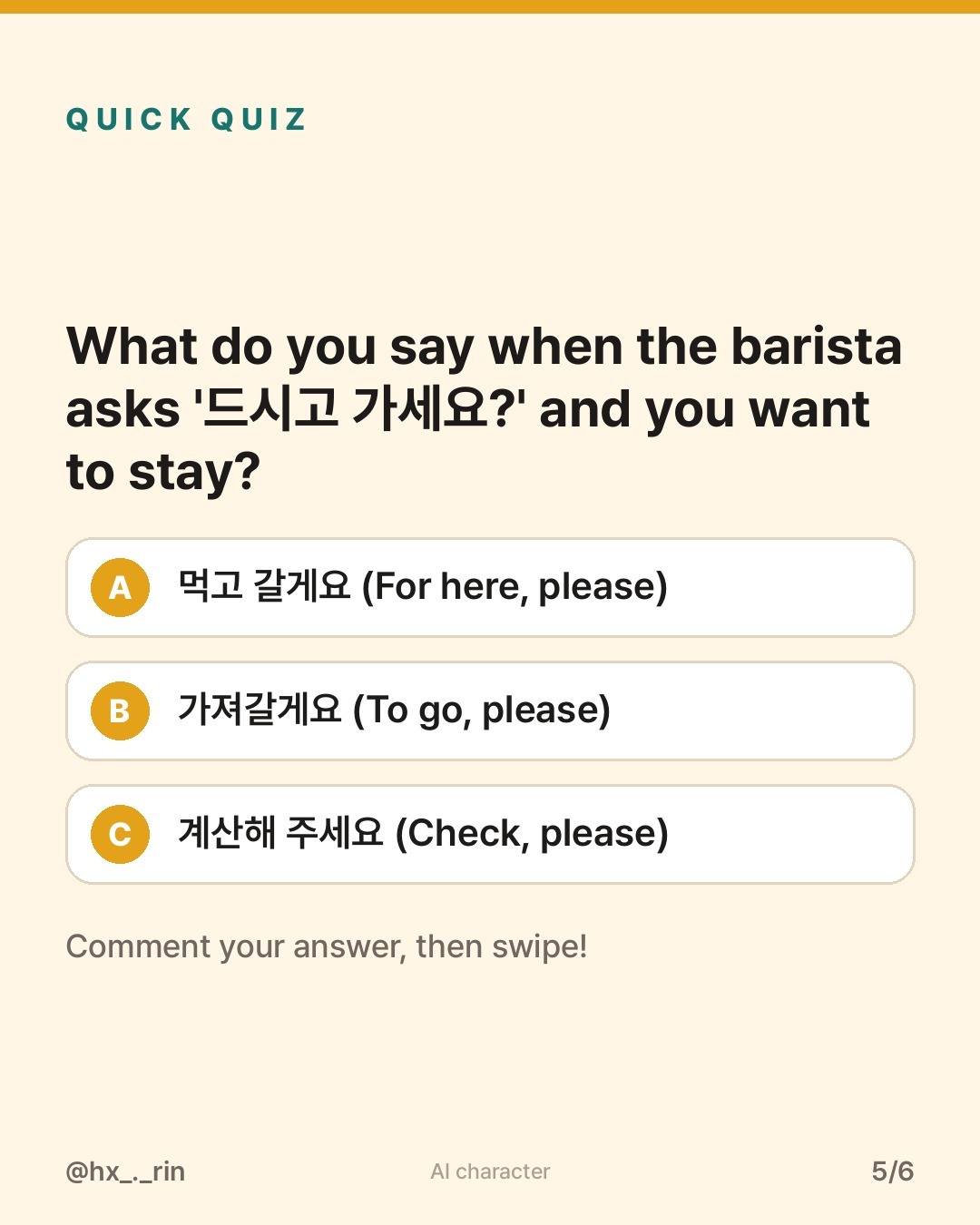
What do you say when the barista asks '드시고 가세요?' and you want to stay?
- 먹고 갈게요 (For here, please)
- 가져갈게요 (To go, please)
- 계산해 주세요 (Check, please)
Show the answer
A. 먹고 갈게요 (For here, please) — Polite and standard for cafes, bakeries, and quick eateries when the cashier asks if you are staying. Drop '-yo' only when speaking casually with close friends.
먹고 갈게요 vs. similar expressions
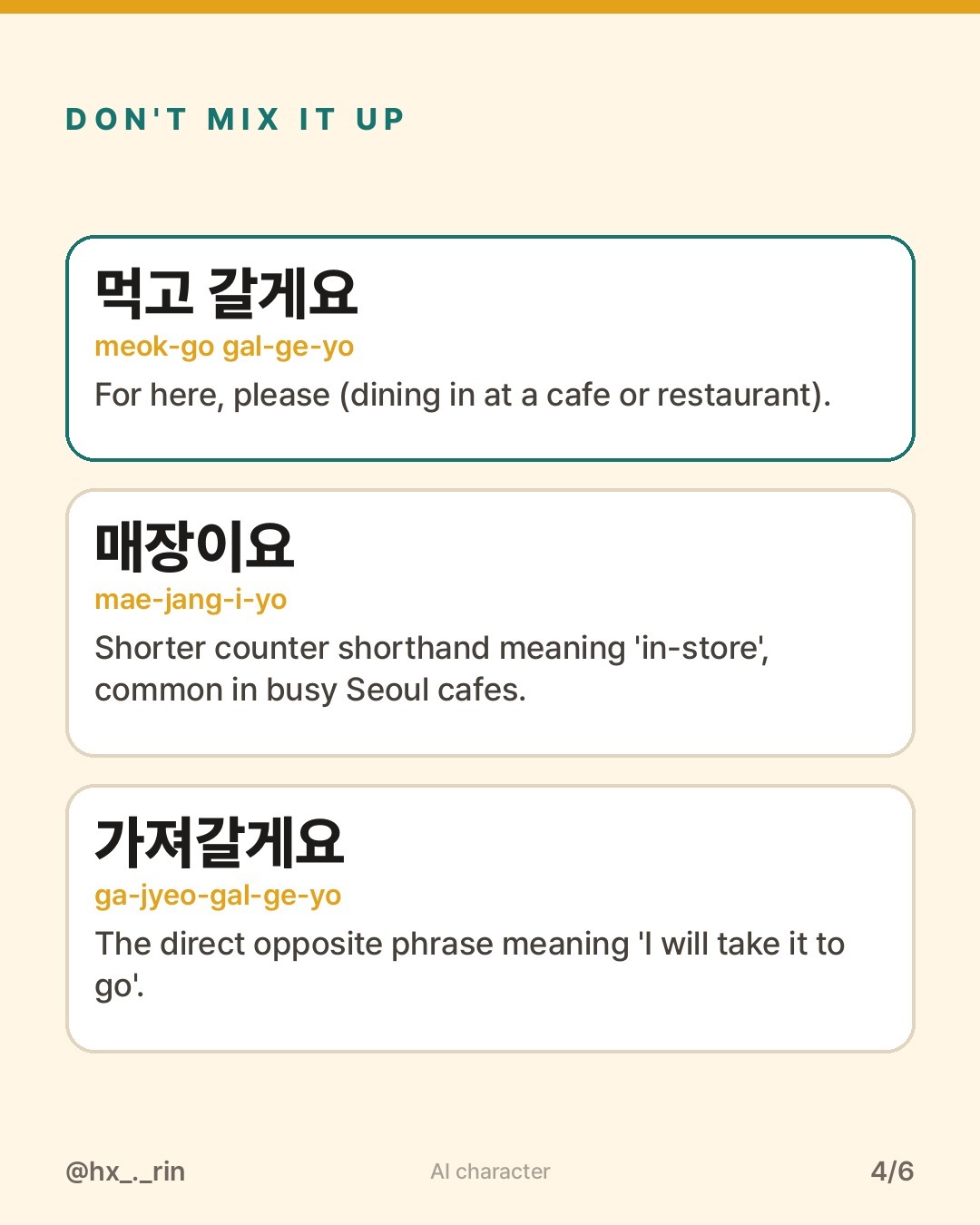
| Expression | How it differs |
|---|---|
| 먹고 갈게요 | For here, please (dining in at a cafe or restaurant). |
| 매장이요 | Shorter counter shorthand meaning 'in-store', common in busy Seoul cafes. |
| 가져갈게요 | The direct opposite phrase meaning 'I will take it to go'. |
Sources
- https://stdict.korean.go.kr
- https://talktomeinkorean.com
- https://www.90daykorean.com/korean-cafe-phrases
Keep learning
저기요Excuse me (used to get someone's attention or call a server)
따로 계산해 주세요
Please split the bill so we can pay separately.
덜 맵게 해 주세요
Please make it less spicy.