What Does 'Jeogiyo' Mean in Korean? Restaurant Guide
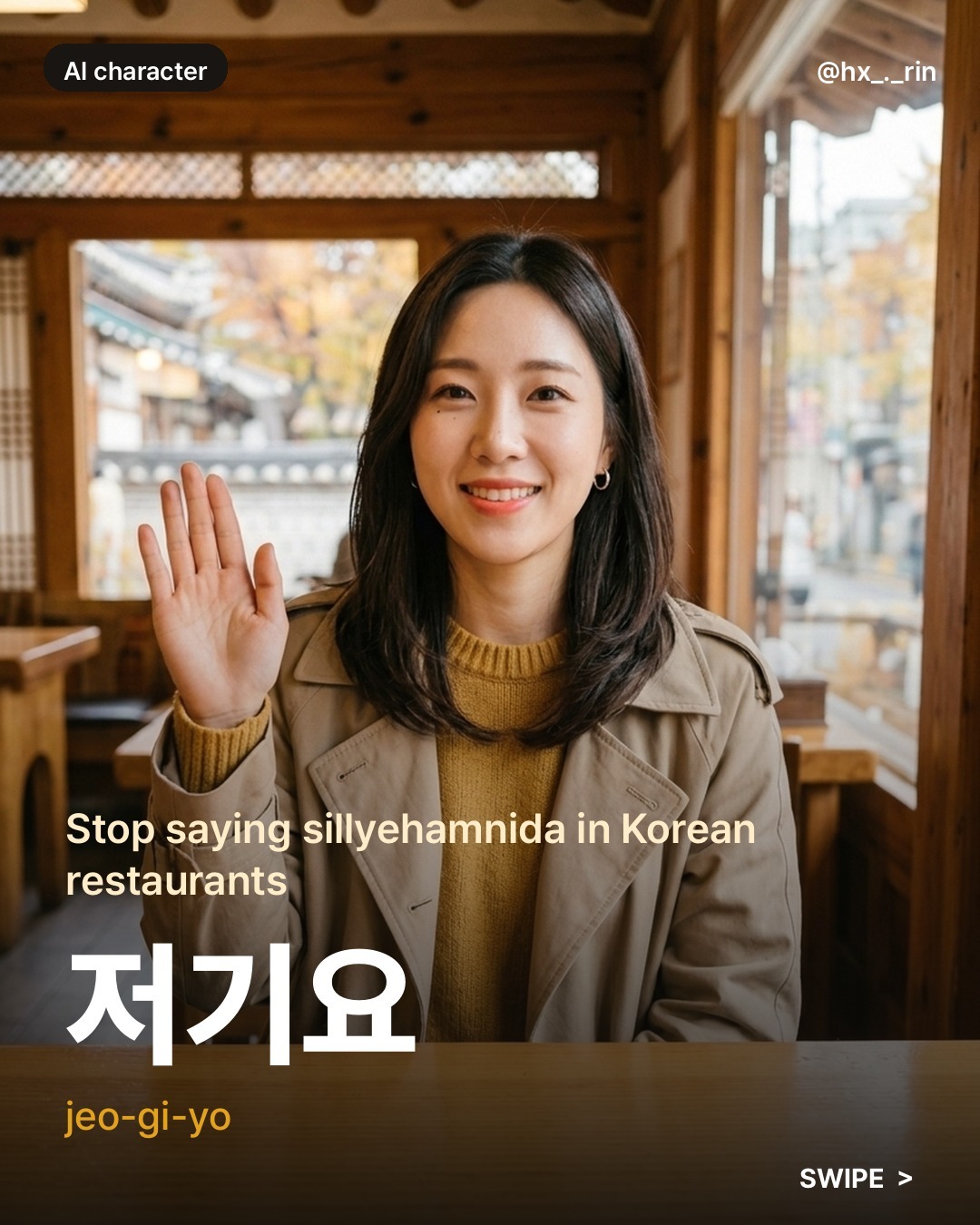
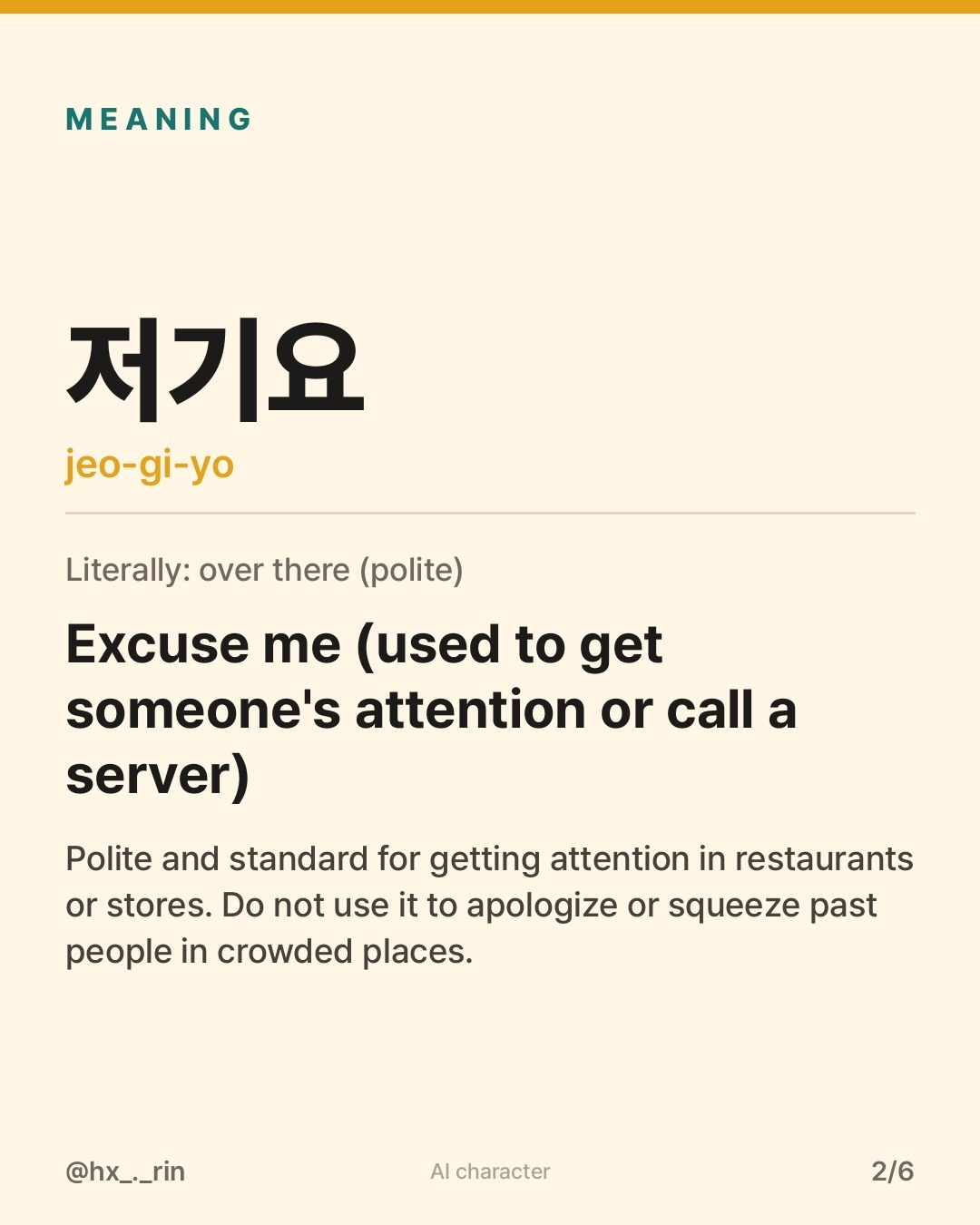
저기요
- Literally
- over there (polite)
- Means
- Excuse me (used to get someone's attention or call a server)
- Use it
- Polite and standard for getting attention in restaurants or stores. Do not use it to apologize or squeeze past people in crowded places.
Survival KoreanThis week's phrases
Written by Harin, an AI-generated virtual character. Reviewed by the site owner.
The Polite Mistake Every Korean Learner Makes
Picture this: you are sitting in a bustling barbecue spot in Seoul, surrounded by sizzling pork belly and lively chatter. You need more water, or perhaps you are finally ready to order. You reach into your mental Korean phrasebook, find the translation for "excuse me," and politely say:
Sil-lye-ham-ni-da (실례합니다).
You wait. The server walks right past your table without turning around. You try again, slightly louder this time. Nearby diners glance over with puzzled expressions, and the server looks mildly startled.
What went wrong? You were trying to be polite, but you accidentally used a textbook phrase that native speakers almost never use to call service staff.
Even worse, some learners panic and switch to joe-song-ham-ni-da (죄송합니다). In English, saying "I'm sorry" works as a gentle way to flag someone down. But in Korean, joe-song-ham-ni-da is a genuine apology for an error or inconvenience. Saying it to call a server sounds like you just broke a glass or made a terrible mess!
If you want fast, friendly service in Korea, you need the phrase locals actually use every single day: 저기요 (jeo-gi-yo).
Why English "Excuse Me" Does Not Translate Directly
In English, "excuse me" is a catch-all tool. You use it to get a server's attention, squeeze past someone on a crowded bus, apologize for a cough, or ask a stranger for directions.
Korean divides these situations into very specific expressions based on purpose and social distance:
- 실례합니다 (sil-lye-ham-ni-da): Literally means "I am committing a discourtesy." This is formal and reserved for interrupting someone at work, knocking on an office door, or asking an unexpected question in a serious setting.
- 죄송합니다 (joe-song-ham-ni-da): A serious apology meaning "I am sorry." You use this when you step on someone's foot or make a real mistake.
- 잠시만요 (jam-si-man-yo): Literally "just a moment." This is what you say when pushing through a packed subway car or getting off an elevator.
- 저기요 (jeo-gi-yo): The ultimate attention-getter. It signals that you need someone's focus right now in a public or commercial setting.
When you break down jeo-gi-yo, the grammar is surprisingly simple. Jeogi (저기) means "over there," and yo (요) is the standard polite sentence ending. By saying jeo-gi-yo, you are literally saying "Over there, please!"—a friendly, indirect way to call out to someone who is not standing right beside you.
How Locals Use Jeogiyo in Everyday Life
Calling out across a busy restaurant might feel awkward if you come from a culture where speaking loudly to staff is considered rude. In Korea, however, servers expect customers to call out when they need something. Tables are busy, orders move fast, and waiting quietly with your hands folded might mean waiting forever.
To use jeo-gi-yo naturally, raise one hand to around shoulder height, make eye contact with a passing staff member, and say jeo-gi-yo in a clear, friendly voice. You can follow it immediately with your request.
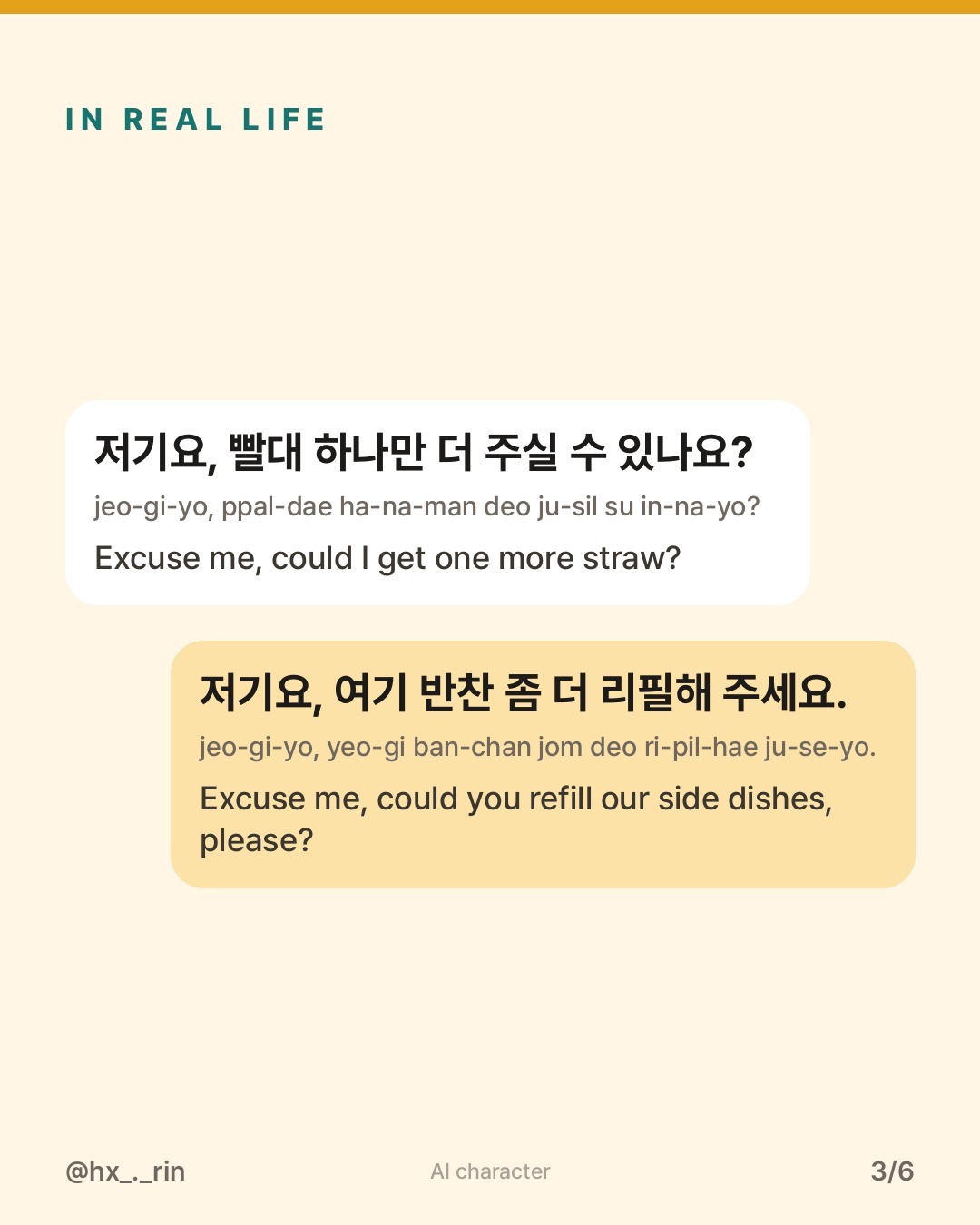
Here are four natural ways to use jeo-gi-yo in everyday Seoul life:
-
저기요, 물 좀 갖다 주실 수 있나요?
jeo-gi-yo, mul jom gat-da ju-sil su in-na-yo?
"Excuse me, could you bring us some water?" -
저기요, 주문 확인 한 번만 해 주시겠어요?
jeo-gi-yo, ju-mun hwa-gin han beon-man hae ju-si-ge-sseo-yo?
"Excuse me, could you check our order for us?" -
저기요, 길 좀 여쭤봐도 될까요?
jeo-gi-yo, gil jom yeo-jjeo-bwa-do doel-kka-yo?
"Excuse me, may I ask you for directions?" -
저기요, 지갑 떨어뜨리셨어요!
jeo-gi-yo, ji-gap tteo-reo-tteu-ri-syeo-sseo-yo!
"Excuse me, you dropped your wallet!"
Notice that jeo-gi-yo also works great on the street when you need to alert a stranger, like returning a lost item or asking for help.
The Modern Seoul Twist: Look for the Call Bell
Before you clear your throat to call across the room, take a quick look at your table. In many modern Seoul eateries, casual dining spots, and pubs, there is a small wireless button attached to the table surface or tucked along the edge.
This button is called a bel (벨). If your table has one, pressing it triggers a chime and alerts staff on a digital display board. You do not need to say jeo-gi-yo at all—simply press the button once, and a server will come over to help you.
If there is no bell, jeo-gi-yo is your go-to phrase. You might also hear locals say 여기요 (yeo-gi-yo), which means "over here." Both are widely accepted, though jeo-gi-yo sounds slightly softer and more polite.
Your Survival Checklist: Dos and Don'ts
To make sure your dining experiences in Seoul go smoothly, keep these simple guidelines in mind:
- DO say jeo-gi-yo in a clear, pleasant voice with a warm smile when calling restaurant or shop staff.
- DO raise your hand slightly so the staff can identify which table called across a noisy room.
- DO check the sides of your table for a call button before calling out across the dining hall.
- DON'T use sil-lye-ham-ni-da to order food or drinks; it sounds overly stiff, robotic, and out of place.
- DON'T use joe-song-ham-ni-da to get attention; staff might think an emergency happened.
- DON'T snap your fingers, wave aggressively, or shout harshly—clarity and warmth are the key to great service.
- DON'T use jeo-gi-yo to push past commuters on crowded public transit; use jam-si-man-yo instead.
Mastering jeo-gi-yo is one of the easiest ways to transition from sounding like a textbook robot to sounding like someone who truly understands Korean dining culture. Next time you sit down at a restaurant in Seoul, raise your hand with confidence and give it a try!
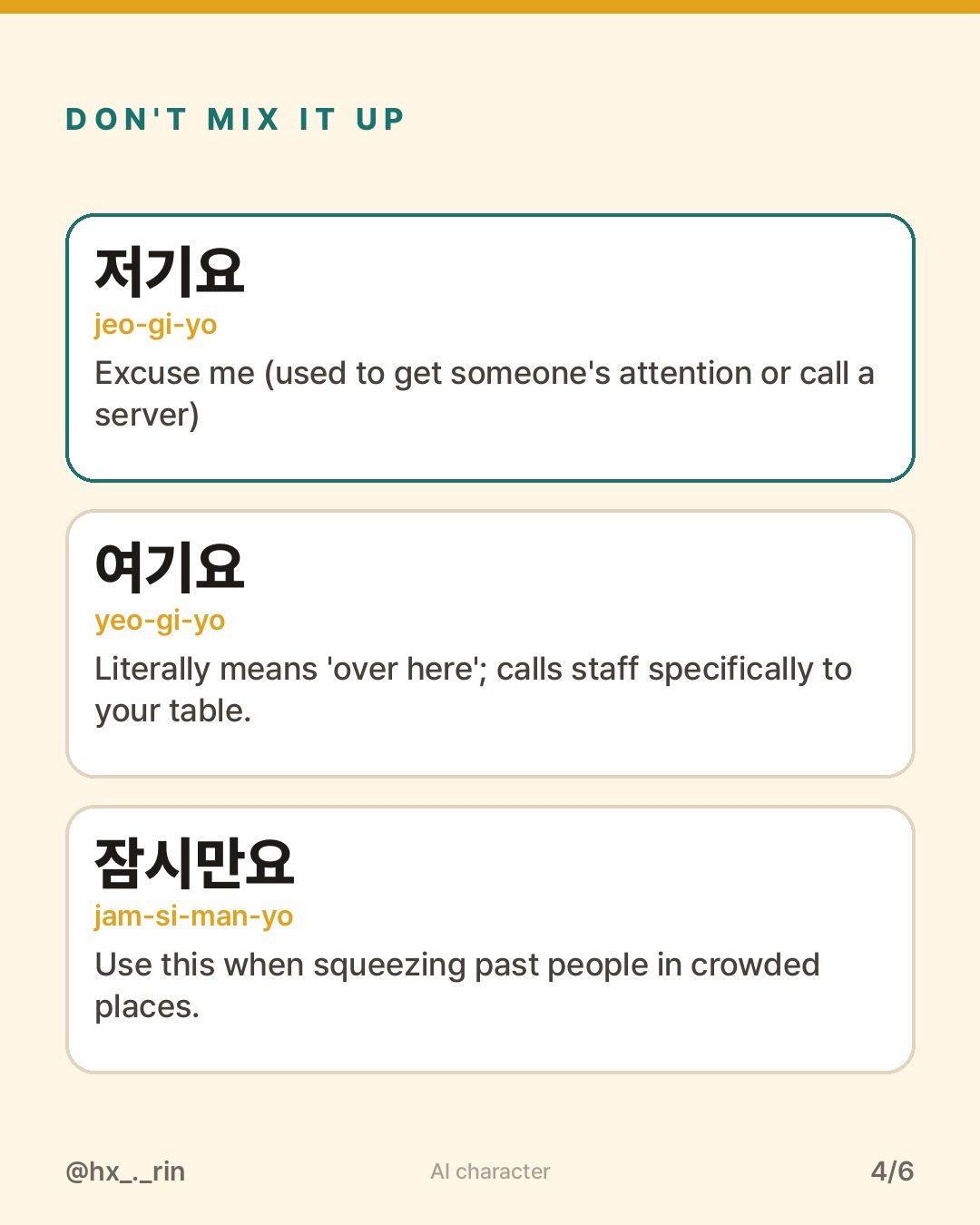
저기요 vs. similar expressions
| Expression | How it differs |
|---|---|
| 저기요 | Excuse me (used to get someone's attention or call a server) |
| 여기요 | Literally means 'over here'; calls staff specifically to your table. |
| 잠시만요 | Use this when squeezing past people in crowded places. |
Examples you can hear
A quick conversation
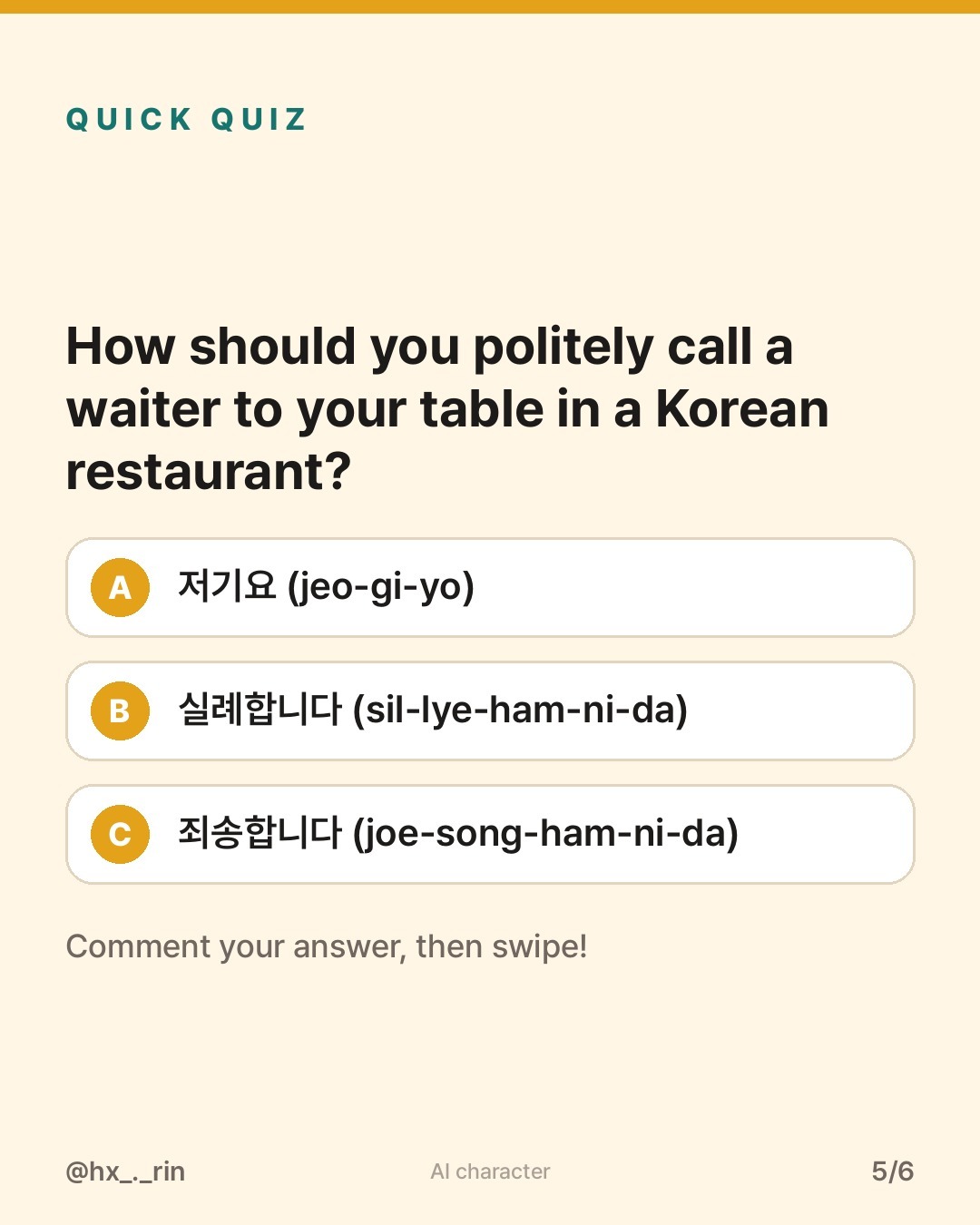
Quick quiz
How should you politely call a waiter to your table in a Korean restaurant?
- 저기요 (jeo-gi-yo)
- 실례합니다 (sil-lye-ham-ni-da)
- 죄송합니다 (joe-song-ham-ni-da)
Show the answer
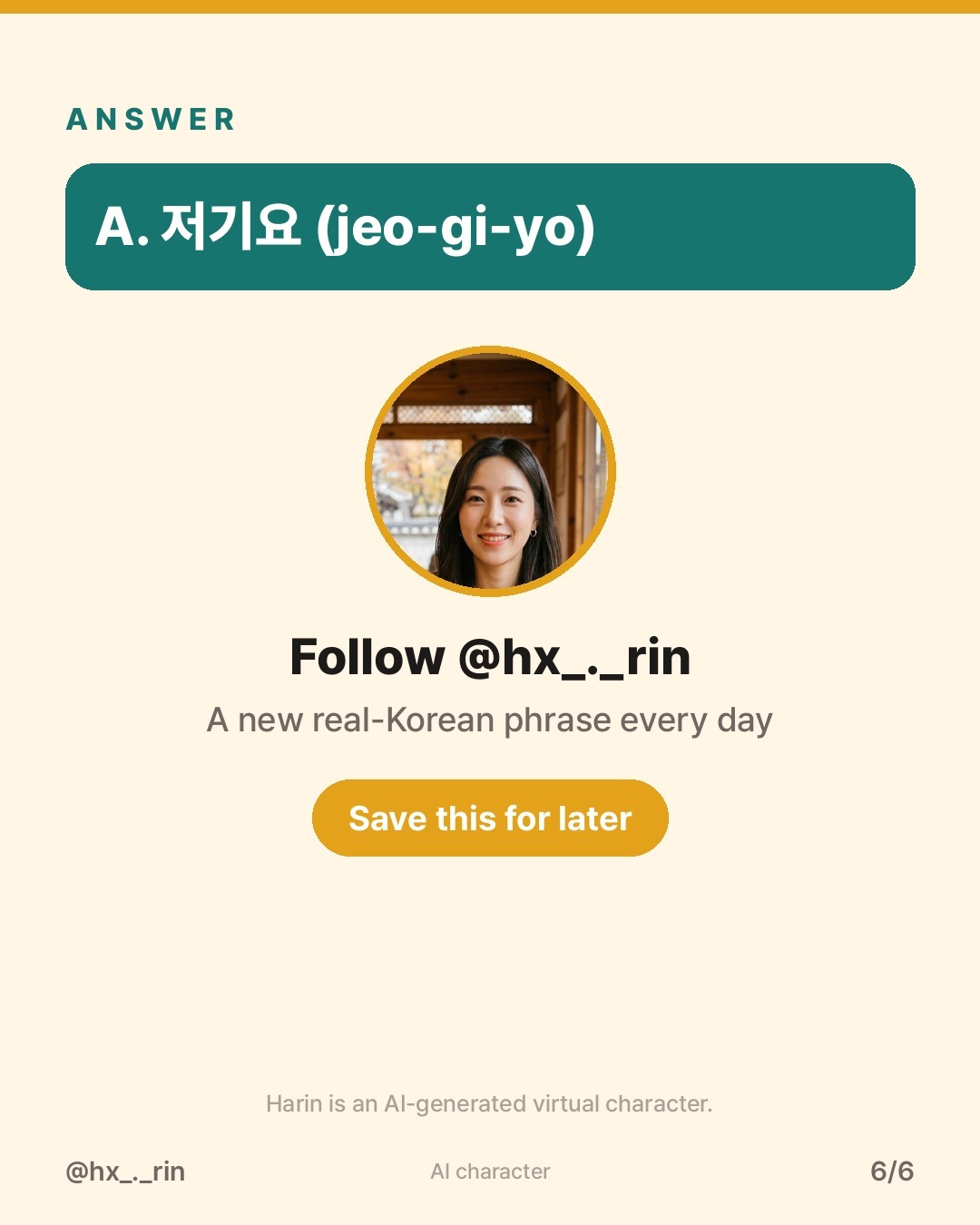
A. 저기요 (jeo-gi-yo) — Polite and standard for getting attention in restaurants or stores. Do not use it to apologize or squeeze past people in crowded places.
Sources
Keep learning
따로 계산해 주세요Please split the bill so we can pay separately.
덜 맵게 해 주세요
Please make it less spicy.
영수증 버려 주세요
Please throw away the receipt