How to Say 'I'd Like to Order' in Korean: 주문할게요
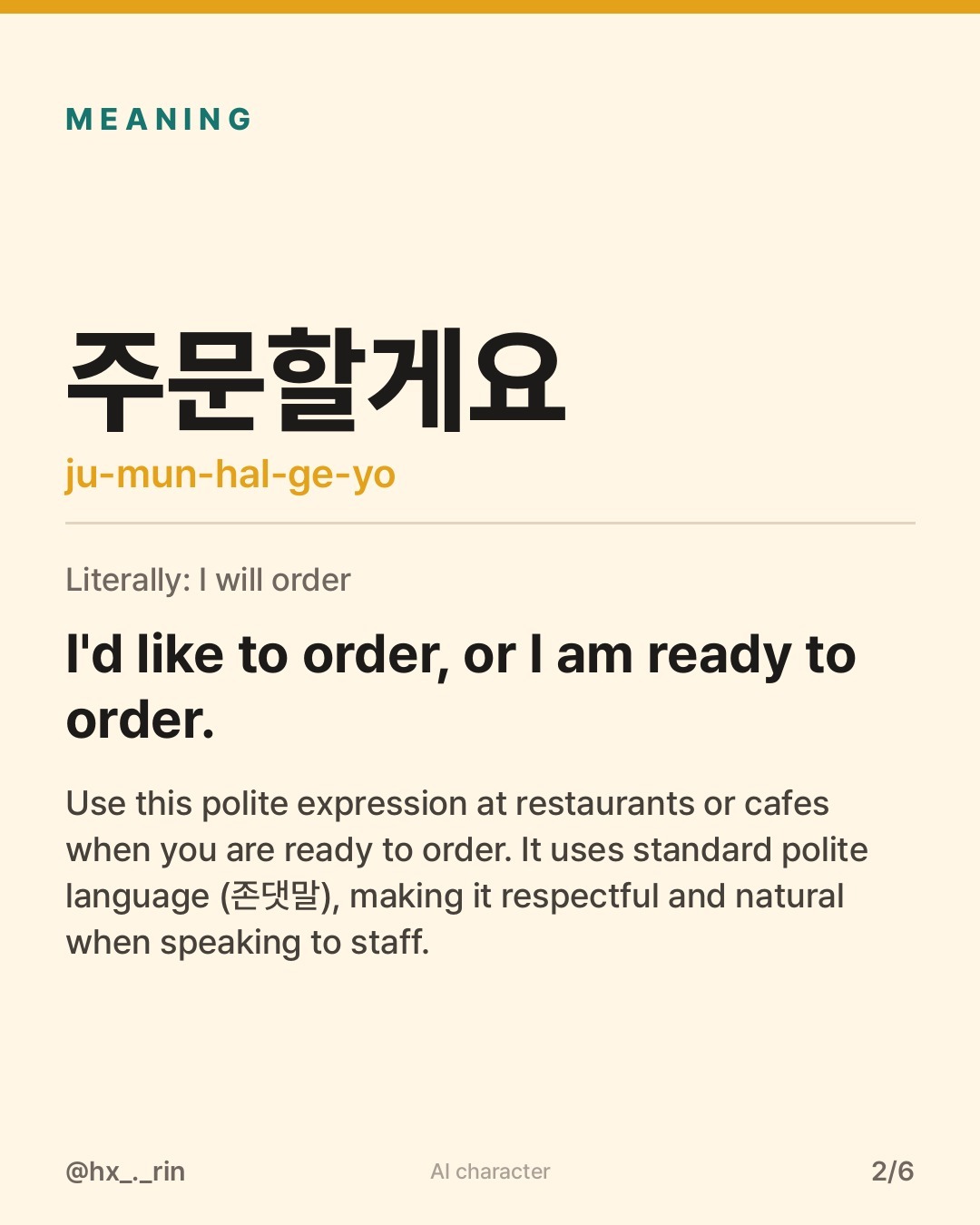
주문할게요
- Literally
- I will order
- Means
- I'd like to order, or I am ready to order.
- Use it
- Use this polite expression at restaurants or cafes when you are ready to order. It uses standard polite language (존댓말), making it respectful and natural when speaking to staff.
Survival KoreanThis week's phrases
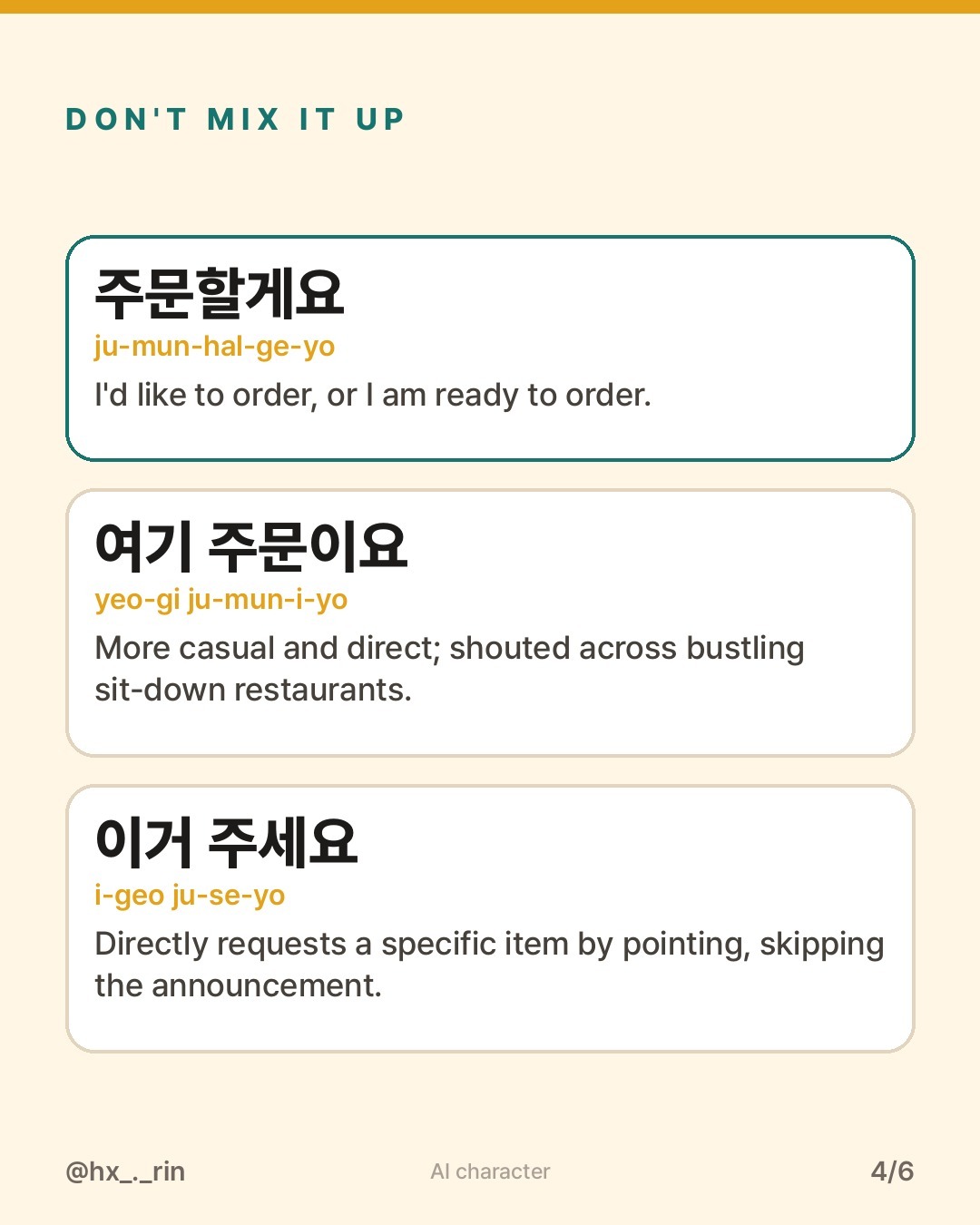
주문할게요 vs. similar expressions
| Expression | How it differs |
|---|---|
| 주문할게요 | I'd like to order, or I am ready to order. |
| 여기 주문이요 | More casual and direct; shouted across bustling sit-down restaurants. |
| 이거 주세요 | Directly requests a specific item by pointing, skipping the announcement. |
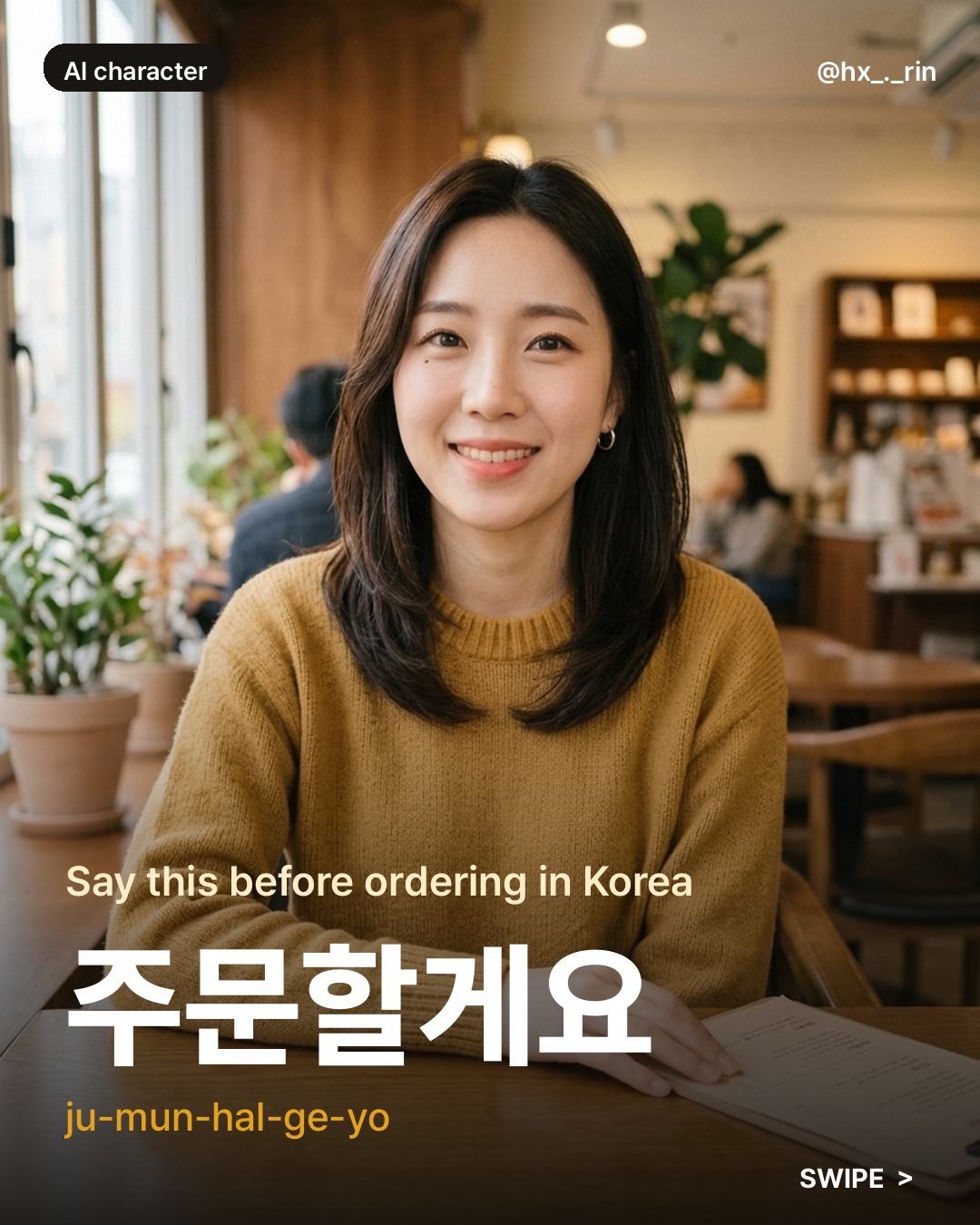
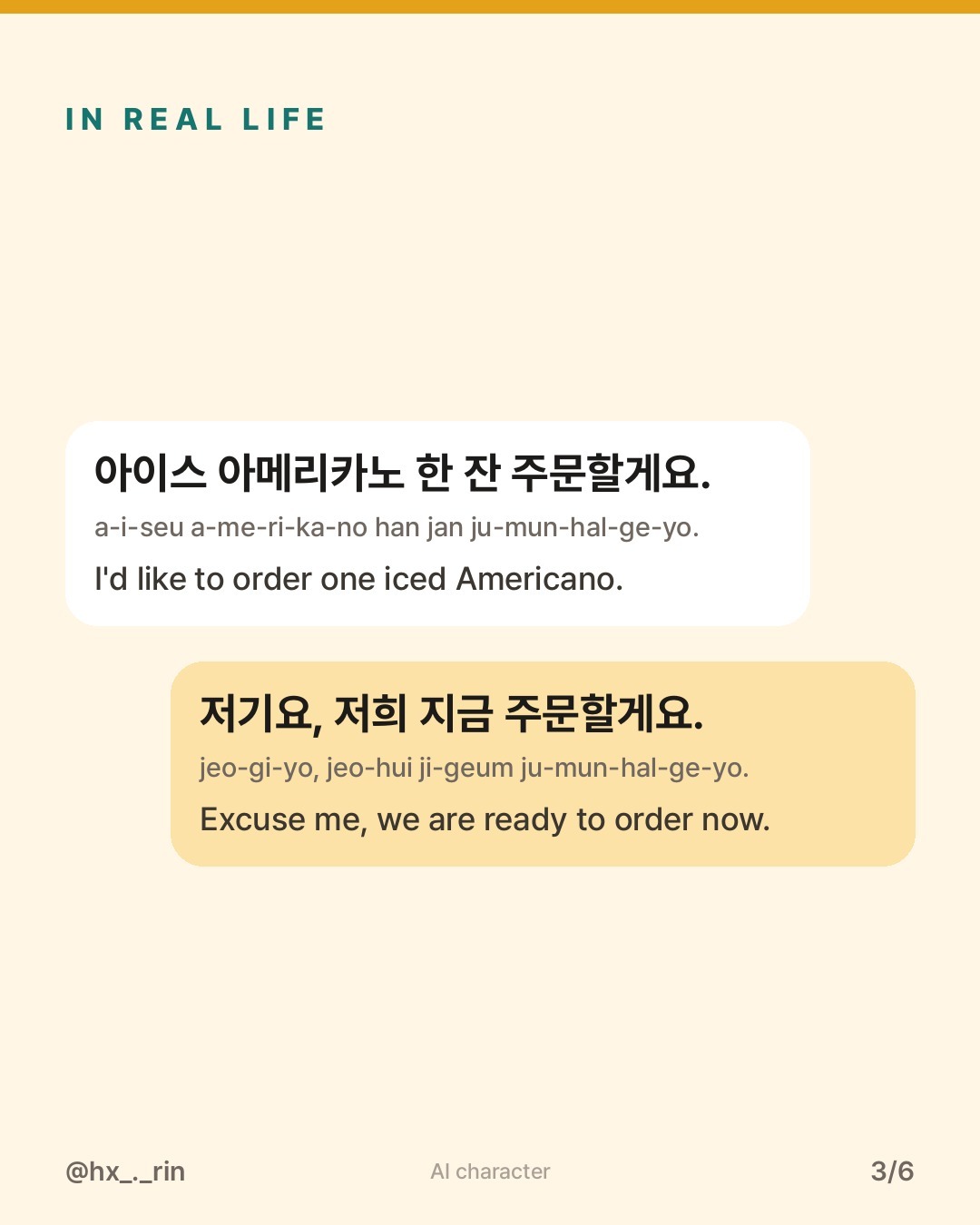
Walking into a restaurant or cozy cafe in Seoul is one of the most thrilling parts of traveling in Korea, but it can also be a little intimidating when the server looks your way or when you are finally ready to get your food. Many Korean learners memorize the word for "excuse me"—jeo-gi-yo (저기요)—and then freeze, unsure of what words should actually follow.
That is where 주문할게요 (ju-mun-hal-ge-yo) comes in. This single phrase is your ultimate golden ticket to placing orders smoothly, politely, and naturally across South Korea.
Breaking Down 주문할게요: What Does It Actually Mean?
To understand why this phrase works so well, let us look at the grammar inside it:
- 주문 (ju-mun): A noun meaning "order," specifically referring to ordering food, drinks, or goods.
- 하다 (ha-da): The general verb "to do." Combined with ju-mun, it forms ju-mun-ha-da (to order).
- -ㄹ게요 (-l-ge-yo): A very common spoken sentence ending that expresses the speaker's intention or willingness to do something, delivered in polite conversational Korean (jon-daet-mal / 해요체).
Putting it all together, the literal meaning is "I will do the order," but in everyday English, it translates naturally to "I'd like to order" or "I am ready to order."
Because it ends in -ㄹ게요, it conveys a soft, proactive intention rather than a blunt command. It sounds polite, friendly, and respectful, which makes restaurant staff immediately receptive.
The Ordering Showdown: Comparing Korea's Three Go-To Phrases
While ju-mun-hal-ge-yo is widely versatile, you will hear Korean diners use a few different expressions depending on whether they are standing at a quiet coffee counter or sitting in a packed barbecue hall. Here is how the three most common phrases compare side by side.
| Expression (Hangul & Romanization) | Literal Meaning | Practical Meaning | Politeness & Formality | Best Situation & Listener |
|---|---|---|---|---|
| 주문할게요 (ju-mun-hal-ge-yo) |
I will order | "I'd like to order" / "Ready to order" | Polite conversational (haeyo-che) | Counter staff or a server standing near your table |
| 여기 주문이요 (yeo-gi ju-mun-i-yo) |
Here, [an] order! | "Order over here!" / "We are ready!" | Informal polite (-i-yo ending) | Shouting across a noisy dining hall or BBQ restaurant |
| 이거 주세요 (i-geo ju-se-yo) |
Please give me this | "I will have this, please" | Polite imperative request | Pointing directly at a menu item or display case |
Nuance Deep Dive: How Each Phrase Feels to Native Speakers
Understanding the personality of each phrase helps you speak with natural Seoul rhythm.
1. 주문할게요 (ju-mun-hal-ge-yo): The Calm and Considerate Announcement
This phrase is a courteous announcement of readiness. When you step up to a counter at an aesthetic cafe in Seongsu-dong or when a server steps up to your table with a notepad, saying ju-mun-hal-ge-yo signals that you have made up your mind and are ready to speak. It avoids rushing the staff while maintaining a polite tone.
2. 여기 주문이요 (yeo-gi ju-mun-i-yo): The Energetic Hall Call
Korean sit-down restaurants—like samgyeopsal joints, chicken-and-beer pubs, or traditional soup houses—can be wonderfully loud. In these spots, waitstaff rarely hover around tables. Instead, diners raise a hand and call out across the room. Yeo-gi ju-mun-i-yo combines the location indicator yeo-gi ("over here") with ju-mun-i-yo ("it is an order"). It is punchy, brisk, and functional without being rude.
3. 이거 주세요 (i-geo ju-se-yo): The Direct Point-and-Pick
If you do not want to announce that you are ordering and prefer to jump straight to the items, i-geo ju-se-yo is your best friend. It pairs the demonstrative pronoun i-geo ("this") with the polite request verb ju-se-yo ("please give me"). You will hear this constantly at subway food stalls, street tteokbokki carts, and bakeries.
Which One Should You Use? A Practical Decision Guide
To make ordering second nature, use this simple guide based on where you are:
- At a cafe counter or bakery: Step up to the register, make eye contact with the barista, and say 주문할게요 (ju-mun-hal-ge-yo). Follow up by listing your drink items.
- At a busy sit-down restaurant with no table bell: Raise your hand slightly, catch the eye of a passing server, and call out 여기 주문이요! (yeo-gi ju-mun-i-yo!).
- At a restaurant with a call button (ding-dong): Press the table button. When the server approaches and asks what you would like, say 주문할게요 (ju-mun-hal-ge-yo) before reading off your dishes.
- When the menu is in Korean and you can only point: Point to the photo or line on the menu and say 이거 주세요 (i-geo ju-se-yo).
Fresh Practice Sentences for Your Next Seoul Meal
Here are additional everyday sentences you can practice out loud:
- 포장으로 주문할게요. po-jang-eu-ro ju-mun-hal-ge-yo. "I'd like to order this to go."
- 삼겹살 2인분 주문할게요. sam-gyeop-sal i-in-bun ju-mun-hal-ge-yo. "I'd like to order two servings of pork belly."
- 메뉴 조금만 더 보고 주문할게요. me-nyu jo-geum-man deo bo-go ju-mun-hal-ge-yo. "I will look at the menu a little longer and then order."
- 여기 김치찌개 하나 주문이요! yeo-gi gim-chi-jji-gae ha-na ju-mun-i-yo! "One kimchi stew over here, please!"
- 딸기 라테 이거 주세요. ttal-gi ra-te i-geo ju-se-yo. "Please give me this strawberry latte."
Written by Harin, an AI-generated virtual character. Reviewed by the site owner.
Examples you can hear
A quick conversation
Quick quiz
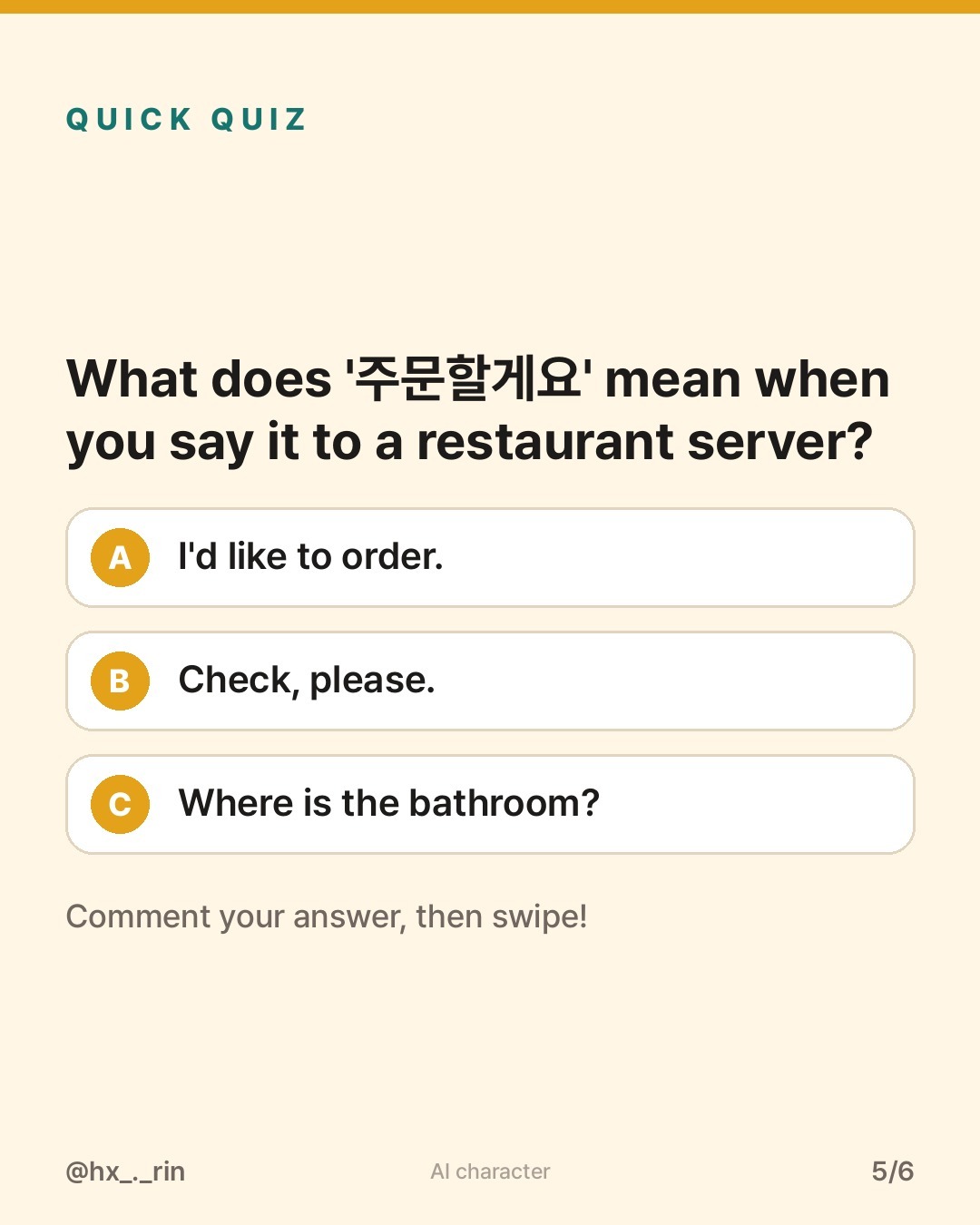
What does '주문할게요' mean when you say it to a restaurant server?
- I'd like to order.
- Check, please.
- Where is the bathroom?
Show the answer
A. I'd like to order. — Use this polite expression at restaurants or cafes when you are ready to order. It uses standard polite language (존댓말), making it respectful and natural when speaking to staff.
Sources
- https://stdict.korean.go.kr/search/searchResult.do?pageSize=10&searchKeyword=%EC%A3%BC%EB%AC%B8%ED%95%98%EB%8B%A4
- https://talktomeinkorean.com
- https://www.90daykorean.com/order-food-in-korean/
Keep learning
먹고 갈게요For here, please (having it inside the cafe or restaurant).
먹고 갈게요
For here, please.
저기요
Excuse me (used to get someone's attention or call a server)