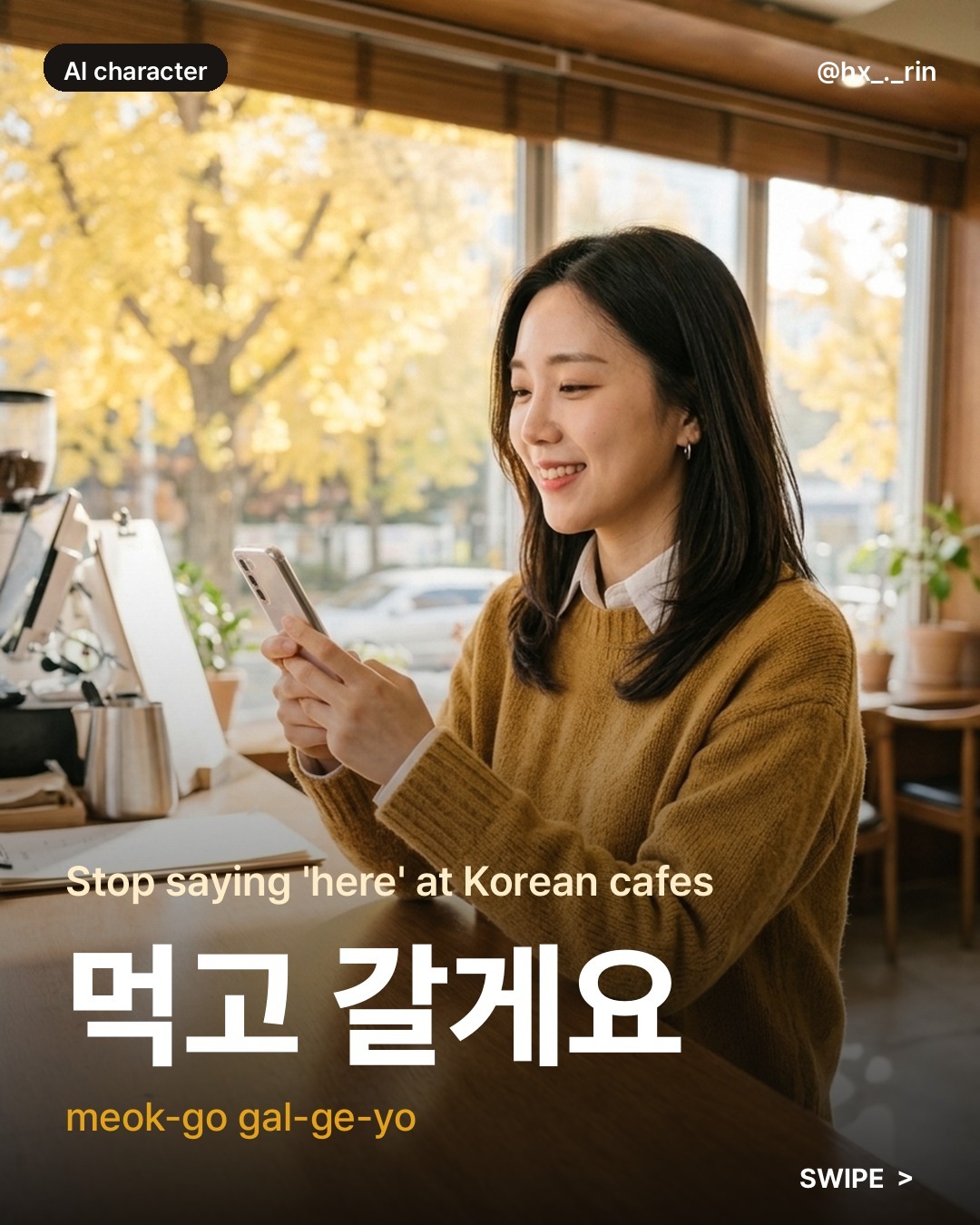
How to Say 'For Here' in Korean: Meok-go Gal-ge-yo
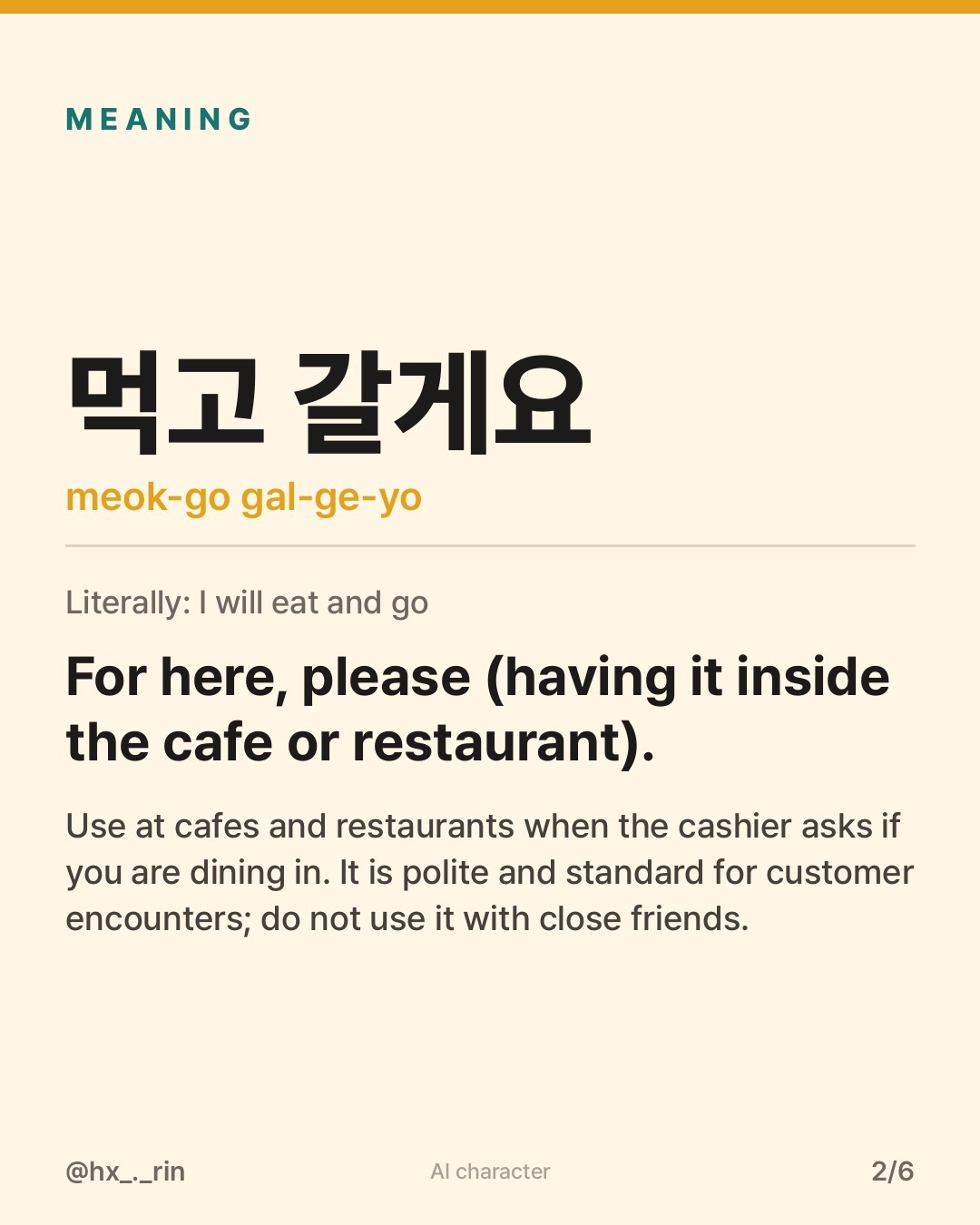
먹고 갈게요
- Literally
- I will eat and go
- Means
- For here, please (having it inside the cafe or restaurant).
- Use it
- Use at cafes and restaurants when the cashier asks if you are dining in. It is polite and standard for customer encounters; do not use it with close friends.
Survival KoreanThis week's phrases
The Counter Panic: Why Saying "여기요" or "드시고 갈게요" Goes Wrong
Picture this: You step into a trendy, bustling cafe in Seongsu or Hongdae. The aroma of freshly roasted espresso fills the air. You step up to the register, proudly order an iced Americano in Korean, and feel like an absolute champion. But right before you can tap your card, the barista looks up and asks:
"드시고 가세요?"
Your mind races. In English, you would casually answer "For here!" But in Korean, translating that simple concept on the spot leads thousands of learners straight into an embarrassing linguistic trap.
The first common slip-up is blurting out "여기요!" (yeo-gi-yo). Because yeogi means "here," learners assume it works just like the English shorthand. But to a Korean worker, shouting "여기요!" at the register sounds like you are abruptly waving down a waiter across a crowded barbecue restaurant. It means "Over here!" or "Excuse me!"—not "I will consume this drink on the premises."
An even more fascinating slip-up is the Echo Mistake: eagerly replying, "네, 드시고 갈게요!" (Ne, deu-si-go gal-ge-yo!). Because the barista just used the verb deusida (드시다), polite learners instinctively repeat the exact same word back to sound respectful. What they do not realize is that they just paid an exaggerated royal honorific tribute to themselves!
The natural, authentic phrase every Seoulite actually uses is 먹고 갈게요 (meok-go gal-ge-yo).
The Linguistic Trap: Why "드시고 갈게요" Will Make Baristas Smile
To understand why 먹고 갈게요 works while the alternatives sound strange, we need to look at two fundamental quirks of spoken Korean.
1. The Asymmetric Honorific Rule
In Korean culture and grammar, honorific verbs exist exclusively to elevate the person you are speaking to or an esteemed third party. The verb 드시다 (deu-si-da) is the high-honorific version of 먹다 (meok-da, to eat) and 마시다 (ma-si-da, to drink).
When the barista asks, "드시고 가세요?", they are being polite to you as a valued customer: "Will you (honored guest) eat and go?"
However, Korean grammar strictly forbids using subject honorifics on yourself. If you respond with "드시고 갈게요", you are grammatically announcing: "Yes, I (the magnificent one) shall dine and depart!" It sounds comically pompous. To maintain polite equilibrium, you must drop down to the standard base verb 먹다 and attach the polite sentence ending -ㄹ게요 (-l-ge-yo).
The ending -ㄹ게요 communicates a cooperative promise or intention directed at the listener. By saying 먹고 갈게요 (literally: "I will eat and go"), you are politely informing the counter clerk of your plan so they can prep your order correctly.
2. The Liquid Dilemma: Can You "Eat" a Coffee?
Another huge hesitation for foreign learners is the verb itself. Many students learn early on that meok-da means "to eat" and ma-si-da means "to drink." Standing at a coffee bar holding a receipt for an espresso, they freeze: "Am I allowed to say '먹고' when I am only drinking a beverage?"
Yes, absolutely! In modern colloquial Korean, 먹다 acts as an umbrella verb for consuming almost anything edible or drinkable. While you can technically say 마시고 갈게요 (ma-si-go gal-ge-yo), natives overwhelmingly use 먹고 갈게요 for bakery snacks, bubble tea, iced coffee, and full meals alike.
Fresh Example Sentences for Real Counter Encounters
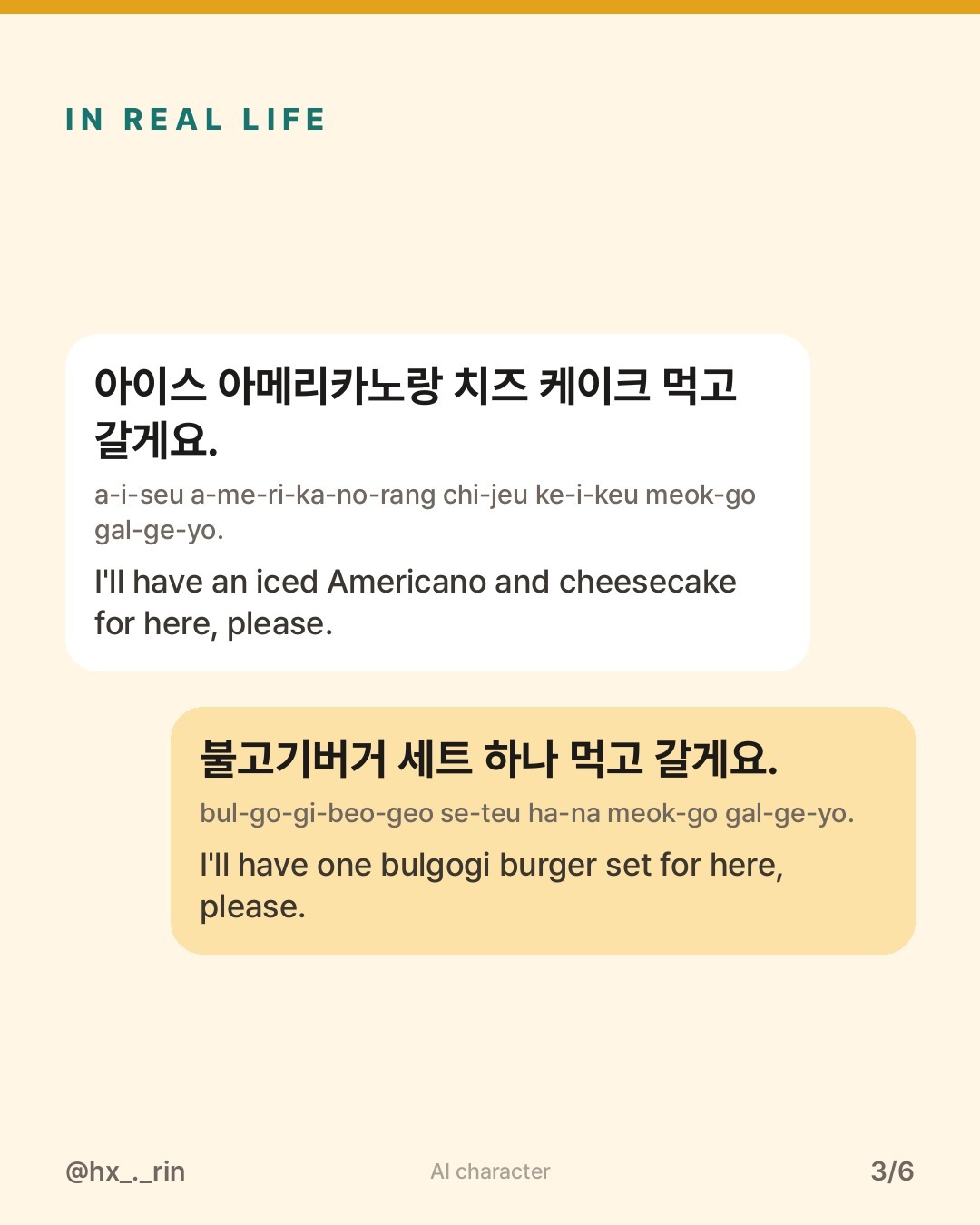
Here are three authentic ways to use this expression in real everyday encounters around town:
-
디카페인 라테랑 스콘 매장에서 먹고 갈게요.
Di-ka-pe-in ra-te-rang seu-kon mae-jang-e-seo meok-go gal-ge-yo.
"I will have a decaf latte and a scone inside the cafe, please." -
김밥 한 줄이랑 라면 여기서 먹고 갈게요.
Gim-bap han ju-ri-rang ra-myeon yeo-gi-seo meok-go gal-ge-yo.
"I will eat one roll of gimbap and ramen here, please." -
저희 두 명 여기서 먹고 갈게요.
Jeo-hui du myeong yeo-gi-seo meok-go gal-ge-yo.
"The two of us will eat here, please."
Why Your Choice Matters: Korea's In-Store Eco Laws
Getting this phrase right is not just about polite grammar—it has direct practical consequences at the register.
South Korea has strict nationwide environmental regulations regarding single-use plastics. By law, cafes and fast-food chains cannot serve beverages in disposable plastic cups to customers who are dining inside the store (mae-jang).
When you say 먹고 갈게요, the barista will prepare your beverage in a washable glass tumbler or ceramic mug. If you change your mind halfway through and try to walk out the door carrying an in-store glass, or if you ask for a disposable cup while sitting at a table, staff can face hefty municipal fines. If you suddenly need to leave unexpectedly, simply approach the counter and say politely: "테이크아웃 잔으로 바꿔 주세요" (Te-i-keu-a-ut jan-eu-ro ba-kkwo ju-se-yo — "Please change this to a takeout cup").
Real-Life Counter Rules: Do’s and Don’ts
To keep your next cafe interaction smooth and stress-free, keep this quick checklist in mind:
- DO say "먹고 갈게요" the moment the cashier asks how you are enjoying your order.
- DO say "매장이요" (mae-jang-i-yo) if you want a quick, super-concise one-word alternative that simply means "in the shop, please."
- DO say "포장해 주세요" (po-jang-hae ju-se-yo) or "테이크아웃이요" (te-i-keu-a-u-si-yo) if you plan to grab your order and leave immediately.
- DON'T say "드시고 갈게요" under any circumstances—never use honorifics to describe your own eating habits.
- DON'T say "여기요!" to mean "for here." Remember that yeo-gi-yo is strictly for calling attention.
- DON'T stress over whether coffee is food or drink. Saying meok-go gal-ge-yo is 100% natural for drinks.
- DON'T take reusable cafe mugs outside. Eco-laws require dining-in cups to stay inside the premises.
Mastering 먹고 갈게요 takes you one giant step closer to speaking Korean the way real locals do every single day. Next time you visit a cafe in Seoul, skip the panic, flash a friendly smile, and say it with confidence!
Written by Harin, an AI-generated virtual character. Reviewed by the site owner.
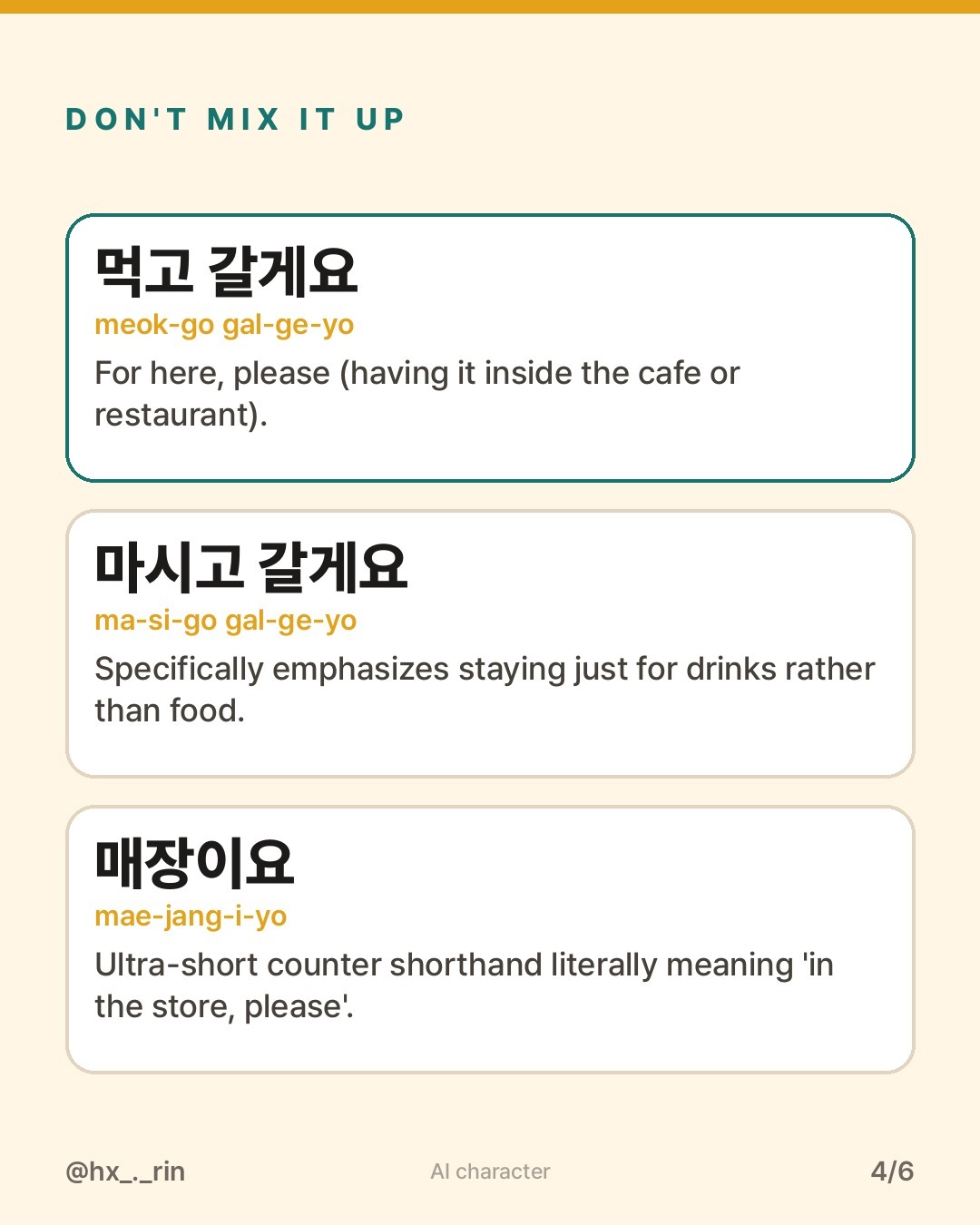
먹고 갈게요 vs. similar expressions
| Expression | How it differs |
|---|---|
| 먹고 갈게요 | For here, please (having it inside the cafe or restaurant). |
| 마시고 갈게요 | Specifically emphasizes staying just for drinks rather than food. |
| 매장이요 | Ultra-short counter shorthand literally meaning 'in the store, please'. |
Examples you can hear
A quick conversation
Quick quiz
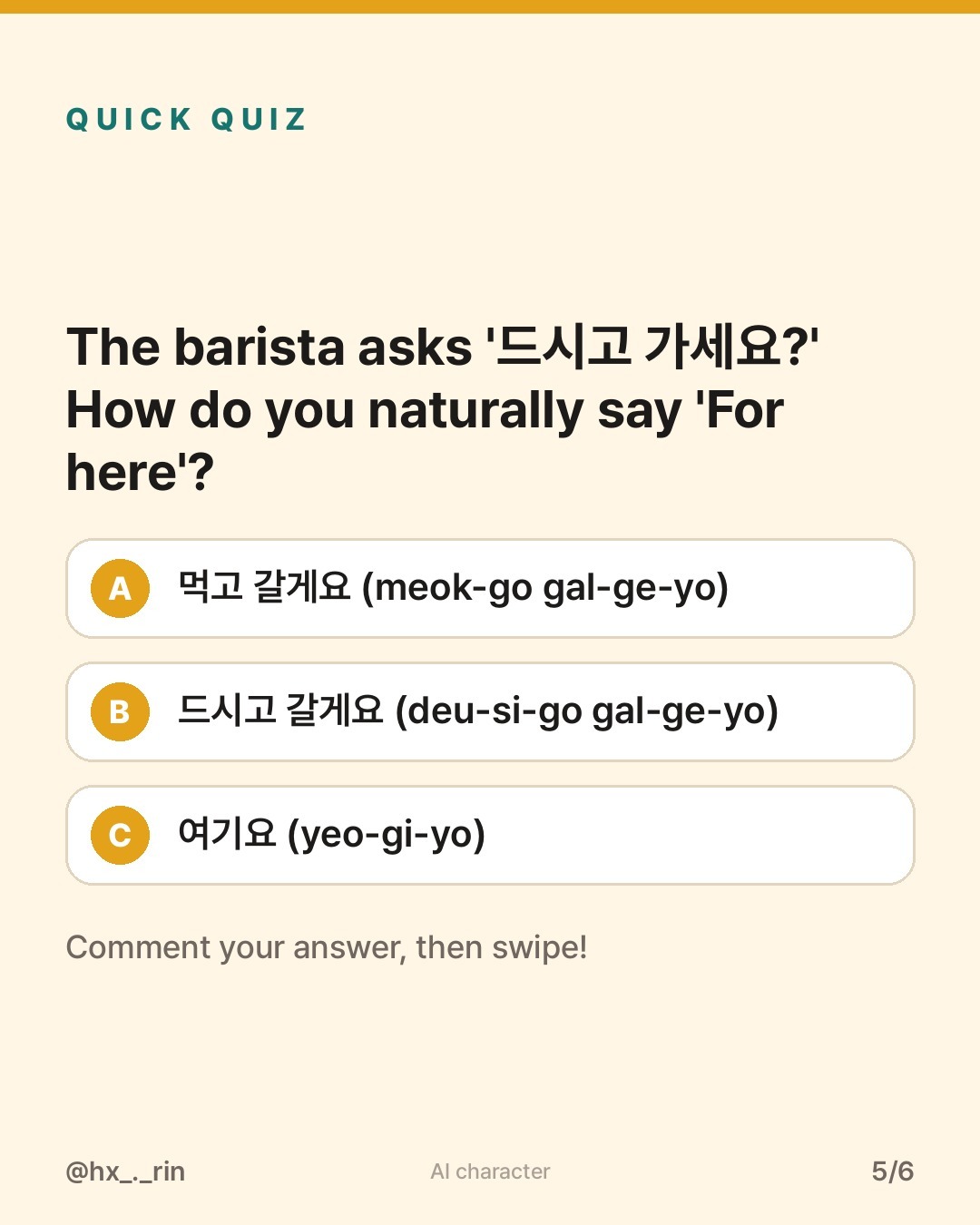
The barista asks '드시고 가세요?' How do you naturally say 'For here'?
- 먹고 갈게요 (meok-go gal-ge-yo)
- 드시고 갈게요 (deu-si-go gal-ge-yo)
- 여기요 (yeo-gi-yo)
Show the answer
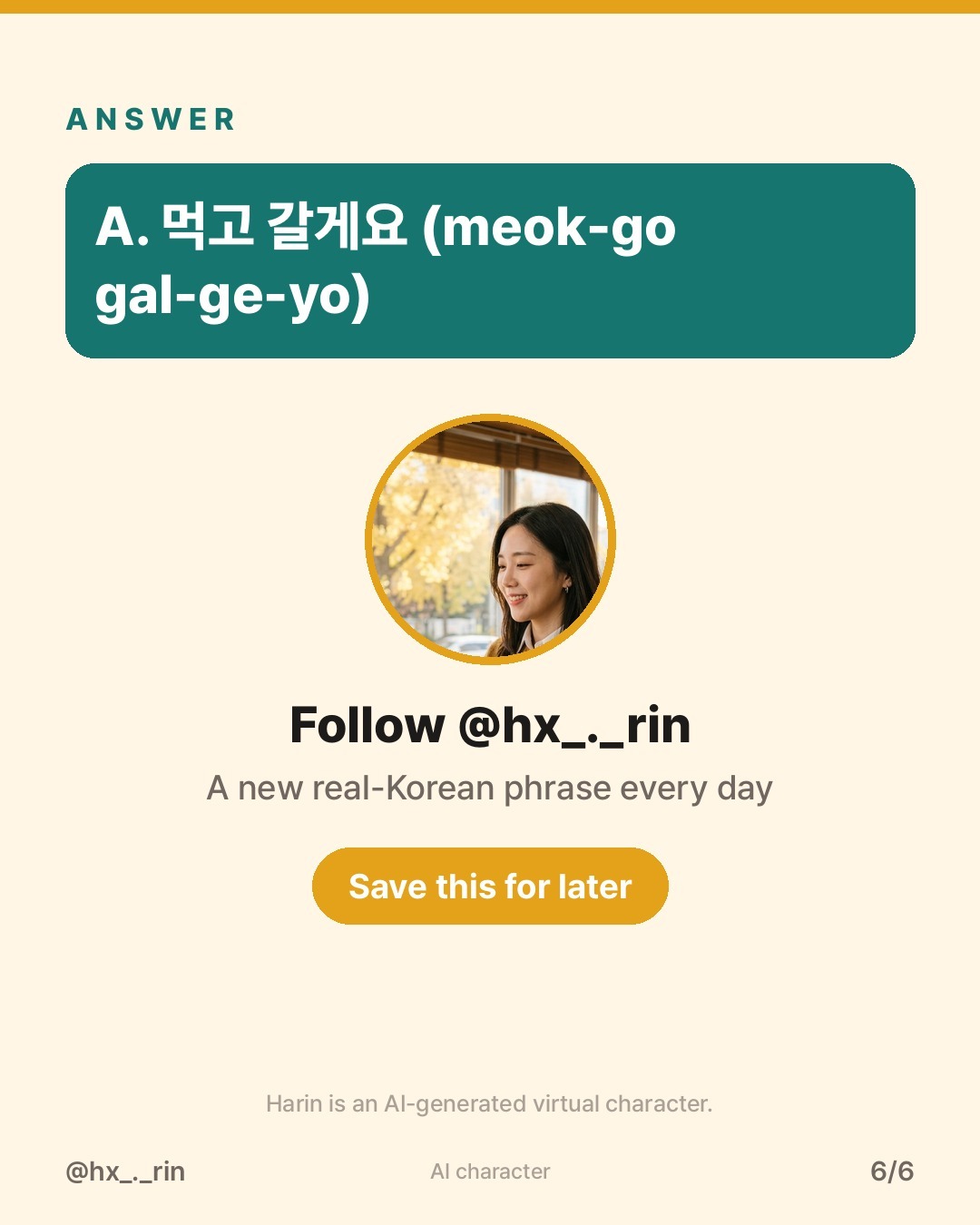
A. 먹고 갈게요 (meok-go gal-ge-yo) — Use at cafes and restaurants when the cashier asks if you are dining in. It is polite and standard for customer encounters; do not use it with close friends.
Sources
Keep learning
먹고 갈게요For here, please.
저기요
Excuse me (used to get someone's attention or call a server)
따로 계산해 주세요
Please split the bill so we can pay separately.