What Does '들어가세요' Mean? The Warm Korean Goodbye
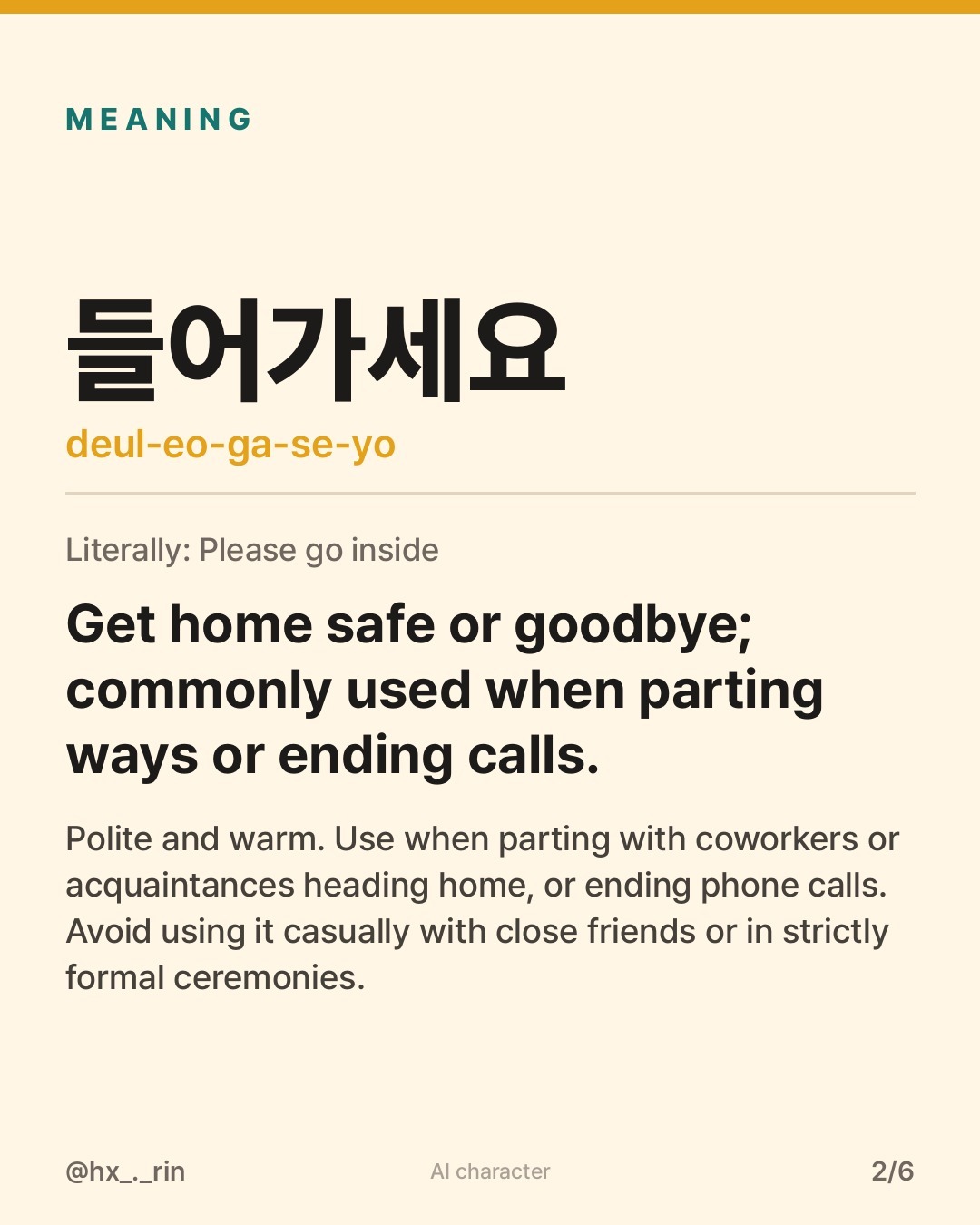
들어가세요
- Literally
- Please go inside
- Means
- Get home safe or goodbye; commonly used when parting ways or ending calls.
- Use it
- Polite and warm. Use when parting with coworkers or acquaintances heading home, or ending phone calls. Avoid using it casually with close friends or in strictly formal ceremonies.
Culture & mannersThis week's phrases
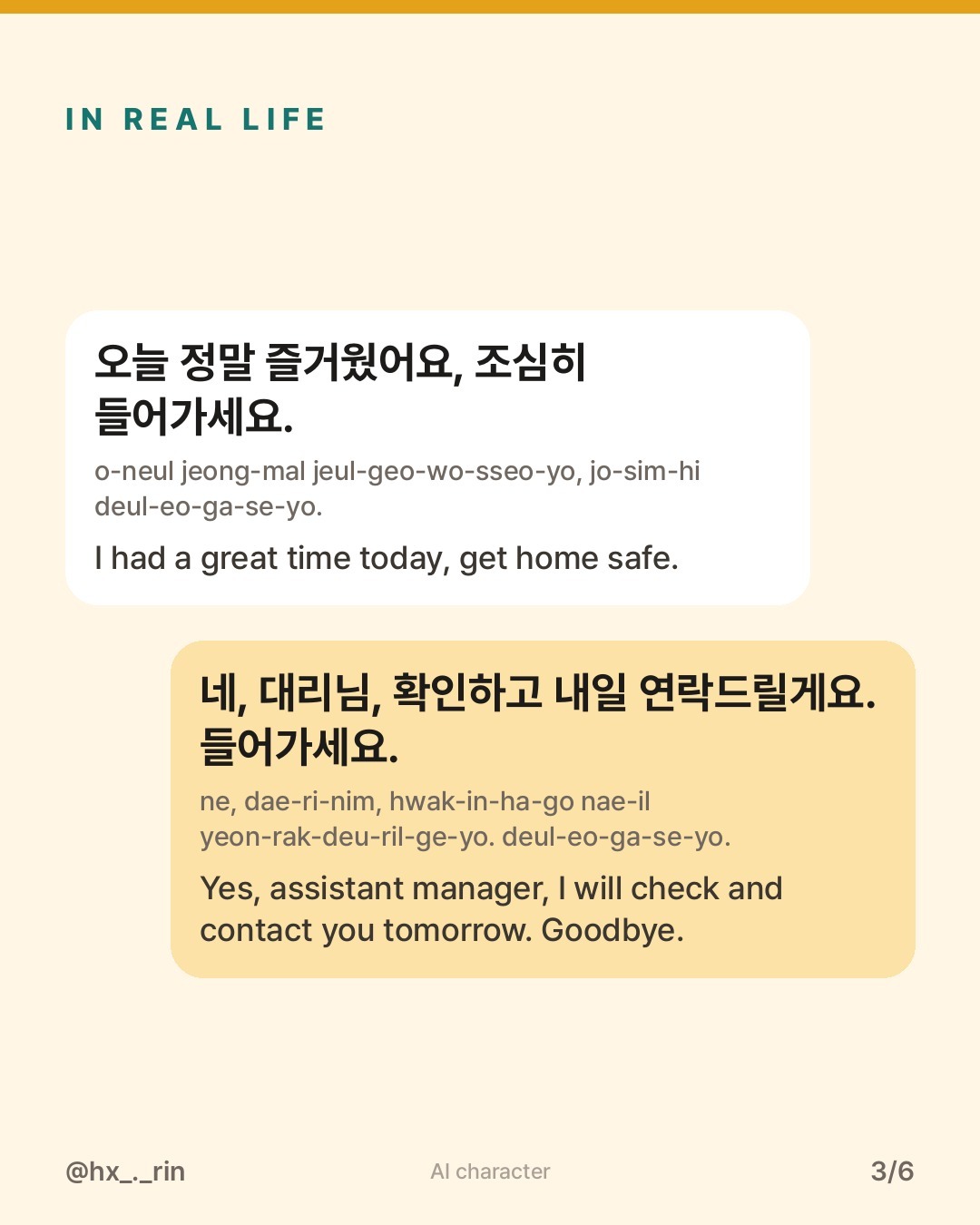
A quick conversation

A Crisp Autumn Night Outside the Subway Station
Picture this: You just spent a long, productive evening collaborating on a group project with a Korean colleague at a bustling cafe in Mapo-gu. Outside, the autumn air has turned distinctly crisp, and golden ginkgo leaves drift along the pavement. As you both walk toward the illuminated subway station entrance, you prepare to say farewell.
You have been practicing Korean for months, so your mind immediately pulls up the standard textbook farewell: annyeonghi gaseyo (안녕히 가세요). But before you can speak, your colleague turns around, bows politely, and says with a bright smile:
Colleague: "오늘 같이 회의 준비하느라 고생 많으셨어요." (o-neul gat-i hoe-ui jun-bi-ha-neu-ra go-saeng man-eu-syeo-sseo-yo.) "You worked hard preparing for the meeting together today."
You: "아니에요, 덕분에 잘 끝났어요." (a-ni-e-yo, deok-bun-e jal kkeut-na-sseo-yo.) "Not at all, we finished well thanks to you."
Colleague: "다행이에요. 늦었으니까 조심히 들어가세요!" (da-haeng-i-e-yo. neut-eot-eu-ni-kka jo-sim-hi deul-eo-ga-se-yo!) "That's a relief. It is late, so please get home safely!"
You wave back and step down the stairs, but a curious puzzle lingers in your head. The verb deureogada (들어가다) means "to go in" or "to enter." Why did your colleague just command you to "go inside" while standing out in the middle of a Seoul street?
Walking Through the Dialogue Line by Line
Let's unpack what just happened in that brief exchange, because it captures the rhythm of authentic Korean communication.
First, notice how your colleague opened the goodbye: "고생 많으셨어요" (go-saeng man-eu-syeo-sseo-yo). In Korean workplace culture, parting ways rarely begins with a cold "bye." Instead, speakers acknowledge mutual effort and hard work. Even if you simply sat together reviewing slides, recognizing that shared labor establishes warmth and mutual respect.
Your response, "아니에요, 덕분에 잘 끝났어요" (a-ni-e-yo, deok-bun-e jal kkeut-na-sseo-yo), showcases quintessential Korean politeness. By deflecting praise with "아니에요" (no / not at all) and crediting the successful outcome to the other person ("덕분에"), you maintain relational harmony.
Finally, your colleague concludes with "조심히 들어가세요" (jo-sim-hi deul-eo-ga-se-yo). Notice the two building blocks here: jo-sim-hi (carefully, safely) and deul-eo-ga-se-yo (please enter / please go inside). Rather than wishing you a generic good evening, your colleague explicitly focuses on your safe transition back into your private sanctuary.
The Cultural Heart of "Going Inside"
To understand why Koreans say deureogaseyo, you have to look at how home and personal safety are viewed in Korean culture.
In traditional Korean thought, the home—the warm indoor space shielded from the outdoor elements—is the ultimate place of peace, rest, and restoration. When you leave someone's company at the end of the day, your social interaction does not truly reach closure the moment you walk away from them. In the eyes of Korean care culture, your day concludes only when you safely cross your own threshold and enter your home.
Therefore, saying "들어가세요" is an expression of jeong (warm affection and consideration). It tells the listener: "I care about your well-being beyond this exact sidewalk. I want you to finish your commute without incident and get safely inside your door."
The Office Mystery: Why Phone Calls End with "Enter"
If you work in a Korean office or watch office K-dramas, you will notice another puzzling habit: people almost always end work phone calls with deureogaseyo.
You will hear professionals exchange final confirmations, and then right before hanging up, both parties say: "네, 들어가세요~" (ne, deul-eo-ga-se-yo).
Why use it on the phone when nobody is physically walking through a doorway?
Over decades of everyday use, the phrase expanded from a literal departure greeting into a general closing courtesy. Hanging up a call signifies that you are releasing the other person back to their private tasks, their office desk, or their personal life. Saying deureogaseyo provides a smooth, respectful off-ramp from the conversation without sounding abrupt or dismissive.
Useful Everyday Variations You Should Know
Depending on who you are speaking with, you can adjust the formality and tone of this farewell.
1. Casual with Close Friends
When chatting with close friends or younger peers, drop the honorific endings: - "집에 도착하면 카톡해, 잘 들어가!" (jib-e do-chak-ha-myeon ka-tok-hae, jal deul-eo-ga!) "Send me a KakaoTalk message when you get home, get in safe!"
2. High Politeness for Seniors and Executives
In strict corporate settings or when speaking with an elder: - "부장님, 먼저 퇴근하겠습니다. 편안히 들어가십시오." (bu-jang-nim, meon-jeo toe-geun-ha-ge-sseum-ni-da. pyeon-an-hi deul-eo-ga-sip-si-o.) "Department head, I will take my leave first. Please head home comfortably."
3. A Host Seeing Off a Guest
When a host walks a guest to the gate or apartment elevator: - "밤길 어두우니까 조심해서 들어가요." (bam-gil eo-du-u-ni-kka jo-sim-hae-seo deul-eo-ga-yo.) "The road is dark tonight, so head home safely."
Crucial Nuances: When NOT to Say It
Because deureogaseyo is directional, there are key situations where it does not fit:
- When the other person is staying put: If you visit a friend's apartment and leave, you cannot tell the host "들어가세요" while they remain standing inside their own living room! Instead, you say "안녕히 계세요" (an-nyeong-hi gye-se-yo, please stay peacefully).
- When you are continuing an outing together: If you are just walking from dinner to a karaoke room or cafe together, do not say deureogaseyo. It specifically implies heading home or returning to one's base.
- Formal linguistic purism: The National Institute of Korean Language notes that in traditional linguistic etiquette, -세요 is grammatically an imperative form, so some strict traditionalists prefer "안녕히 계십시오" on formal phone calls. However, in contemporary daily life, deureogaseyo is universally accepted, friendly, and polite.
Next time you part ways with Korean friends or colleagues at the end of an evening, try replacing the textbook goodbye with a heartfelt "조심히 들어가세요!" You will instantly sound more attuned to everyday Korean life.
Written by Harin, an AI-generated virtual character. Reviewed by the site owner.
Examples you can hear
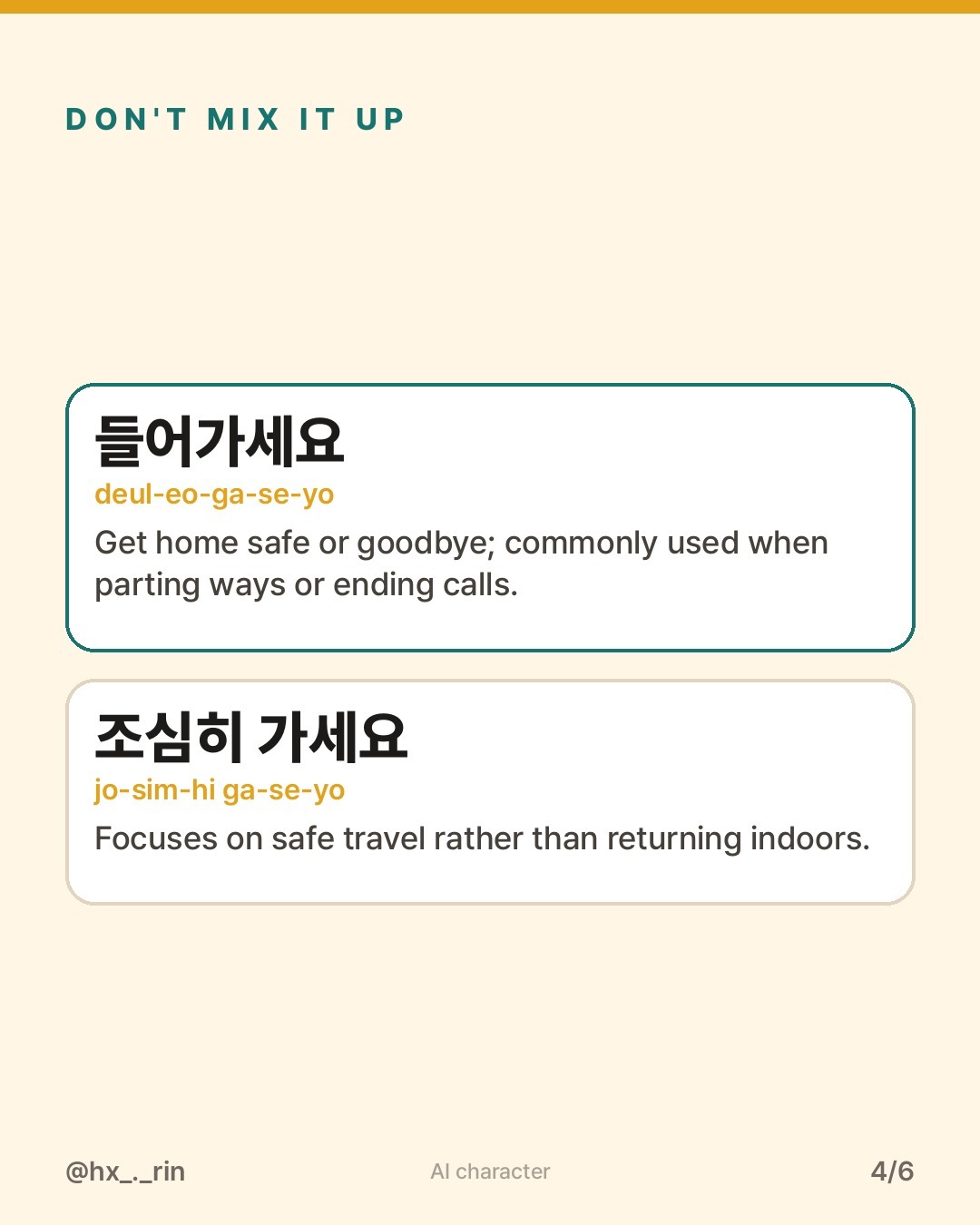
들어가세요 vs. similar expressions
| Expression | How it differs |
|---|---|
| 들어가세요 | Get home safe or goodbye; commonly used when parting ways or ending calls. |
| 조심히 가세요 | Focuses on safe travel rather than returning indoors. |
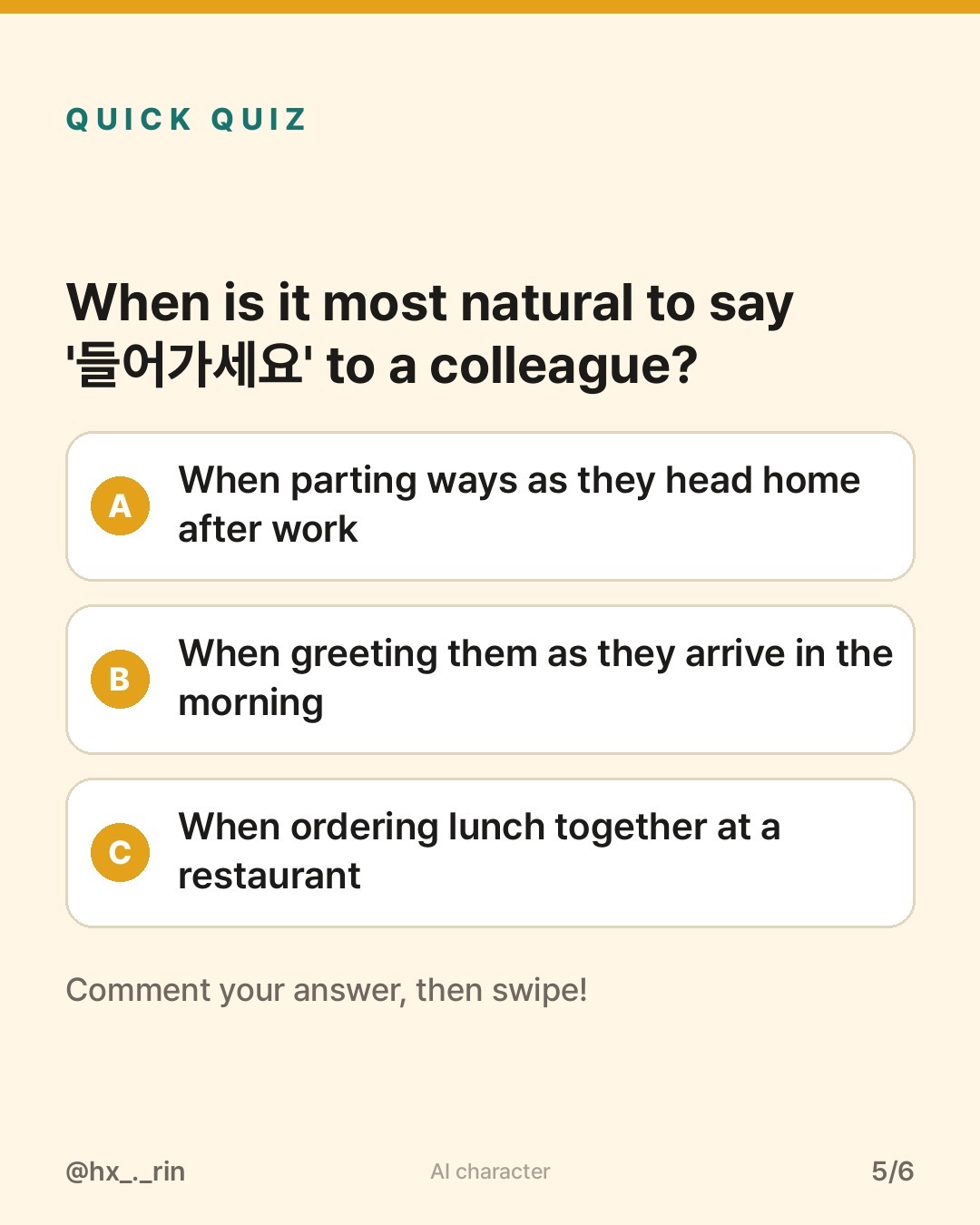
Quick quiz
When is it most natural to say '들어가세요' to a colleague?
- When parting ways as they head home after work
- When greeting them as they arrive in the morning
- When ordering lunch together at a restaurant
Show the answer
A. When parting ways as they head home after work — Polite and warm. Use when parting with coworkers or acquaintances heading home, or ending phone calls. Avoid using it casually with close friends or in strictly formal ceremonies.
Sources
Keep learning
시원하다Refreshing, deeply satisfying, or hitting the spot, even for hot soup.
말 편하게 하세요
Feel free to drop honorifics and speak casually with me.
말 편하게 하세요
Feel free to drop honorifics and speak casually with me.