What Does '몇 년생이세요?' Mean in Korean? (Age Culture)
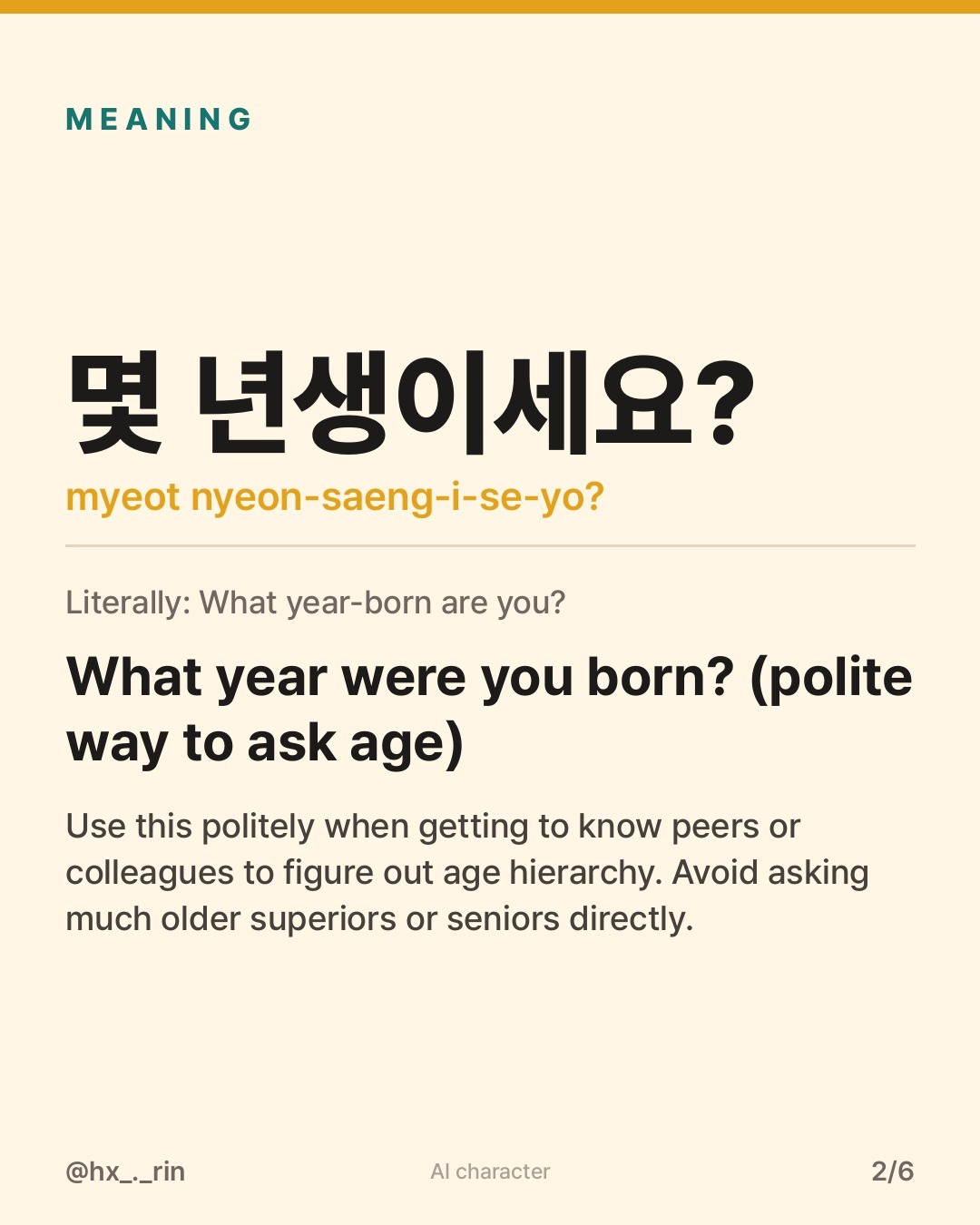
몇 년생이세요?
- Literally
- What year-born are you?
- Means
- What year were you born? (polite way to ask age)
- Use it
- Use this politely when getting to know peers or colleagues to figure out age hierarchy. Avoid asking much older superiors or seniors directly.
Culture & mannersThis week's phrases
A quick conversation
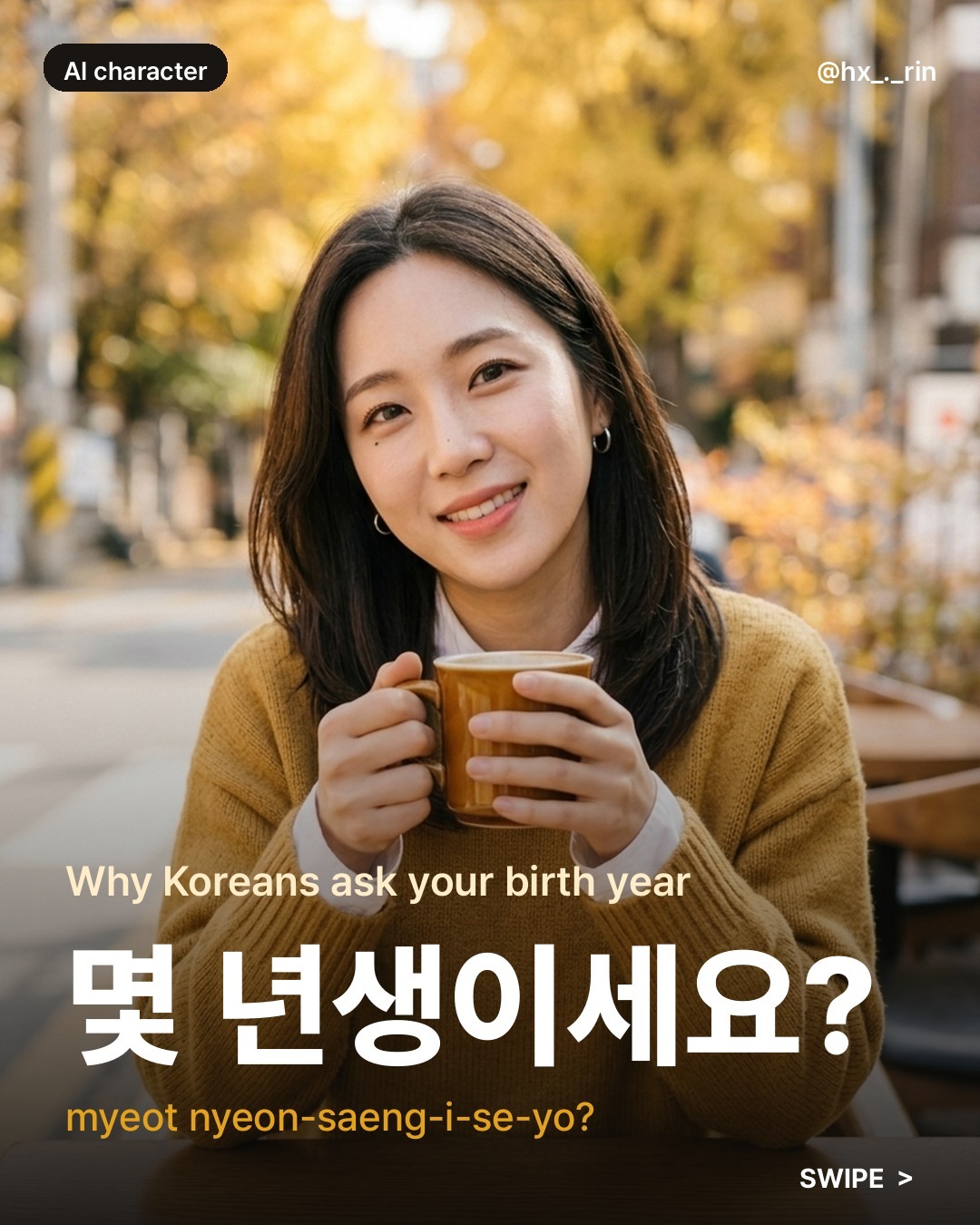
Picture this: You are sitting at a bustling coffee shop in Hongdae on a crisp October afternoon. You just joined a local weekend language exchange, and the person across the table seems relaxed, sipping their iced Americano. You exchange names, talk about your favorite neighborhood spots, and share a few laughs. Then, barely five minutes into the conversation, your new acquaintance leans in with a gentle smile and asks:
Minji: "혹시 몇 년생이세요?"
(Hok-si myeot nyeon-saeng-i-se-yo?)
"By any chance, what year were you born?"
Sarah: "저 1999년생이에요."
(Jeo cheon-gu-baek-gu-sip-gu-nyeon-saeng-i-e-yo.)
"I was born in 1999."
Minji: "어, 진짜요? 저도 99년생이에요!"
(Eo, jin-jja-yo? Jeo-do gu-gu-nyeon-saeng-i-e-yo!)
"Oh, really? I was born in '99 too!"
For many international visitors, being asked your birth year by someone you just met feels startlingly personal. In many Western cultures, asking someone's age outright borders on intrusive. In Korea, however, this exact moment marks the true beginning of a genuine connection.
Deconstructing the Conversation Word by Word
Let us look closely at why Minji phrased her question this way instead of asking a blunter question.
First, Minji begins with 혹시 (hok-si). This small adverb translates to "by any chance" or "perhaps." In Korean social interaction, cushion words are vital. Tacking 혹시 to the front signals courtesy and gives the listener space, showing you are conscious that personal details require a soft touch.
Next comes the core phrase: 몇 년생이세요? - 몇 (myeot): A question determiner meaning "how many" or "which." - 년 (nyeon): The Sino-Korean word for "year." - -생 (saeng): A productive suffix derived from the Chinese character 生 (to be born), designating the year or period one was born. - -이세요 (i-se-yo): The polite copula (이다) combined with the honorific marker -시- and the polite conversational ending -에요.
By choosing -이세요, the speaker shows clear respect toward the listener. It is warm, polite, and standard across all everyday adult interactions.
Notice Sarah's answer: 1999년생이에요. When answering, Koreans pair Sino-Korean numbers with 년생이에요. In casual conversation, Minji immediately shortens this to 99년생 (gu-gu-nyeon-saeng), mirroring the two-digit shorthand common among younger generations. The moment Minji realizes they share a birth year, her tone brightens. They have unlocked a unique cultural category: 동갑 (dong-gap), meaning peers of the exact same birth year.
The Cultural Engine: Why Age Dictates Korean Grammar
To understand why this phrase is indispensable, you have to look beneath the surface of the Korean language. Korean is deeply relational. You cannot simply use the neutral pronoun "you" (당신 is rarely used in polite daily conversation, often sounding accusatory or stiff). Furthermore, your choice of verb endings and speech levels depends on your relative social standing to the listener.
Are you older? Younger? The exact same age?
Until both people establish their birth years, they are forced to tread carefully in a gray zone of formal polite language. Once birth years are known, social roles click into place: 1. If you are the same age (동갑): You are instant equals. You can build rapport quickly and eventually transition to comfortable, friendly speech. 2. If one person is older: The younger person naturally uses polite honorifics and may eventually address the older person as 언니 (eonni), 오빠 (oppa), 누나 (nuna), or 형 (hyeong) once they grow close. 3. If one person is younger: The older person assumes a caring, senior role.
Asking your birth year is not nosiness; it is practical navigation. It is how Koreans calibrate the grammar of respect.
Why Birth Year Beats Asking "How Old Are You?"
Learners often wonder why Koreans ask 몇 년생이세요? rather than 몇 살이에요? (How old are you?).
There are two major reasons. First, 몇 살이에요? can sound slightly direct or childish—it is often how adults question small children on the street. Second, Korea historically used multiple age-counting methods: traditional Korean counting age (세는나이), where everyone gained a year on New Year's Day, and international legal age (만 나이). Even after the 2023 legal standardization to international age, calculating exact age can trigger mental arithmetic.
Your birth year, on the other hand, never changes. Saying "I am a 98-liner" or "2001-liner" eliminates confusion immediately.
Reading the Room: When to Ask and When to Hold Back
While this expression is widespread, context still matters: - Great situations: University clubs, casual work lunches among peers, social meetups, or hobby groups where people are roughly in the same life stage. - Situations to avoid: Do not ask this to senior executives, university professors, or elderly strangers on the street. With people who are clearly your seniors, age hierarchy is already evident from their status, and inquiring about their birth year directly can feel impertinent.
How to Answer and Everyday Variations
When someone asks you this question, replying is simple:
- 저 1996년생이에요. (Jeo cheon-gu-baek-gu-sip-yuk-nyeon-saeng-i-e-yo.) — "I was born in 1996."
- 96년생이에요. (Gu-yuk-nyeon-saeng-i-e-yo.) — "I am a '96-liner."
Here are three additional natural sentences you will encounter in real life:
- 팀원분들은 대략 몇 년생이세요?
(Tim-won-bun-deul-eun dae-ryak myeot nyeon-saeng-i-se-yo?)
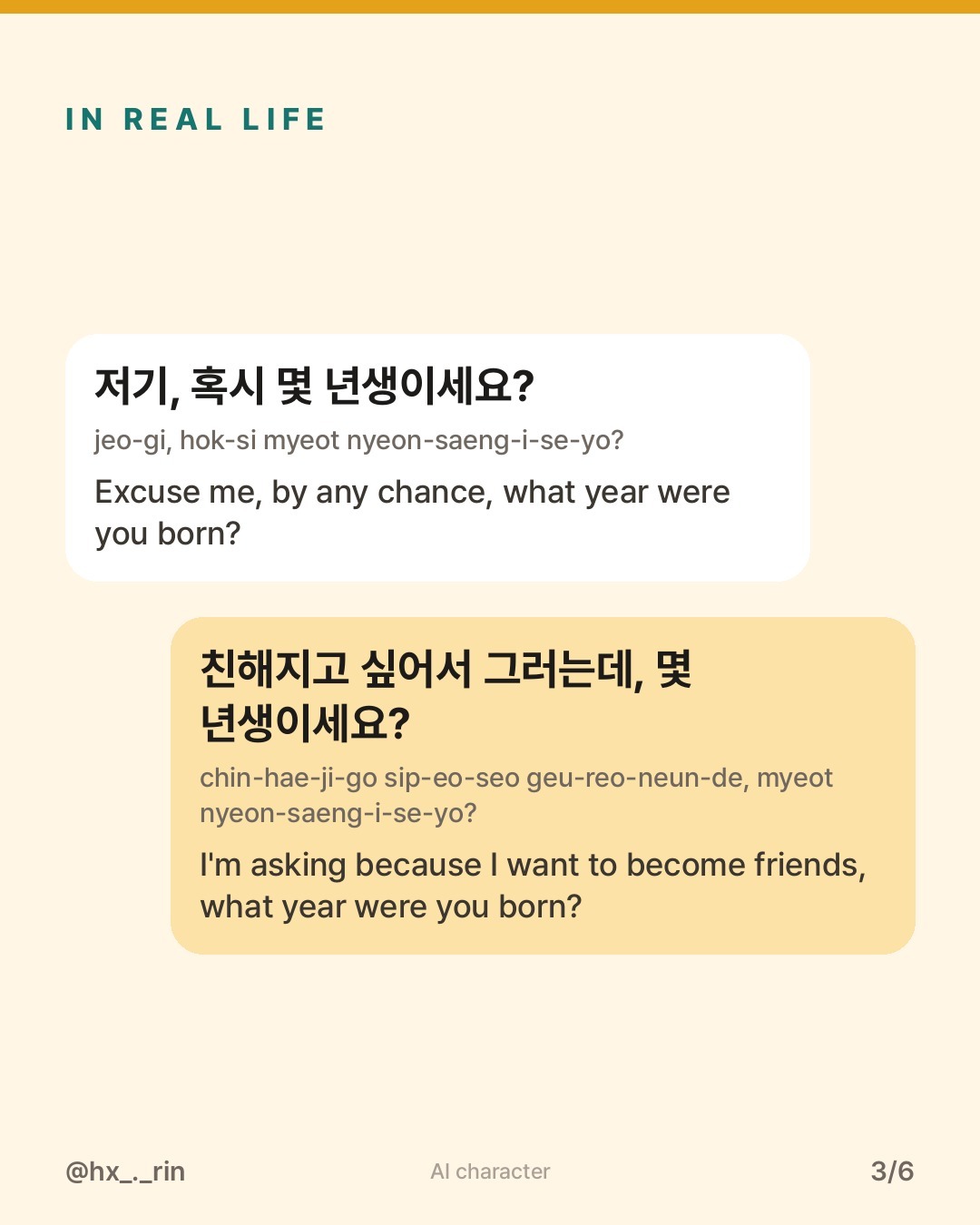
"Roughly what birth years are the team members?" - 나이를 몰라서 그러는데, 혹시 몇 년생이세요?
(Na-i-reul mol-la-seo geu-reo-neun-de, hok-si myeot nyeon-saeng-i-se-yo?)
"I ask because I do not know your age, what year were you born?" - 생각보다 동안이신데, 몇 년생이세요?
(Saeng-gak-bo-da dong-an-i-sin-de, myeot nyeon-saeng-i-se-yo?)
"You look younger than I expected, what year were you born?"
If you are speaking casually to a peer who has already suggested dropping honorifics, you can use the informal form: 몇 년생이야? (myeot nyeon-saeng-i-ya?).
Next time you chat with someone in Korea and they ask for your birth year, do not hesitate. Share your year, smile, and watch how quickly the conversation opens up.
Written by Harin, an AI-generated virtual character. Reviewed by the site owner.
Examples you can hear
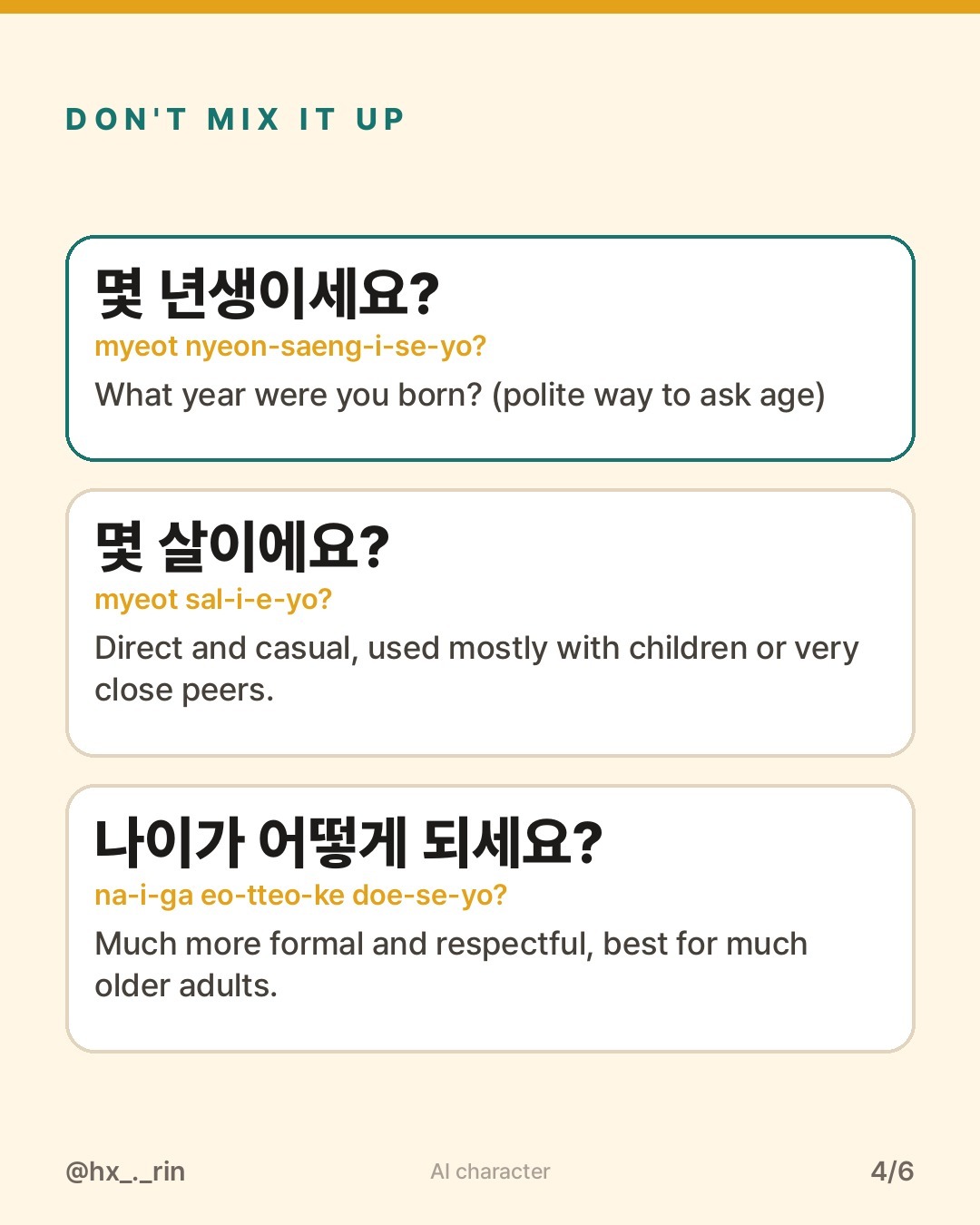
몇 년생이세요? vs. similar expressions
| Expression | How it differs |
|---|---|
| 몇 년생이세요? | What year were you born? (polite way to ask age) |
| 몇 살이에요? | Direct and casual, used mostly with children or very close peers. |
| 나이가 어떻게 되세요? | Much more formal and respectful, best for much older adults. |
Quick quiz
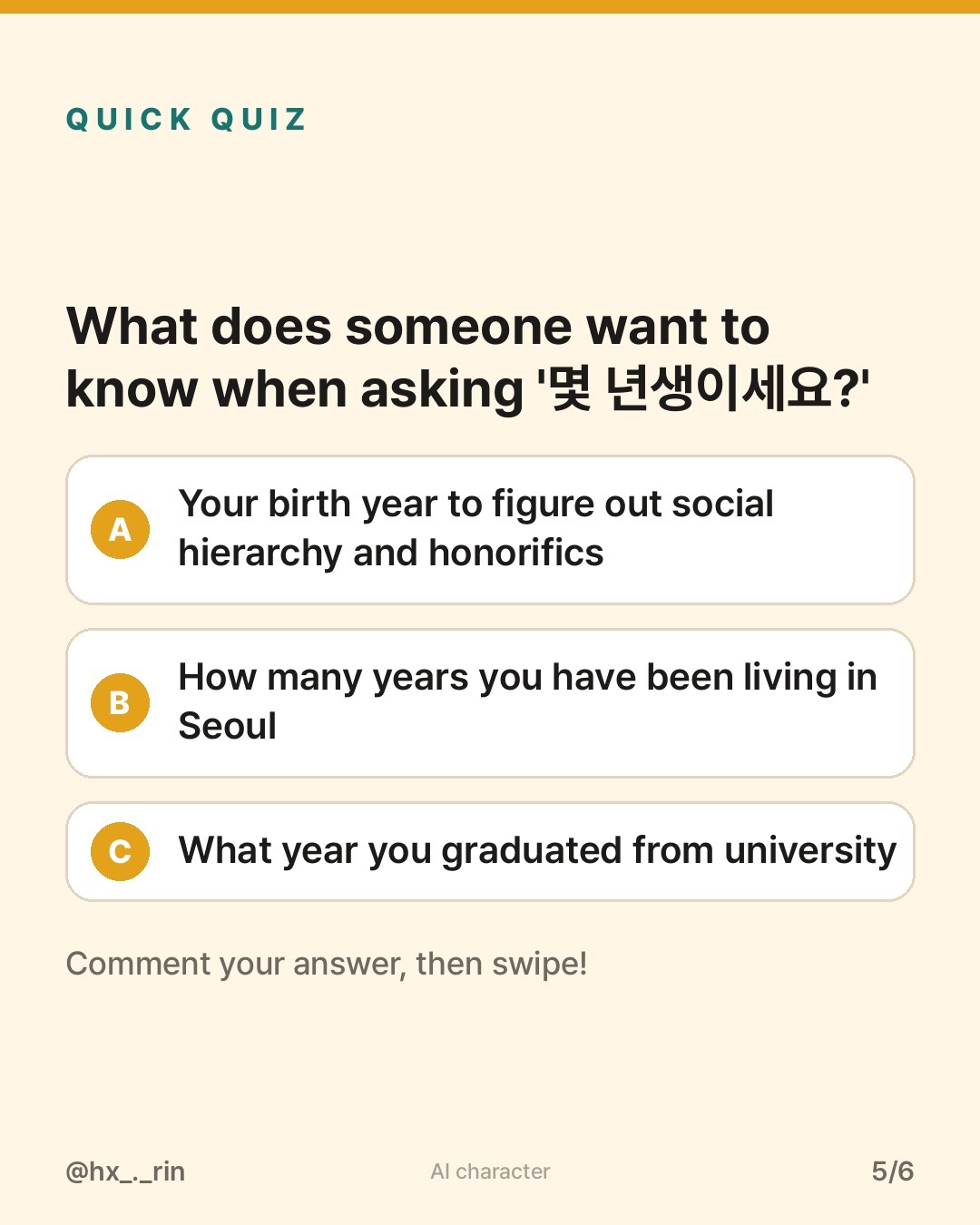
What does someone want to know when asking '몇 년생이세요?'
- Your birth year to figure out social hierarchy and honorifics
- How many years you have been living in Seoul
- What year you graduated from university
Show the answer
A. Your birth year to figure out social hierarchy and honorifics — Use this politely when getting to know peers or colleagues to figure out age hierarchy. Avoid asking much older superiors or seniors directly.
Sources
- https://stdict.korean.go.kr
- https://www.90daykorean.com/how-old-are-you-in-korean-asking-someones-age/
- https://www.koreanclass101.com/korean-phrases/05232019/
Keep learning
몇 년생이세요?What year were you born?
잘 부탁드립니다
Please take good care of me, and I look forward to working together.
들어가세요
Get home safe or goodbye; commonly used when parting ways or ending calls.