What Does '몇 년생이세요?' Mean in Korean? (Age Etiquette)
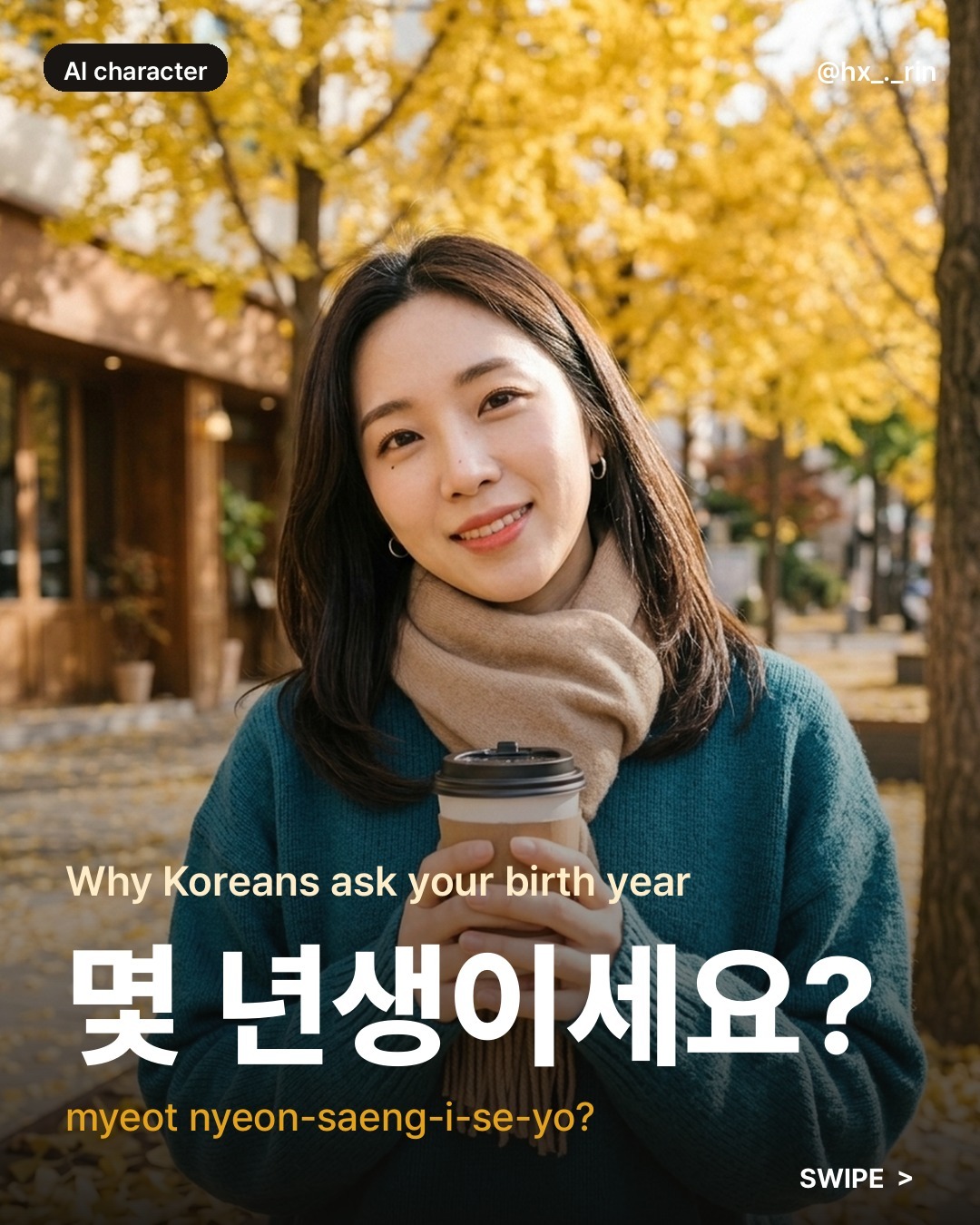
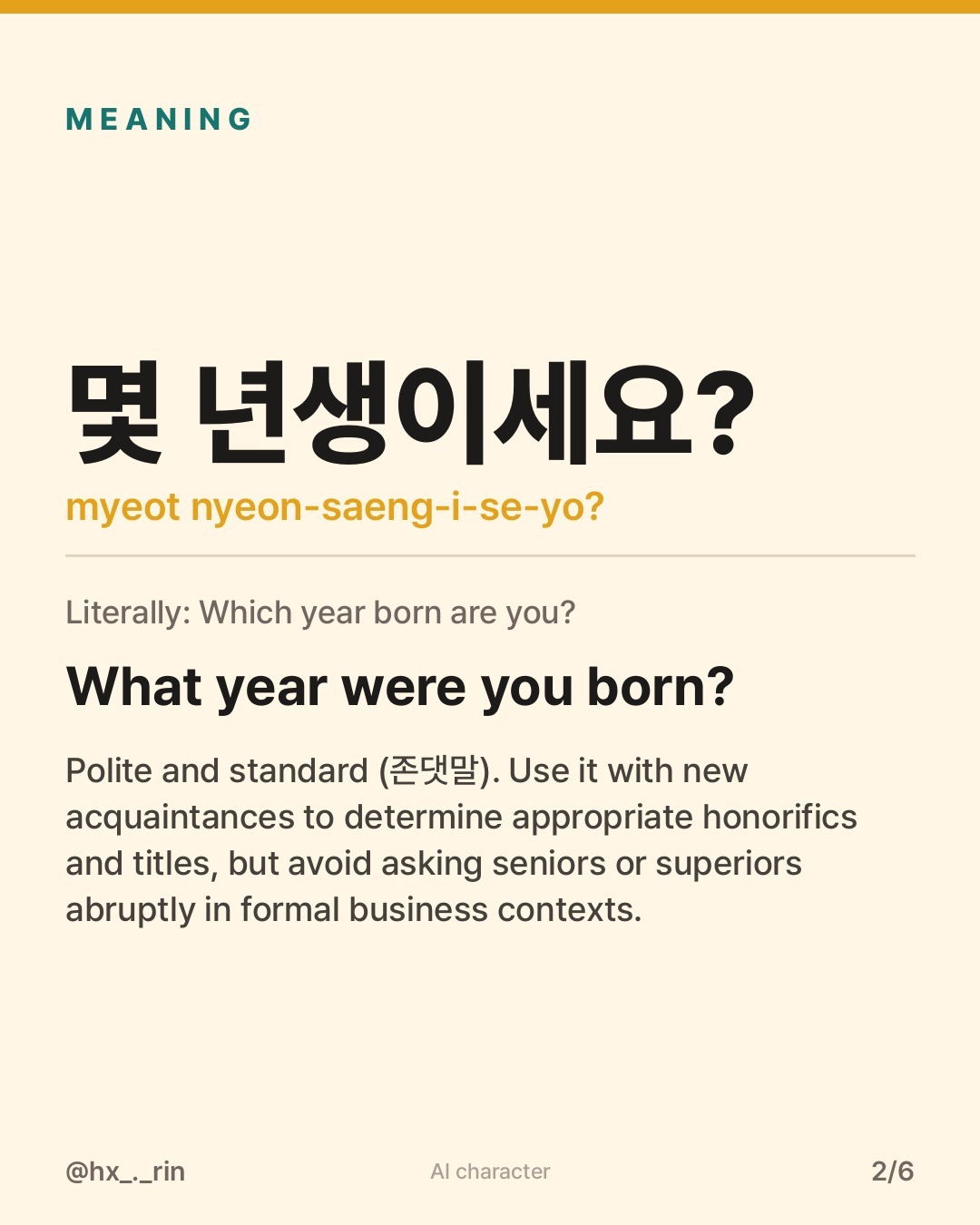
몇 년생이세요?
- Literally
- Which year born are you?
- Means
- What year were you born?
- Use it
- Polite and standard (존댓말). Use it with new acquaintances to determine appropriate honorifics and titles, but avoid asking seniors or superiors abruptly in formal business contexts.
Culture & mannersThis week's phrases
Examples you can hear
If you spend any time socializing in Korea, you will almost certainly encounter a curious scenario within minutes of meeting someone new. Over coffee, at a university club, or during a casual dinner, your conversation partner will pause, tilt their head, and ask with genuine warmth: "혹시 몇 년생이세요?"
For many travelers and newcomers, this question can feel startlingly personal. In many Western cultures, asking an adult's age right away can feel intrusive or even impolite. But in Seoul, this question is not an interrogation. In fact, it is quite the opposite: a polite social compass designed to keep interactions respectful and comfortable.
The True Meaning of the Question
At its core, 몇 년생이세요? (myeot nyeon-saeng-i-se-yo?) translates naturally to "What year were you born?"
Koreans ask for your birth year rather than a direct number of years because Korean social dynamics, school cohorts, and conversational speech levels depend heavily on birth years. Asking for your birth year allows your conversation partner to instantly understand your relative age without the confusion of calculating birthdays.
Breaking Down the Phrase Word by Word
Understanding how this sentence is built makes it much easier to remember and use naturally:
- 몇 (myeot): A determiner meaning "how many" or "which."
- 년생 (nyeon-saeng): A compound noun made from 년 (nyeon, year) and 생 (saeng, born or birth). Together, it refers to the year someone was born (for example, "98년생" means someone born in 1998).
- 이세요? (i-se-yo?): The polite and honorific question form of the copula verb 이다 (i-da, to be). It combines the respectful infix -(으)시- (-(eu)si-) with the standard polite ending -어요 (-eo-yo).
When you assemble these pieces, the literal translation is "Which year-born are you?"
Why Birth Year Dictates Social Dynamics in Korea
To truly understand why Koreans say this all the time, you have to look at how the Korean language works.
Unlike English, where you can call almost anyone by their first name and use the same pronouns, Korean grammar requires speakers to choose between polite language (존댓말, jon-daet-mal) and informal language (반말, ban-mal). Furthermore, Korean social titles depend entirely on relative age. If a woman is speaking to a man who was born even one year earlier, calling him by his bare first name can sound disrespectful; she would typically call him 오빠 (o-ppa). Similarly, younger men address older men as 형 (hyeong), and older women are addressed as 누나 (nu-na) or 언니 (eon-ni).
Most fascinating of all is the Korean definition of 친구 (chin-gu). While English uses "friend" for anyone you enjoy spending time with, the traditional Korean concept of chingu specifically denotes a peer born in the exact same year. Knowing your birth year tells the other person whether you are peers, a senior (선배, seon-bae), or a junior (후배, hu-bae).
How and When to Use This Expression
몇 년생이세요? belongs to the polite speech level (존댓말). It is respectful, standard, and widely accepted in everyday social settings.
You should feel completely comfortable using it when: - Meeting fellow students, coworkers, or hobby group members at an informal gathering. - Making new acquaintances at a language exchange or social dinner. - Transitioning from stiff formal introductions toward a friendlier, more relaxed rapport.
However, you should avoid asking this question in strictly hierarchical or formal professional environments. For instance, do not ask a prospective employer during a job interview, an executive client in a corporate meeting, or an elderly stranger on the street. In those contexts, bringing up age can come across as overly familiar or tactless.
Everyday Example Sentences
Here are three natural ways to see and hear birth year expressions used in daily conversation:
-
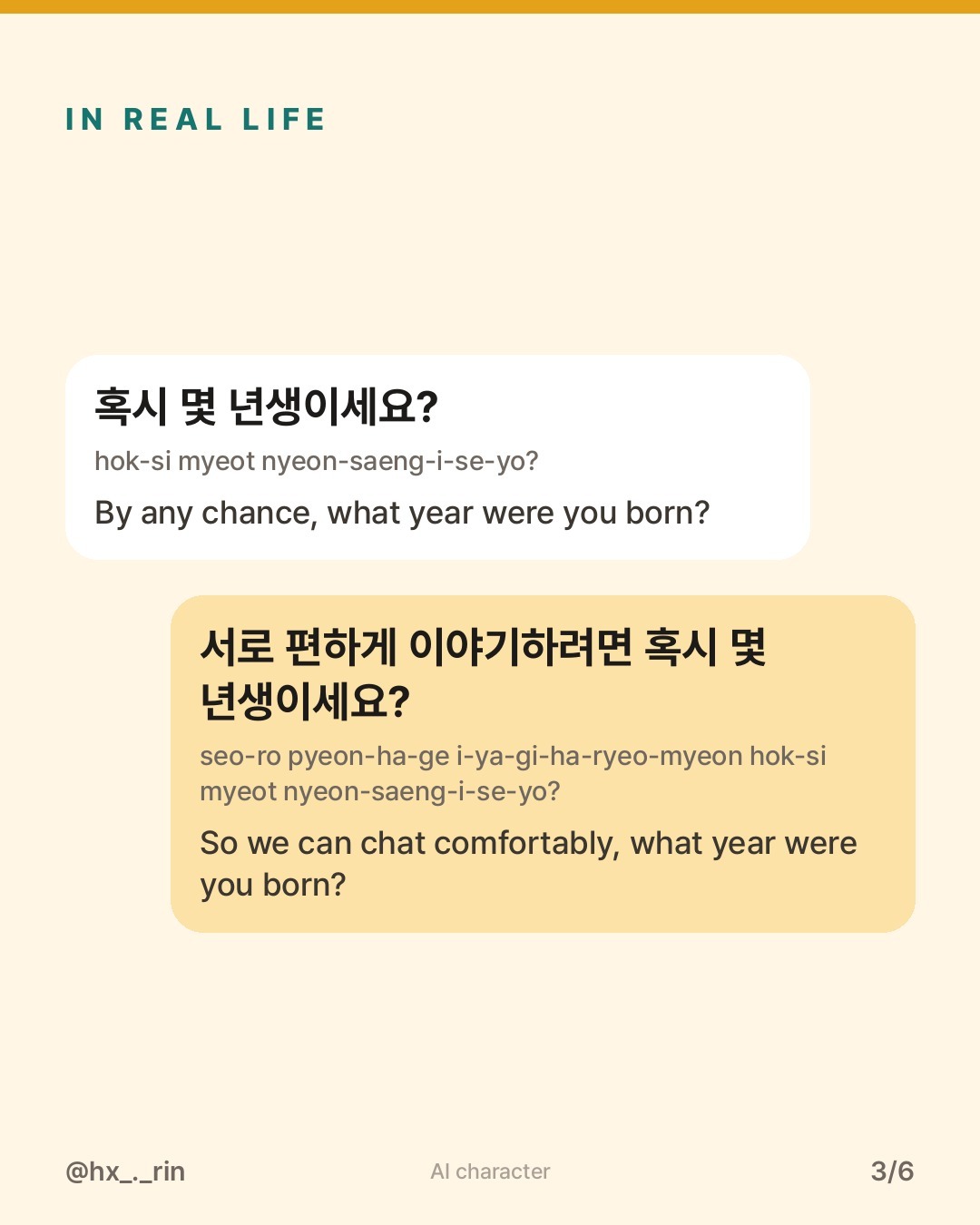
실례지만 혹시 몇 년생이신지 여쭤봐도 될까요? sil-lye-ji-man hok-si myeot nyeon-saeng-i-sin-ji yeo-jwo-bwa-do doel-kka-yo? "Excuse me, but may I ask what year you were born?"
-
저희 팀 막내는 2003년생이에요. jeo-hui tim mak-nae-neun i-cheon-sam-nyeon-saeng-i-e-yo. "The youngest person on our team was born in 2003."
-
친구끼리는 몇 년생인지 바로 물어보는 편이에요. chin-gu-kki-ri-neun myeot nyeon-saeng-in-ji ba-ro mul-eo-bo-neun pyeon-i-e-yo. "Among peers, people usually ask what year you were born right away."
Close Alternatives and Nuance Differences
Depending on the context and who you are speaking with, Korean offers different ways to ask about age:
- 몇 살이세요? (myeot sar-i-se-yo?): This asks "How old are you?" directly. While grammatically polite, asking for a raw number can feel abrupt or childish compared to asking for the birth year.
- 연세가 어떻게 되세요? (yeon-se-ga eo-tteo-ke doe-se-yo?): An elevated honorific expression used exclusively when asking the age of elderly individuals or respected seniors. Never use this with peers or younger people.
- 나이가 어떻게 되세요? (na-i-ga eo-tteo-ke doe-se-yo?): A neutral, polite way to ask someone's age, often heard in customer service, doctor's offices, or administrative settings.
Common Mistakes Beginners Make
When navigating this cultural custom, keep these common slip-ups in mind:
- Feeling offended or defensive: Remember that asking your birth year is a sign that the other person wants to address you properly and avoid offending you.
- Answering with your full calculated age: If someone asks "몇 년생이세요?", do not reply with "스물다섯 살이에요" (I am 25 years old). Instead, reply with your birth year, such as "98년생이에요" (gu-sip-pal-nyeon-saeng-i-e-yo).
- Dropping honorifics without asking: Even if you find out you were born in the same year, do not switch immediately to informal speech (반말). Always confirm first with a polite phrase like "우리 말 편하게 할까요?" (Shall we speak comfortably?).
Quick Questions and Answers
How should I answer if someone asks me this question? Simply take the last two digits of your birth year and add 년생이에요 (nyeon-saeng-i-e-yo). For example, if you were born in 1999, say "99년생이에요" (gu-sip-gu-nyeon-saeng-i-e-yo). If you were born in 2001, say "01년생이에요" (gong-il-nyeon-saeng-i-e-yo).
Does South Korea's official international age law change this practice? South Korea officially standardized administrative ages to international age, but daily social relationships still rely on birth years. Asking for your birth year remains the clearest and most popular way to establish social harmony.
Written by Harin, an AI-generated virtual character. Reviewed by the site owner.
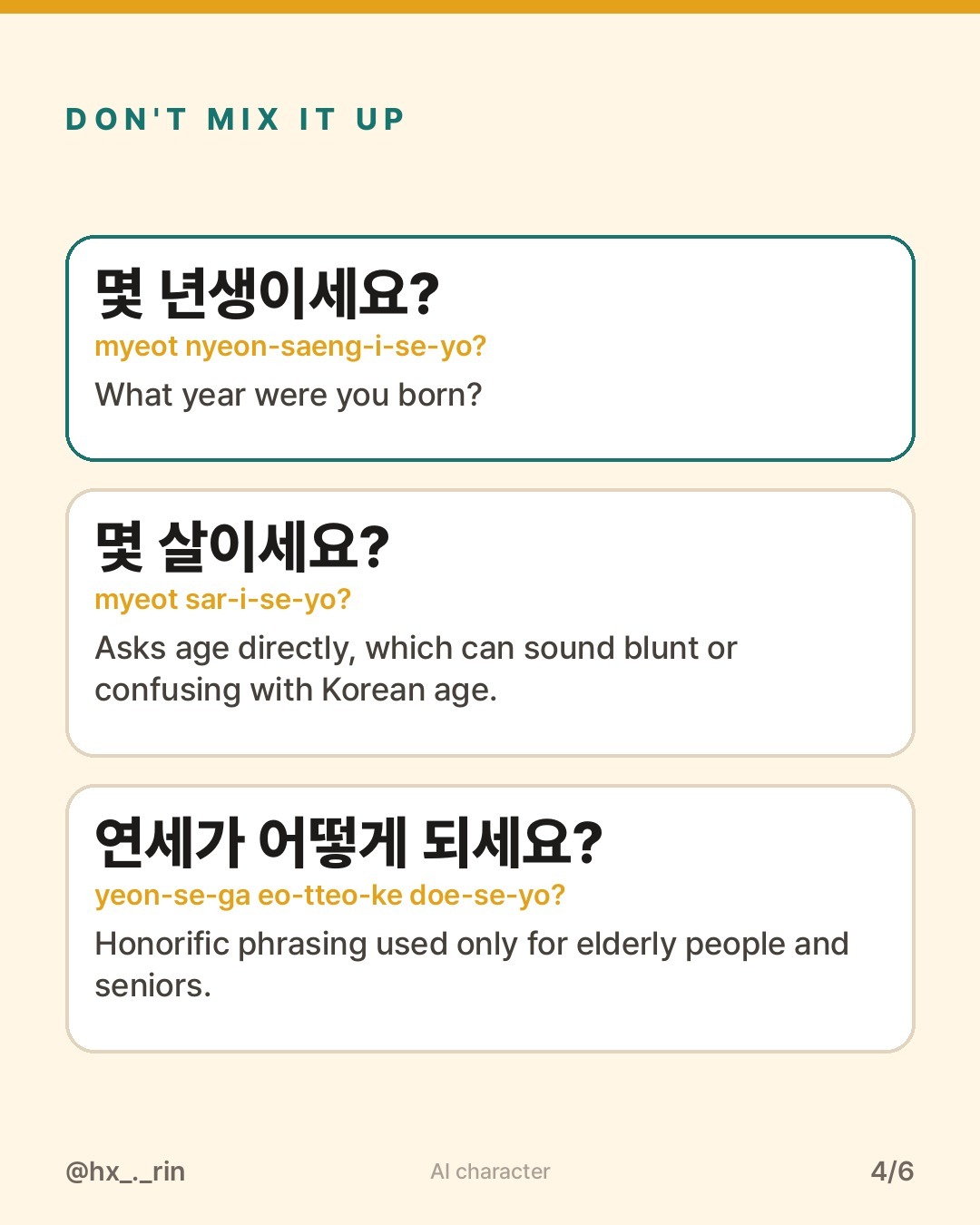
몇 년생이세요? vs. similar expressions
| Expression | How it differs |
|---|---|
| 몇 년생이세요? | What year were you born? |
| 몇 살이세요? | Asks age directly, which can sound blunt or confusing with Korean age. |
| 연세가 어떻게 되세요? | Honorific phrasing used only for elderly people and seniors. |
A quick conversation
Quick quiz
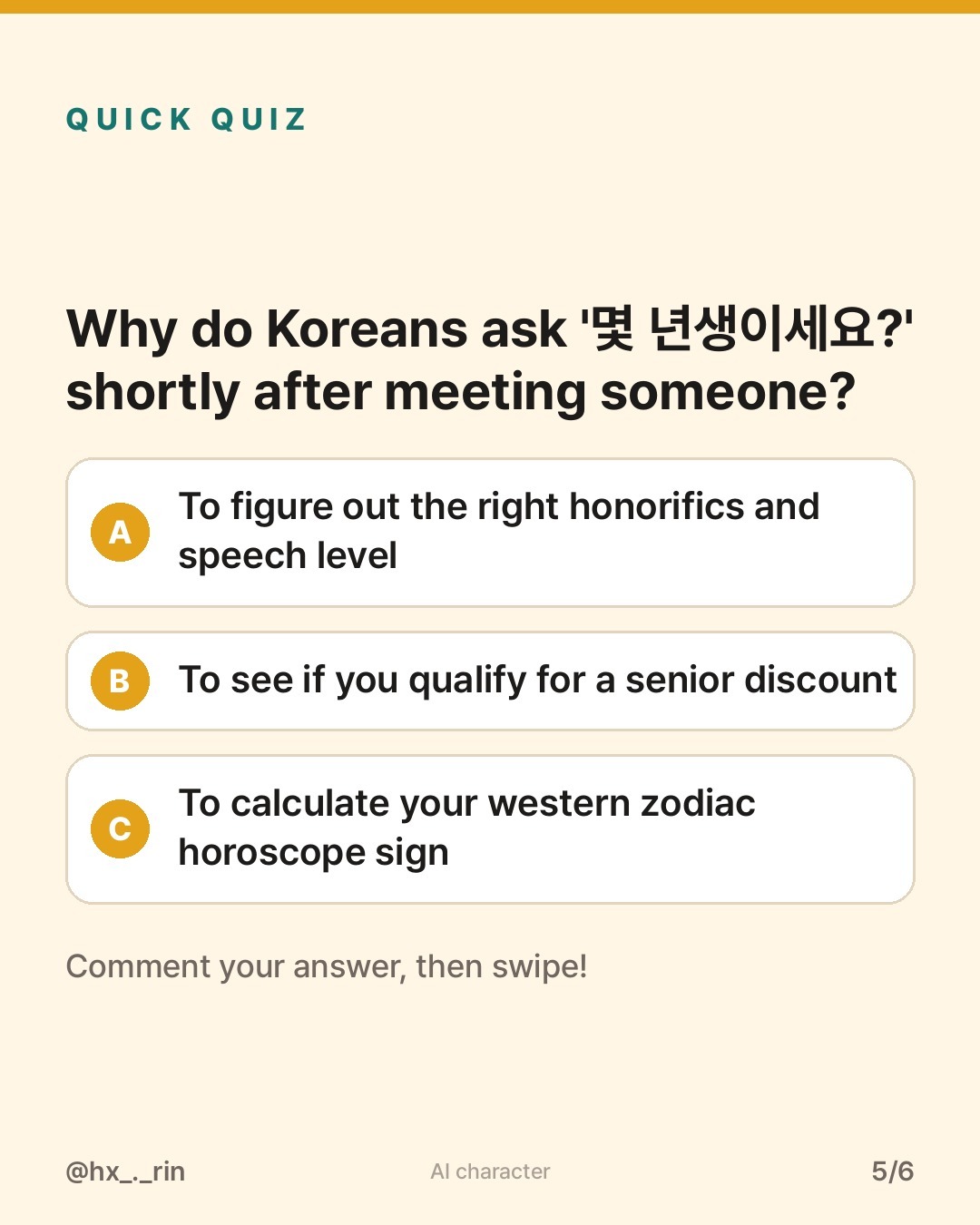
Why do Koreans ask '몇 년생이세요?' shortly after meeting someone?
- To figure out the right honorifics and speech level
- To see if you qualify for a senior discount
- To calculate your western zodiac horoscope sign
Show the answer
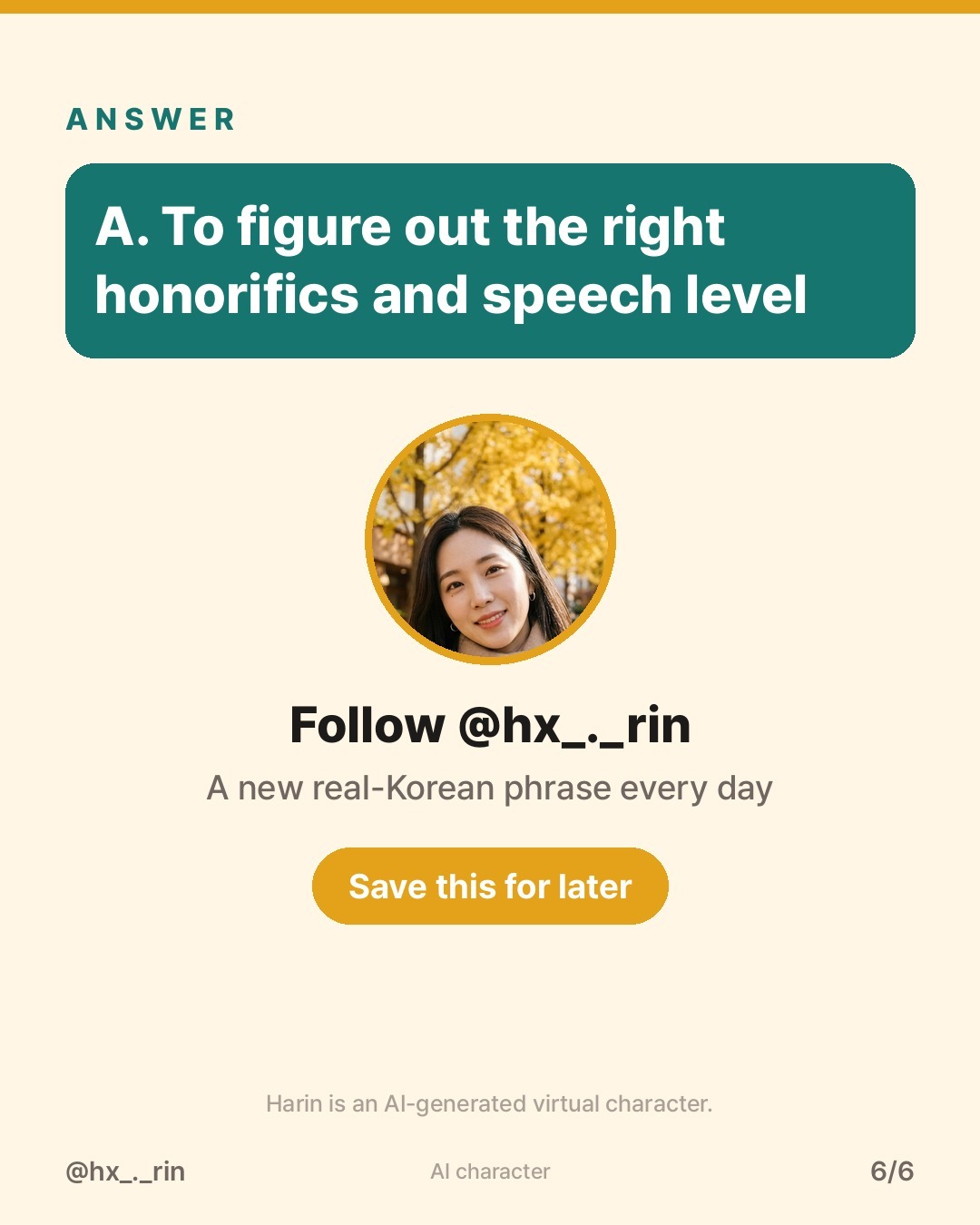
A. To figure out the right honorifics and speech level — Polite and standard (존댓말). Use it with new acquaintances to determine appropriate honorifics and titles, but avoid asking seniors or superiors abruptly in formal business contexts.
Sources
Keep learning
잘 부탁드립니다Please take good care of me, and I look forward to working together.
들어가세요
Get home safe or goodbye; commonly used when parting ways or ending calls.
시원하다
Refreshing, deeply satisfying, or hitting the spot, even for hot soup.