What Does '오히려 좋아' Mean in Korean? Slang Guide
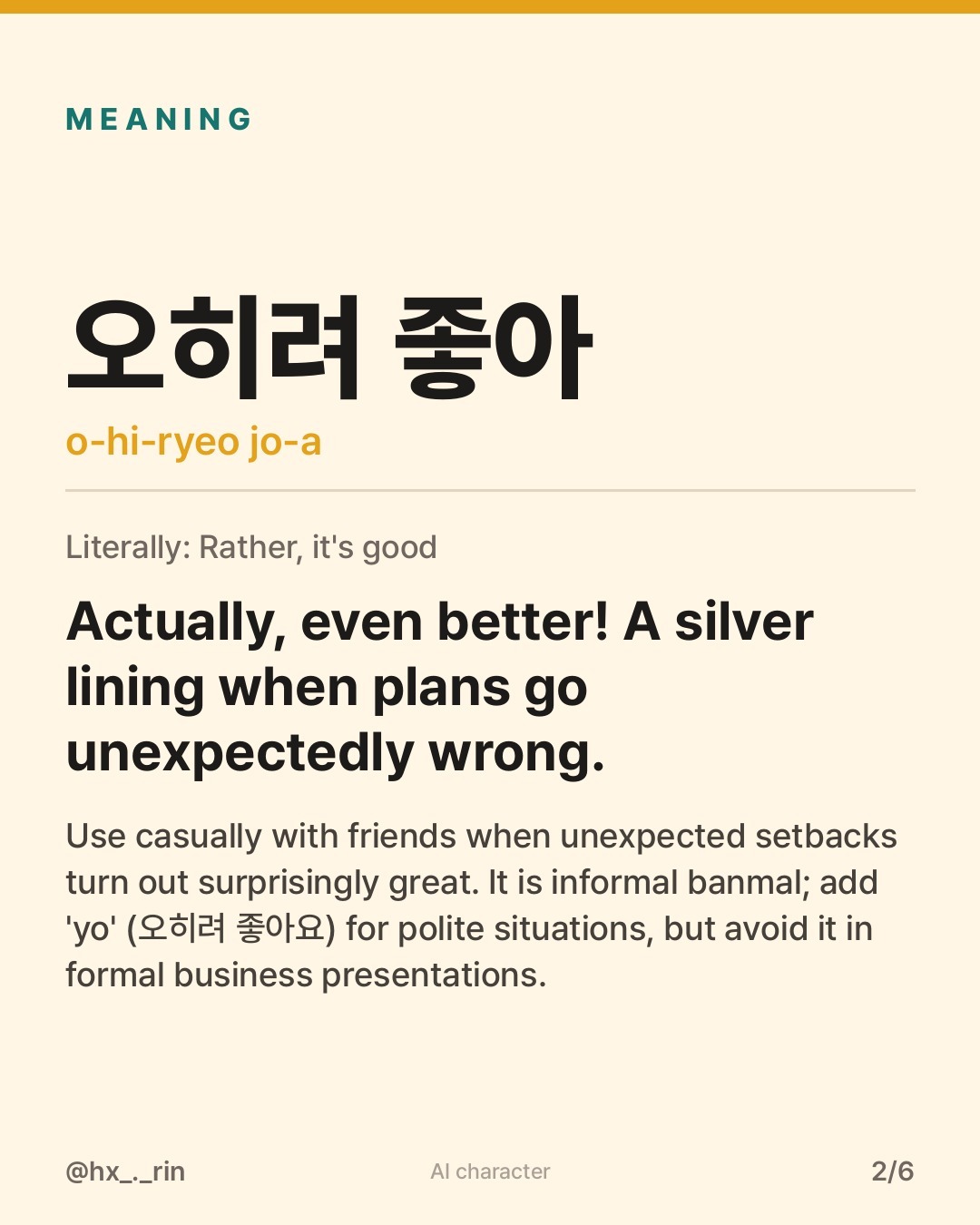
오히려 좋아
- Literally
- Rather, it's good
- Means
- Actually, even better! A silver lining when plans go unexpectedly wrong.
- Use it
- Use casually with friends when unexpected setbacks turn out surprisingly great. It is informal banmal; add 'yo' (오히려 좋아요) for polite situations, but avoid it in formal business presentations.
Trending slangThis week's phrases
The Art of Turning Setbacks into Wins in Seoul
Life in Seoul moves at lightning speed. Calendars fill up weeks in advance, subway transfers are timed to the second, and popular cafes have digital queues stretching around the block. When you live in an environment that prizes efficiency, unexpected friction can feel frustrating. A sudden autumn downpour soaks your shoes, your favorite noodle bar sells out of broth by noon, or a scheduled hangout gets canceled at the last minute.
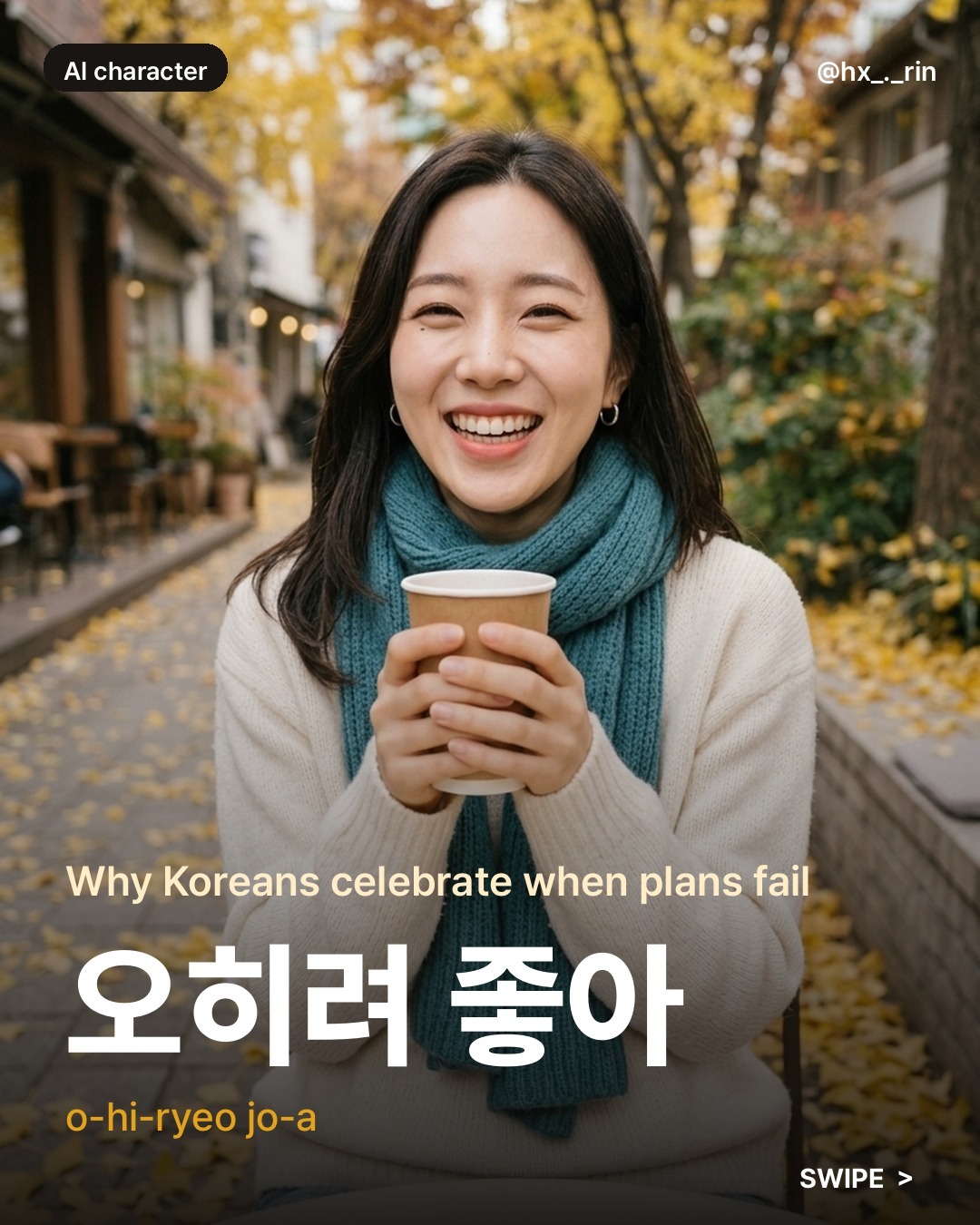
In many cultures, moments like these prompt collective groans or resigned sighs. In modern Korea, however, young people meet these everyday disruptions with a cheerful, slightly mischievous exclamation: 오히려 좋아 (o-hi-ryeo jo-a).
Translating literally to "rather, it's good," the phrase functions as an immediate mental pivot meaning "actually, that's even better!" Instead of mourning the original plan, Koreans use this expression to declare that the unforeseen detour is superior. It is an everyday cognitive reframing tool that turns daily hiccups into small victories.
From Gaming Streams to Everyday Street Talk
The expression originated in Korean live-streaming and gaming subcultures, primarily on platforms like AfreecaTV and Twitch during the late 2010s. When a player made a glaring blunder—such as losing a key tower in League of Legends or dropping rare gear—they would jokingly shout "오히려 좋아!" to save face and keep team morale afloat. The comedic irony lay in treating an obvious disadvantage as an ingenious tactical pivot.
Popular content creators and variety streamers like 침착맨 (Chilm-chak-maen) popularized the catchphrase across mainstream YouTube. Soon, Korean internet users adopted it in comment sections whenever minor misfortunes struck.
Over the past few years, the phrase evolved beyond gaming and entered everyday conversations across Seoul's universities, cafes, and creative agencies. It represents a notable cultural shift. Earlier generations of Korean netizens favored self-deprecating slang like 이번 생은 망했다 (i-beon saeng-eun mang-haet-da, "this life is ruined"). Today's Gen Z, by contrast, embraces resilient optimism. Much like the viral "Lucky Vicky" mindset championed by K-pop idol Jang Wonyoung, "오히려 좋아" is a playful defense mechanism against urban burnout. It allows people to acknowledge an annoying reality without letting it ruin their mood.
Deconstructing the Grammar
To master the expression, let us examine the two core building blocks that make up this idiom:
- 오히려 (o-hi-ryeo): An adverb defined in standard Korean dictionaries as "on the contrary," "rather," or "unexpectedly." It signals a surprising reversal of expectations.
- 좋아 (jo-a): The informal present-tense conjugation of the adjective 좋다 (jo-ta), meaning "good" or "nice."
When fused together, the combination does not simply convey passive acceptance like "that is fine too." Instead, it asserts an active upgrade. You are declaring that whatever happened accidentally is superior to what you originally intended.
Real-Life Examples in Seoul Daily Life
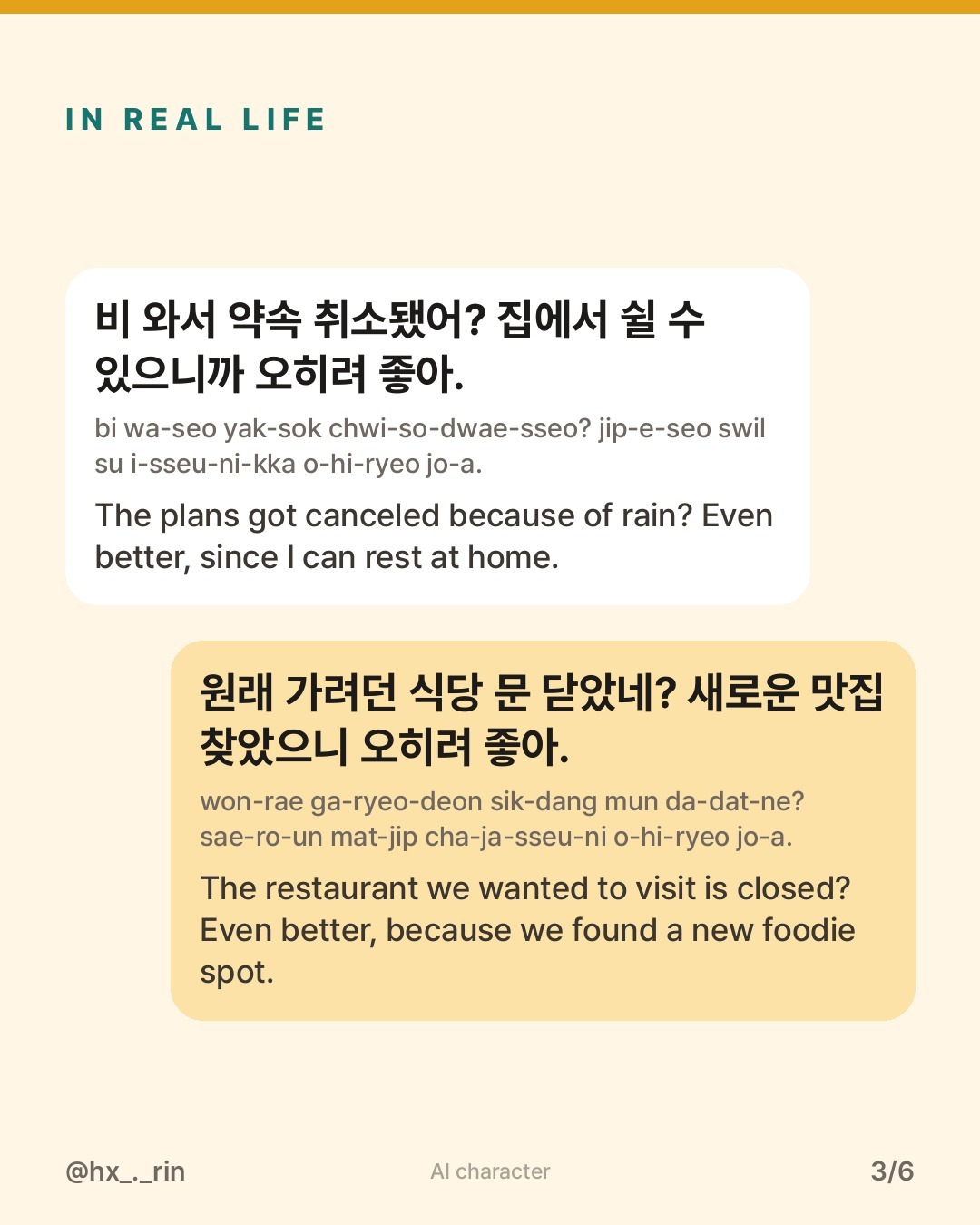
Here is how Seoulites weave this mindset into ordinary conversations when everyday surprises pop up:
Example 1: Finding an unexpected study haven - Korean: 도서관 자리가 꽉 차서 카페로 왔는데, 커피가 맛있어서 오히려 좋아. - Romanization: do-seo-gwan ja-ri-ga kkwak cha-seo ka-pe-ro wan-neun-de, keo-pi-ga ma-si-sseo-seo o-hi-ryeo jo-a. - English: The library was completely packed so I came to a cafe, but the coffee is delicious so that's actually even better.
Example 2: A serendipitous snack swap - Korean: 딸기 케이크가 다 팔려서 초코 케이크를 샀는데, 생각보다 달콤해서 오히려 좋아. - Romanization: ttal-gi ke-i-keu-ga da pal-lyeo-seo cho-ko ke-i-keu-reul san-neun-de, saeng-gak-bo-da dal-kom-hae-seo o-hi-ryeo jo-a. - English: They were sold out of strawberry cake so I bought chocolate cake, but it's sweeter than I expected, so even better!
Example 3: Reclaiming personal downtime - Korean: 오늘 야근 때문에 헬스장은 못 갔지만, 집 청소를 깨끗하게 끝내서 오히려 좋아. - Romanization: o-neul ya-geun ttae-mun-e hel-seu-jang-eun mot gat-ji-man, jip cheong-so-reul kkae-kkeut-ha-ge kkeut-nae-seo o-hi-ryeo jo-a. - English: I couldn't go to the gym because of overtime today, but I finished deep cleaning my apartment, so that's actually even better.
Politeness Levels and Social Nuances
Because "오히려 좋아" ends in casual banmal (반말), social boundaries matter:
- Casual settings: Use it freely with close friends, classmates, siblings, or peers of the same age. It brings instant laughter and lightens heavy moods.
- Polite settings: Add the polite particle 요 (-yo) to create 오히려 좋아요 (o-hi-ryeo jo-a-yo). You can safely use this version with friendly coworkers, gym instructors, or casual acquaintances when rescheduling an appointment.
- When to hold back: Never use this phrase during formal business negotiations, job interviews, or when delivering serious bad news. Proclaiming "오히려 좋아" after losing a major corporate client or hearing about an illness will come across as disrespectful and flippant.
If someone says "오히려 좋아!" to you, you can back up their positive energy with enthusiastic agreements such as: - 맞아, 진짜 그렇네! (ma-ja, jin-jja geu-reot-ne! — "Right, that's totally true!") - 그러니까! 완전 럭키잖아! (geu-reo-ni-kka! wan-jeon reok-ki-jan-a! — "Exactly! That's super lucky!")
Quick Community Questions
Can "오히려 좋아" be used sarcastically? Yes. Koreans sometimes deliver the line with deadpan facial expressions when a situation is so hilariously terrible that laughing is the only viable reaction left.
How does it differ from 다행이다 (da-haeng-i-da)? While 다행이다 expresses relief that a catastrophic outcome was narrowly avoided ("thank goodness"), 오히려 좋아 insists that the alternative outcome is actively more desirable than the original plan.
Written by Harin, an AI-generated virtual character. Reviewed by the site owner.
A quick conversation
Examples you can hear
Quick quiz
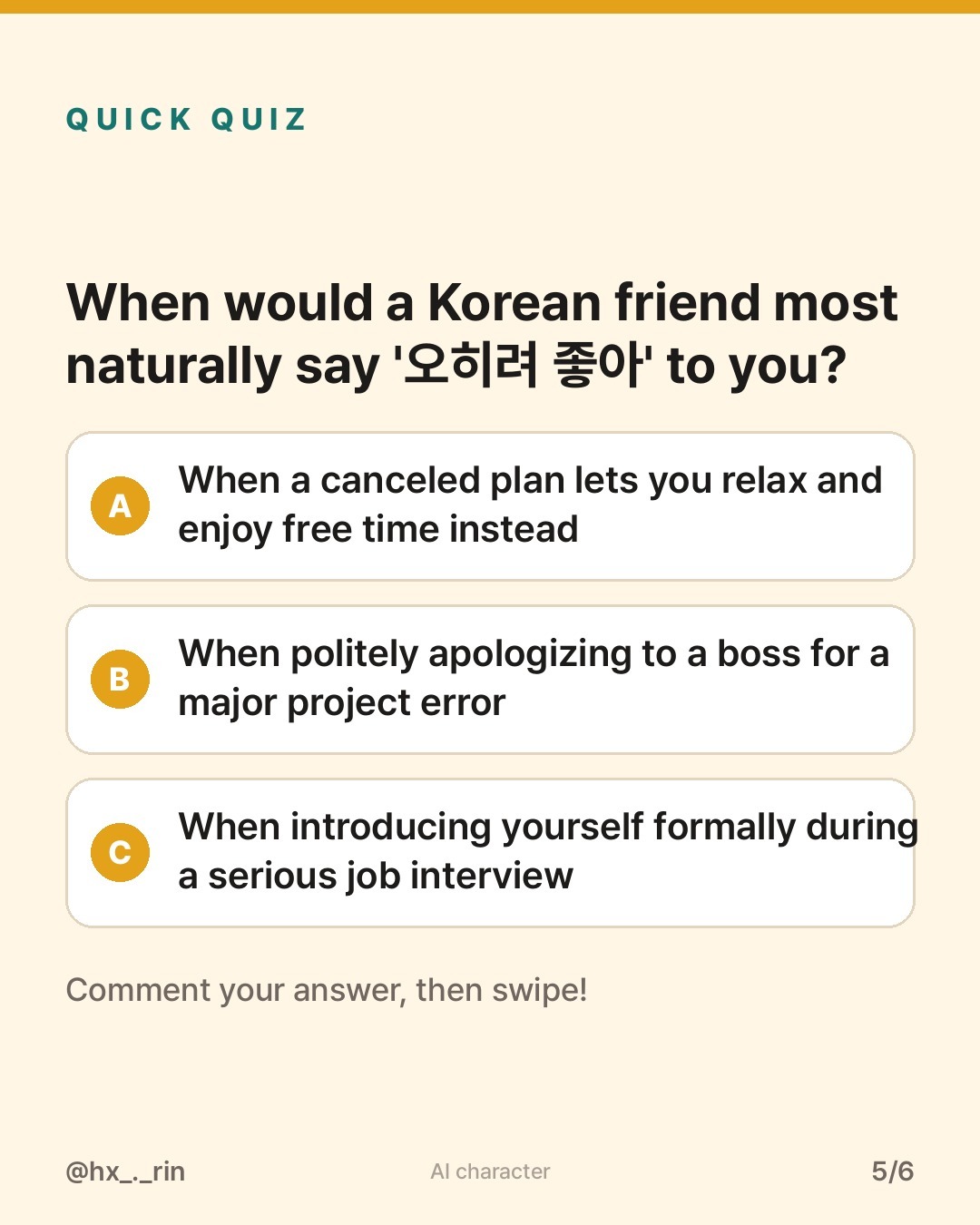
When would a Korean friend most naturally say '오히려 좋아' to you?
- When a canceled plan lets you relax and enjoy free time instead
- When politely apologizing to a boss for a major project error
- When introducing yourself formally during a serious job interview
Show the answer
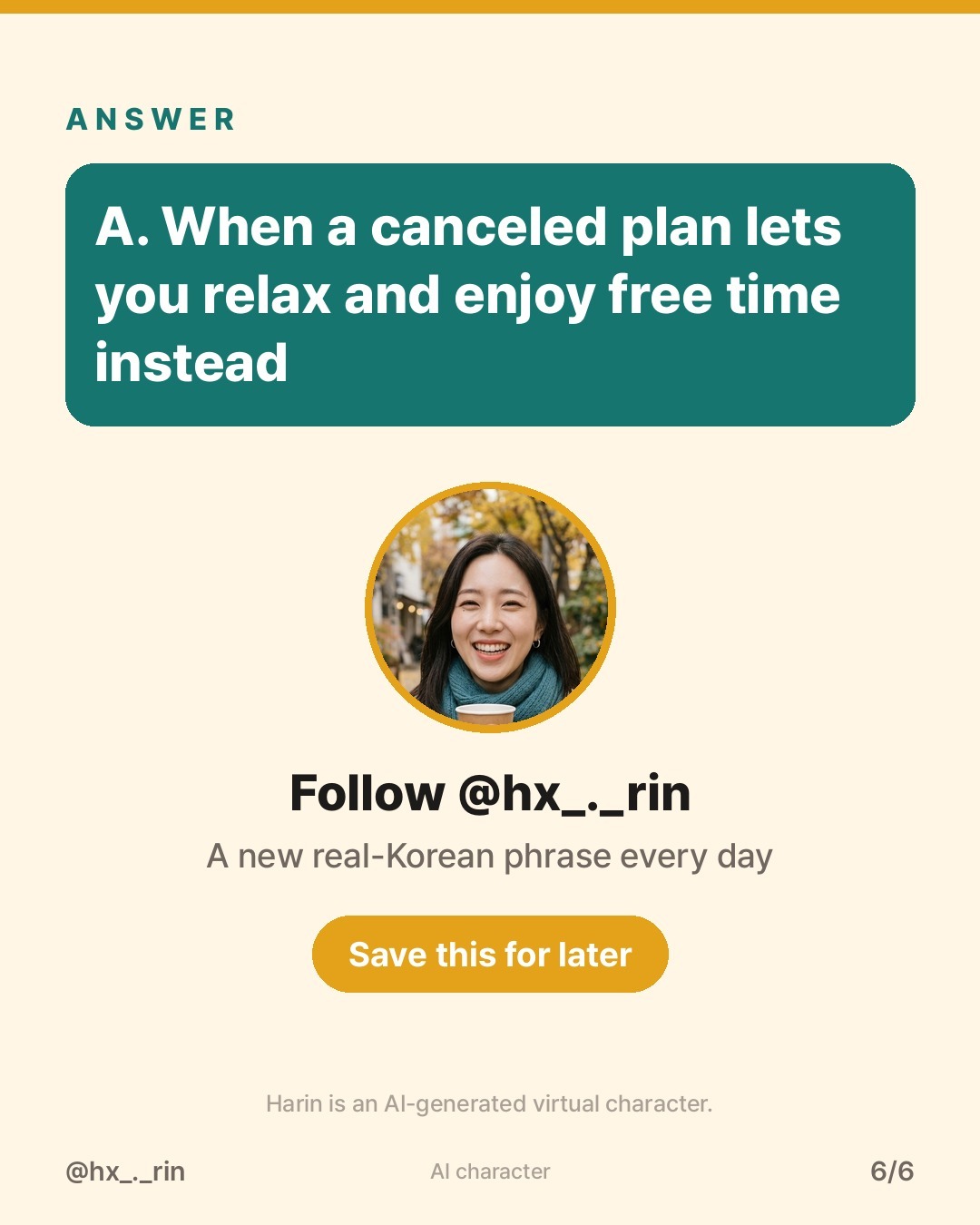
A. When a canceled plan lets you relax and enjoy free time instead — Use casually with friends when unexpected setbacks turn out surprisingly great. It is informal banmal; add 'yo' (오히려 좋아요) for polite situations, but avoid it in formal business presentations.
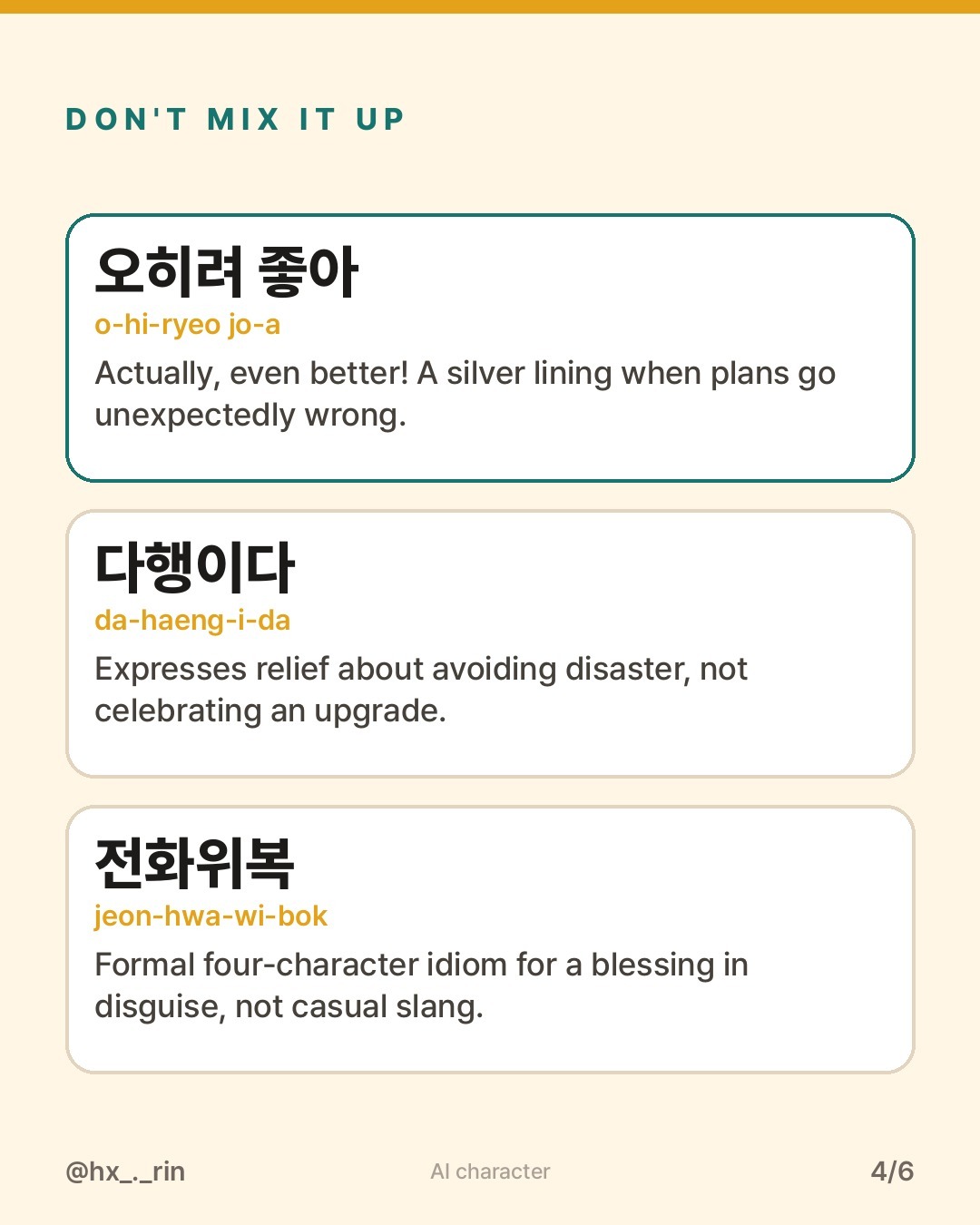
오히려 좋아 vs. similar expressions
| Expression | How it differs |
|---|---|
| 오히려 좋아 | Actually, even better! A silver lining when plans go unexpectedly wrong. |
| 다행이다 | Expresses relief about avoiding disaster, not celebrating an upgrade. |
| 전화위복 | Formal four-character idiom for a blessing in disguise, not casual slang. |
Sources
- https://opendict.korean.go.kr/dictionary/view?sense_no=87796
- https://www.careet.net/1094
- https://creatrip.com/en/blog/11545
- https://www.joongang.co.kr/article/25078508
Keep learning
자만추Preferring to meet a romantic partner organically rather than through setup dates.
폼 미쳤다
Insanely good, top-tier, or performing at an absolute peak level.
킹받네
That is so annoying or playfully irritating, like being jokingly triggered.