How to Pronounce 괜찮아요 (Gwaenchanayo) in Korean
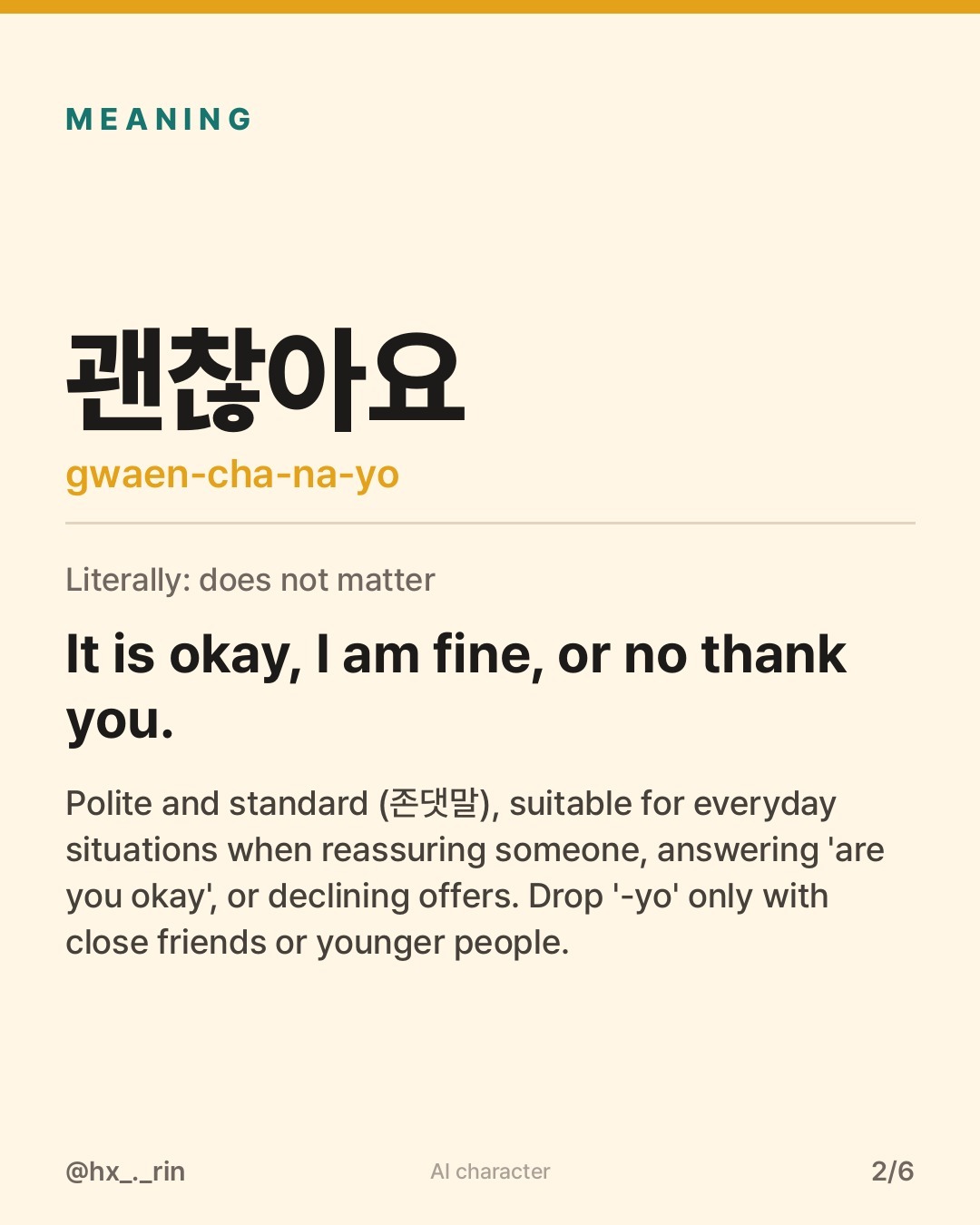
괜찮아요
- Literally
- does not matter
- Means
- It is okay, I am fine, or no thank you.
- Use it
- Polite and standard (존댓말), suitable for everyday situations when reassuring someone, answering 'are you okay', or declining offers. Drop '-yo' only with close friends or younger people.
PronunciationThis week's phrases

The Trap Hiding Inside Korea's Friendliest Word
If you have ever opened a Korean textbook or watched a K-drama, you have heard 괜찮아요 dozens of times. On paper, it looks like a warm, comforting hug of a phrase. In practice, almost every Korean learner hits a massive pronunciation wall the very first time they try to read it aloud.
The most common mistake learners make is trying to sound out every single letter they see. When people look at the second syllable, 찮, their eyes land on that complex double consonant at the bottom: ㄴㅎ. Believing that every letter must be voiced, beginners often push out a hard, awkward breath: "gwaen-chan-ha-yo" or "gwaen-chan... a-yo."
It sounds choppy, robotic, and exhausting to say. Even worse, some learners get so intimidated by the cluster that they freeze entirely mid-sentence. But here is the secret that native Seoul speakers take for granted: that letter ㅎ is completely silent here. You never pronounce it.
Why the Silent "H" Happens (Without the Headache)
To understand why this happens, look closely at how Korean syllables connect when we speak naturally.
The syllable block 찮 contains what linguists call a compound final consonant (gyeop-batchim), made of ㄴ (n) and ㅎ (h). Under the official standard pronunciation rules set by the National Institute of Korean Language (국립국어원 표준 발음법 제12항), whenever a syllable ending in ㄶ or ㅀ is immediately followed by a vowel—like the 아 in -아요—the consonant ㅎ completely drops out. It vanishes into thin air.
Once the ㅎ drops, the empty circle ㅇ in the next syllable acts as an open vowel slot. The remaining ㄴ slides right across the syllable boundary through liaison (yeoneum).
So while your eyes read: 괜 - 찮 - 아 - 요
Your mouth should only ever produce: [괜 - 차 - 나 - 요] (gwaen-cha-na-yo)
If this pattern feels unfamiliar, think about other common words you might already know. For instance, 좋아요 is pronounced [조아요] (jo-a-yo), not joh-a-yo. Similarly, 많아요 is pronounced [마나요] (ma-na-yo), not man-ha-yo. The phrase 괜찮아요 follows this exact same rule: the ㅎ simply steps aside so the sounds can connect smoothly. Recognizing this family of words makes your listening and speaking click into place across dozens of everyday conversations.
What Natives Actually Say on the Streets of Seoul
Koreans say this ALL the time, and when spoken at natural conversational speed in Seoul, the rhythm is fast and effortless. In casual daily chats, you will even notice many native speakers slightly relax the first diphthong ㅙ (wae) into a simpler, softer vowel, sounding almost like gaen-cha-na-yo.
Beyond the pronunciation, learners often misunderstand just how versatile this single expression is. Depending on your intonation and context, 괜찮아요 handles three major jobs in everyday Korean:
- Reassurance: "I am totally fine" or "No worries at all."
- Polite Refusal: "No thank you, I am good" (the standard way to turn down a receipt or plastic bag).
- Approval: "That looks good" or "That works for me."
Here are three natural ways to hear and use it in daily life:
-
매운 음식 잘 못 먹는데, 이 찌개는 진짜 괜찮네요.
mae-un eum-sik jal mot meong-neun-de, i jji-gae-neun jin-jja gwaen-chan-ne-yo.
"I cannot really handle spicy food, but this stew is actually really good." -
물 한 잔 더 드릴까요? — 아니요, 전 괜찮아요.
mul han jan deo deu-ril-kka-yo? — a-ni-yo, jeon gwaen-cha-na-yo.
"Can I bring you another glass of water? — No, I am all set, thank you." -
내일 저녁 일곱 시에 만나는 거 괜찮아요?
nae-il jeo-nyeok il-gop si-e man-na-neun geo gwaen-cha-na-yo?
"Is meeting at seven tomorrow evening okay with you?"
Notice how the tone shifts the meaning. A rising pitch turns it into a question (괜찮아요? "Are you okay?"), while a gentle falling pitch turns it into reassurance (괜찮아요. "I am fine.").
Quick Guide: What to Do and What to Skip
To keep your speech sounding natural and polished, keep these practical rules in mind:
Do
- Glide the "n" over: Connect the sound into gwaen-cha-na-yo without pausing between syllables.
- Use it to decline politely: When a cashier asks if you need a plastic bag or receipt, a gentle 괜찮아요 with a small nod is the most natural way to say "No thank you."
- Drop the "-yo" only with close peers: Say 괜찮아 (gwaen-cha-na) exclusively to close friends of the same age or younger.
Don't
- Do not force the "h": Never say gwaen-chan-ha-yo. The ㅎ is 100% silent before vowels.
- Do not spell it phonetically in writing: Even though it sounds like 괜차나요, always write it correctly as 괜찮아요 in text messages and formal writing.
- Do not confuse it with 됐어요: While 됐어요 (dwae-sseo-yo) can also mean "no thanks," it often carries a sharp, annoyed undertone ("enough already"). Stick to 괜찮아요 when you want to stay warm and polite.
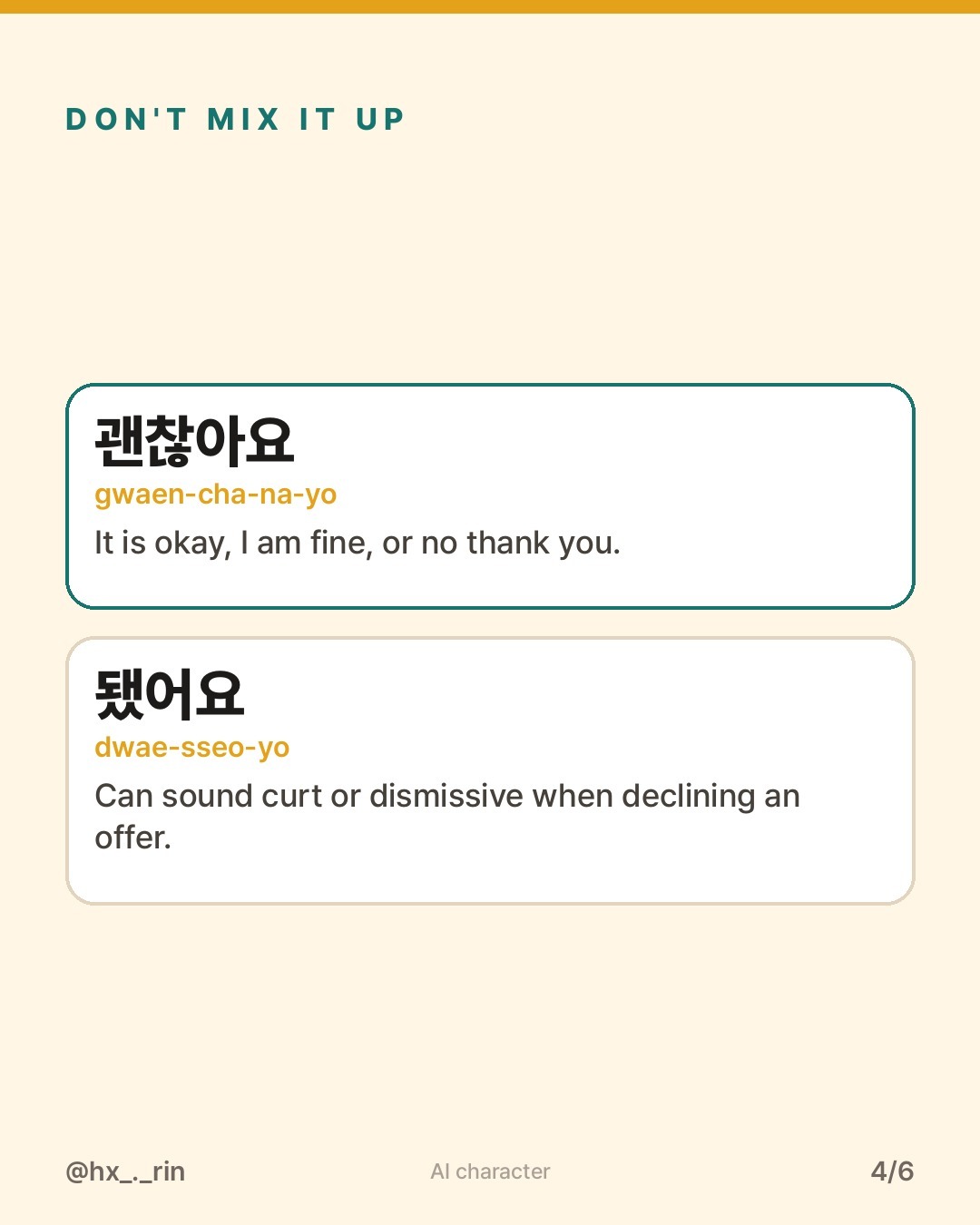
괜찮아요 vs. similar expressions
| Expression | How it differs |
|---|---|
| 괜찮아요 | It is okay, I am fine, or no thank you. |
| 됐어요 | Can sound curt or dismissive when declining an offer. |
Examples you can hear
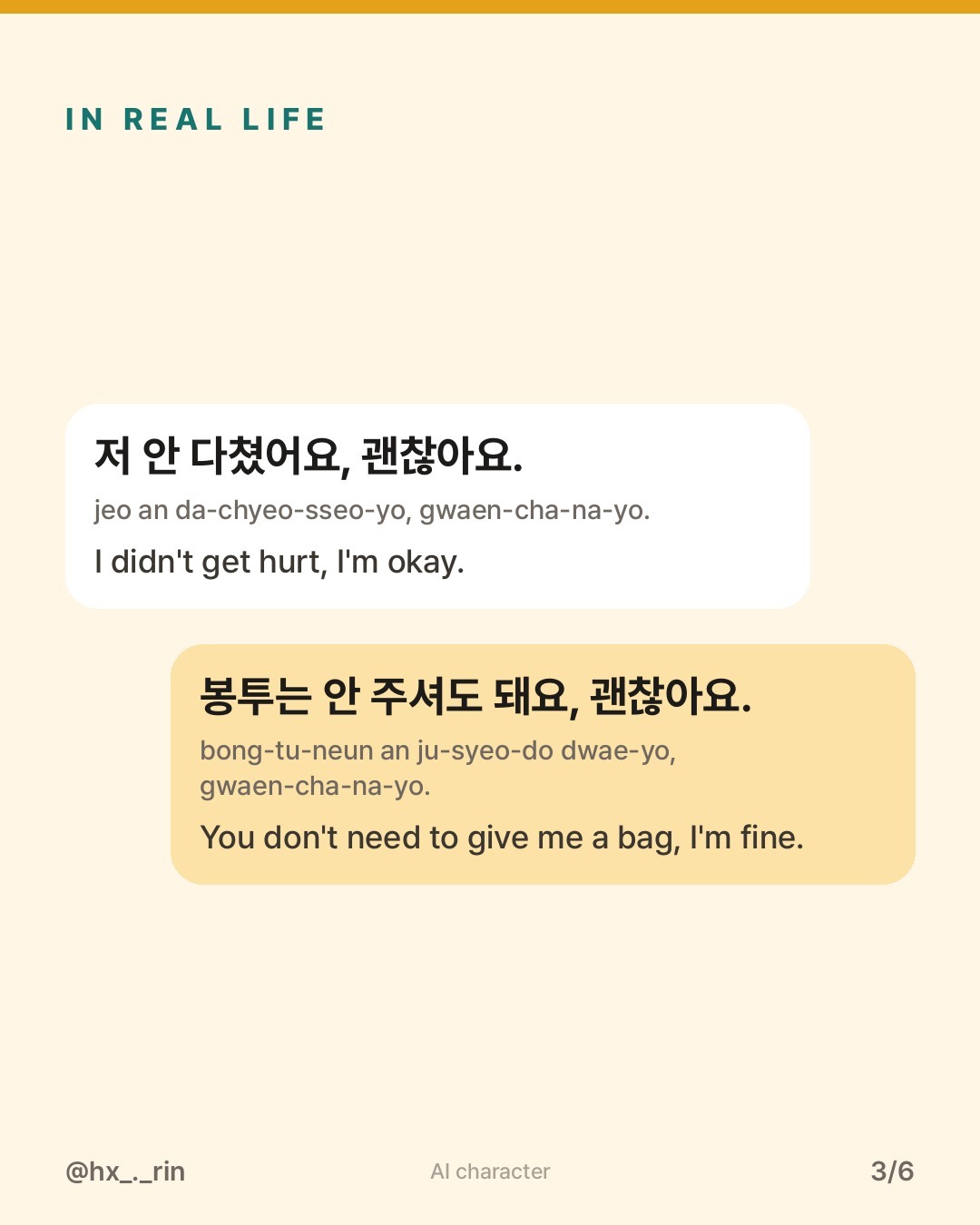
A quick conversation
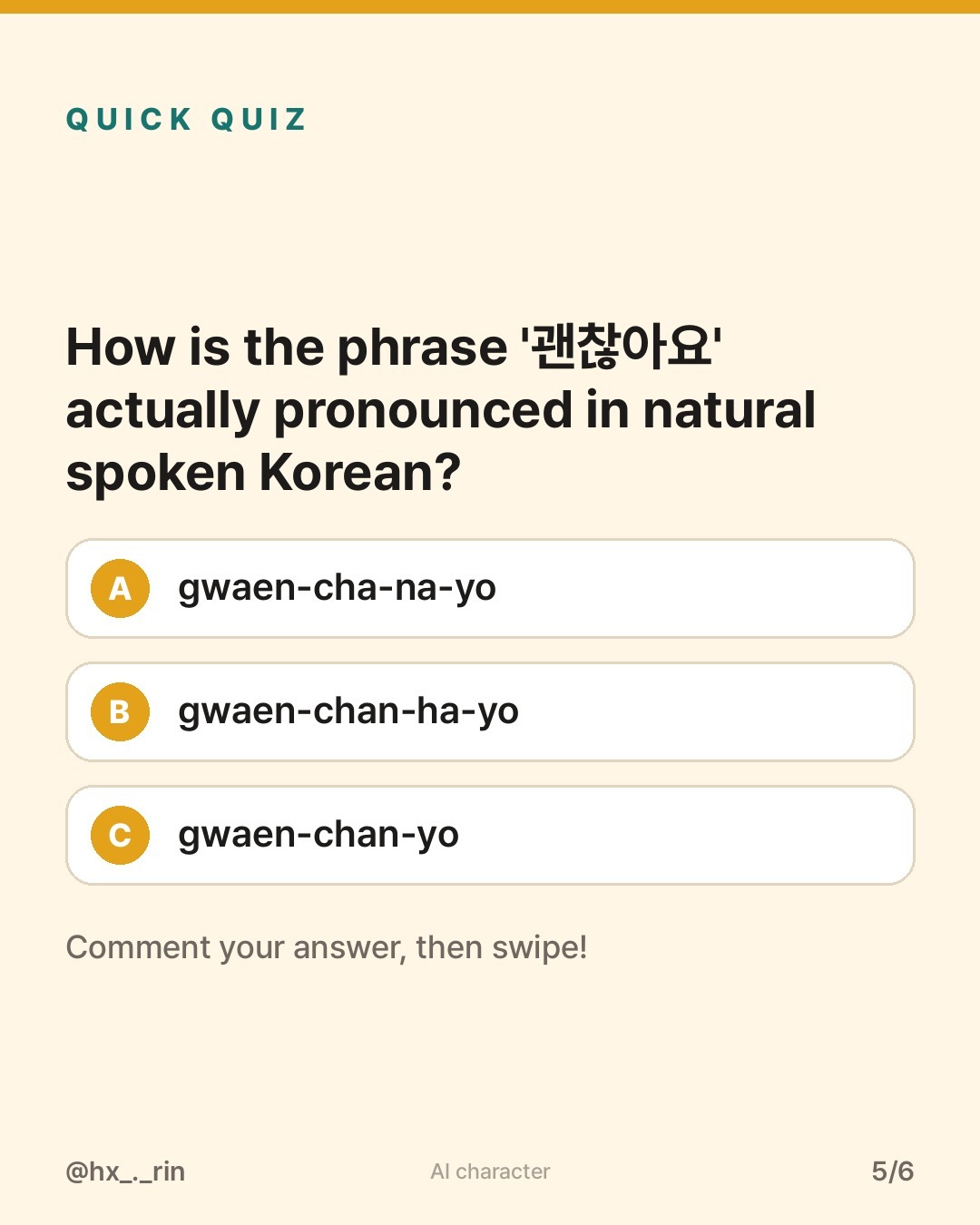
Quick quiz
How is the phrase '괜찮아요' actually pronounced in natural spoken Korean?
- gwaen-cha-na-yo
- gwaen-chan-ha-yo
- gwaen-chan-yo
Show the answer
A. gwaen-cha-na-yo — Polite and standard (존댓말), suitable for everyday situations when reassuring someone, answering 'are you okay', or declining offers. Drop '-yo' only with close friends or younger people.
Sources
- https://krdict.korean.go.kr
- https://stdict.korean.go.kr
- https://talktomeinkorean.com/curriculum/level-4-korean-grammar/lessons/level-4-lesson-7/
Keep learning
괜찮아요It's okay, I'm fine, or a polite way to decline an offer.
연락해요
Keep in touch, or let's stay in contact.
막내
The youngest person in a family, friend group, workplace team, or organization.