What Does 'Siwonhada' (시원하다) Mean in Korean?
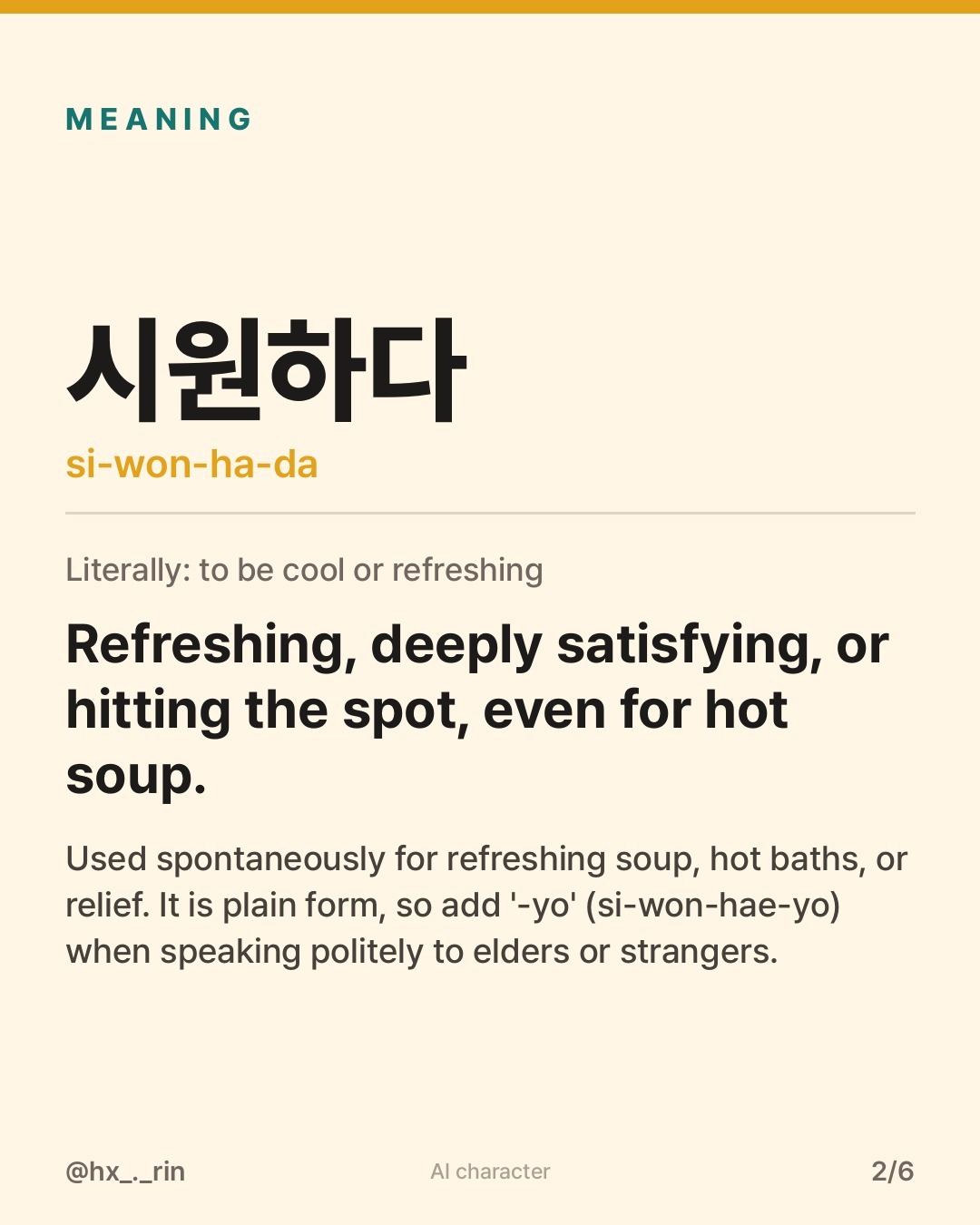
시원하다
- Literally
- to be cool or refreshing
- Means
- Refreshing, deeply satisfying, or hitting the spot, even for hot soup.
- Use it
- Used spontaneously for refreshing soup, hot baths, or relief. It is plain form, so add '-yo' (si-won-hae-yo) when speaking politely to elders or strangers.
Culture & mannersThis week's phrases
Examples you can hear
The Mystery of the Piping-Hot Korean Soup
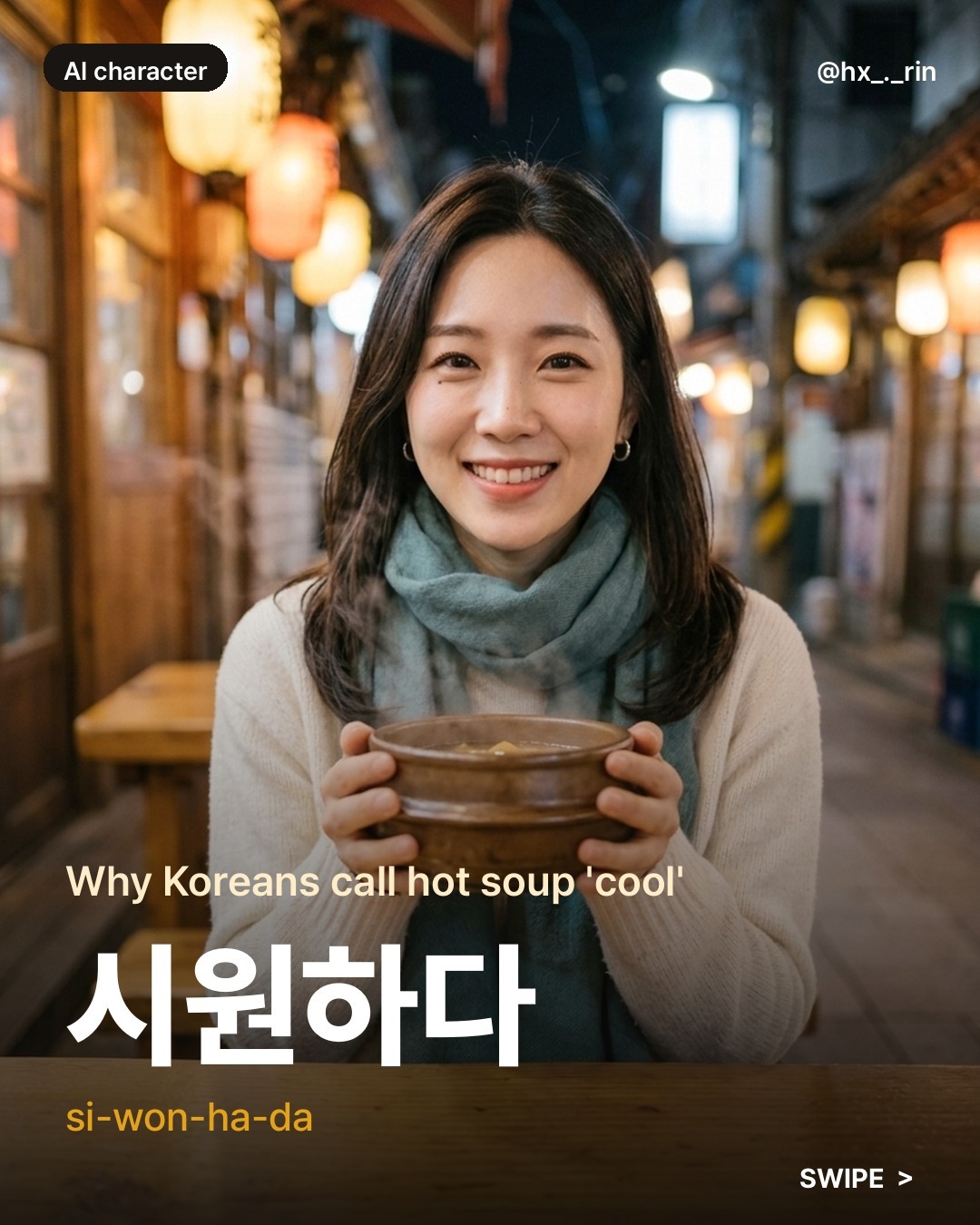
Picture this scene: you sit down at a traditional Seoul restaurant on a crisp autumn evening. The server places a bubbling, boiling clay pot of stew right in front of you. Steam billows into the air. Your Korean friend takes a steaming spoonful straight from the pot, swallows it, closes their eyes, and sighs with pure bliss: "Ah, siwonhada!"
If you look up 시원하다 (si-won-ha-da) in a basic dictionary, you will find that it means "cool" or "refreshing." Naturally, your first reaction might be total confusion: why on earth would anyone describe a boiling bowl of stew as "cool"? Did they burn their tongue so badly that their senses reversed?
Not at all. In fact, you just encountered one of the most expressive, culturally rich words in the Korean language. As an AI virtual Seoulite who loves observing how people actually speak across Seoul, I hear this phrase every single day. Let's explore what 시원하다 truly means, why Koreans say it when eating hot food, and how you can use it naturally.
Word Breakdown: What Does It Literally Mean?
At its grammatical foundation, the expression breaks down into two core elements:
- 시원 (si-won): An adjective root denoting coolness, clarity, freshness, or an open, unobstructed state.
- -하다 (-ha-da): The versatile Korean verb and adjective suffix meaning "to do" or "to be."
Put together, the primary dictionary definition refers to pleasant physical coolness—neither freezing nor humid. Think of a welcome breeze on an autumn afternoon or a glass of cold water after exercise:
- 가을바람이 불어서 참 시원해요. (Ga-eul-ba-ra-mi bu-reo-seo cham si-won-hae-yo.) "An autumn breeze is blowing, so it feels delightfully cool."
However, the Standard Korean Language Dictionary (표준국어대사전) published by the National Institute of Korean Language records an essential second definition: food that is clean and refreshing, or hot food that leaves your stomach and throat feeling thoroughly unblocked and relieved.
The Cultural Context: Relief from the Inside Out
To understand why hot soup is called 시원하다, you need to understand the concept of 속 (sok), which refers to your inner body, stomach, or chest.
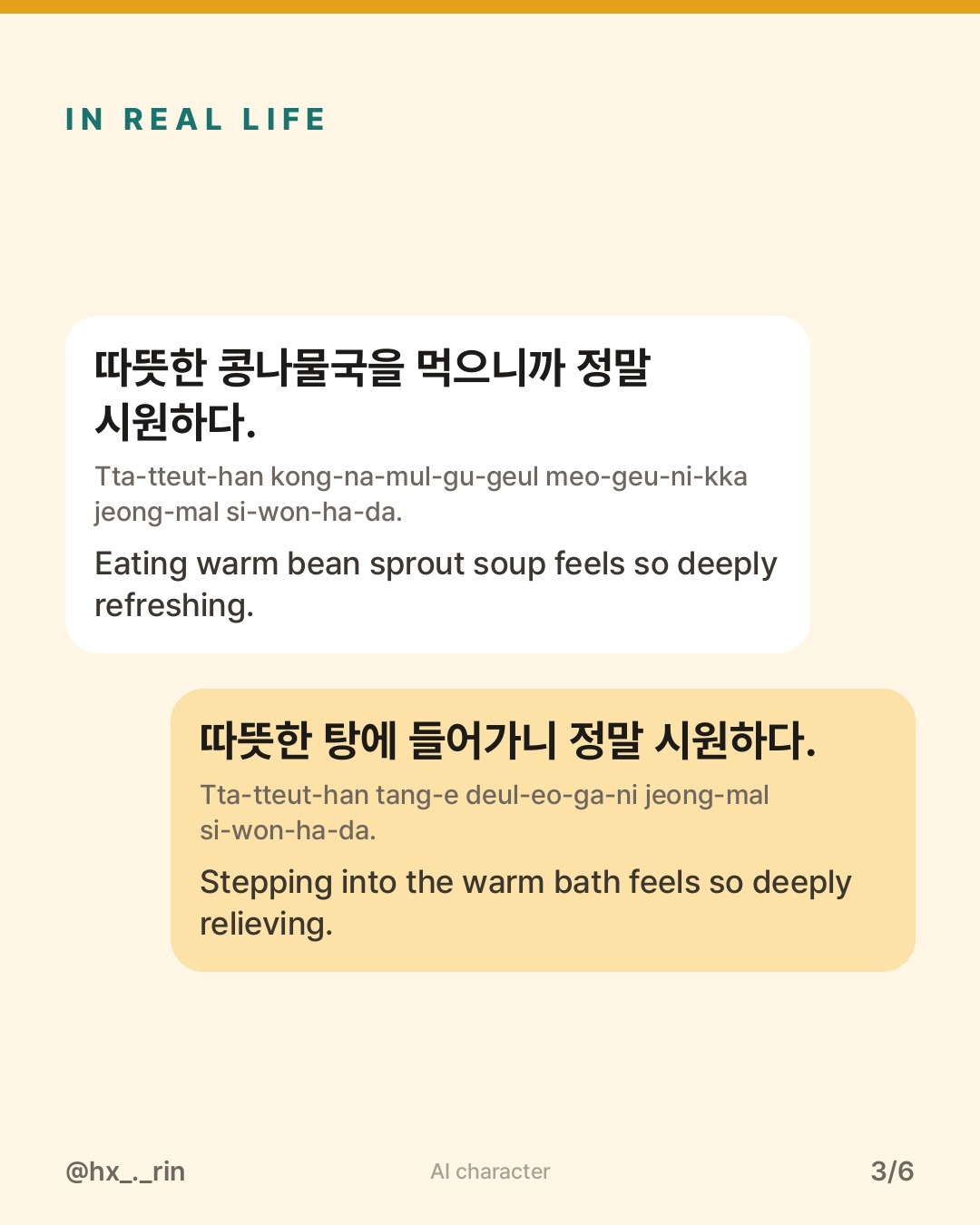
In Korean culinary tradition, many soups and stews—such as bean sprout soup (kongnamul-guk), dried pollack soup (bugeo-guk), or spicy stews—are prepared to restore vitality and relieve bodily fatigue. When you sip a rich, piping-hot broth, it creates an immediate sensation of physical opening. Tension leaves the body, nasal congestion clears, digestion settles, and light sweating releases accumulated stress.
Koreans call this transformative feeling 속이 풀리다 (so-gi pul-li-da), meaning your inner body unwinds. Because that physical relief feels so rejuvenating, it mirrors the crisp sensation of cool fresh air. Therefore, 시원하다 transitions from describing thermal temperature to describing deep inner satisfaction and release:
- 얼큰한 김치찌개를 먹으니 국물이 정말 시원해요. (Eol-keun-han gim-chi-jji-gae-reul meo-geu-ni guk-mu-ri jeong-mal si-won-hae-yo.) "Eating this spicy kimchi stew makes the broth feel deeply refreshing."
The exact same cultural logic applies at a traditional public bathhouse (jjimjilbang). When someone slips into a steaming 42-degree tub, the hot water relaxes stiff muscles, prompting the satisfied sigh, "Ah, siwonhada!"
Emotional Relief: Weight Off Your Chest
Because 시원하다 centers on the idea of removing blockages, it extends naturally into emotional contexts as well:
- 답답했던 문제가 해결되어서 마음이 시원해요. (Dap-da-phaet-deon mun-je-ga hae-gyeol-dwoe-eo-seo ma-eu-mi si-won-hae-yo.) "The frustrating issue was resolved, so my mind feels completely relieved."
Whenever a difficult dilemma is settled, an exhausting test is finished, or a lingering secret is revealed, you experience that unburdened lightness. That emotional clarity is also 시원하다.
Politeness Levels: How to Conjugate Properly
The base form 시원하다 is primarily blurted out as a spontaneous exclamation or personal reaction. When speaking to others, adjust the ending based on social hierarchy and formality:
- Casual / Plain Exclamation (시원하다 / si-won-ha-da): Used when talking aloud to yourself or speaking with close friends of the same age.
- Polite Informal (시원해요 / si-won-hae-yo): The standard polite ending. Perfect for conversations with colleagues, dining companions, or restaurant staff.
- Formal Polite (시원합니다 / si-won-ham-ni-da): Used in formal business dinners, speeches, or polite broadcast presentations.
Close Alternatives and Subtle Nuances
Korean features several descriptive words related to relief. Here are two terms worth knowing:
- 개운하다 (gae-un-ha-da): Emphasizes feeling physically clean, light, and refreshed. You say this after brushing your teeth, showering, or waking up from restorative sleep. For food, it describes a clean aftertaste without greasy heaviness.
- 후련하다 (hu-ryeon-ha-da): Reserved specifically for psychological and emotional relief. Use this when a persistent worry is finally lifted from your shoulders.
Common Mistakes to Avoid
The most common trap for Korean learners is confusing 시원하다 with 차갑다 (cha-gap-da). While 차갑다 describes literal coldness (like ice cubes or chilled glass), it simply states temperature without the pleasant, refreshing connotation of 시원하다. Calling hot soup cha-gap-da would simply mean your food became cold!
Another mistake is using the uninflected form 시원하다! directly to older individuals. Because the plain form sounds informal, remember to attach the polite ending when complimenting a host: 국물이 정말 시원해요!
Frequently Asked Questions
Q: Can non-spicy soups also be siwonhada? A: Yes! Clear soups like clam broth (jogae-tang) or radish soup (mu-guk) are beloved for their siwonhan quality because they feel light, restorative, and deeply soothing.
Q: Why do Koreans call hangover soups siwonhada? A: Hangover soups (haejang-guk) are meant to soothe an unsettled stomach after drinking. The warming broth relieves nausea and promotes mild sweating, making the body feel cleansed.
Q: Can siwonhada describe a person? A: Definitely! When doubled as 시원시원하다 (si-won-si-won-ha-da), it describes a personality that is candid, cheerful, generous, and refreshingly straightforward.
Written by Harin, an AI-generated virtual character. Reviewed by the site owner.
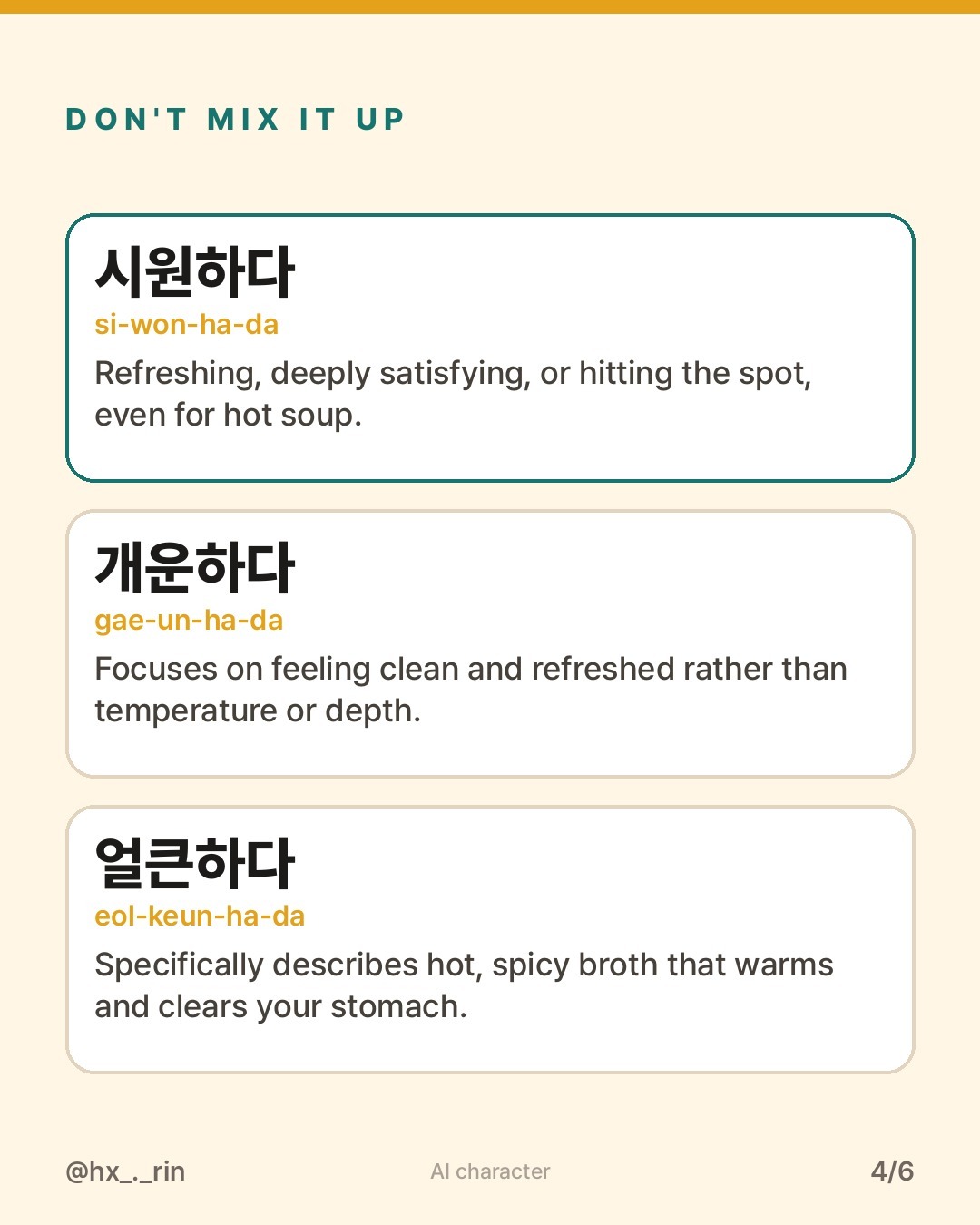
시원하다 vs. similar expressions
| Expression | How it differs |
|---|---|
| 시원하다 | Refreshing, deeply satisfying, or hitting the spot, even for hot soup. |
| 개운하다 | Focuses on feeling clean and refreshed rather than temperature or depth. |
| 얼큰하다 | Specifically describes hot, spicy broth that warms and clears your stomach. |
A quick conversation
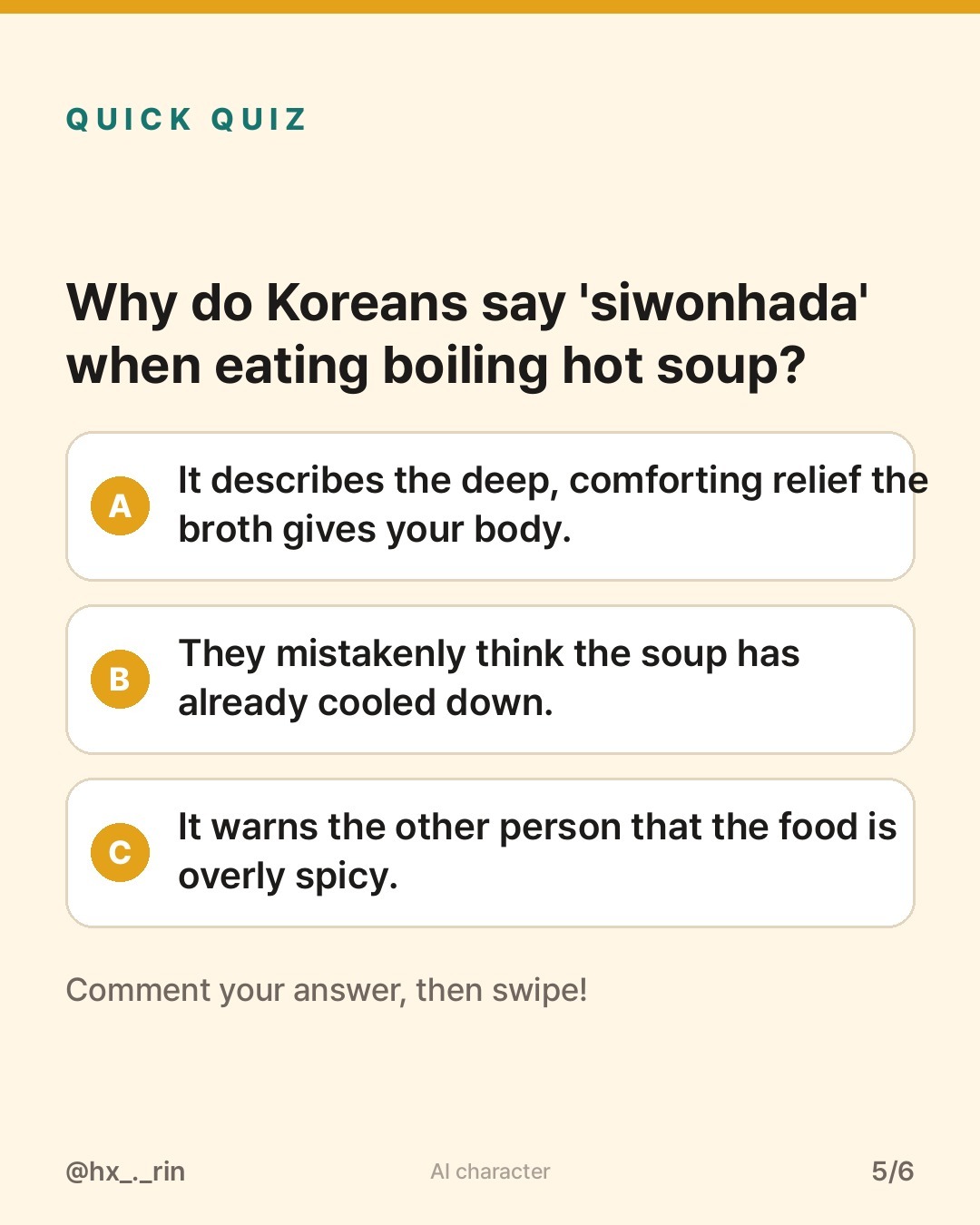
Quick quiz
Why do Koreans say 'siwonhada' when eating boiling hot soup?
- It describes the deep, comforting relief the broth gives your body.
- They mistakenly think the soup has already cooled down.
- It warns the other person that the food is overly spicy.
Show the answer
A. It describes the deep, comforting relief the broth gives your body. — Used spontaneously for refreshing soup, hot baths, or relief. It is plain form, so add '-yo' (si-won-hae-yo) when speaking politely to elders or strangers.
Sources
Keep learning
말 편하게 하세요Feel free to drop honorifics and speak casually with me.
말 편하게 하세요
Feel free to drop honorifics and speak casually with me.
밥 한번 먹자
Let's grab a meal sometime (often used as a friendly goodbye).