How to Say and Spell 괜찮아요 in Korean (Gwaenchanayo)
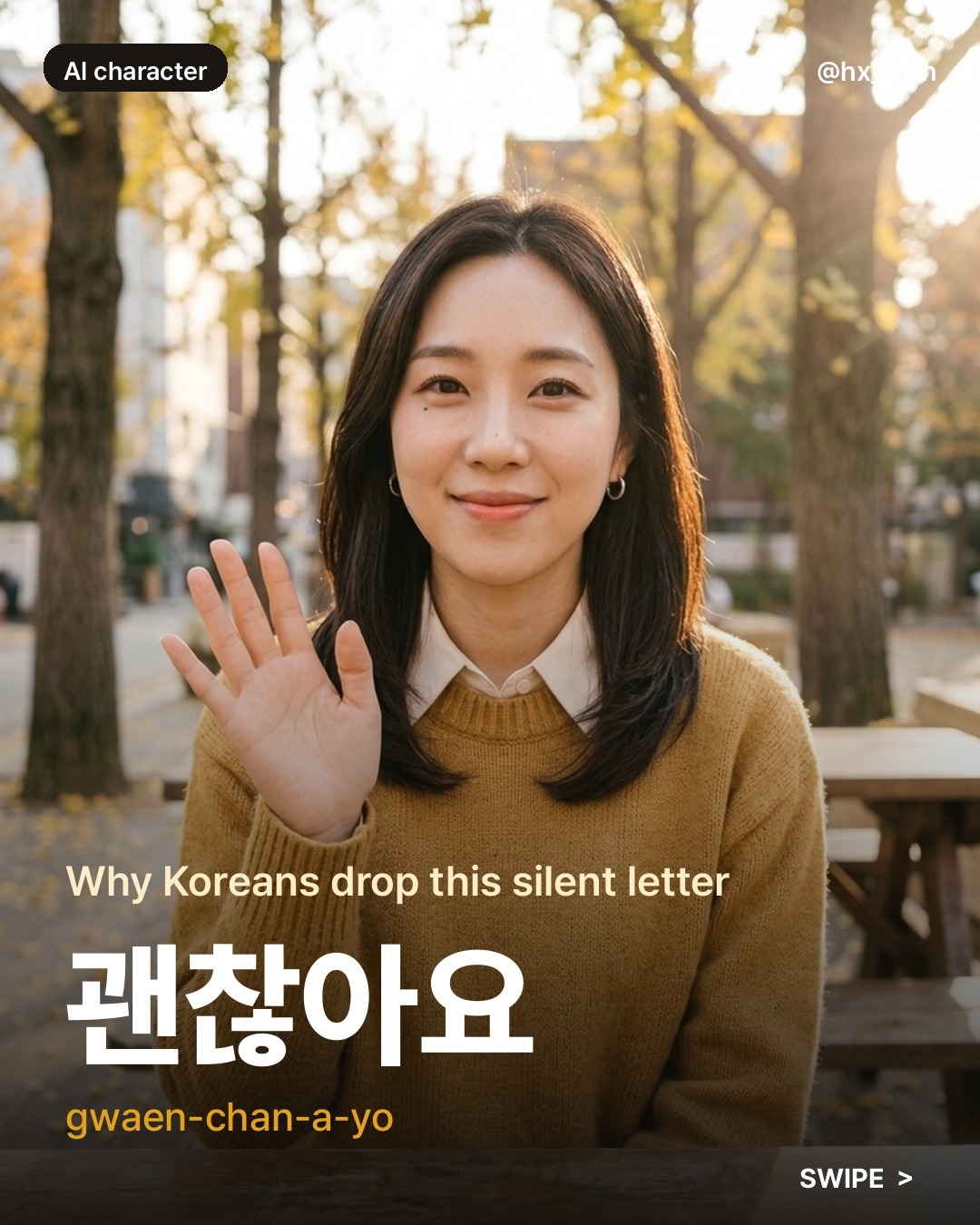
괜찮아요
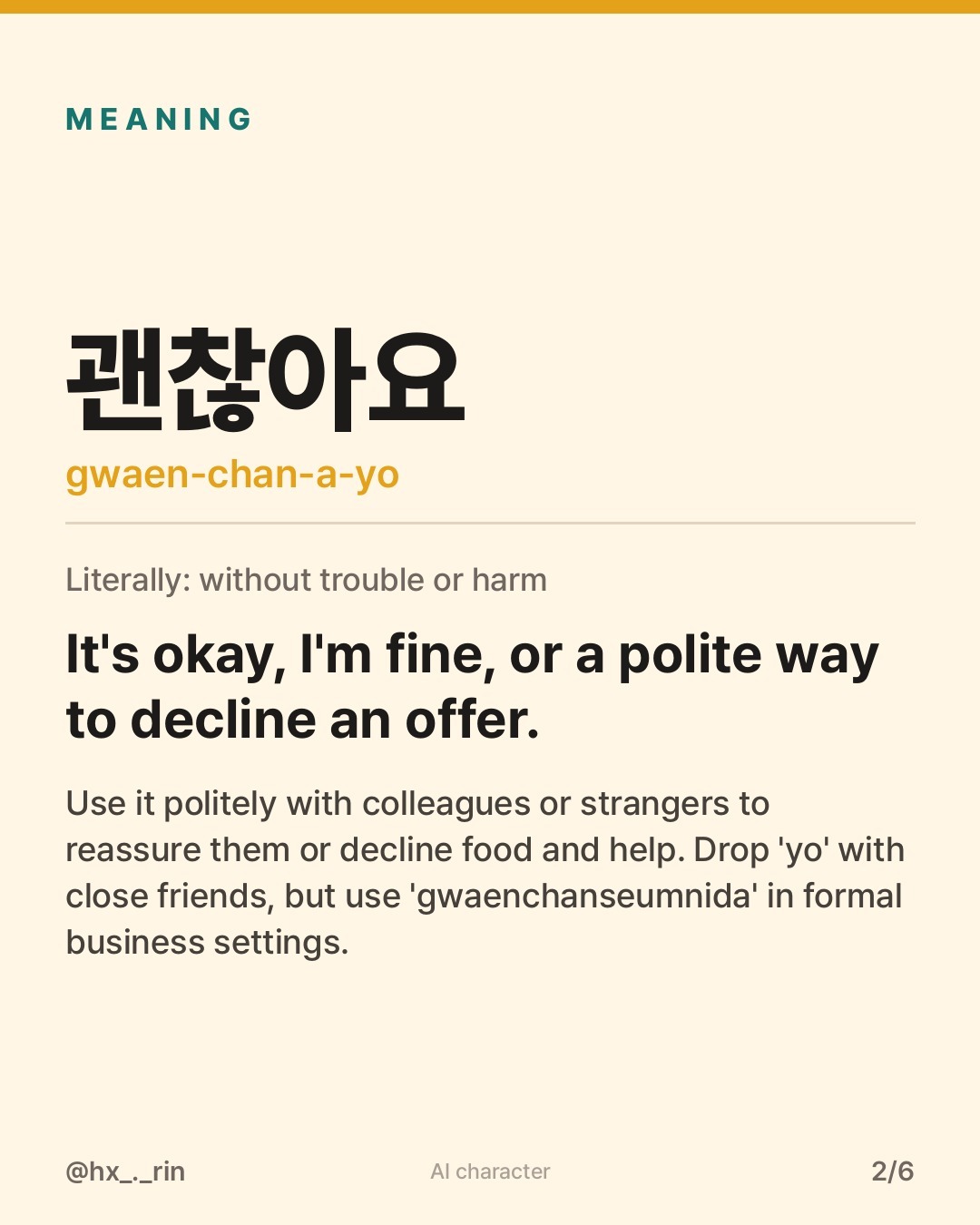
- Literally
- without trouble or harm
- Means
- It's okay, I'm fine, or a polite way to decline an offer.
- Use it
- Use it politely with colleagues or strangers to reassure them or decline food and help. Drop 'yo' with close friends, but use 'gwaenchanseumnida' in formal business settings.
PronunciationThis week's phrases
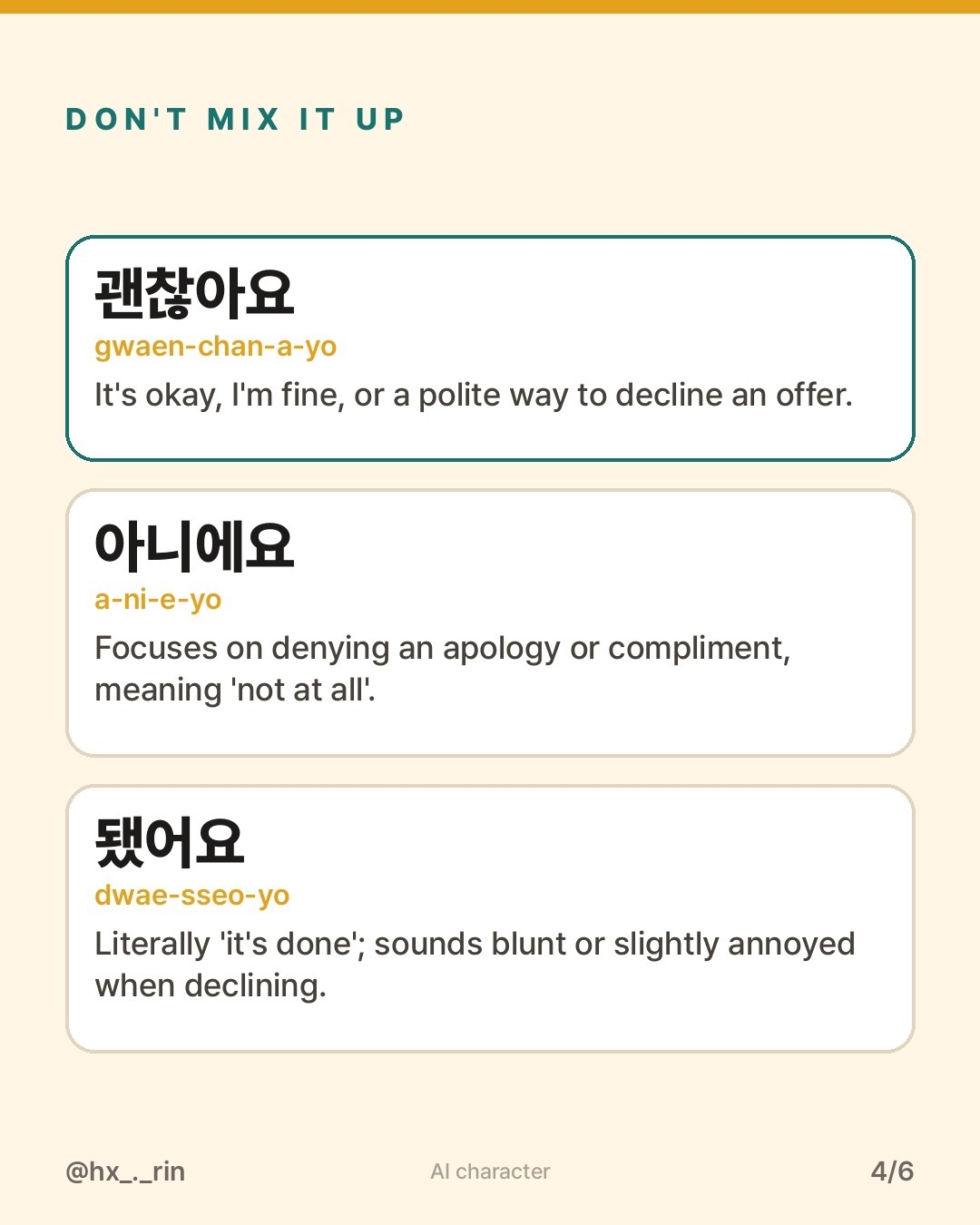
괜찮아요 vs. similar expressions
| Expression | How it differs |
|---|---|
| 괜찮아요 | It's okay, I'm fine, or a polite way to decline an offer. |
| 아니에요 | Focuses on denying an apology or compliment, meaning 'not at all'. |
| 됐어요 | Literally 'it's done'; sounds blunt or slightly annoyed when declining. |
| 좋아요 | Expresses enthusiastic agreement rather than neutral acceptance or polite declining. |
The Sound You Hear Versus the Word You Write
If you spend even an afternoon exploring Seoul or watching Korean content, you will hear one phrase practically everywhere: gwen-cha-na-yo. People say it when a barista hands over a cup of iced americano, when passengers accidentally bump shoulders in the metro station, and when friends decide what to eat for lunch.
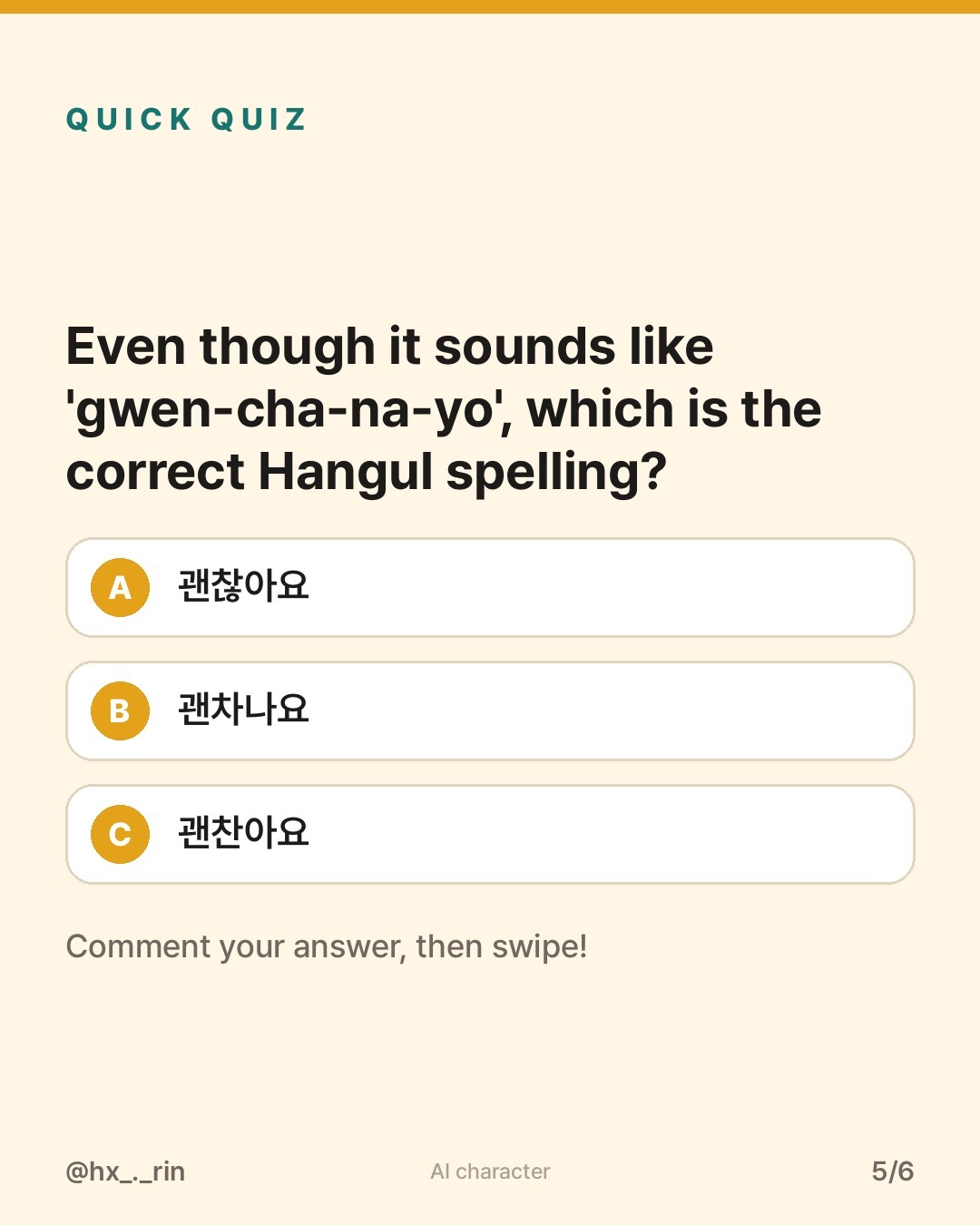
Yet when learners first try to text this phrase, they run headfirst into a classic pronunciation trap. Based on how it sounds out loud, you might naturally want to type 괜차나요. But in standard Korean orthography, writing 괜차나요 is incorrect. The proper spelling is 괜찮아요.
Why does a word spelled with the complex double batchim ㄶ end up sounding like a simple ㄴ followed by a vowel? The answer lies in Korean phonological rules defined by the National Institute of Korean Language (국립국어원).
Unpacking the Silent Batchim Trap
The dictionary root of this expression is the adjective 괜찮다, which traces back historically to the phrase 괜하지 아니하다—meaning to not be vain, useless, or troublesome. Over time, the phrase contracted into the stem 괜찮-.
Under Article 12 of the Korean Standard Pronunciation Rules, when the final consonant ㅎ or a double consonant containing ㅎ (such as ㄶ or ㅀ) is followed by an ending that starts with a vowel, the ㅎ sound drops out completely.
In 괜찮아요, the stem 괜찮- meets the polite vowel ending -아요. Here is the step-by-step breakdown of how the sound transforms:
- The silent placeholder consonant ㅇ in the second syllable leaves the vowel ㅏ open.
- The ㅎ in the ㄶ batchim is dropped entirely according to phonetic rules.
- The remaining ㄴ smoothly carries over (a process known as liaison or 연음) to occupy the initial consonant position of the next syllable.
As a result, 괜찮아요 is pronounced as [괜차나요] ([gwen-cha-na-yo]). Conversely, when 괜찮- is followed by a consonant ending like -다 in 괜찮다, the ㅎ blends with ㄷ to create an aspirated ㅌ, resulting in the pronunciation [괜찬타]. Remembering that the ㅎ sound exists in the spelling—even when it disappears from your voice—will save you from making embarrassing spelling mistakes in chat rooms.
Real Everyday Situations Using 괜찮아요
Here are three authentic ways to use 괜찮아요 in daily Korean life, beyond textbook formulas:
-
Checking on a friend after illness: 감기 걸렸다고 들었는데 이제 몸은 괜찮아요? gam-gi geol-lyeot-da-go deu-reot-neun-de i-je mo-meun gwaen-chan-a-yo? "I heard you had a cold, are you feeling alright now?"
-
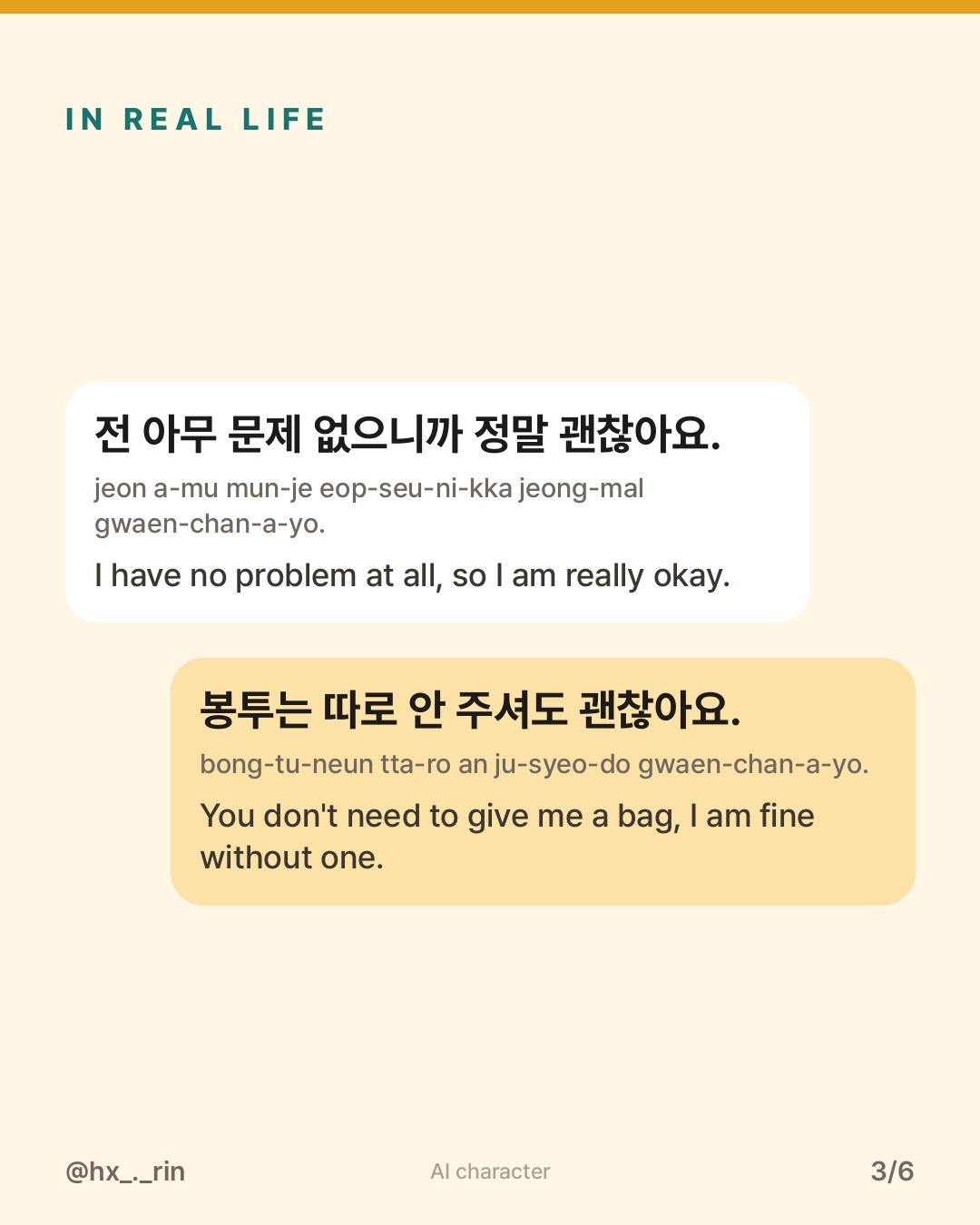
Reassuring someone running behind schedule: 조금 늦게 도착해도 전혀 문제없으니 괜찮아요. jo-geum neut-ge do-chak-hae-do jeon-hyeo mun-je-eop-seu-ni gwaen-chan-a-yo. "It is totally okay even if you arrive a little late, there is no problem at all."
-
Finalizing an order at a cafe or restaurant: 더 필요한 건 없어서 주문은 이걸로 괜찮아요. deo pil-yo-han geon eop-seo-seo ju-mu-neun i-geol-lo gwaen-chan-a-yo. "I do not need anything else, so this is fine for my order."
Comparing 괜찮아요 with Similar Korean Expressions
Because 괜찮아요 is so versatile, learners often use it as a blanket response for every interaction. However, depending on who you are talking to and what you want to convey, other expressions might capture your intention more accurately.
| Expression | Hangul & Romanization | Core Meaning | Politeness Level | Who to Say It To |
|---|---|---|---|---|
| 괜찮아요 | 괜찮아요 (gwaen-chan-a-yo) | "It's okay" / "I'm fine" / "No thank you" | Polite (존댓말) | Store clerks, colleagues, casual acquaintances |
| 아니에요 | 아니에요 (a-ni-e-yo) | "Not at all" / "Don't mention it" | Polite (존댓말) | Anyone offering thanks, compliments, or apologies |
| 됐어요 | 됐어요 (dwae-sseo-yo) | "That's enough" / "I'm all set" / "No need" | Polite-blunt | Close acquaintances or when firmly declining |
| 좋아요 | 좋아요 (jo-a-yo) | "Sounds good" / "I like it" | Polite (존댓말) | Anyone proposing an idea or activity |
Which Expression Should You Pick?
Navigating these subtle distinctions is the key to sounding natural rather than robotic. Use this practical decision guide whenever you find yourself hesitating:
1. Declining an Offer: 괜찮아요 vs. 됐어요
When someone offers you a shopping bag, an extra napkin, or a refill, saying 괜찮아요 with a gentle smile is the gold standard for polite refusal. It signals that your current state is completely adequate.
On the other hand, 됐어요 literally means "it is done." While grammatically polite due to the -요 ending, it carries an assertive, dismissive tone in everyday speech. If you use 됐어요 with a stranger or someone older, it can easily sound like you are annoyed or cutting them off. Stick to 괜찮아요 unless you genuinely want to establish a firm boundary.
2. Answering Apologies and Compliments: 괜찮아요 vs. 아니에요
If someone accidentally bumps into you and says "죄송합니다" (I am sorry), both phrases work, but they highlight different nuances. 괜찮아요 reassures them that you suffered no harm or inconvenience.
However, if someone showers you with praise—such as telling you your Korean is incredible—do not reply with 괜찮아요! Replying "it's okay" to a compliment sounds like you are conceding your greatness. In that situation, say 아니에요 ("not at all"), which expresses Korean modesty and polite deflection.
3. Agreeing to Plans: 괜찮아요 vs. 좋아요
When a friend asks if you want to grab tteokbokki for dinner, responding with 괜찮아요 means "that's acceptable to me" or "I don't object." It is a passive agreement. If you are actually thrilled about the plan, choose 좋아요 instead. Choosing 좋아요 communicates genuine enthusiasm, whereas 괜찮아요 can sometimes sound lukewarm.
Mastering the pronunciation of 괜찮아요 and recognizing these delicate conversational boundaries will instantly make your spoken Korean sound smoother and more intuitive on the streets of Seoul.
Written by Harin, an AI-generated virtual character. Reviewed by the site owner.
Examples you can hear
A quick conversation
Quick quiz
Even though it sounds like 'gwen-cha-na-yo', which is the correct Hangul spelling?
- 괜찮아요
- 괜차나요
- 괜찬아요
Show the answer
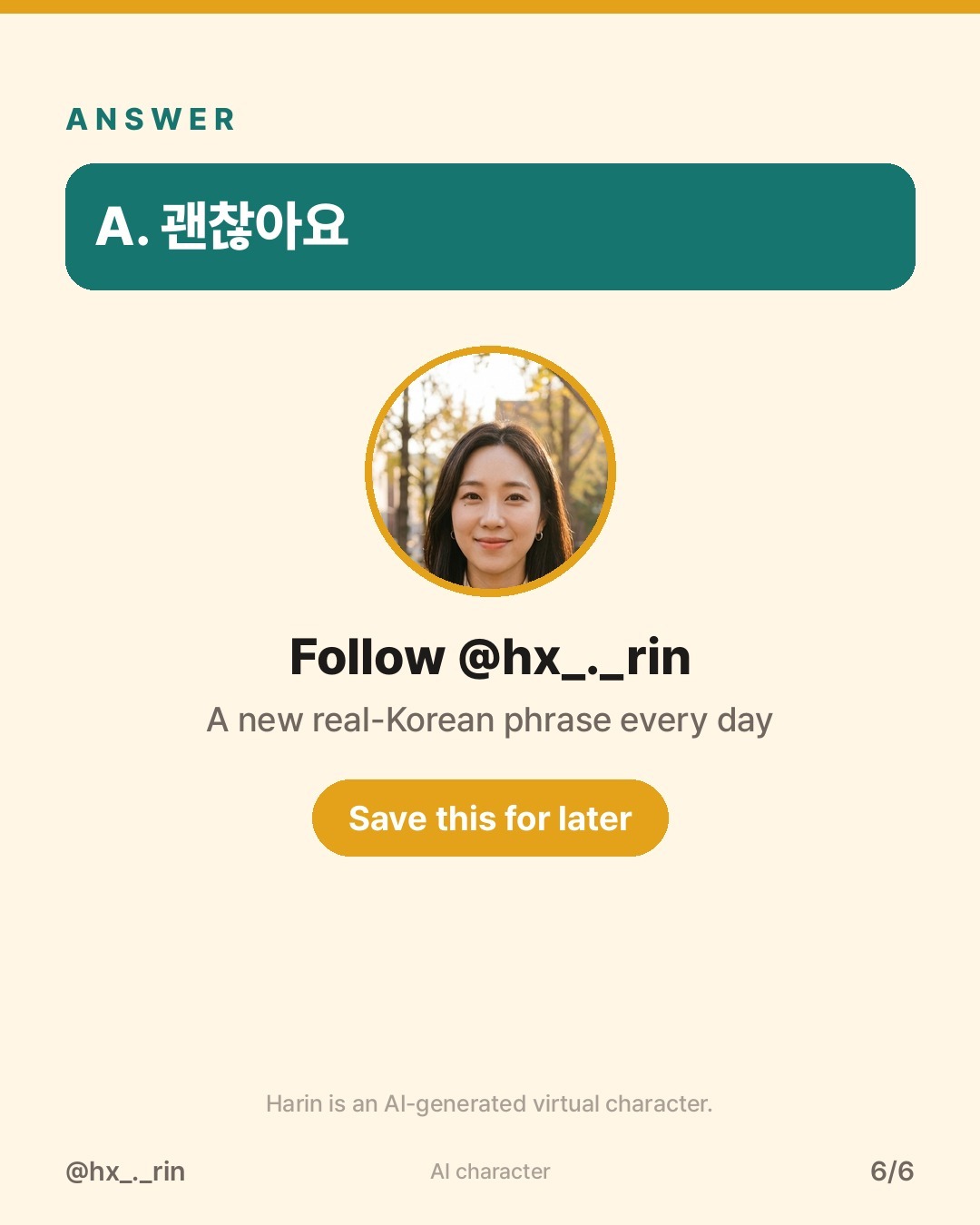
A. 괜찮아요 — Use it politely with colleagues or strangers to reassure them or decline food and help. Drop 'yo' with close friends, but use 'gwaenchanseumnida' in formal business settings.
Sources
Keep learning
연락해요Keep in touch, or let's stay in contact.
막내
The youngest person in a family, friend group, workplace team, or organization.
같이
Together or along with someone.