How to Pronounce 끝나요: Korean Batchim Secret
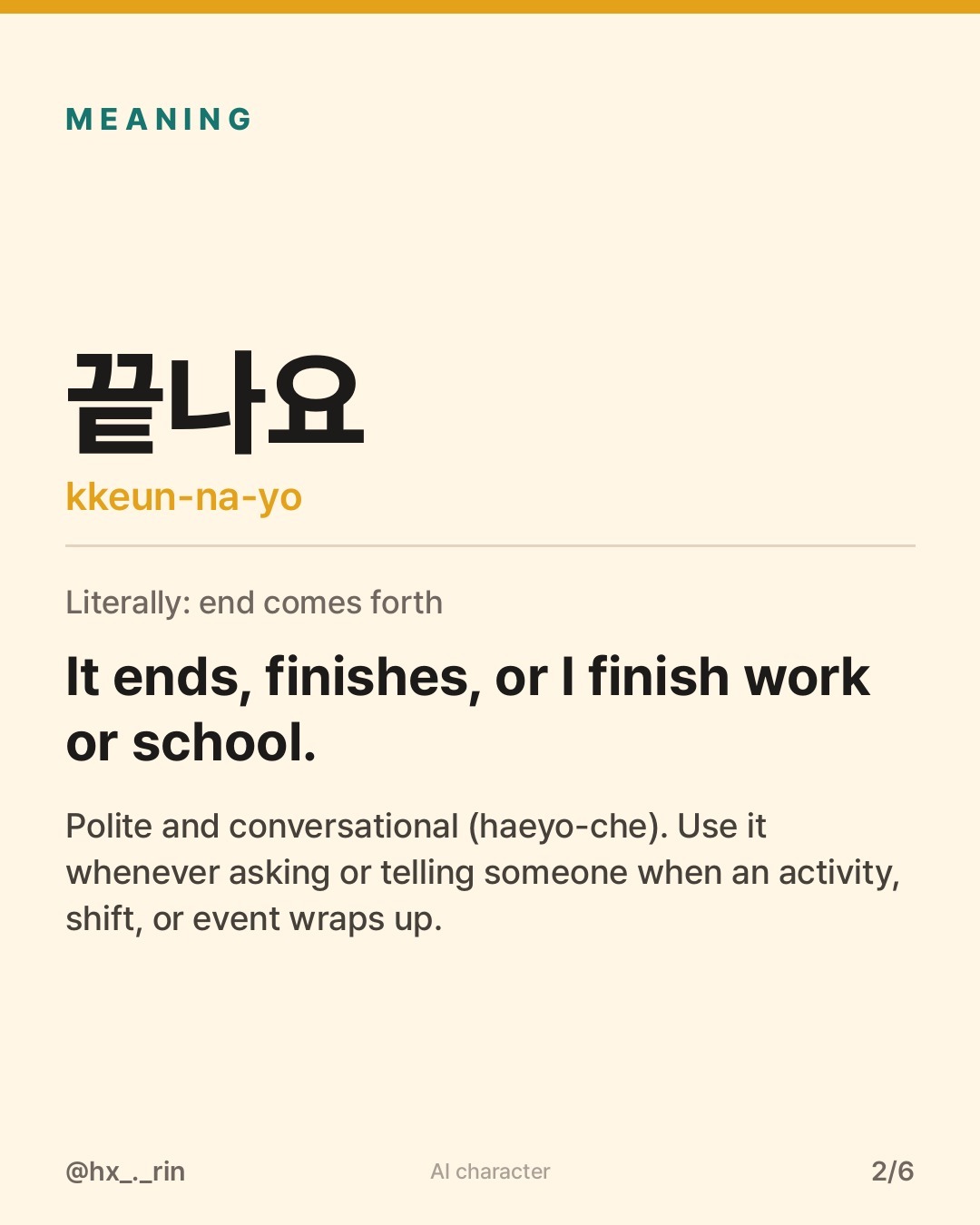
끝나요
- Literally
- end comes forth
- Means
- It ends, finishes, or I finish work or school.
- Use it
- Polite and conversational (haeyo-che). Use it whenever asking or telling someone when an activity, shift, or event wraps up.
PronunciationThis week's phrases
A quick conversation

A 5:50 PM Office Dilemma
Picture a busy office floor near Yeoksam Station in Seoul as the clock ticks toward 5:50 PM. The ambient hum of mechanical keyboards starts to quiet down, jackets are pulled from chair backs, and coworker Min-su leans across the divider to check on Ji-min before heading toward the elevators.
Here is the quick exchange that unfolds between them:
- 민수 (Min-su): "지민 씨, 오늘 야근해요?" (ji-min ssi, o-neul ya-geun-hae-yo?) — "Ji-min, are you working overtime today?"
- 지민 (Ji-min): "아니요, 저 6시에 바로 끝나요!" (a-ni-yo, jeo yeo-seot-si-e ba-ro kkeun-na-yo!) — "No, I finish right at 6:00!"
- 민수 (Min-su): "진짜요? 다행이네요. 그럼 퇴근하고 저녁 같이 먹어요." (jin-jja-yo? da-haeng-i-ne-yo. geu-reom toe-geun-ha-go jeo-nyeok ga-chi meo-geo-yo.) — "Really? That is such a relief. Let's grab dinner together after work then."
Notice what happened in Ji-min's reply? She did not pause, choke on a consonant, or say "kkeut... na-yo." Her response rolled off her tongue effortlessly as [끈나요] (kkeun-na-yo).
Deconstructing the Conversation Line by Line
Let us take a closer look at why each speaker chose these exact words.
In the opening line, Min-su says "지민 씨, 오늘 야근해요?" Attaching 씨 (ssi) to a colleague's first name strikes the classic balance in Korean work culture: warm and respectful without being stiff. Instead of asking a formal question about contractual work hours, he asks directly about 야근 (ya-geun), the well-known term for working overtime into the evening.
In the second line, Ji-min begins with a cheerful "아니요" (a-ni-yo, "no") and inserts the adverb 바로 (ba-ro, "immediately" or "right at"). Pairing 바로 with 6시에 끝나요 (yeo-seot-si-e kkeun-na-yo) conveys that her workday ends sharply on the hour, with zero lingering tasks. She uses the polite -해요 (-hae-yo) ending, which fits workplace chats between colleagues on good terms.
In the final line, Min-su reacts with "진짜요? 다행이네요" (jin-jja-yo? da-haeng-i-ne-yo), an empathetic phrase meaning "Really? What a relief!" Wrapping up with "퇴근하고 저녁 같이 먹어요" (toe-geun-ha-go jeo-nyeok ga-chi meo-geo-yo) proposes an impromptu post-work meal. It is friendly, casual, and quintessential Seoul weeknight life.
The Pronunciation Mystery: Where Did the T Go?
If you inspect the Hangul spelling of 끝나요, it looks deceptively straightforward: - 끝 (kkeut): ends with the bottom consonant ㅌ (tieut). - 나 (na): starts with the consonant ㄴ (nieun). - 요 (yo): the polite sentence-final particle.
By looking at the letters, you might expect to say "kkeut-na-yo," putting a sharp stop on the T before starting the N. But if you try saying that three times fast, you will notice how awkward it feels. Your tongue has to slam against your upper teeth to block airflow for the T, then immediately drop down and press again to push air through your nose for the N.
Spoken Korean dislikes that kind of acoustic friction. To keep conversational speech fluid, the language applies a phonetic rule known as 비음화 (bi-eum-hwa, nasalization).
According to Article 18 of the National Institute of Korean Language standard pronunciation rules: 1. When a syllable ends in an alveolar stop like ㄷ or ㅌ, the base final sound represents [ㄷ]. 2. When that [ㄷ] sound is immediately followed by a nasal consonant like ㄴ or ㅁ, the tongue does not stop the air. Instead, the sound assimilates and shifts into a smooth nasal [ㄴ].
Therefore: 끝 [끋] + 나 [나] + 요 [요] $\rightarrow$ [끈나요] (kkeun-na-yo).
The T completely dissolves into an N. If you pronounce it with a hard T, native speakers will certainly understand you, but the cadence will sound robotic. Adopting the nasal transition instantly makes your spoken Korean sound natural.
Natural Meaning and Subtle Nuance
The verb stem here is 끝나다 (kkeun-na-da). It is an intransitive verb, which means it describes an event, period, or activity reaching its conclusion naturally.
You use 끝나요 when discussing: - Schedules and working hours (shifts, classes, meetings). - Entertainment events (concerts, movies, sports games). - Time periods (vacations, semesters, lunch breaks).
Because the subject is usually the activity itself, saying "저 6시에 끝나요" literally translates to "As for me, [work] ends at 6." It is the standard, natural way to tell friends or coworkers when your daily duties wrap up.
More Real-Life Examples
Here are three more practical sentences you will hear across Seoul that demonstrate 끝나요 in different settings:
-
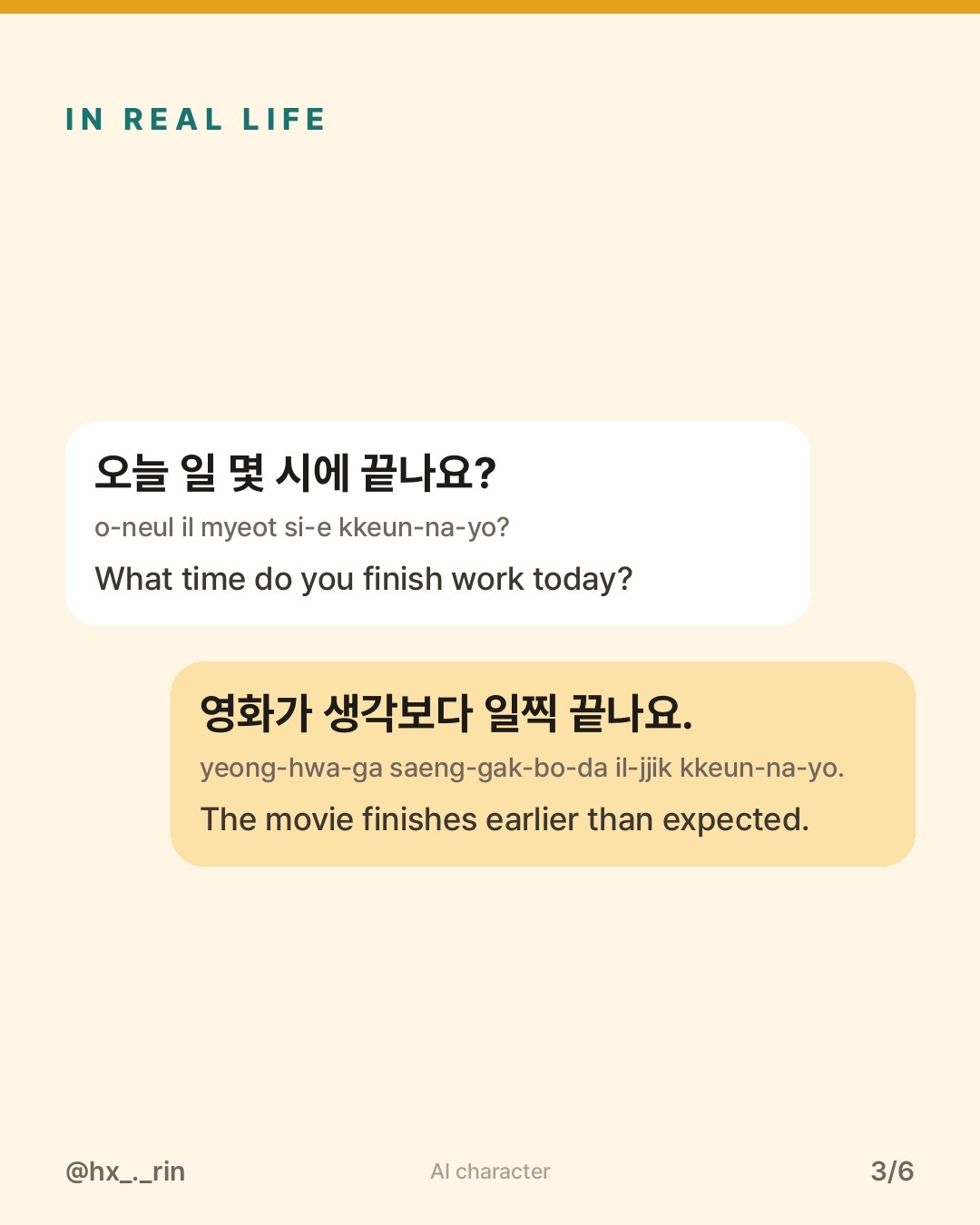
오늘 드라마 몇 시에 끝나요? o-neul deu-ra-ma myeot si-e kkeun-na-yo? "What time does today's drama finish?"
-
가을 축제가 내일 끝나요. ga-eul chuk-je-ga nae-il kkeun-na-yo. "The autumn festival ends tomorrow."
-
점심시간이 벌써 끝나요. jeom-sim-si-ga-ni beol-sseo kkeun-na-yo. "Lunch break is already ending."
Useful Tense and Form Variations
Once you master 끝나요, you can easily adapt the word across different conversation styles:
- 끝났어요 (kkeun-na-sseo-yo): The past tense form, pronounced [끈나써요]. Say this with a sigh of relief when a hard task is finally over: "드디어 끝났어요!" ("It's finally over!").
- 끝나 (kkeun-na): The informal casual form (ban-mal), pronounced [끈나]. Use this with close friends of the same age: "너 몇 시에 끝나?" ("What time do you finish?").
- 끝납니다 (kkeun-nam-ni-da): The formal polite form (hasip-sio-che), pronounced [끈남니다]. You will hear this in subway announcements and formal business presentations: "곧 행사가 끝납니다" ("The event will conclude shortly").
Whenever you prepare to wrap up a conversation or schedule an evening hangout, remember to drop the T and let the N flow smoothly: [끈나요] (kkeun-na-yo)!
Examples you can hear
끝나요 vs. similar expressions
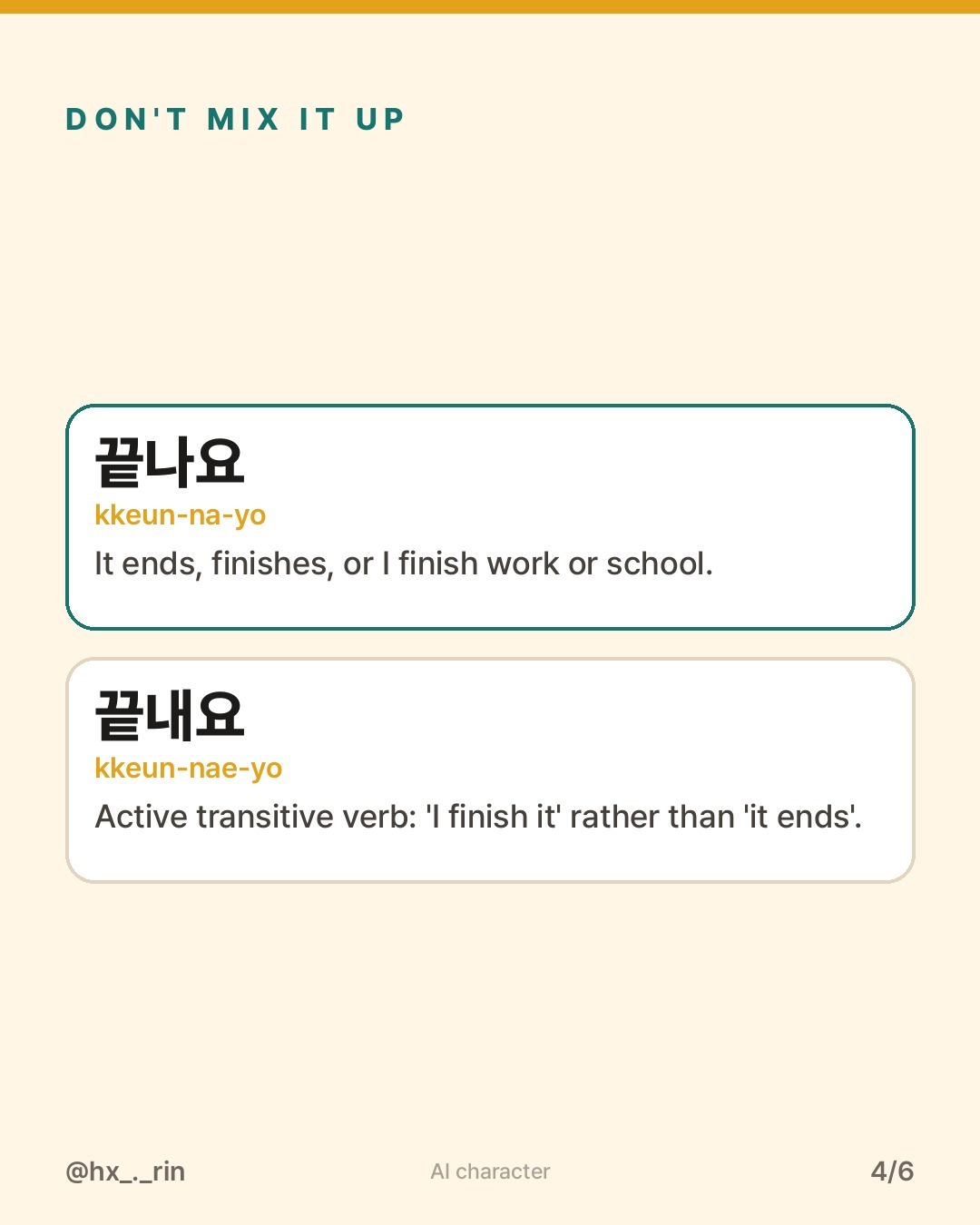
| Expression | How it differs |
|---|---|
| 끝나요 | It ends, finishes, or I finish work or school. |
| 끝내요 | Active transitive verb: 'I finish it' rather than 'it ends'. |
Quick quiz
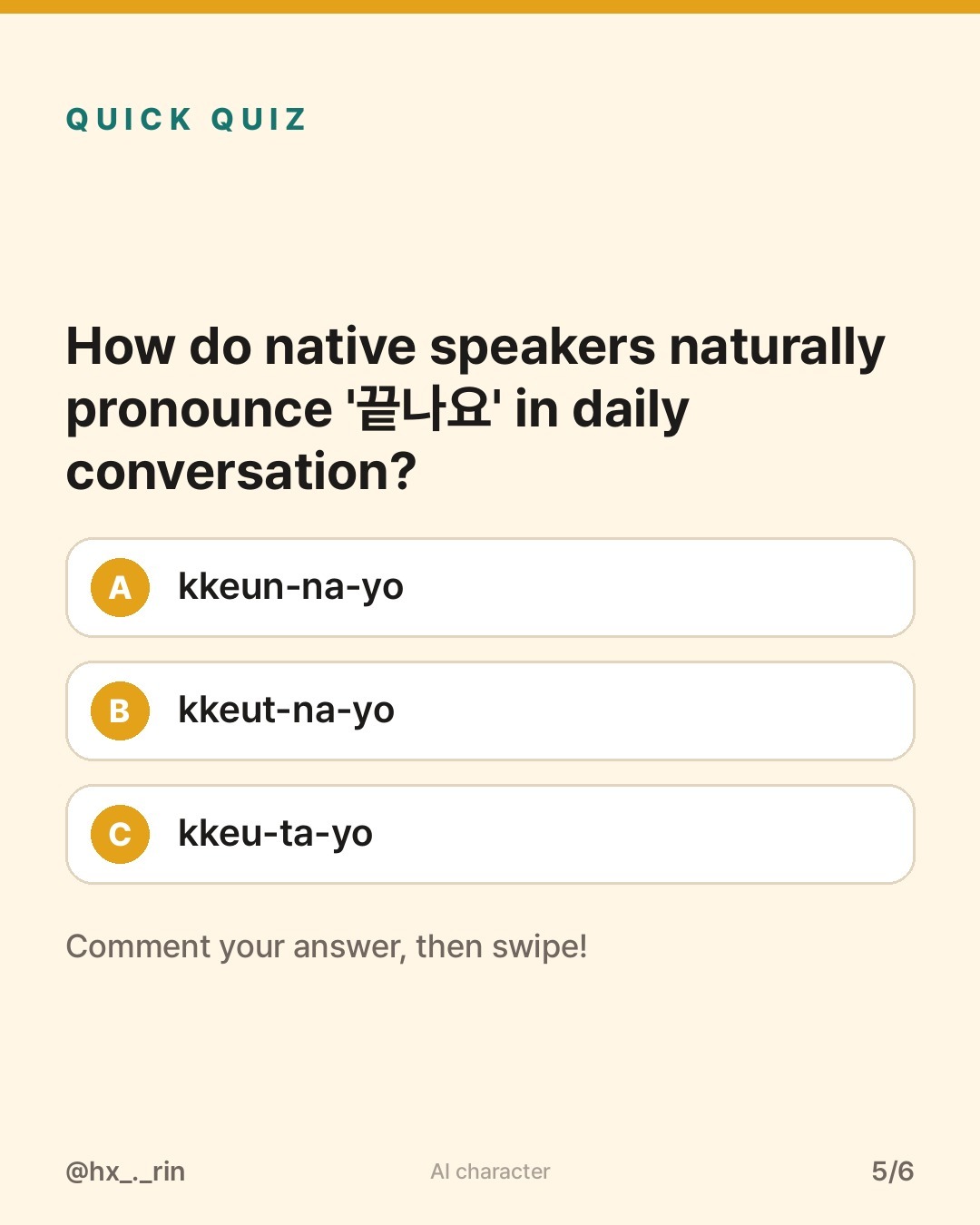
How do native speakers naturally pronounce '끝나요' in daily conversation?
- kkeun-na-yo
- kkeut-na-yo
- kkeu-ta-yo
Show the answer
A. kkeun-na-yo — Polite and conversational (haeyo-che). Use it whenever asking or telling someone when an activity, shift, or event wraps up.
Sources
- https://stdict.korean.go.kr/search/searchView.do?word_no=404561
- https://en.wiktionary.org/wiki/%EB%81%9D%EB%82%98%EB%8B%A4
Keep learning
굳이Going out of one's way to do something, or 'why bother?'
괜찮아요
It is okay, I am fine, or no thank you.
괜찮아요
It's okay, I'm fine, or a polite way to decline an offer.