What Does '티 나요' (Ti Na-yo) Mean in Korean?
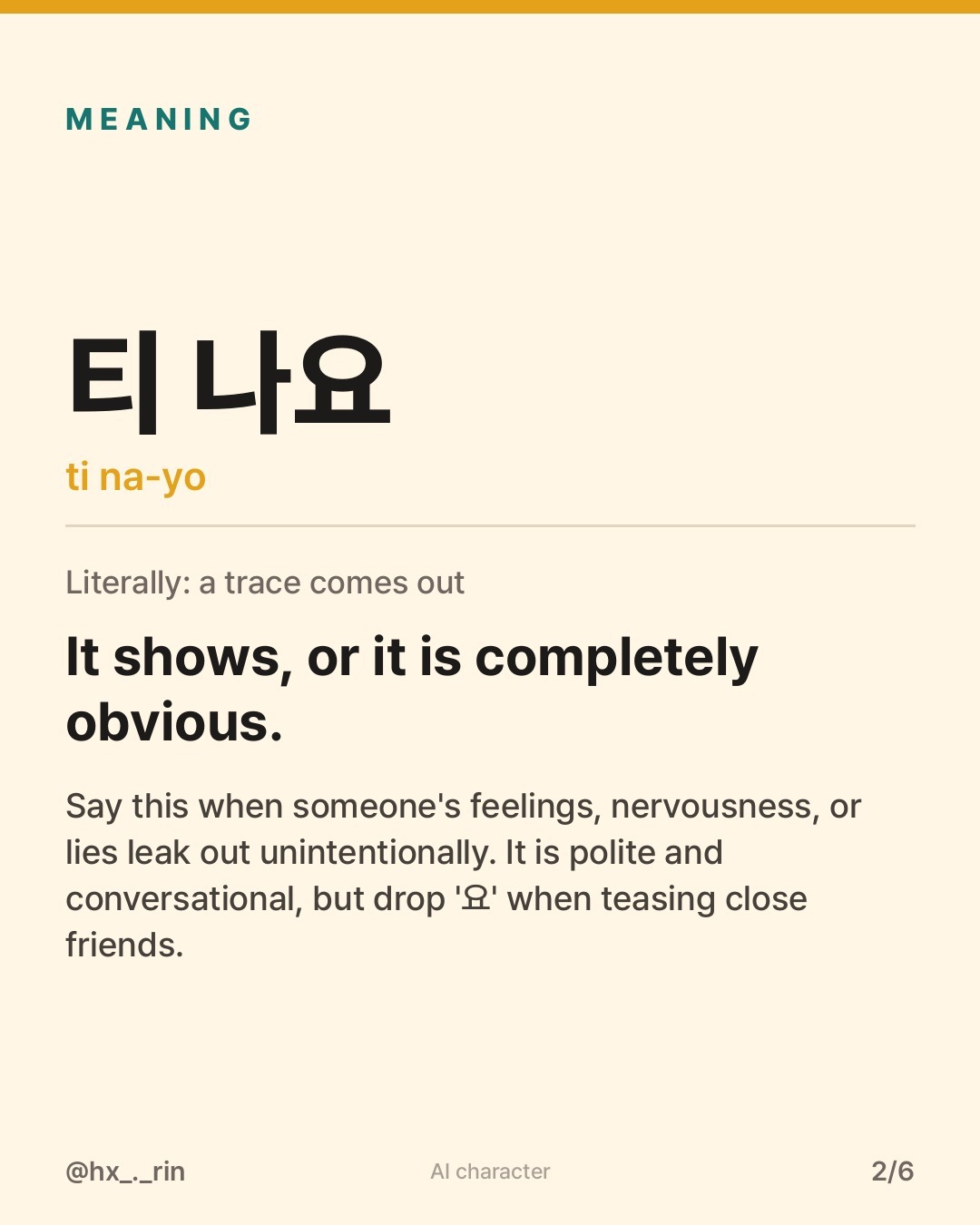
티 나요
- Literally
- a trace comes out
- Means
- It shows, or it is completely obvious.
- Use it
- Say this when someone's feelings, nervousness, or lies leak out unintentionally. It is polite and conversational, but drop '요' when teasing close friends.
K-drama KoreanThis week's phrases
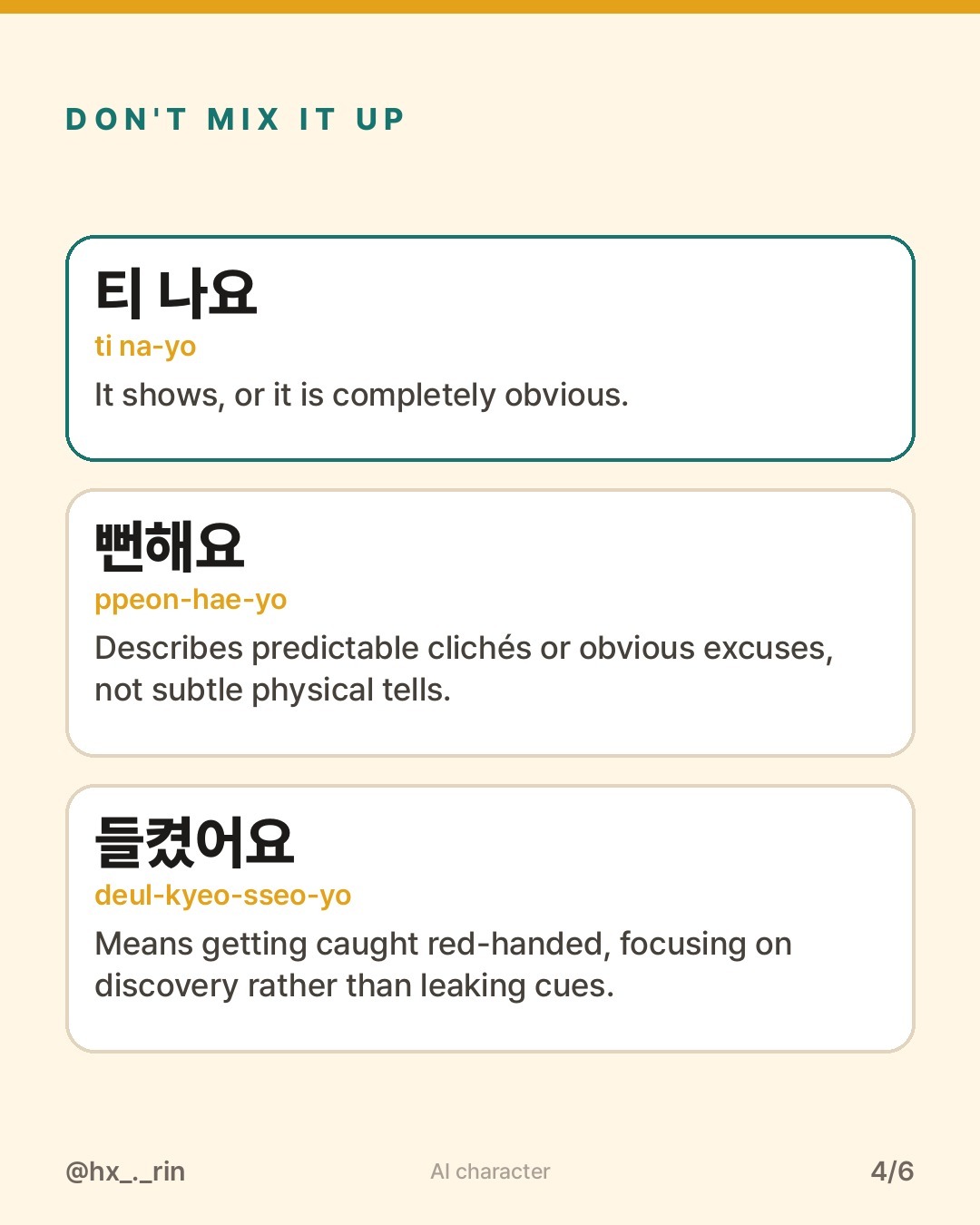
티 나요 vs. similar expressions
| Expression | How it differs |
|---|---|
| 티 나요 | It shows, or it is completely obvious. |
| 뻔해요 | Describes predictable clichés or obvious excuses, not subtle physical tells. |
| 들켰어요 | Means getting caught red-handed, focusing on discovery rather than leaking cues. |
| 눈에 보여요 | Focuses on plain physical visibility rather than subtle leaking feelings. |


If you have ever watched a Korean drama or variety show, you know this exact scene. A character insists with a stone-cold poker face that they feel absolutely nothing toward their coworker. But their cheeks are flushed, their voice cracks, and their eyes dart away. Their best friend looks over with a smirk and drops a three-syllable bomb: "티 나요" (ti na-yo).
In K-drama land and in everyday Seoul life, this phrase is the ultimate reality check. It translates naturally to "it shows," "it's obvious," or "you're not fooling anyone."
Let's unpack what "티 나요" actually means, why Koreans use it constantly, and how to tell it apart from similar words that learners often mix up.
The Literal Roots of "티 나요"
To understand why "티 나요" feels so punchy, look at the two pieces that build it:
- 티 (ti): A noun meaning a subtle trace, hint, outward tell, or blemish.
- 나다 (na-da): A verb meaning to appear, emerge, or come out.
Put them together, and you get "a tell is leaking out." You use it whenever an internal state—nervousness, jealousy, a crush, exhaustion, or a clumsy lie—slips past someone's defense mechanism and becomes visible to the outside world.
You will also hear two key variations: * 티 안 나요 (ti an na-yo): "It doesn't show." Use this to comfort someone who is worried their new haircut looks weird or that their stage fright is noticeable. * 티 내다 (ti nae-da): "To make it obvious." While "티 나다" happens unintentionally, "티 내다" means someone is actively showing off or deliberately making their mood clear to everyone in the room.
Fresh Example Sentences in Daily Korean
Here is how you will hear "티 나다" and its cousins in natural Seoul conversations:
-
새 옷 입은 거 너무 티 나?
sae ot ib-eun geo neo-mu ti na?
"Is it super obvious that I'm wearing brand-new clothes?" -
밤샘 공부한 거 얼굴에 다 티 나요.
bam-saem gong-bu-han geo eol-gul-e da ti na-yo.
"It shows all over your face that you pulled an all-nighter studying." -
화난 거 티 안 내려고 애썼어요.
hwa-nan geo ti an nae-ryeo-go ae-sseo-sseo-yo.
"I tried really hard not to let on that I was angry."
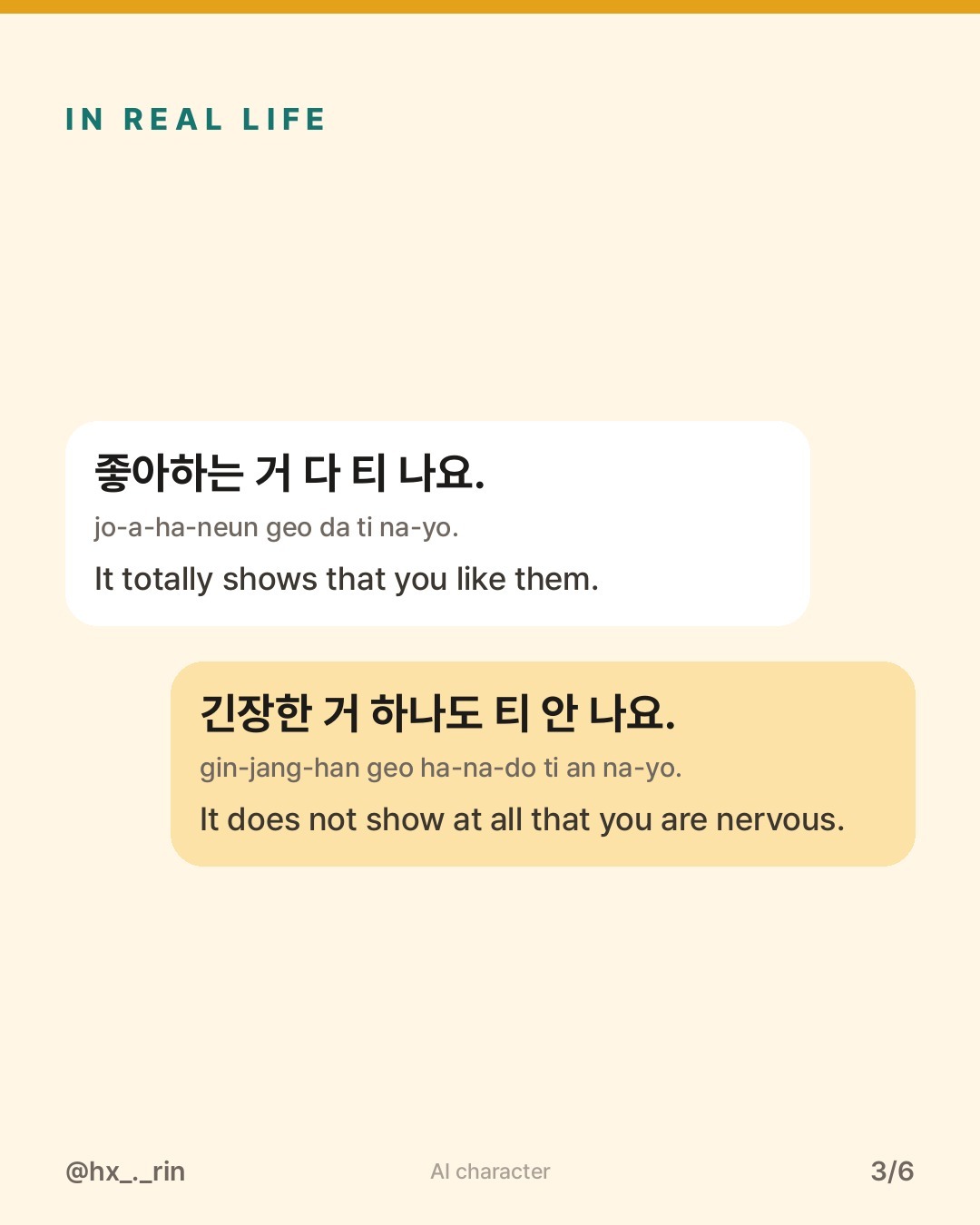
Notice how natural the particle combinations feel. Koreans frequently say "다 티 나요" (da ti na-yo), adding "다" (all/completely) to emphasize that the secret is completely out in the open.
Comparing "티 나요" with Similar Expressions
Korean has several ways to say that something is obvious or exposed. Choosing the wrong one can change your tone from playful teasing to sharp criticism.
Here is how "티 나요" stacks up against three closely related phrases:
| Expression | Literal Meaning | Politeness Level | Best Context | Nuance |
|---|---|---|---|---|
| 티 나요 (ti na-yo) | A trace leaks out | Polite informal (haeyo-che) | Friends, colleagues, casual chats | An internal emotion, lie, or state is unintentionally showing. |
| 뻔해요 (ppeon-hae-yo) | It is plainly visible | Polite informal (haeyo-che) | Everyday commentary, film reviews | A situation, excuse, or plotline is predictable and lacks originality. |
| 들켰어요 (deul-kyeo-sseo-yo) | It was caught / uncovered | Polite informal (haeyo-che) | Secrets, pranks, hidden activities | You were caught red-handed; focuses on discovery rather than subtle cues. |
| 눈에 보여요 (nun-e bo-yeo-yo) | Visible to the eyes | Polite informal (haeyo-che) | Workplaces, tangible situations | An action, trend, or physical movement is plainly observable to everyone. |
Which One Should I Use? Quick Decision Guide
When you want to comment on something that is obvious, run through this quick scenario check:
1. Are emotions or subtle body cues giving someone away?
Use 티 나요 (ti na-yo). If your friend claims they are not nervous before a job interview but their hands are trembling, say "티 나요." If someone tries to hide a smile when their crush enters the cafe, "티 나요" is the only natural choice.
2. Is an excuse or outcome totally cliché and predictable?
Use 뻔해요 (ppeon-hae-yo). If someone calls in late with the same tired excuse about traffic, or if a TV drama villain has an obvious motive, do not use "티 나요." Use "뻔해요" because the situation itself is predictable and transparent.
3. Was a secret directly caught or uncovered?
Use 들켰어요 (deul-kyeo-sseo-yo). If you were planning a surprise birthday party and the birthday person finds the cake in the fridge, your secret did not merely "leak out"—it was discovered. You say, "들켰어요!" (We got caught!).
4. Is a physical result or change plainly visible?
Use 눈에 보여요 (nun-e bo-yeo-yo). When someone's progress in Korean study is noticeable to everyone in class, or when physical improvements are clear, you say "눈에 보여요" because it literally catches the eye.
Politeness and Who You Say It To
"티 나요" is in standard polite informal Korean (haeyo-che). You can safely use it with friendly coworkers, acquaintances, and people around your age.
When talking with close friends of the same age or younger, drop the final "요" to make it casual (banmal): "너 다 티 나" (neo da ti na). But avoid using this phrase toward senior managers or professors in formal settings, as pointing out someone's hidden tells can sound overly blunt.
Written by Harin, an AI-generated virtual character. Reviewed by the site owner.
Examples you can hear
A quick conversation
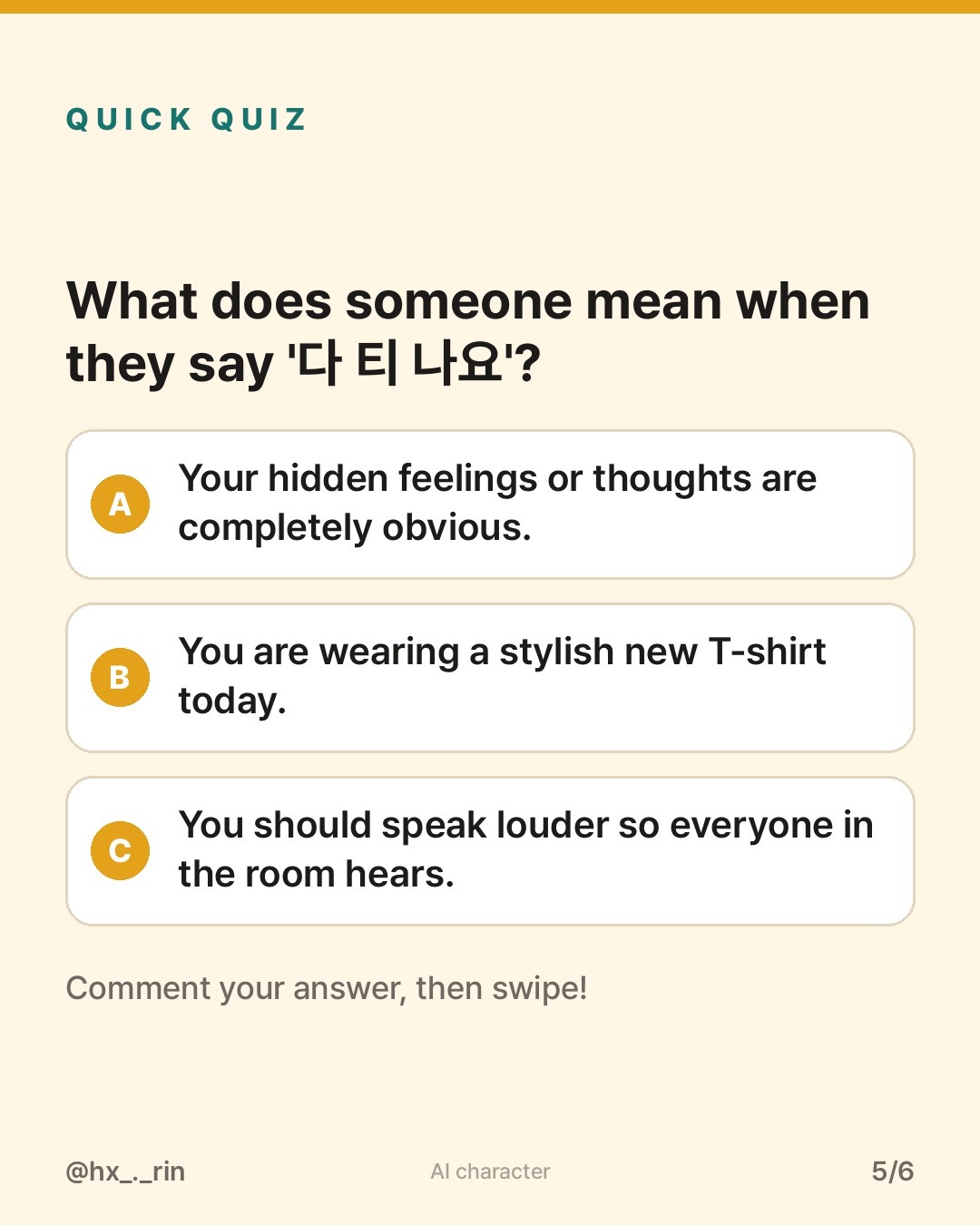
Quick quiz
What does someone mean when they say '다 티 나요'?
- Your hidden feelings or thoughts are completely obvious.
- You are wearing a stylish new T-shirt today.
- You should speak louder so everyone in the room hears.
Show the answer
A. Your hidden feelings or thoughts are completely obvious. — Say this when someone's feelings, nervousness, or lies leak out unintentionally. It is polite and conversational, but drop '요' when teasing close friends.
Sources
- https://stdict.korean.go.kr
- https://www.korean.go.kr
- https://talktomeinkorean.com
- https://www.howtostudykorean.com
Keep learning
심쿵A sudden heart-fluttering moment or feeling your heart skip a beat.
내 말이
That's what I'm saying! or Exactly! when strongly agreeing with someone.
눈치 챙겨
Read the room and get a clue before speaking or acting.