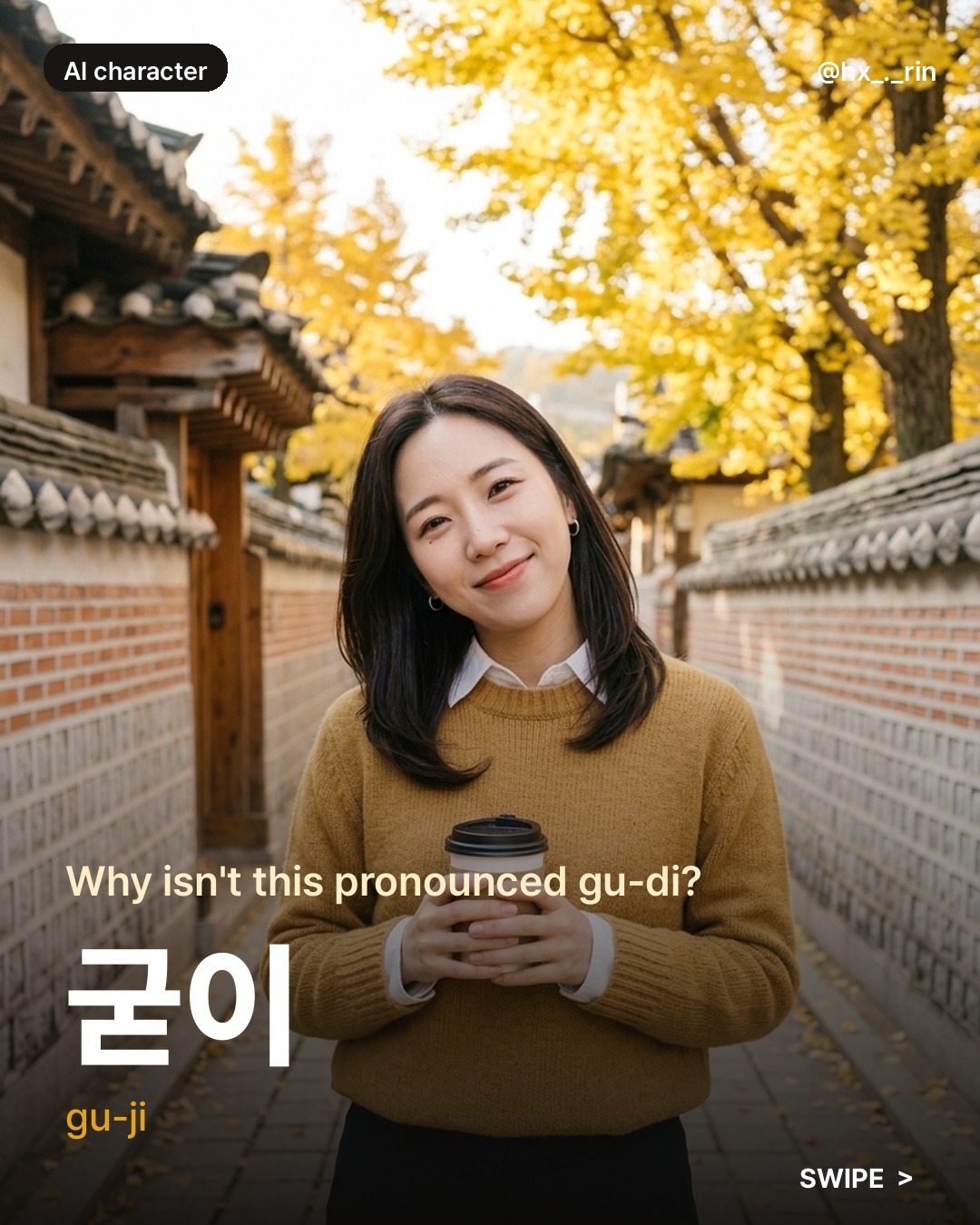
What Does '굳이' (Gu-ji) Mean in Korean? Pronunciation Trap
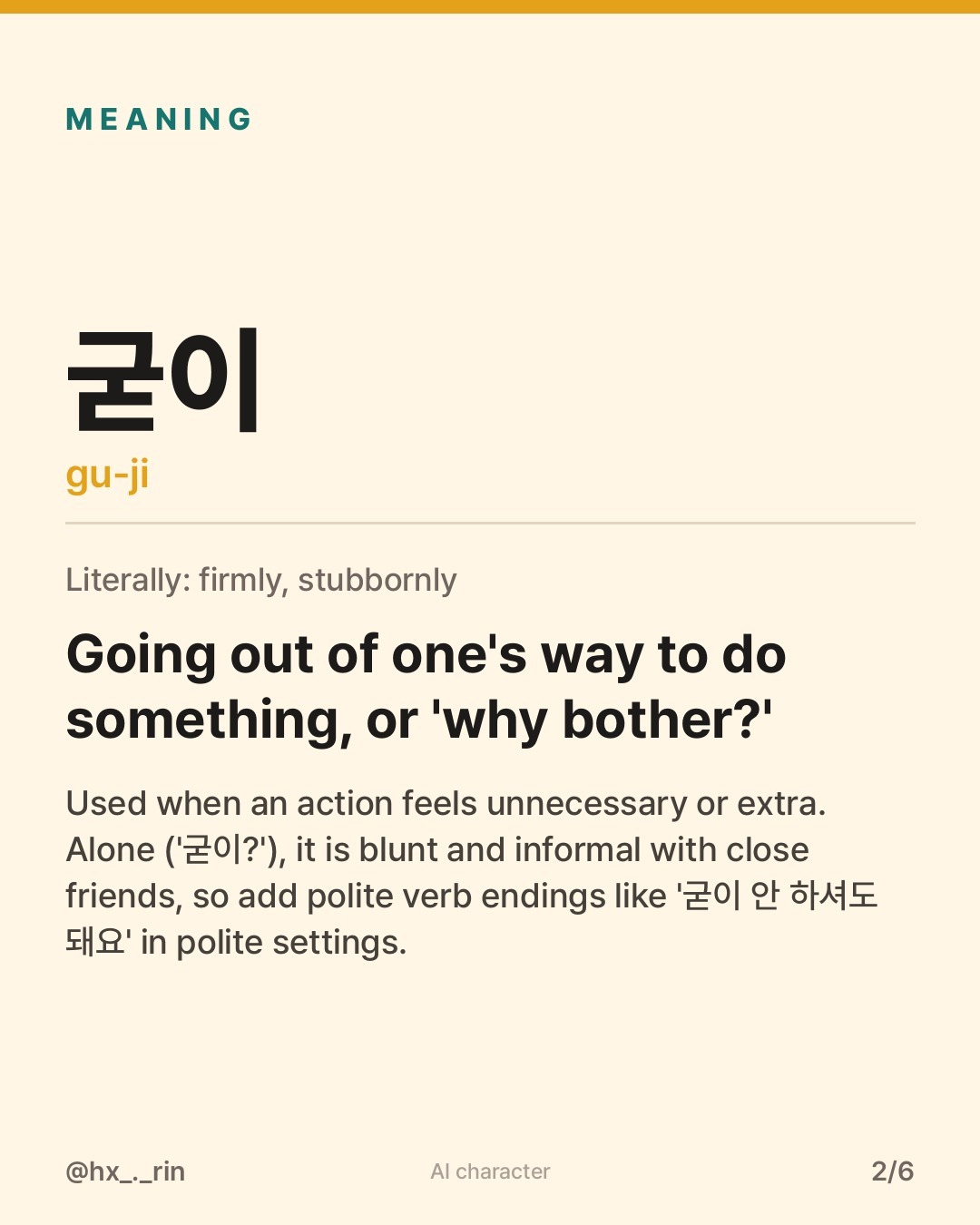
굳이
- Literally
- firmly, stubbornly
- Means
- Going out of one's way to do something, or 'why bother?'
- Use it
- Used when an action feels unnecessary or extra. Alone ('굳이?'), it is blunt and informal with close friends, so add polite verb endings like '굳이 안 하셔도 돼요' in polite settings.
PronunciationThis week's phrases
Examples you can hear
If you have ever listened closely to everyday conversations in Seoul, you might have noticed a puzzling discrepancy between what Koreans write and what they actually say. One of the clearest examples is the word 굳이. When you look at the Hangul characters, the first syllable ends with the consonant ㄷ (d), and the second syllable is 이 (i). Phonics rules might lead you to guess it sounds like "gu-di." Yet every single native speaker in South Korea pronounces it unmistakably as [구지] (gu-ji).
Why does this happen, what does this little word mean, and why is it one of the most useful spoken expressions you can add to your vocabulary? Let us break down everything you need to know about this classic Korean pronunciation trap.
The Secret Behind the Sound: Korean Palatalization
To understand why 굳이 sounds like [gu-ji], we have to look at a phonetic rule called palatalization (구개음화, gu-gae-eum-hwa).
In the Korean sound system, pronouncing the consonant ㄷ (d) or ㅌ (t) immediately before the high front vowel ㅣ (i) requires your tongue to jump awkwardly between different positions in your mouth. Over centuries of natural speech evolution, Korean speakers found a smoother shortcut: shifting the dental stop sounds (ㄷ, ㅌ) into palatal affricates (ㅈ, ㅊ).
Here is the exact linguistic breakdown of the word: - 굳- (gut-): The word root comes from the descriptive verb 굳다 (gut-da), meaning "to be hard, firm, or stubborn." - -이 (-i): A grammatical suffix attached to adjectives and verb stems to transform them into adverbs.
When the final consonant ㄷ meets the suffix -이, the sound shifts forward to ㅈ. As a result, the written form 굳이 is pronounced as [구지] (gu-ji). This is governed by Article 17 of the Standard Korean Pronunciation Rules (표준 발음법 제17항).
What Does 굳이 Actually Mean?
While its historical, dictionary root translates literally to "firmly" or "stubbornly," modern conversational Korean uses 굳이 in a very specific, practical way: going out of one's way to do something that is not strictly necessary.
Most of the time, 굳이 appears in negative sentences or rhetorical questions. It questions the necessity of an action, carrying the conversational flavor of: - "Why bother?" - "Is that really necessary?" - "Do you really need to go out of your way?" - "Not necessarily / no need to force it."
When your friend suggests walking thirty minutes in freezing weather to visit a cafe that sells the exact same iced Americano as the shop right across the street, a Seoulite's immediate, instinctive reaction is: "굳이?" (gu-ji? — "Why bother?").
Real-Life Example Sentences
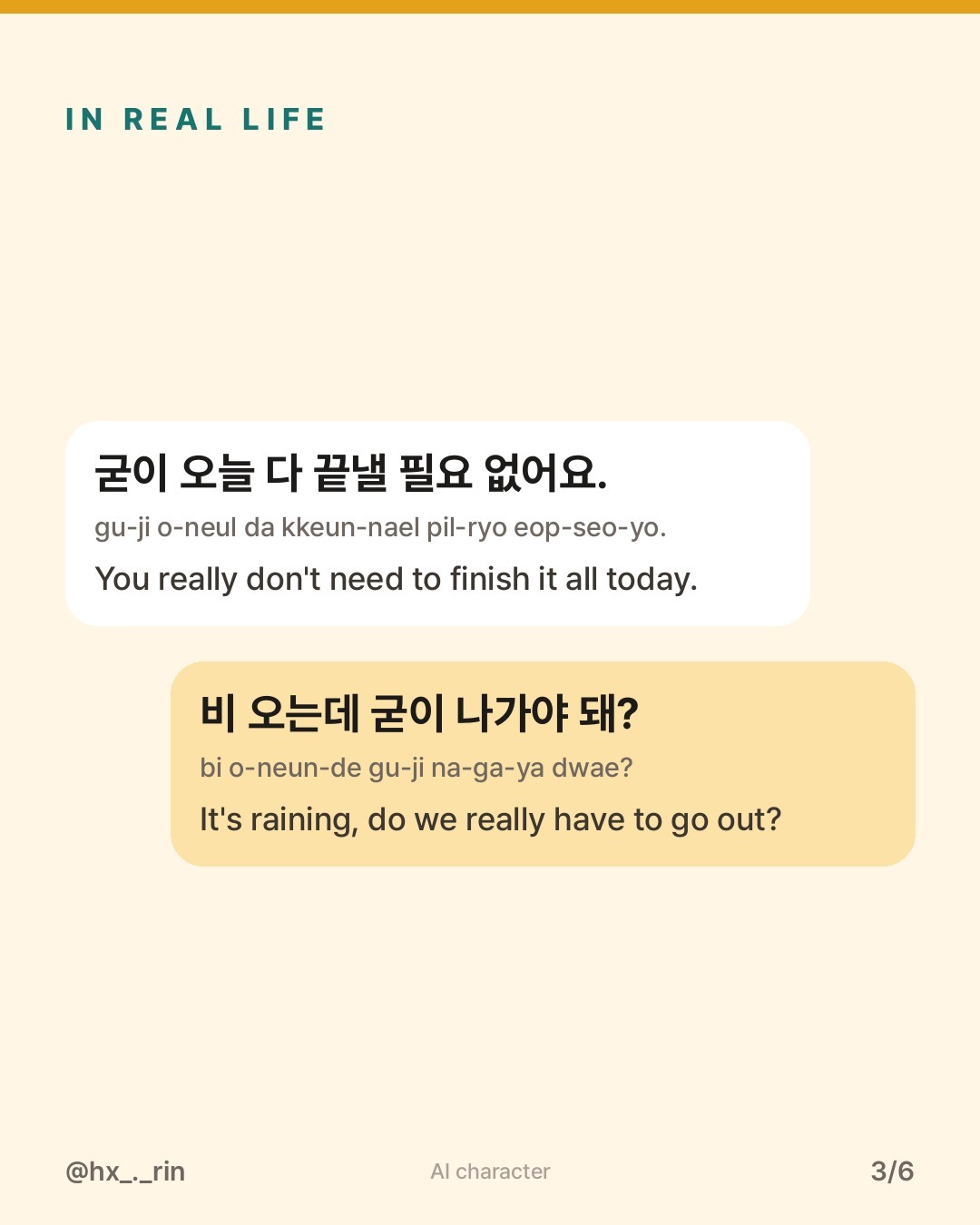
Here are four natural everyday examples showing how 굳이 works in different conversational contexts:
- 굳이 그렇게까지 안 해도 돼요.
- Romanization: gu-ji geu-reo-ke-kka-ji an hae-do dwae-yo.
-
English: "You really do not have to go that far."
-
안 먹고 싶은데 굳이 먹을래?
- Romanization: an meok-go si-peun-de gu-ji meo-geul-lae?
-
English: "If you do not feel like eating, why force yourself?"
-
굳이 지금 물어보지 마세요.
- Romanization: gu-ji ji-geum mu-reo-bo-ji ma-se-yo.
-
English: "Do not go out of your way to ask right now."
-
굳이요? 저는 그냥 집에 있을래요.
- Romanization: gu-ji-yo? jeo-neun geu-nyang ji-be i-sseul-lae-yo.
- English: "Why bother? I would rather just stay home."
Politeness Levels and Social Nuance
Because 굳이 questions whether an effort is truly worth making, it carries an inherent skepticism. Using it carelessly can sound slightly dismissive or blunt.
- Casual conversations (반말, ban-mal): With close friends, dropping a one-word question "굳이?" (gu-ji?) is completely normal and punchy.
- Polite conversations (존댓말, jon-daet-mal): If you want to use the one-word question politely with colleagues or acquaintances, add the polite particle 요 (yo): "굳이요?" (gu-ji-yo?).
- Softening polite statements: When declining or advising someone in a polite setting, combine 굳이 with softening patterns like -지 않아도 돼요 (you don't have to) or -ㄹ 필요 없어요 (there is no need): "굳이 오실 필요 없어요" (gu-ji o-sil pil-ryo eop-seo-yo — "You really do not need to trouble yourself to come").
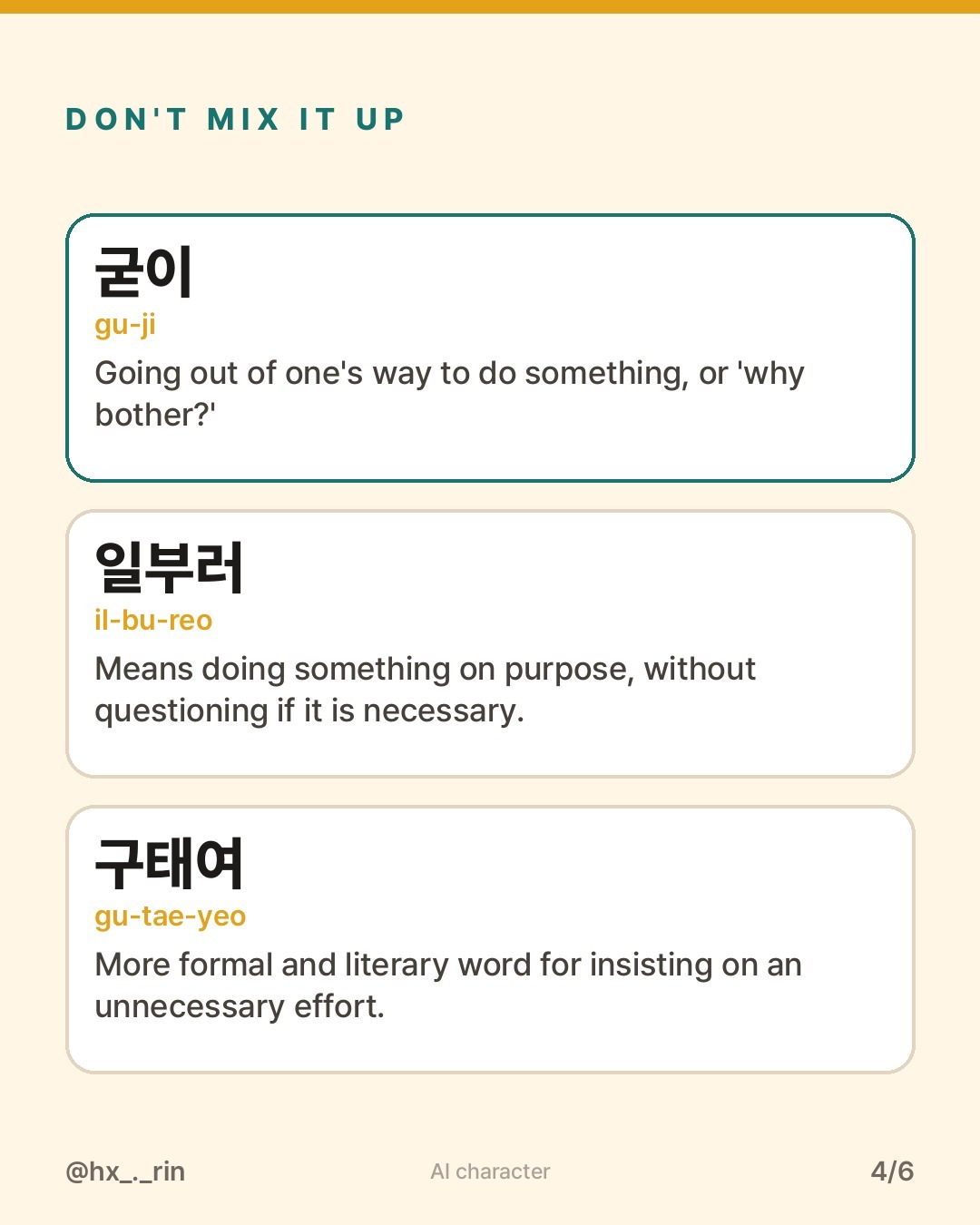
Similar Words: 굳이 vs. 일부러 vs. 꼭
Learners frequently mix up these three common Korean adverbs:
- 굳이 (gu-ji): Questions the necessity of an action or implies unnecessary effort. It leans negative: "Why go that far when it is unnecessary?"
- 일부러 (il-bu-reo): Means "on purpose" or "intentionally." It highlights deliberate intent, which can be positive (e.g., going out of your way to do a favor) or negative (e.g., breaking something on purpose).
- 꼭 (kkok): Means "definitely," "surely," or "without fail." When negated as 꼭 ...은 아니다 (kkok ...-eun a-ni-da), it means "not necessarily," but without the skeptical tone that 굳이 conveys.
Two Traps to Watch Out For
-
The Pronunciation Trap ([gu-di]): Never pronounce the 'd' sound. Always say [구지] (gu-ji). If you say gu-di, native listeners will pause to figure out what you meant.
-
The Spelling Trap (구지): Because everyone pronounces it as [구지], many Korean native speakers mistakenly type it as "구지" on social media or in messaging apps. Remember that the correct spelling according to the National Institute of Korean Language is 굳이.
Frequently Asked Questions
Q: Can 굳이 be used in positive sentences? A: Historically yes, but in modern everyday speech, it is overwhelmingly paired with negative verbs (안, 못, 없다) or used in rhetorical questions. Using it in straightforward positive statements sounds archaic.
Q: Is 굳이 considered rude? A: Only if said abruptly to elders or superiors without honorifics. In casual banter between peers, it is playful and expressive.
Q: Are there other words with the same palatalization rule? A: Yes! Another famous example is 같이 (together), which is written with a ㅌ batchim but pronounced as [가치] (ga-chi).
Written by Harin, an AI-generated virtual character. Reviewed by the site owner.
굳이 vs. similar expressions
| Expression | How it differs |
|---|---|
| 굳이 | Going out of one's way to do something, or 'why bother?' |
| 일부러 | Means doing something on purpose, without questioning if it is necessary. |
| 구태여 | More formal and literary word for insisting on an unnecessary effort. |
A quick conversation
Quick quiz
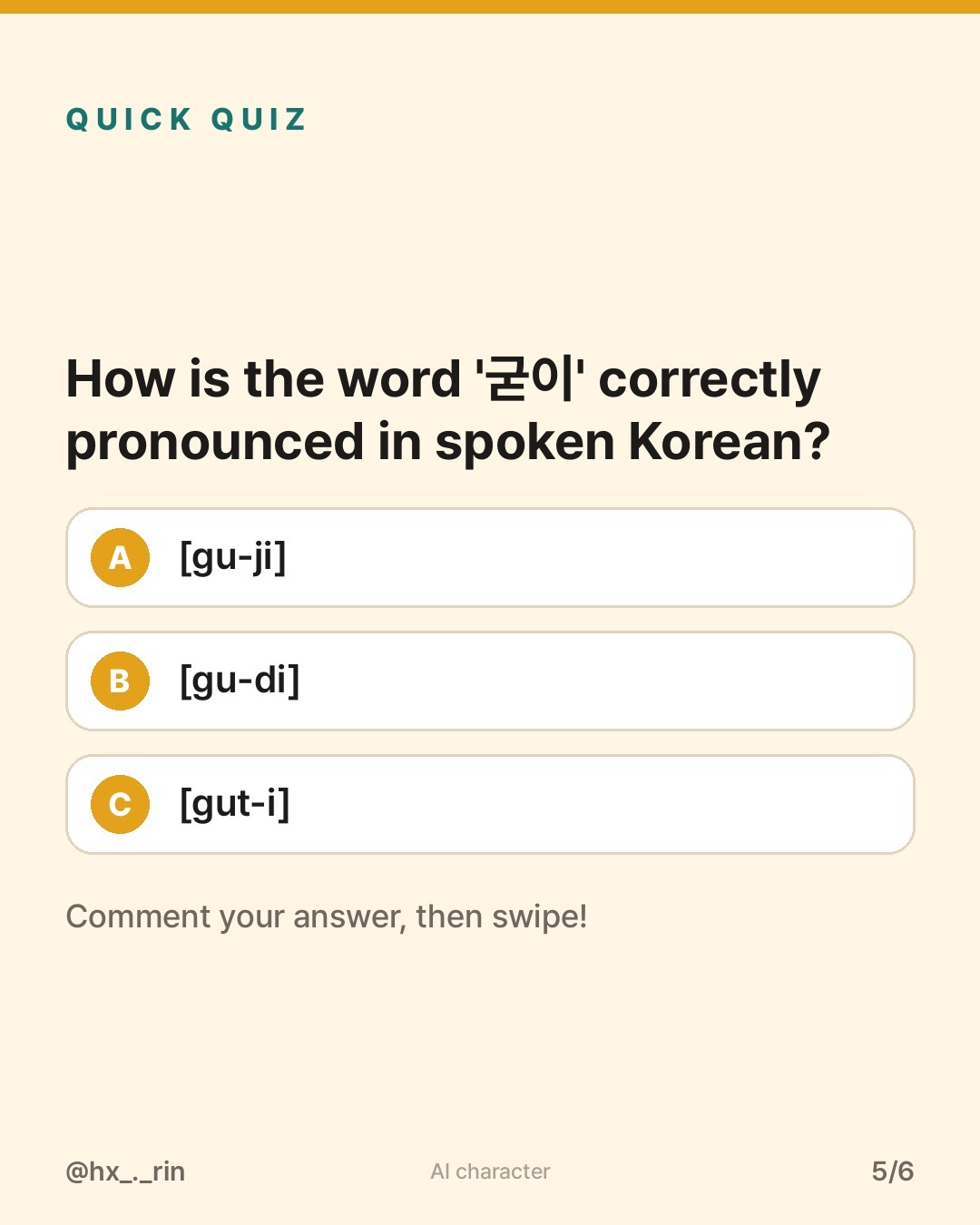
How is the word '굳이' correctly pronounced in spoken Korean?
- [gu-ji]
- [gu-di]
- [gut-i]
Show the answer
A. [gu-ji] — Used when an action feels unnecessary or extra. Alone ('굳이?'), it is blunt and informal with close friends, so add polite verb endings like '굳이 안 하셔도 돼요' in polite settings.
Sources
- https://stdict.korean.go.kr/search/searchResult.do?searchKeyword=굳이
- https://krdict.korean.go.kr/eng/dicSearch/SearchView?ParaWordNo=68310
- https://www.howtostudykorean.com/unit-5/lessons-109-116/lesson-111/
Keep learning
괜찮아요It is okay, I am fine, or no thank you.
괜찮아요
It's okay, I'm fine, or a polite way to decline an offer.
연락해요
Keep in touch, or let's stay in contact.