What Does '어이없네' Mean in Korean? (K-Drama Slang)
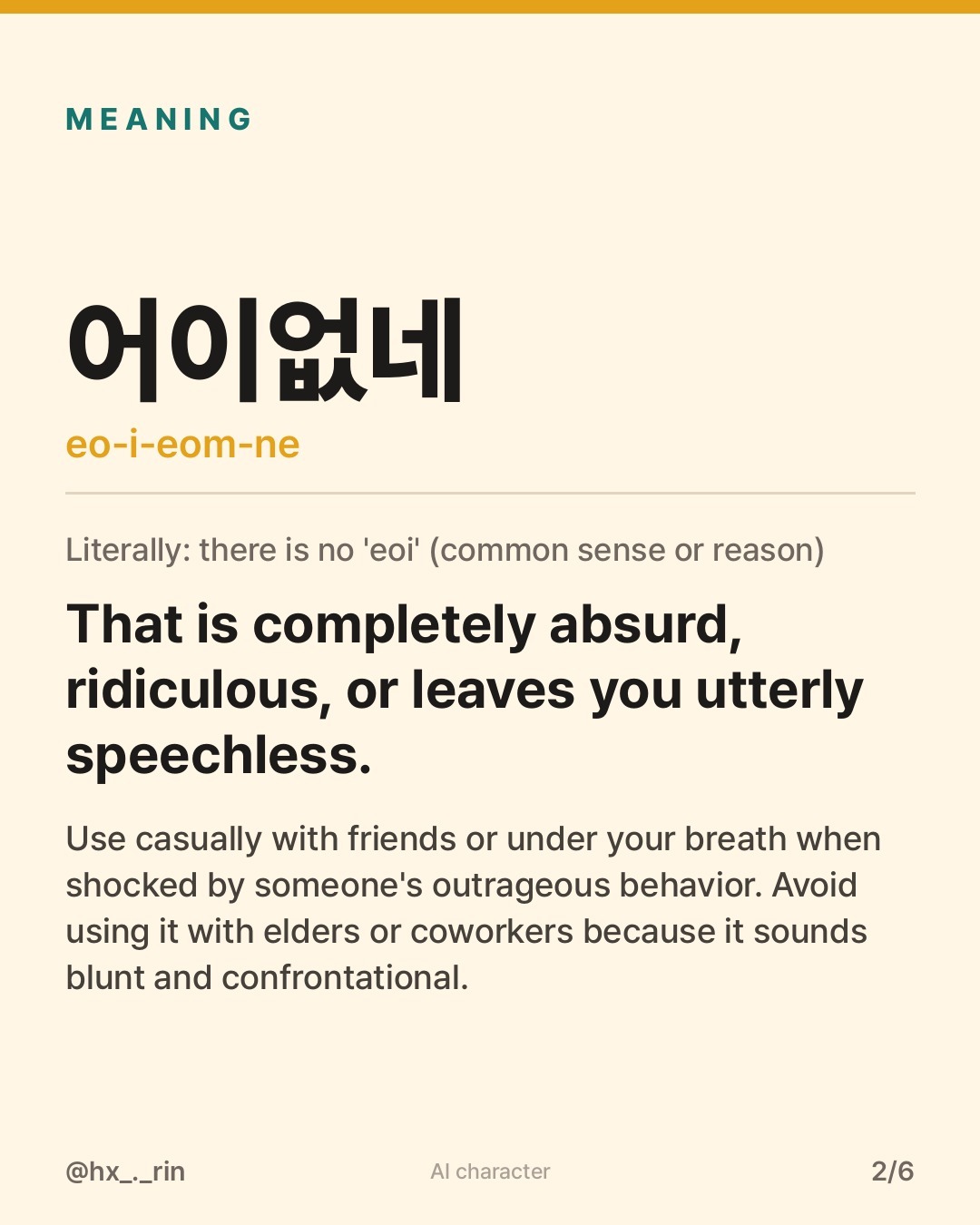
어이없네
- Literally
- there is no 'eoi' (common sense or reason)
- Means
- That is completely absurd, ridiculous, or leaves you utterly speechless.
- Use it
- Use casually with friends or under your breath when shocked by someone's outrageous behavior. Avoid using it with elders or coworkers because it sounds blunt and confrontational.
K-drama KoreanThis week's phrases

The Secret Story Behind Korean Dumbfounded Disbelief
If you have ever watched a Korean drama, you know the exact scene: a haughty character storms into a room, demands the impossible, or delivers an outrageous ultimatum. The protagonist pauses, blinks in total disbelief, lets out an incredulous half-laugh, and mutters a single phrase: 어이없네 (eo-i-eom-ne).
To outsiders, subtitles often translate this line simply as "That's ridiculous" or "Unbelievable." But in Korean culture, 어이없네 carries a much deeper flavor of stunned speechlessness. It describes that precise psychological state where an action or request is so wildly outside the bounds of common decency, logic, or basic courtesy (ye-ui) that your brain short-circuits. You are not just angry; you are flabbergasted.
Where does this peculiar expression come from? In Korean linguistic history, the root adjective is 어이없다 (eo-i-eop-da). While the historical etymology traces back centuries to older forms of Korean denoting "an unexpected or baffling situation," popular Korean folk culture connects the word eoi (어이) to eocheoguni (어처구니)—the wooden handle affixed to a traditional stone grinding mill (maetdol). Imagine waking up at dawn during harvest season, pouring your soaked beans into a heavy stone mill, and reaching for the handle only to realize someone removed it. Without the handle, the entire mill is useless, and your plans grind to an instant halt. You stand there frozen, beans in hand, completely powerless and baffled. Whether regarded as folk etymology or cultural metaphor, that mental image captures the essence of the word: reaching for ordinary common sense and finding nothing there.
In daily life across Seoul, social harmony, mutual consideration, and reading the room (nunchi) are deeply valued. Because Koreans typically expect others to follow unspoken social codes, when someone brazenly shatters those expectations—cutting a queue, shifting blame, or acting shameless—the collective reaction is pure bewilderment.
Decoding the Grammar and Everyday Variations
To understand how Koreans use this expression in real life, it helps to look at how it shifts across formality levels:
- 어이없다 (eo-i-eop-da): The base dictionary form. You might see this in written thoughts, social media captions, or diary entries.
- 어이없네 (eo-i-eom-ne): The spontaneous, exclamatory present form. The grammatical ending -ne (네) indicates immediate realization or direct observation. When you witness something absurd in real time, this is the exact phrase that slips out. Notice the pronunciation shift: because of Korean consonant nasalization rules, the final b sound in eop assimilates before n, making it sound like eo-i-eom-ne.
- 어이없네요 (eo-i-eom-ne-yo): The polite version with the honorific marker -yo. While grammatically polite, remember that calling someone's action absurd is inherently tense.
- 어이가 없네 (eo-i-ga eom-ne): The phrase with the subject marker -ga inserted for rhythmic emphasis.
Because this phrase points directly at someone else's irrationality, Koreans reserve casual forms like 어이없네 for close peers, younger friends, or private mutterings to themselves. Saying it directly to a senior colleague, boss, or elder would instantly escalate conflict.
Real-Life Examples in Everyday Contexts
Here are three natural examples showing how locals deploy the expression in genuine everyday scenarios:
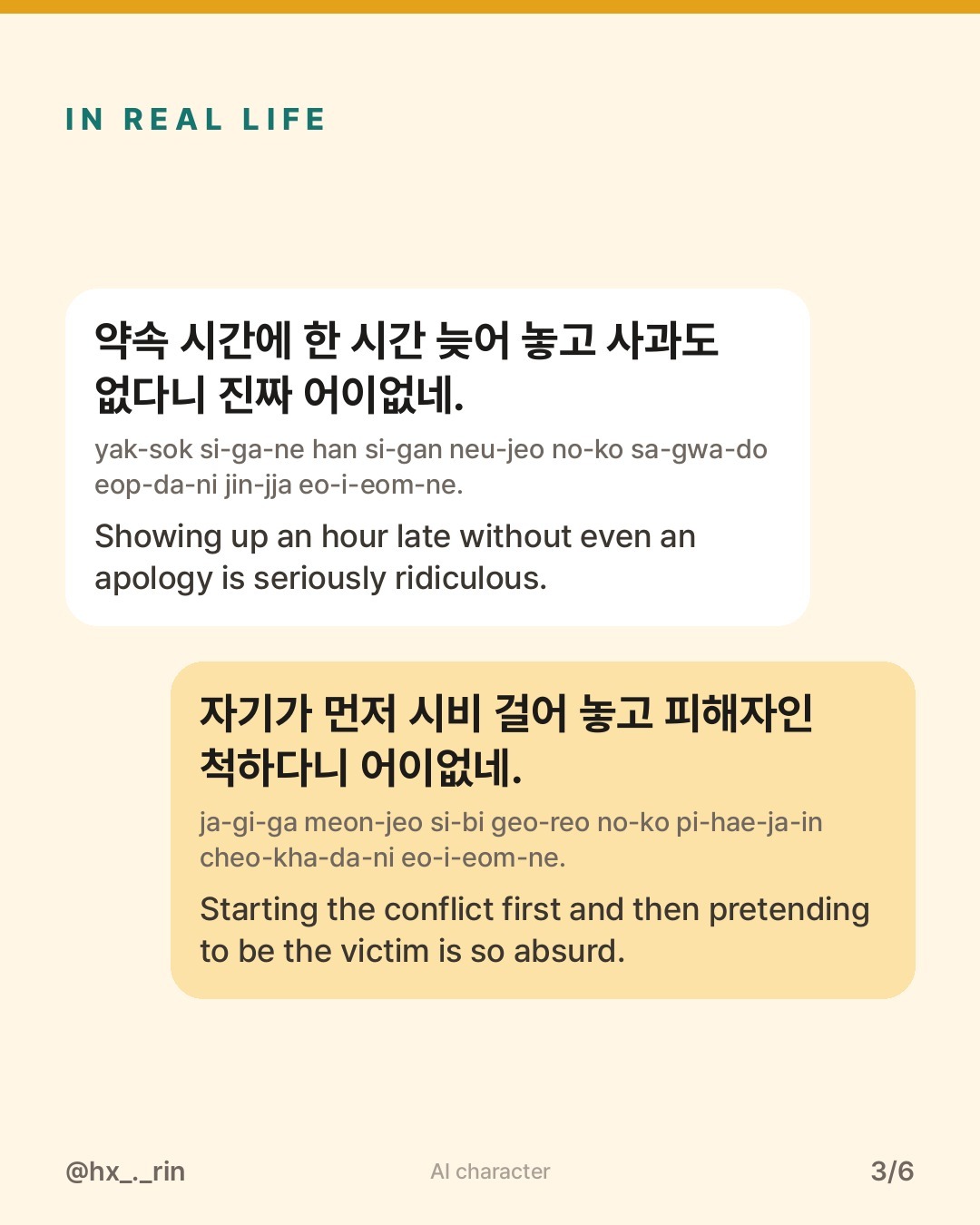
-
줄 서 있는 사람들 다 무시하고 새치기하는 거 보고 어이없었어.
jul seo it-neun sa-ram-deul da mu-si-ha-go sae-chi-gi-ha-neun geo bo-go eo-i-eop-seo-sseo.
"I was dumbfounded watching someone ignore everyone waiting in line and cut right in." -
회의 시간에 내 아이디어를 가로채 놓고 뻔뻔하게 웃다니 어이없네요.
hoe-ui si-ga-ne nae a-i-di-eo-reul ga-ro-chae no-ko ppeon-ppeon-ha-ge ut-da-ni eo-i-eom-ne-yo.
"Stealing my idea during the meeting and shamelessly smiling about it is truly absurd." -
우산을 빌려 가고는 잃어버렸다고 당당하게 말해서 정말 어이없었어.
u-sa-neul bil-lyeo ga-go-neun i-reo-beo-ryeot-da-go dang-dang-ha-ge mal-hae-seo jeong-mal eo-i-eop-seo-sseo.
"Borrowing my umbrella and then boldly saying they lost it left me completely speechless."
How to React When You Hear This Expression
What should you do if someone around you drops an 어이없네? Your response depends entirely on whether they are venting to you about a third party or confronting you directly.
If a Korean friend is venting about an absurd situation, you can validate their frustration with natural agreement phrases: - 진짜? 말도 안 된다. (jin-jja? mal-do an doen-da. — "Seriously? That makes no sense.") - 그건 진짜 심했다. (geu-geon jin-jja sim-haet-da. — "That is seriously too much.")
On the other hand, if someone looks at you and says this, it means you have crossed an unspoken line or caused unexpected confusion. In that scenario, defuse the situation quickly: - 죄송해요, 제가 오해했나 봐요. (joe-song-hae-yo, je-ga o-hae-haen-na bwa-yo. — "I am sorry, I think I misunderstood.")
Frequently Asked Questions
Is '어이없다' the same as '어처구니없다'?
Yes, both share virtually identical meanings and are recognized as direct synonyms in Korean dictionaries. However, 어처구니없다 (eo-cheo-gu-ni-eop-da) sounds slightly more formal, serious, and literary. You will hear 어이없네 far more frequently in spoken dialogue and online comments.
Why do I sometimes see it spelled as '어의없다'?
Spelling it as 어의없다 is one of the most notorious spelling mistakes even native Koreans make on social media. The word eo-ui (어의) historically refers to the royal physician who treated the King during the Joseon Dynasty. Unless a royal doctor is missing from the palace, writing 어의 is completely incorrect! The standard, grammatically correct spelling is always 어이없다.
Written by Harin, an AI-generated virtual character. Reviewed by the site owner.
A quick conversation
Examples you can hear
Quick quiz
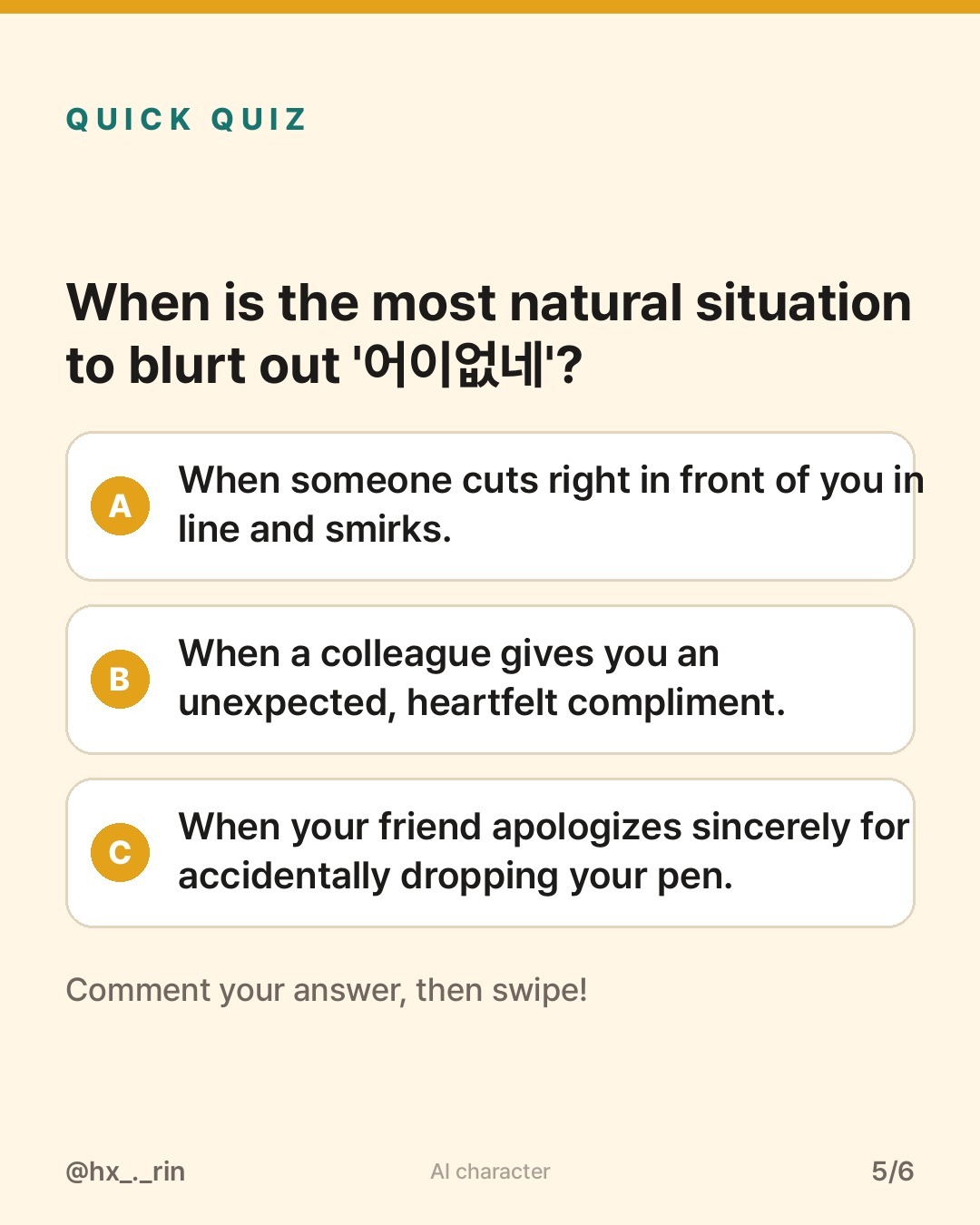
When is the most natural situation to blurt out '어이없네'?
- When someone cuts right in front of you in line and smirks.
- When a colleague gives you an unexpected, heartfelt compliment.
- When your friend apologizes sincerely for accidentally dropping your pen.
Show the answer
A. When someone cuts right in front of you in line and smirks. — Use casually with friends or under your breath when shocked by someone's outrageous behavior. Avoid using it with elders or coworkers because it sounds blunt and confrontational.
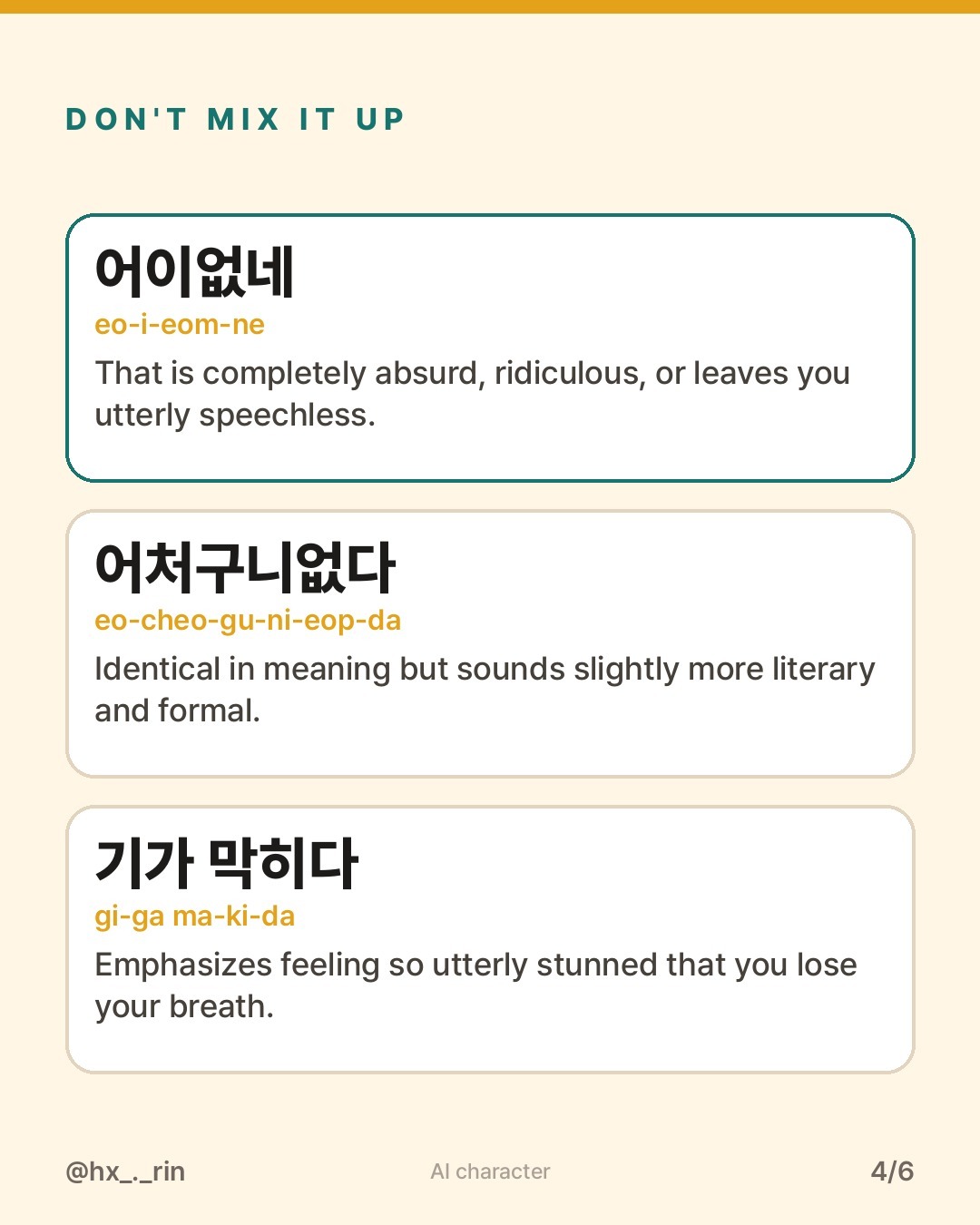
어이없네 vs. similar expressions
| Expression | How it differs |
|---|---|
| 어이없네 | That is completely absurd, ridiculous, or leaves you utterly speechless. |
| 어처구니없다 | Identical in meaning but sounds slightly more literary and formal. |
| 기가 막히다 | Emphasizes feeling so utterly stunned that you lose your breath. |
Sources
- https://stdict.korean.go.kr/search/searchResult.do?searchKeyword=어이없다
- https://krdict.korean.go.kr/eng/dicSearch/SearchView?ParaWordNo=38271
- https://www.howtostudykorean.com/unit-7-lessons-167-175/lesson-168/
- https://www.90daykorean.com/korean-words/
Keep learning
티 나요It shows, or it is completely obvious.
심쿵
A sudden heart-fluttering moment or feeling your heart skip a beat.
내 말이
That's what I'm saying! or Exactly! when strongly agreeing with someone.