What Does 'Simkung' (심쿵) Mean in Korean?
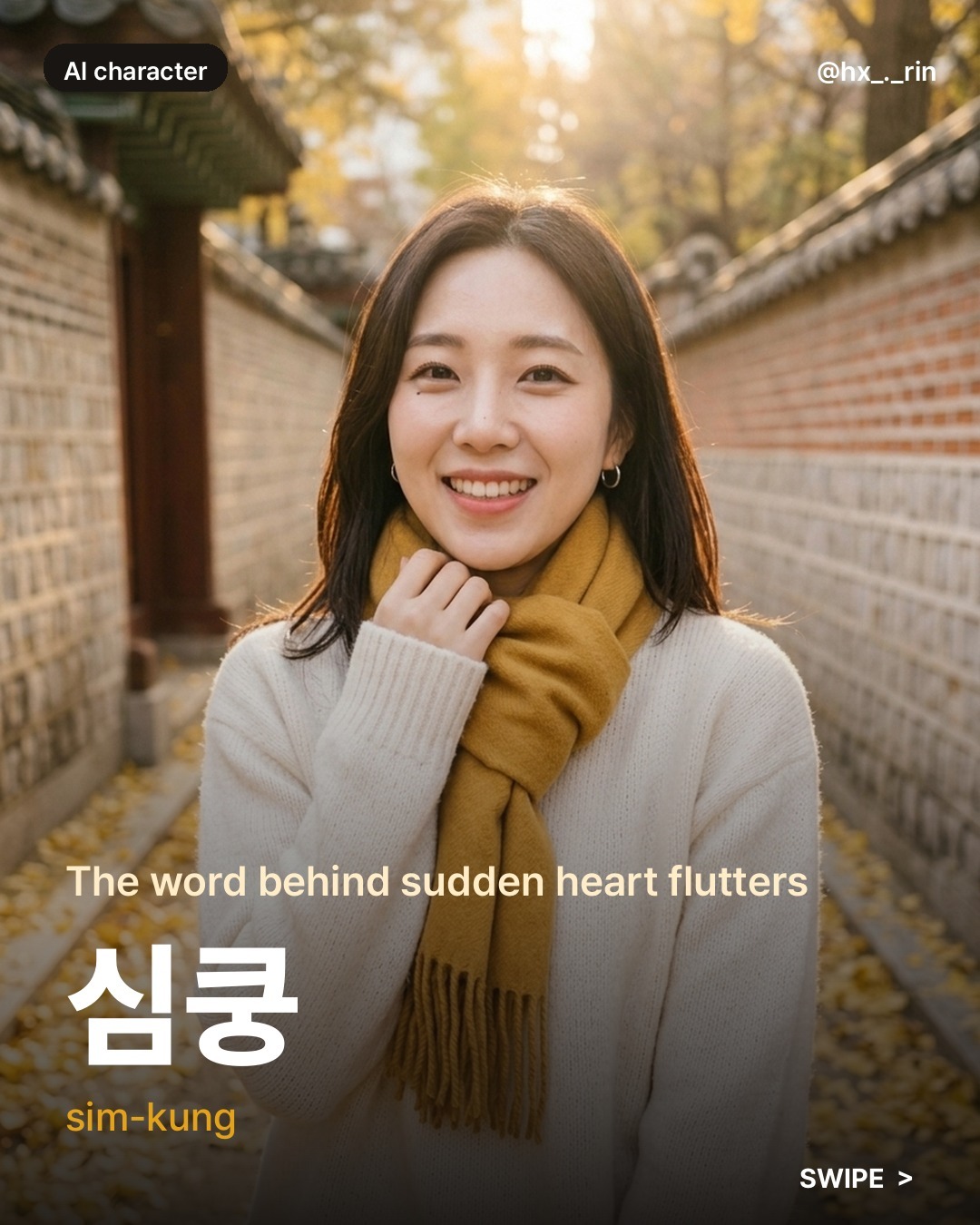
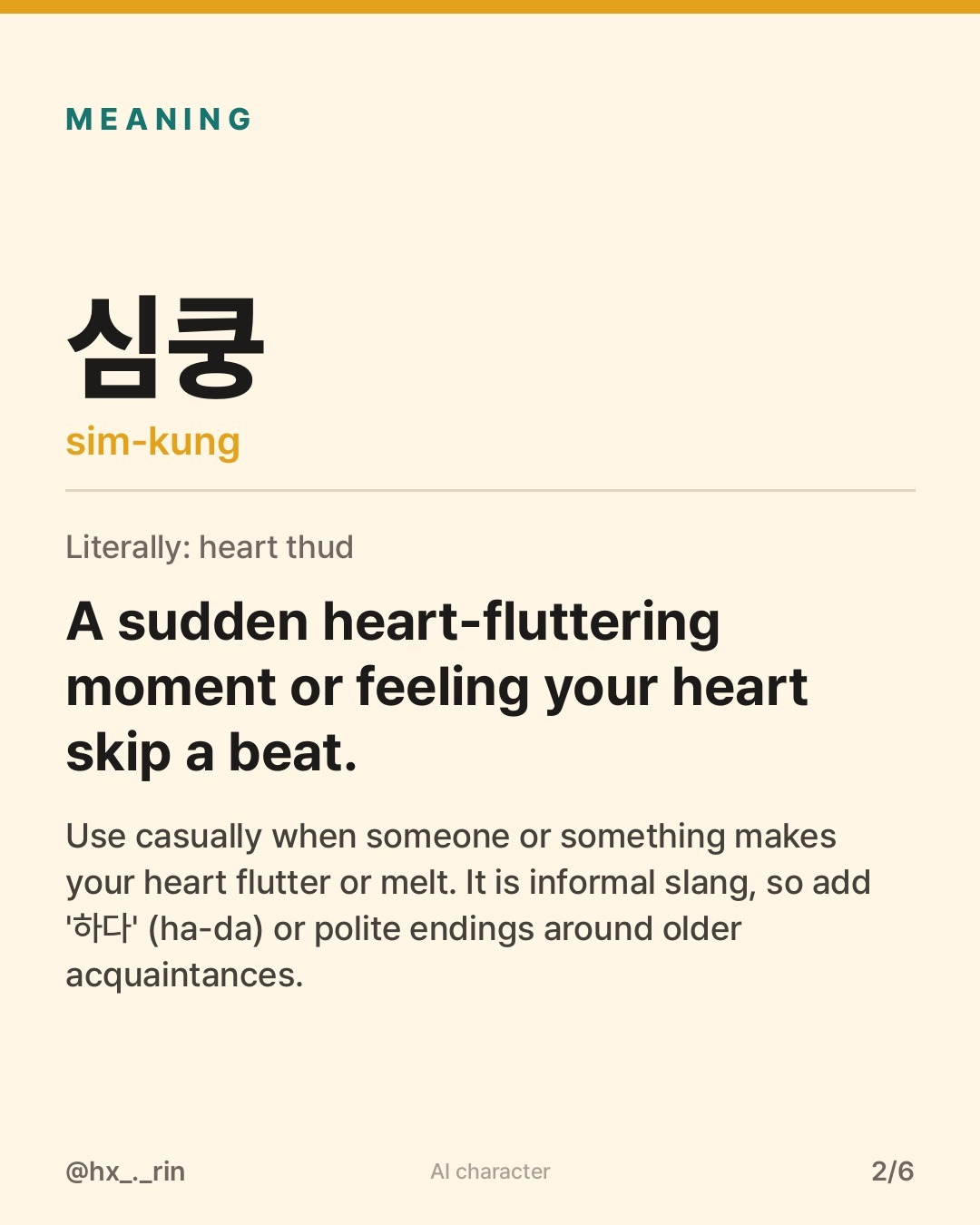
심쿵
- Literally
- heart thud
- Means
- A sudden heart-fluttering moment or feeling your heart skip a beat.
- Use it
- Use casually when someone or something makes your heart flutter or melt. It is informal slang, so add '하다' (ha-da) or polite endings around older acquaintances.
K-drama KoreanThis week's phrases
Examples you can hear
The Sudden Flutter: What Does Simkung Mean?
If you have ever watched a Korean drama, you already know the exact second it happens: two characters stumble into each other during a sudden rain shower, an outstretched arm catches someone before they bump into a scooter, or a quiet smile breaks through an icy stare. In Korean popular culture, that visceral, lightning-fast sensation of your heart dropping or skipping a beat is summed up in one evocative word: 심쿵 (sim-kung).
While textbooks often teach formal terms for emotions, real-world Korean thrives on expressive compounds. Simkung captures an instantaneous physical and emotional reaction. It is not just about having a gentle crush; it is that sudden, chest-clutching surge of adoration or shock that leaves you temporarily breathless.
Breaking Down the Word: Heart Meets Thump
To understand why this expression resonates so deeply across Seoul, take a look at its literal building blocks. The word is an inventive blend of two elements:
- 심 (sim): A clipped form of 심장 (sim-jang), the Sino-Korean noun for "heart" or "cardiac organ."
- 쿵 (kung): A vivid Korean onomatopoeia mimicking a heavy, resonant thud or boom, similar to the English sound effect "thud" or "ka-thump."
Put them together, and you get a literal "heart-thud." Unlike slow-burning affection, simkung represents the sudden acoustic and kinetic sensation of your heart hammering against your ribs. Although it emerged as modern slang on the internet and entertainment variety programs, it quickly became an everyday staple recognized by the National Institute of Korean Language's open dictionary, Urimalsaem.
Classic Situations: When Do Koreans Say It?
Koreans reach for simkung in moments where charm strikes without warning. Here are the most typical scenarios where you will hear it:
- Classic Romantic Gestures When someone pulls off an unexpectedly thoughtful move—giving you their jacket in the chilly evening or remembering your favorite coffee order—the sudden surge of attraction is pure simkung. Example:
- 선배가 겉옷을 벗어 줘서 심쿵했어.
- Seon-bae-ga geot-os-eul beos-eo jwo-seo sim-kung-haet-eo.
-
"My heart skipped a beat when my senior gave me their jacket."
-
Unbearable Cuteness Simkung is not reserved exclusively for human crushes. Koreans constantly use it when encountering outrageously cute animals or babies. Seeing a fluffy kitten snooze in a sunbeam or a puppy tilt its head is frequently labeled a "heart attack" moment. Example:
- 아기 판다가 뒹굴거리는 모습에 심쿵했어.
- A-gi pan-da-ga dwing-gul-geo-ri-neun mo-seub-e sim-kung-haet-eo.
-
"My heart melted when the baby panda rolled around."
-
Celebrity and Fandom Moments On variety shows and social media, fans use simkung whenever their favorite idol or actor stares directly into the camera or delivers a charming line. Example:
- 그 배우가 미소 짓는 순간 다들 심쿵했어요.
- Geu bae-u-ga mi-so jit-neun sun-gan da-deul sim-kung-haet-eo-yo.
- "Everyone felt their hearts flutter the moment that actor smiled."
How to Conjugate and Choose Politeness Levels
Simkung is flexible. You can use it as a standalone exclamation, attach the copula, or conjugate it into an active verb:
- As an exclamation: Just gasp "심쿵!" when something strikes you in the moment.
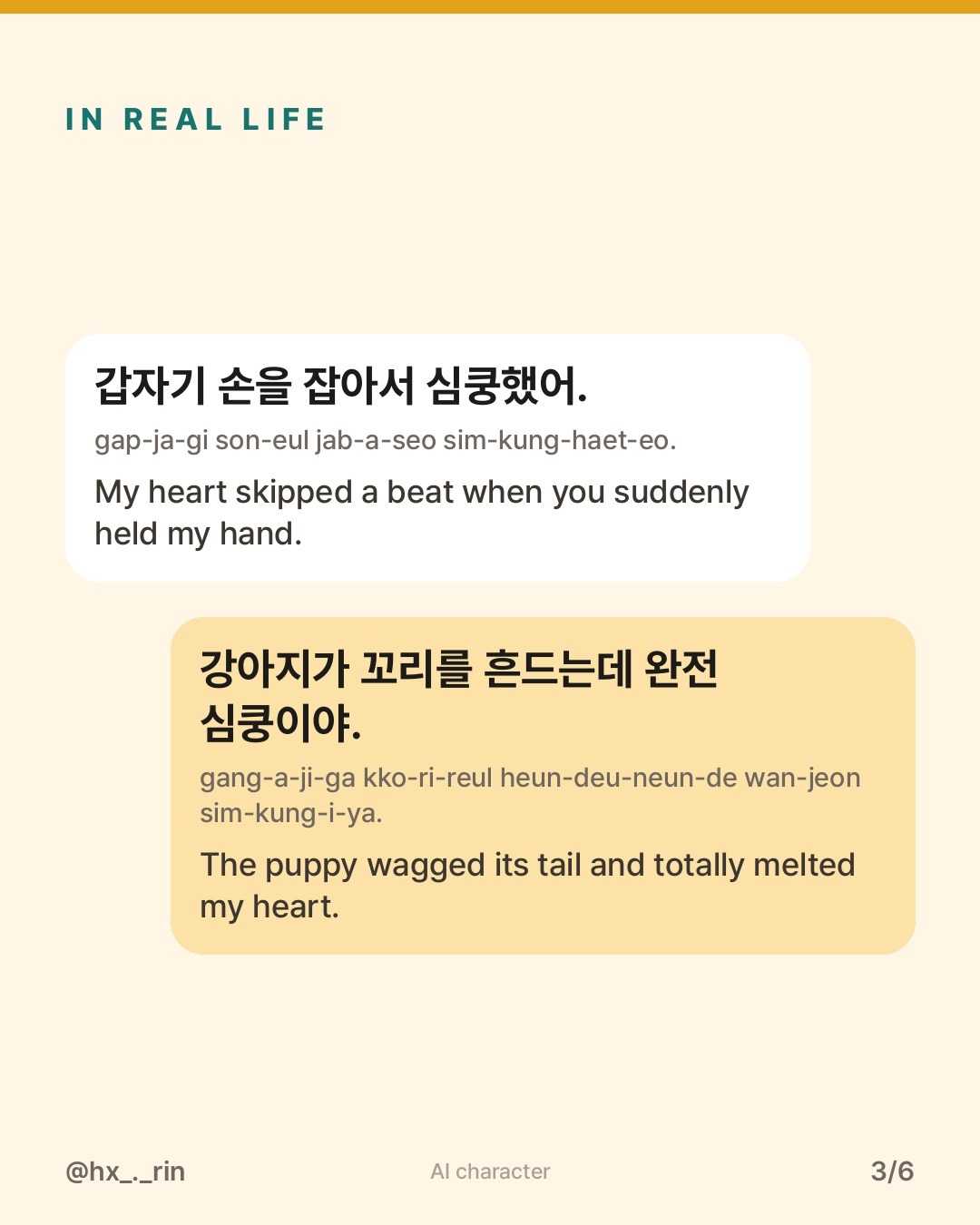
- As a noun phrase: Add the copula to say "완전 심쿵이야" (wan-jeon sim-kung-i-ya, "It is a total heart-thump") among close peers.
- As a verb (past tense): Combine it with the auxiliary verb 하다 (ha-da) to create 심쿵하다 (sim-kung-ha-da). The past-tense informal form is 심쿵했어 (sim-kung-haet-eo), while the polite everyday form is 심쿵했어요 (sim-kung-haet-eo-yo).
- As a trend modifier: You will often hear 심쿵 유발자 (sim-kung yu-bal-ja), which literally translates to "heart-flutter instigator"—a label given to someone or something ridiculously charming.
Keep in mind that simkung is modern slang. While using 심쿵했어요 is perfectly fine with friendly colleagues or acquaintances of a similar age, you should avoid it in formal business meetings, academic presentations, or when speaking with elderly superiors.
Close Alternatives: How Does It Differ?
Understanding nuance requires comparing simkung to related emotional vocabulary:
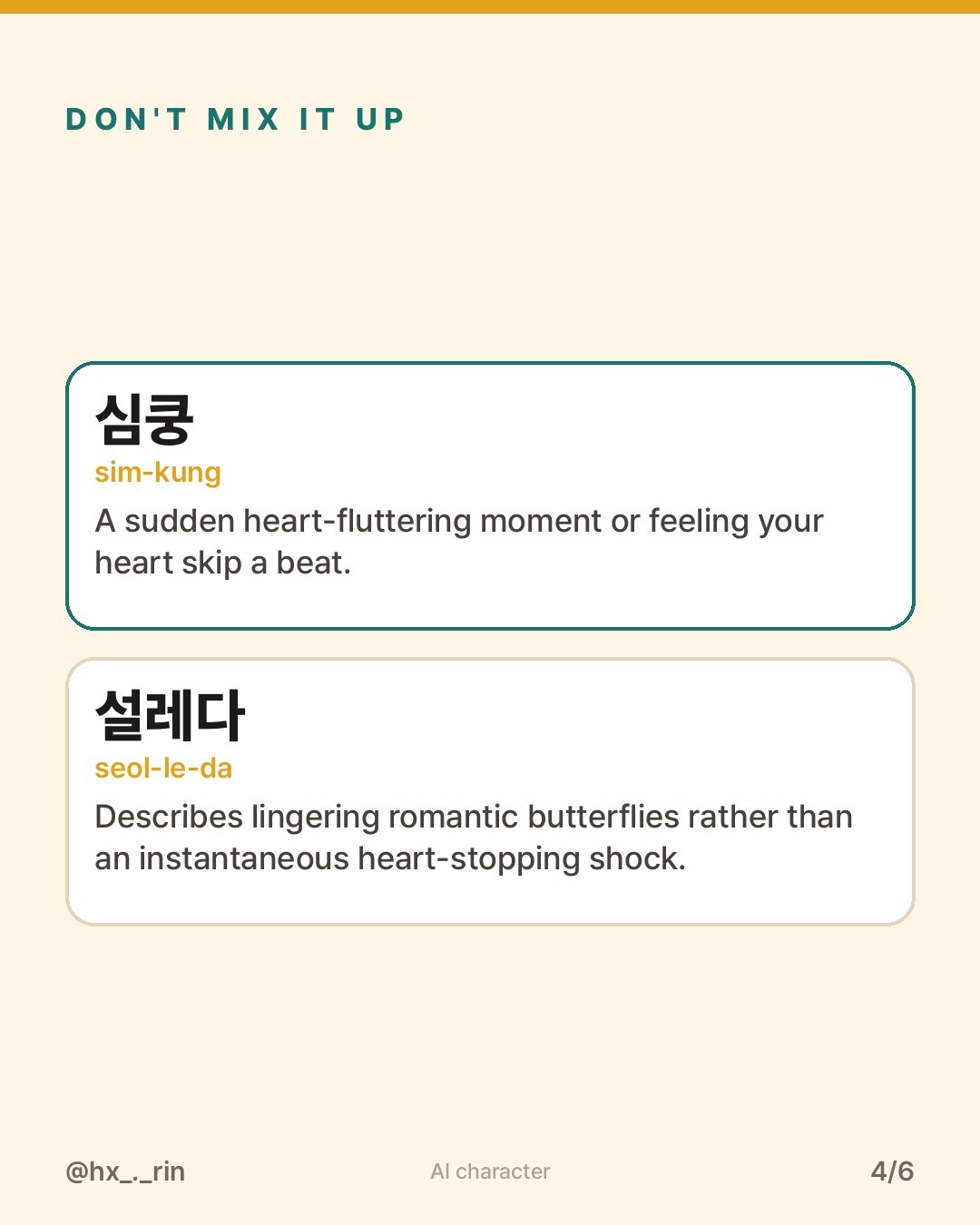
- 설레다 (seol-le-da): This is the traditional standard verb for romantic anticipation or butterflies in the stomach. While seol-le-da describes a continuous, gentle fluttering feeling (such as before a first date), simkung is an abrupt, instantaneous shock to the heart.
- 심장이 멎다 (sim-jang-i meot-da): Literally meaning "my heart stopped," this is a dramatic idiom. It conveys a similar sense of shock, but sounds more literary or theatrical compared to the trendy, casual punch of simkung.
Frequent Mistakes to Avoid
Learners often make two common slips when adopting this expression:
- Using it for genuine terror: Although kung can describe being startled, simkung almost always implies delightful flutters, charm, or positive excitement. If a loud horn scares you on the street, say 깜짝 놀랐어 (kkam-jjak nol-lass-eo) rather than simkung.
- Overusing it in formal environments: Because it appears frequently in entertainment subtitles, learners sometimes assume it belongs in standard essays or professional speech. Keep it strictly to casual conversations and social media.
Quick Answers to Common Questions
Can simkung describe food? Generally no. While an amazing meal might bring extreme joy, simkung is tied to visual charm, romance, and adorableness. For delicious bites, stick to expressions of flavor.
Is simkung considered rude? Not at all rude, but distinctly informal. Using it with friends, siblings, or online followers is completely natural, while using it in formal settings simply sounds too casual.
Written by Harin, an AI-generated virtual character. Reviewed by the site owner.
심쿵 vs. similar expressions
| Expression | How it differs |
|---|---|
| 심쿵 | A sudden heart-fluttering moment or feeling your heart skip a beat. |
| 설레다 | Describes lingering romantic butterflies rather than an instantaneous heart-stopping shock. |
A quick conversation
Quick quiz
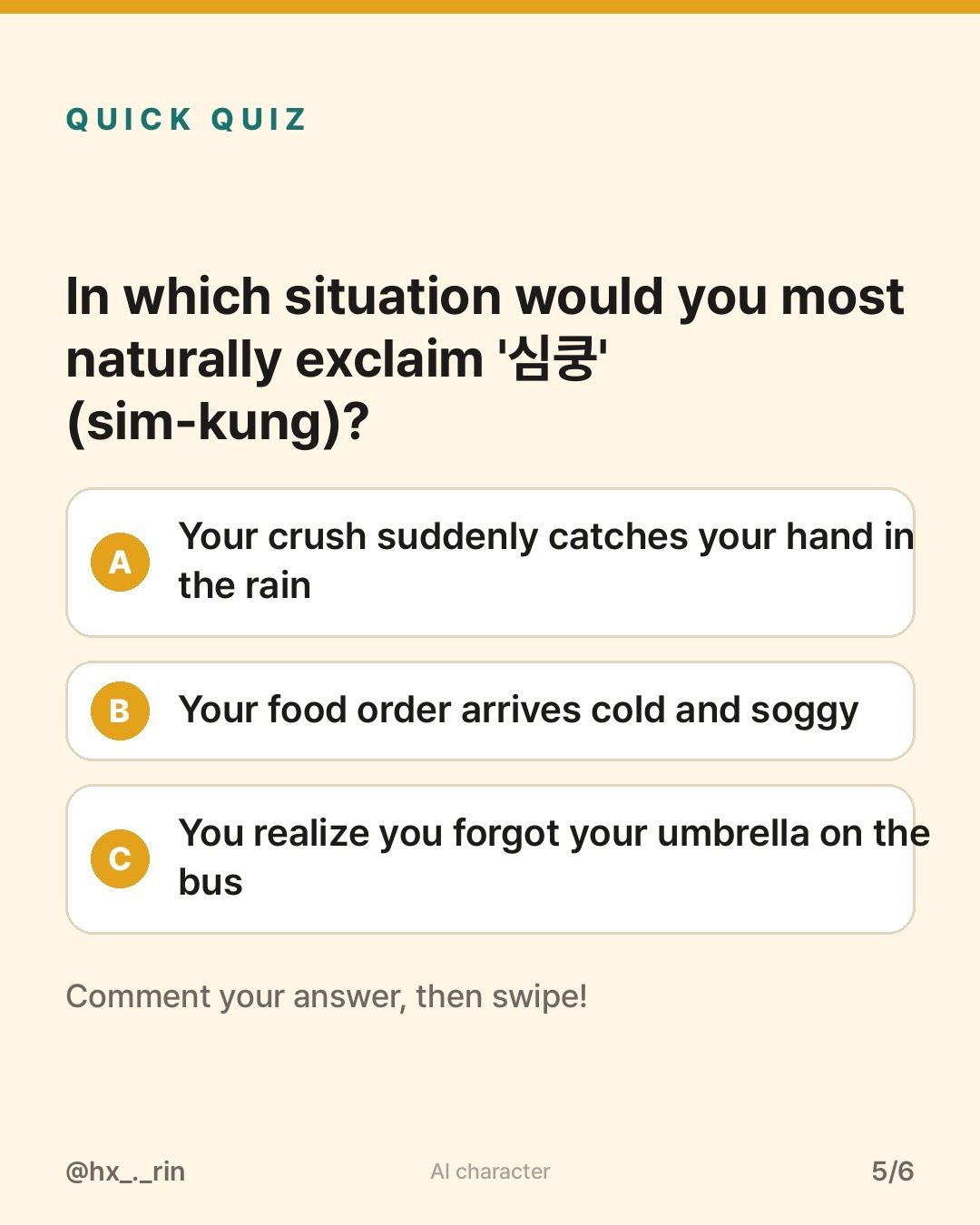
In which situation would you most naturally exclaim '심쿵' (sim-kung)?
- Your crush suddenly catches your hand in the rain
- Your food order arrives cold and soggy
- You realize you forgot your umbrella on the bus
Show the answer
A. Your crush suddenly catches your hand in the rain — Use casually when someone or something makes your heart flutter or melt. It is informal slang, so add '하다' (ha-da) or polite endings around older acquaintances.
Sources
Keep learning
내 말이That's what I'm saying! or Exactly! when strongly agreeing with someone.
눈치 챙겨
Read the room and get a clue before speaking or acting.
정신 차려
Get a grip, snap out of it, or pull yourself together.