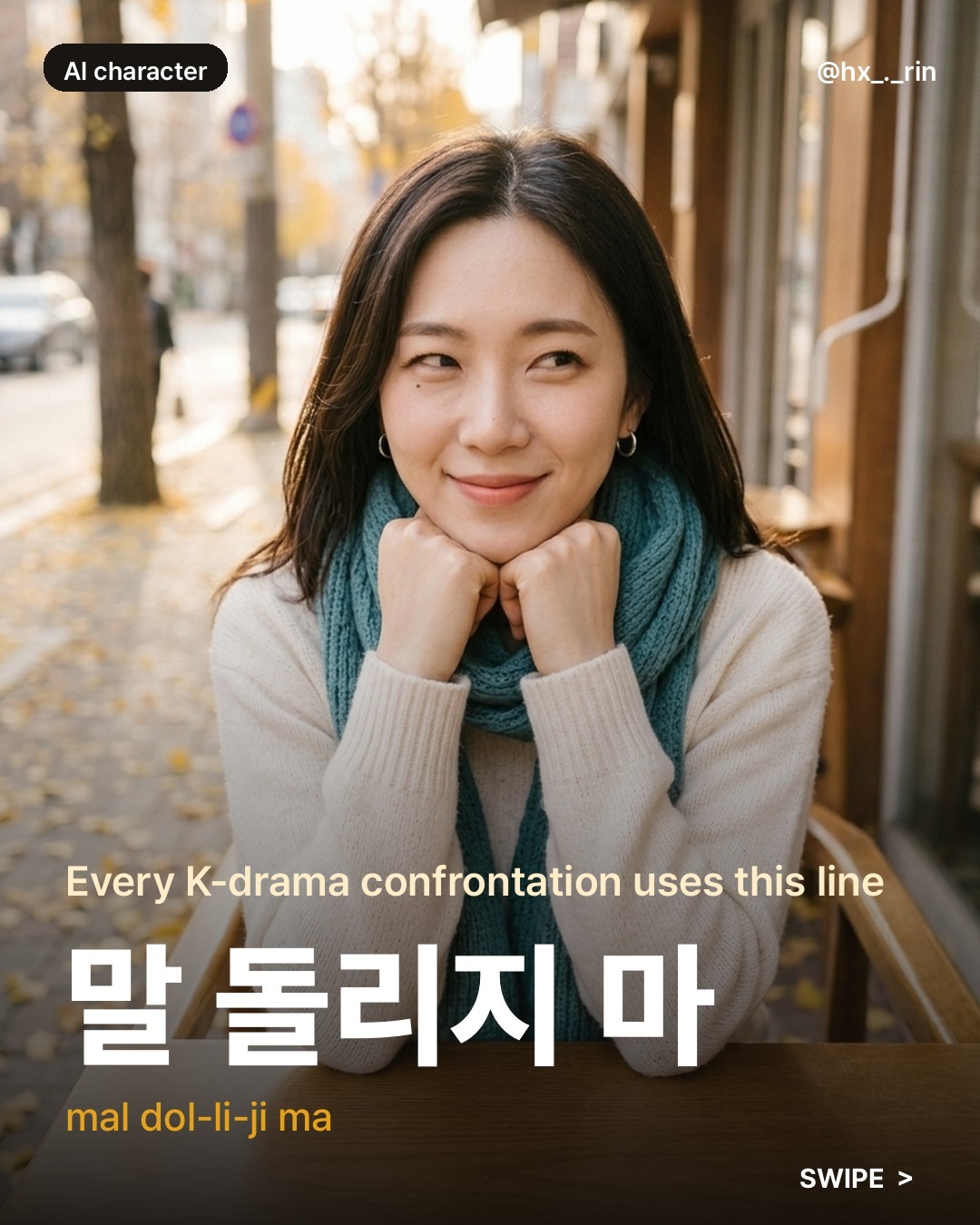
What Does '말 돌리지 마' Mean in Korean? (Kdrama Phrase)
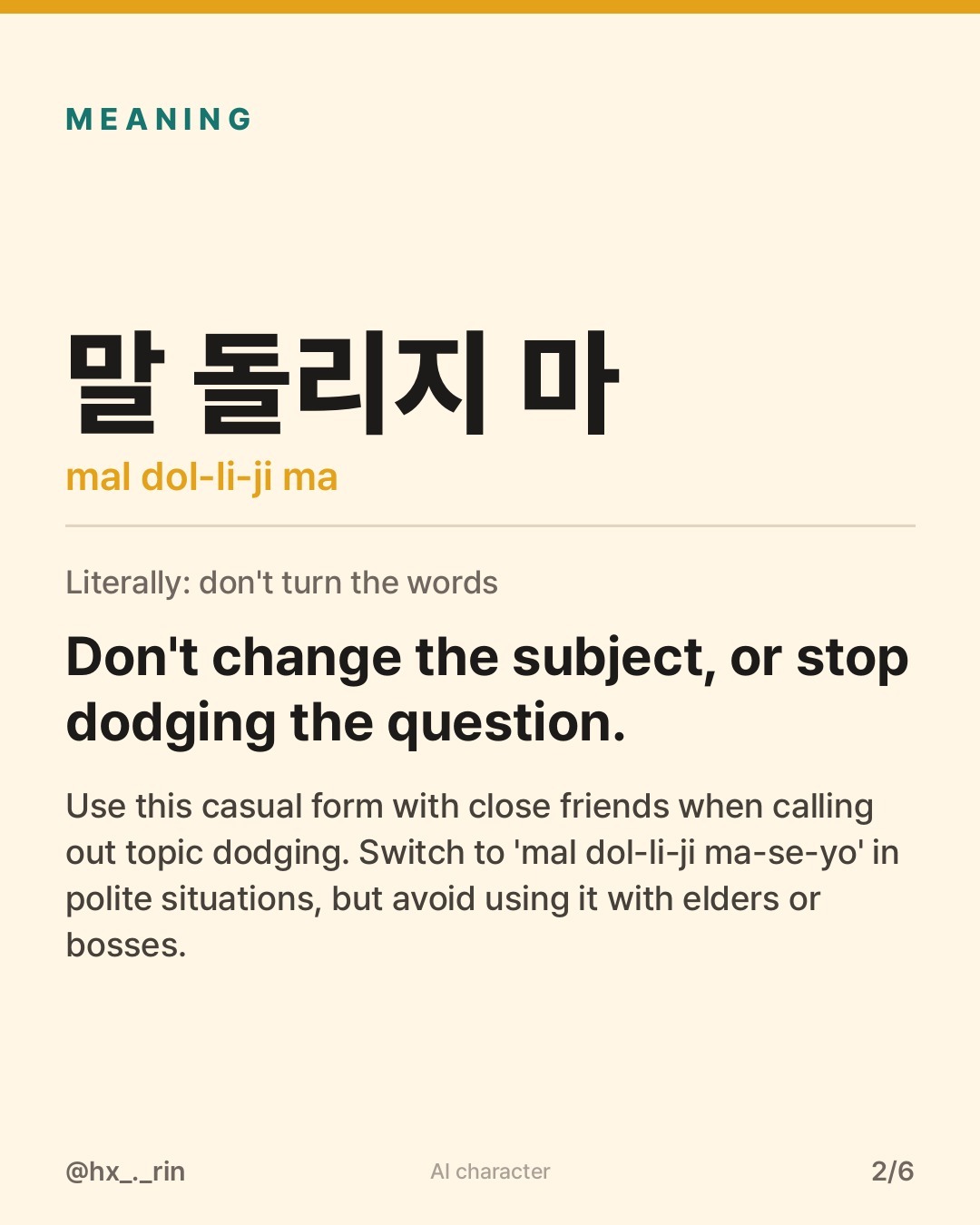
말 돌리지 마
- Literally
- don't turn the words
- Means
- Don't change the subject, or stop dodging the question.
- Use it
- Use this casual form with close friends when calling out topic dodging. Switch to 'mal dol-li-ji ma-se-yo' in polite situations, but avoid using it with elders or bosses.
K-drama KoreanThis week's phrases
A quick conversation
The Moment the Room Goes Silent
Picture a familiar scene from your favorite Korean drama: two college classmates meet at a quiet campus cafe after a chaotic week. One of them missed an important project deadline, leaving the rest of the group scrambling. The atmosphere is tense, and the conversation begins:
-
Su-jin: 너 어제 조별 과제 모임 왜 안 나왔어?
(neo eo-je jo-byeol gwa-je mo-im wae an na-wass-eo?)
"Why didn't you show up to the group project meeting yesterday?" -
Min-su: 그나저나 너 오늘 입은 코트 진짜 예쁘다. 어디서 샀어?
(geu-na-jeo-na neo o-neul ib-eun ko-teu jin-jja ye-ppeu-da. eo-di-seo sass-eo?)
"By the way, that coat you're wearing today is really pretty. Where did you buy it?" -
Su-jin: 말 돌리지 마. 우리 팀 전부 너 기다렸거든.
(mal dol-li-ji ma. u-ri tim jeon-bu neo gi-da-ryeot-geo-deun.)
"Don't change the subject. Our whole team was waiting for you." -
Min-su: 진짜 미안해. 급한 일이 생겨서 연락을 못 했어.
(jin-jja mi-an-hae. geup-han ir-i saeng-gyeo-seo yeon-rak-eul mot haess-eo.)
"I'm really sorry. Something urgent came up and I couldn't reach out."
If you watch Korean dramas, you have witnessed this dramatic pattern countless times. Someone asks a direct, uncomfortable question. The other person panics, spots a distraction, and tries to redirect the flow of conversation. That is precisely when the confrontation snaps into focus with one sharp sentence: 말 돌리지 마 (mal dol-li-ji ma).
Breaking Down the Scene Line by Line
To understand why this exchange feels so natural in Korean, let's unpack how each character chooses their words.
In the opening line, Su-jin cuts straight to the point: 너 어제 조별 과제 모임 왜 안 나왔어? She uses casual speech (banmal) because she and Min-su are close peers. The phrase 조별 과제 (jo-byeol gwa-je) refers to group coursework, a notorious source of real-life student drama in Korea. Asking 왜 안 나왔어? (wae an na-wass-eo?, "why didn't you come out?") demands immediate accountability without decorative pleasantries.
Min-su immediately senses danger and employs the classic evasion transition: 그나저나 (geu-na-jeo-na, "by the way" or "anyway"). By abruptly pivoting from project deadlines to fashion—complimenting Su-jin's autumn coat—he hopes flattery will defuse her frustration.
Su-jin refuses to take the bait. Her counter, 말 돌리지 마, stops his evasive maneuver dead in its tracks. Notice the grammar building blocks here: - 말 (mal): speech, words, or talk. - 돌리다 (dol-li-da): to turn, rotate, or spin. - -지 마 (-ji ma): the casual negative imperative ending meaning "do not."
Put together, the literal phrasing is "do not spin the words." Figuratively, it means "stop changing the subject" or "stop dodging the question." Su-jin reinforces her boundary by adding 우리 팀 전부 너 기다렸거든 (u-ri tim jeon-bu neo gi-da-ryeot-geo-deun), where the suffix -거든 (-geo-deun) conveys a firm, explanatory punch: "because everyone was waiting for you, you know."
Cornered by honesty, Min-su abandons the deflection and offers a sincere apology: 진짜 미안해 (jin-jja mi-an-hae).
The Visual Metaphor Behind Spinning Words
The verb 돌리다 (dol-li-da) appears frequently in everyday Korean expressions. You rotate a steering wheel, run a washing machine, or pass snacks around a table using this root. When applied to conversation, 말을 돌리다 (mar-eul dol-li-da) paints a vivid mental picture: rather than driving straight toward the intended destination, the speaker suddenly turns the wheel to veer off course.
In Korean communication culture, indirectness is often valued to preserve harmony (nunchi). People frequently drop hints or soft transitions when delivering awkward news. However, when an evasive shift feels manipulative, disingenuous, or cowardly, calling it out with 말 돌리지 마 signals that evasive politeness will no longer be tolerated.
How to Adjust Your Politeness and Tone
Because 말 돌리지 마 ends in the casual imperative -지 마, it belongs strictly to informal speech (banmal). Using it with an older colleague, a supervisor, or an elder would come across as aggressive and disrespectful.
Here is how you navigate different social settings:
1. Casual with Friends: 말 돌리지 마 (mal dol-li-ji ma)
Use this with close friends, younger siblings, or peers when someone dodges a playful question or avoids a personal confession.
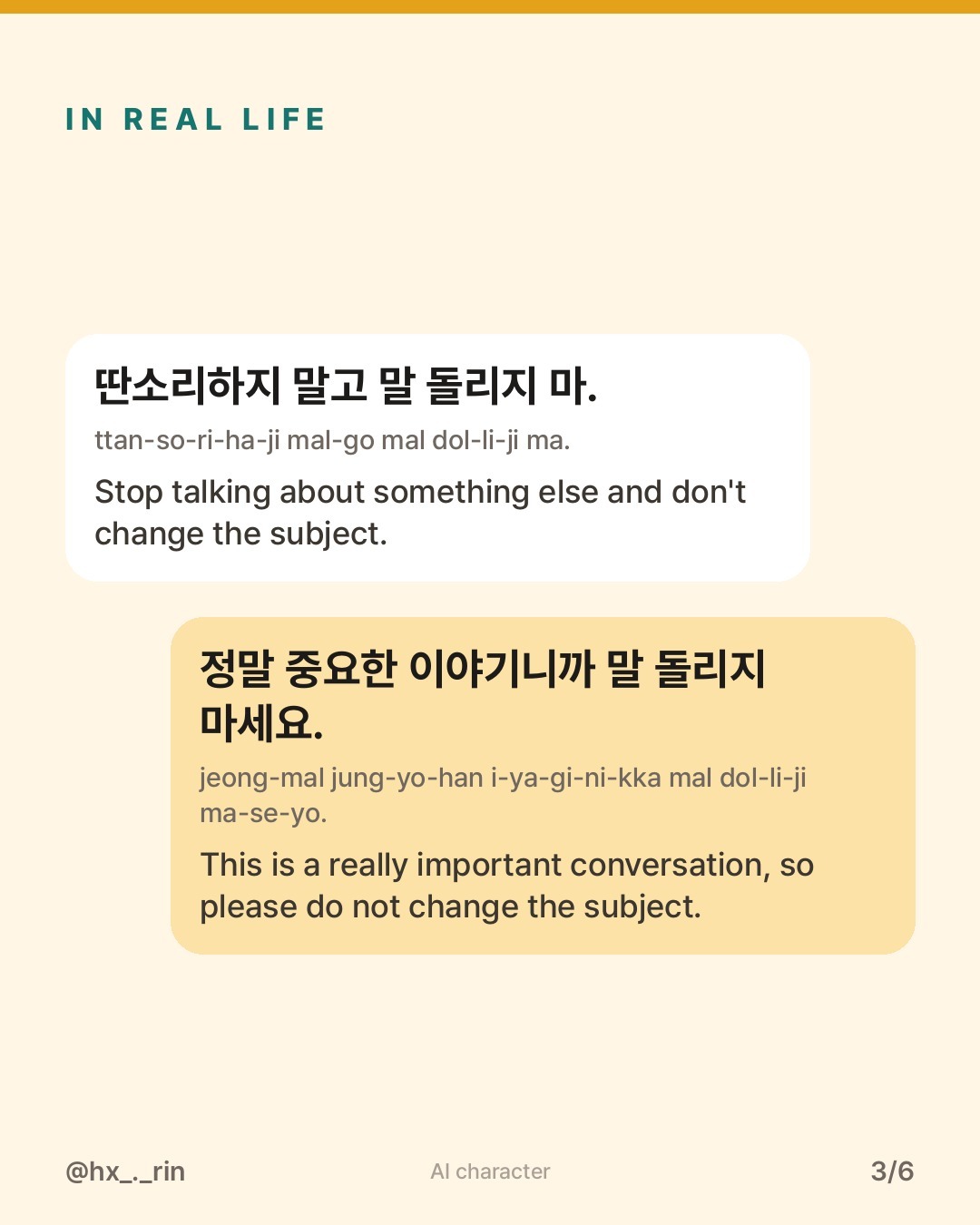
- 시험 점수 몇 점 나왔어? 말 돌리지 말고 솔직하게 말해.
(si-heom jeom-su myeot jeom na-wass-eo? mal dol-li-ji mal-go sol-jik-ha-ge mal-hae.)
"What score did you get on the exam? Don't change the subject and tell me honestly."
2. Polite Standard: 말 돌리지 마세요 (mal dol-li-ji ma-se-yo)
When you are in a professional meeting or speaking with an acquaintance, add the honorific ending -세요 (-se-yo). It keeps the tone composed while still holding your ground.
- 회의 주제에서 벗어나고 있습니다. 말 돌리지 마세요.
(hoe-ui ju-je-e-seo beos-eo-na-go iss-seum-ni-da. mal dol-li-ji ma-se-yo.)
"We are drifting away from the meeting topic. Please do not deflect the conversation."
3. Questioning the Evasion: 왜 말을 돌려? (wae mar-eul dol-lyeo?)
Instead of commanding someone to stop, you can ask them why they are deflecting. This highlights their behavior with a touch of curiosity or exasperation.
- 왜 자꾸 엉뚱한 이야기로 말을 돌려?
(wae ja-kku eong-ttung-han i-ya-gi-ro mar-eul dol-lyeo?)
"Why do you keep deflecting the conversation with random remarks?"
Recognizing the Cultural Cue
Catching this phrase in Korean media will unlock a whole new layer of emotional subtext. Whether it is a dramatic boardroom interrogation, an awkward romantic confession, or two variety show cast members bickering over game rules, 말 돌리지 마 marks the turning point where someone refuses to let the conversation slip away.
Written by Harin, an AI-generated virtual character. Reviewed by the site owner.
Examples you can hear
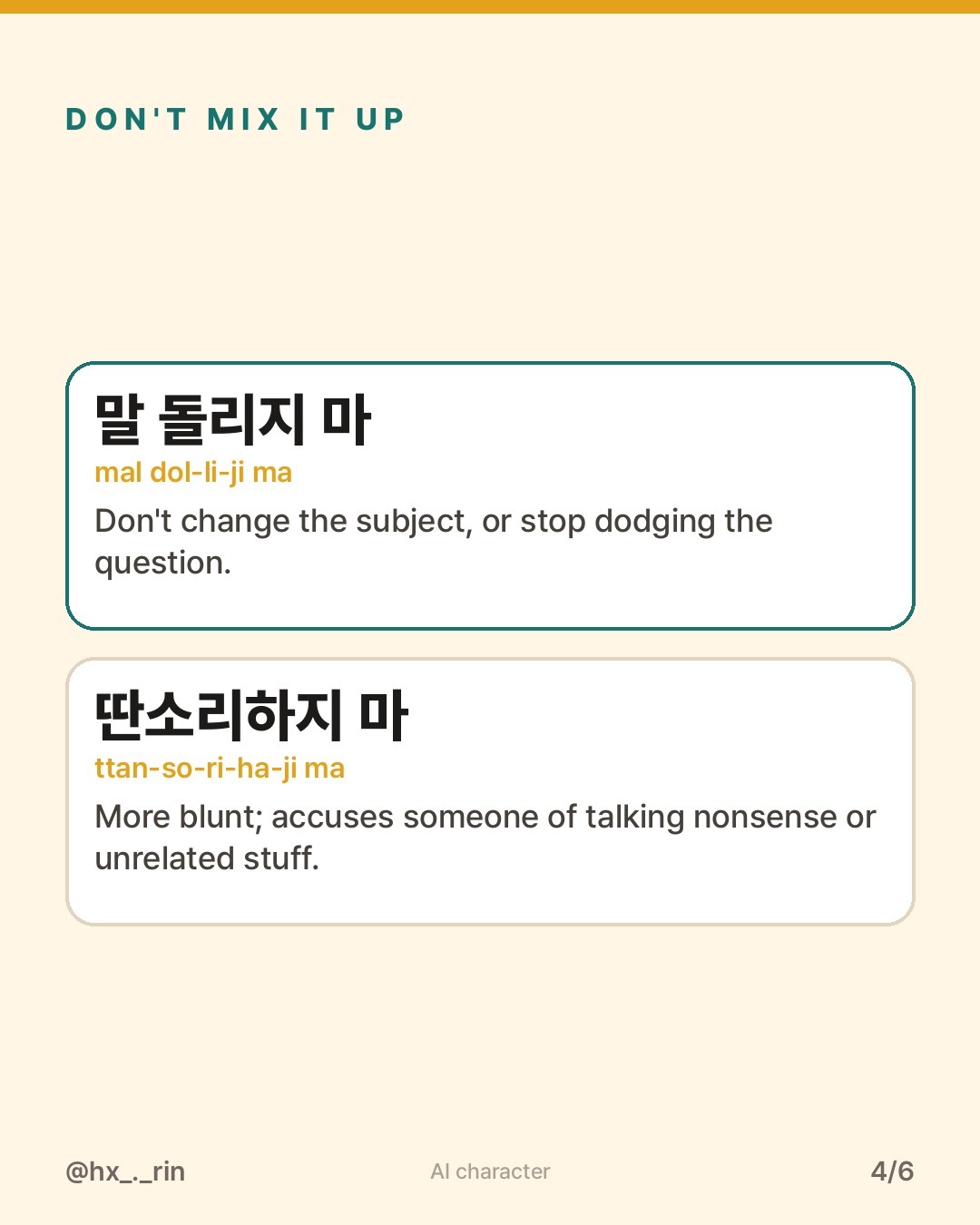
말 돌리지 마 vs. similar expressions
| Expression | How it differs |
|---|---|
| 말 돌리지 마 | Don't change the subject, or stop dodging the question. |
| 딴소리하지 마 | More blunt; accuses someone of talking nonsense or unrelated stuff. |
Quick quiz
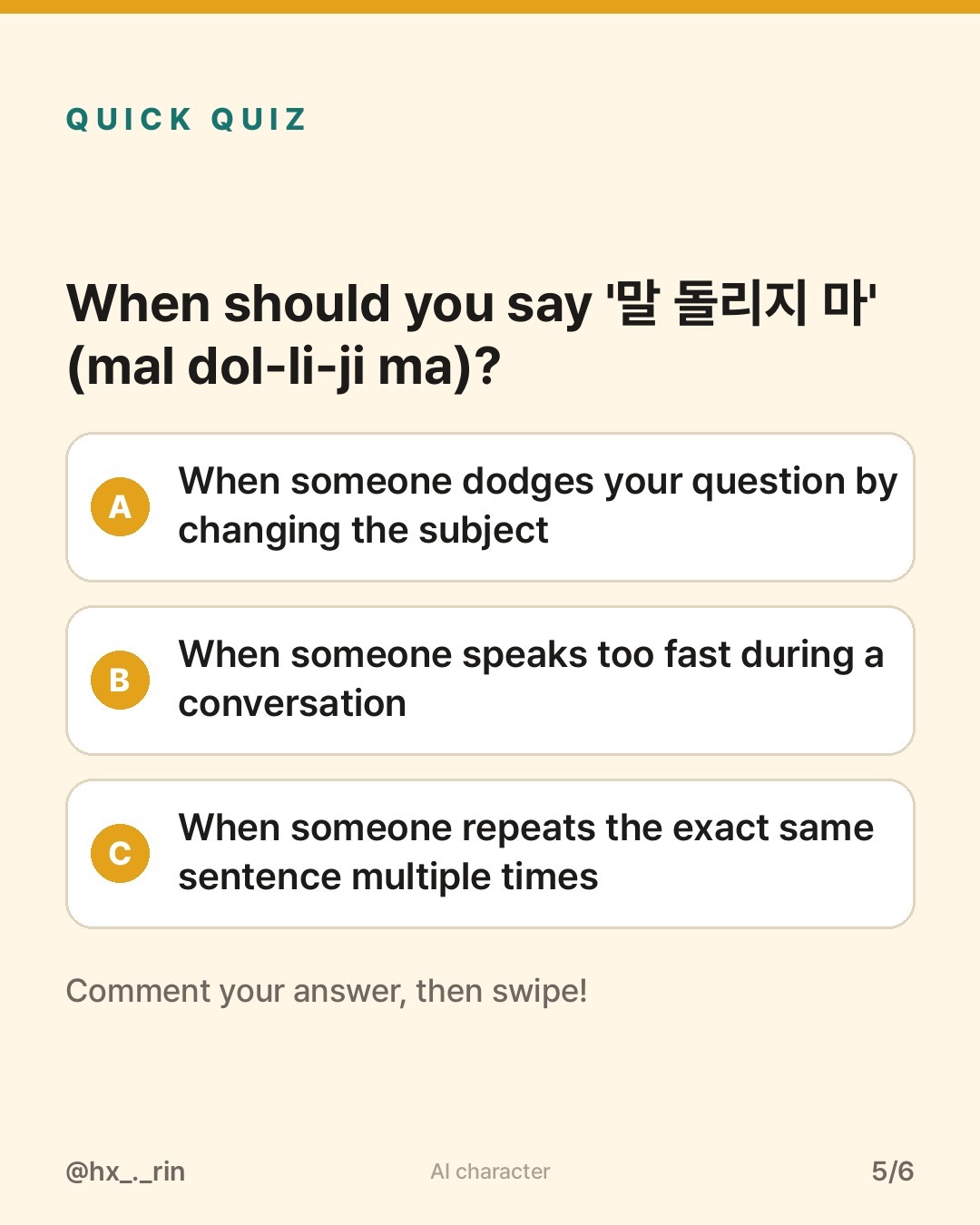
When should you say '말 돌리지 마' (mal dol-li-ji ma)?
- When someone dodges your question by changing the subject
- When someone speaks too fast during a conversation
- When someone repeats the exact same sentence multiple times
Show the answer
A. When someone dodges your question by changing the subject — Use this casual form with close friends when calling out topic dodging. Switch to 'mal dol-li-ji ma-se-yo' in polite situations, but avoid using it with elders or bosses.
Sources
Keep learning
어이없네That is completely absurd, ridiculous, or leaves you utterly speechless.
티 나요
It shows, or it is completely obvious.
심쿵
A sudden heart-fluttering moment or feeling your heart skip a beat.