What Does '내 말이' Mean in Korean? (Nae Mar-i Guide)
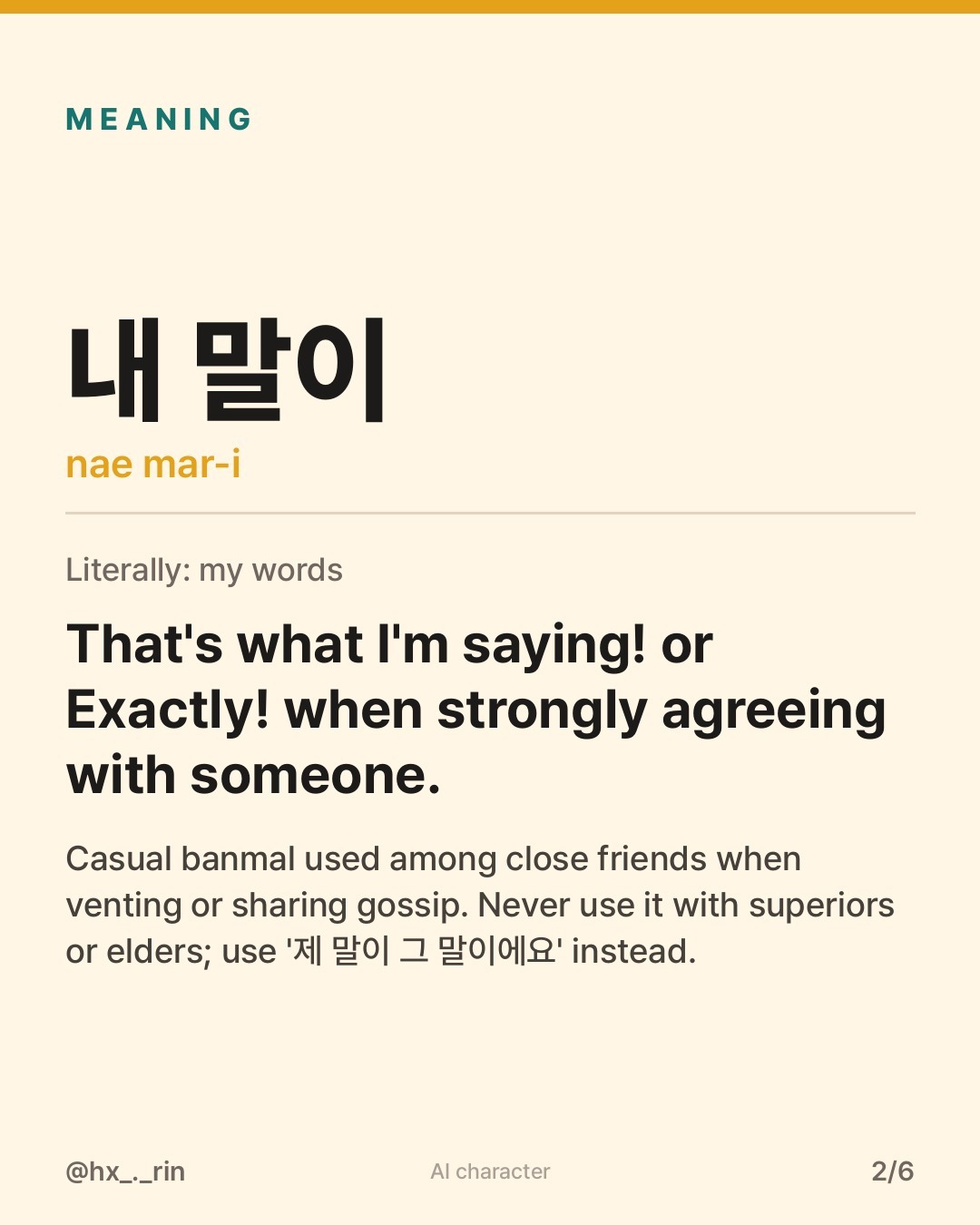
내 말이
- Literally
- my words
- Means
- That's what I'm saying! or Exactly! when strongly agreeing with someone.
- Use it
- Casual banmal used among close friends when venting or sharing gossip. Never use it with superiors or elders; use '제 말이 그 말이에요' instead.
K-drama KoreanThis week's phrases

The Stiff Agreement Trap: Why Textbook Korean Fails in Real Chats
When you first start learning Korean, textbooks diligently teach you polite expressions like dong-ui-ham-ni-da (동의합니다, "I agree") or maj-a-yo (맞아요, "that is right"). These phrases are grammatically immaculate, but here is the problem: the moment you sit down with Korean friends at a cafe or watch a fiery debate on a Korean variety show, nobody talks like a business contract.
Imagine your Korean friend leans over their iced americano and vents about how impossible the bus commute was this morning. If you respond with a stiff "동의합니다," the conversation instantly halts. It sounds as though you are officially signing a multilateral treaty rather than sharing mutual frustration.
Even worse, many English speakers attempt a direct translation of the common English idiom "that is what I am saying" into Korean. You might end up cobbling together something like geu-ge nae-ga mal-ha-go iss-neun geo-ya (그게 내가 말하고 있는 거야). To a native Korean speaker, that sentence sounds painfully robotic and slightly confusing.
Another frequent misunderstanding happens when learners first hear the native phrase 내 말이 (nae mar-i). Because nae (내) means "my" and mal-i (말이) is the noun "words" paired with the subject particle, beginners often wait in silence for the speaker to finish the sentence. They wonder, "Your words did what?" Some beginners even wonder if someone is suddenly talking about a horse, since mal (말) is a homophone for horse! But in authentic spoken Korean, nae mar-i is already a complete, punchy sentence.
The Formality Trap: When Casual Slang Becomes a Faux Pas
The second major blunder learners commit with nae mar-i is social misplacement. K-drama fans hear this snappy phrase shouted constantly by best friends in dramatic cafe confrontations or variety show panels. It sounds catchy, energetic, and irresistibly cool.
Naturally, excited learners rush to use it in real life. But here is the catch: nae (내) is strictly ban-mal (반말, casual speech). It is the informal word for "my."
If your company manager sighs about a delayed project and you enthusiastically shout "내 말이!" across the meeting table, you have just addressed your superior as if they were your middle-school classmate. Instead of bonding over shared stress, you have triggered an awkward social silence.
When you want to express passionate agreement with a superior, an elder, or a colleague in a professional environment, native speakers switch to the honorific form: 제 말이 그 말이에요 (je mar-i geu mar-i-e-yo) or simply 그러게요 (geu-reo-ge-yo). The humble pronoun je (제) respects social hierarchy while still conveying total alignment with their thought.
Why Natives Truncate: The Logic of Korean Conversational Ellipsis
Why do Koreans leave the sentence at nae mar-i? The expression is actually an abbreviation of a longer traditional idiom: 내 말이 그 말이야 (nae mar-i geu mar-i-ya), which literally translates to "my words are those exact words."
Spoken Korean thrives on contextual economy. When mutual emotion is high—especially during shared gossip, venting, or comic disbelief—speed matters. Dropping the verb ending transforms the phrase into an exclamation of instant camaraderie. It communicates: "You took the exact thought out of my head before I could speak it!"
How Natives Use It: Natural Everyday Examples
To see how native speakers actually use this phrase across different settings, look at these natural exchanges:
- Venting about an absurd movie plot with a close peer:
- Korean: 내 말이, 그 영화 결말 진짜 황당하더라.
- Romanization: nae mar-i, geu yeong-hwa gyeol-mal jin-jja hwang-dang-ha-deo-ra.
-
English: "That is what I am saying, that movie's ending was seriously absurd."
-
Agreeing enthusiastically on weekend recovery plans:
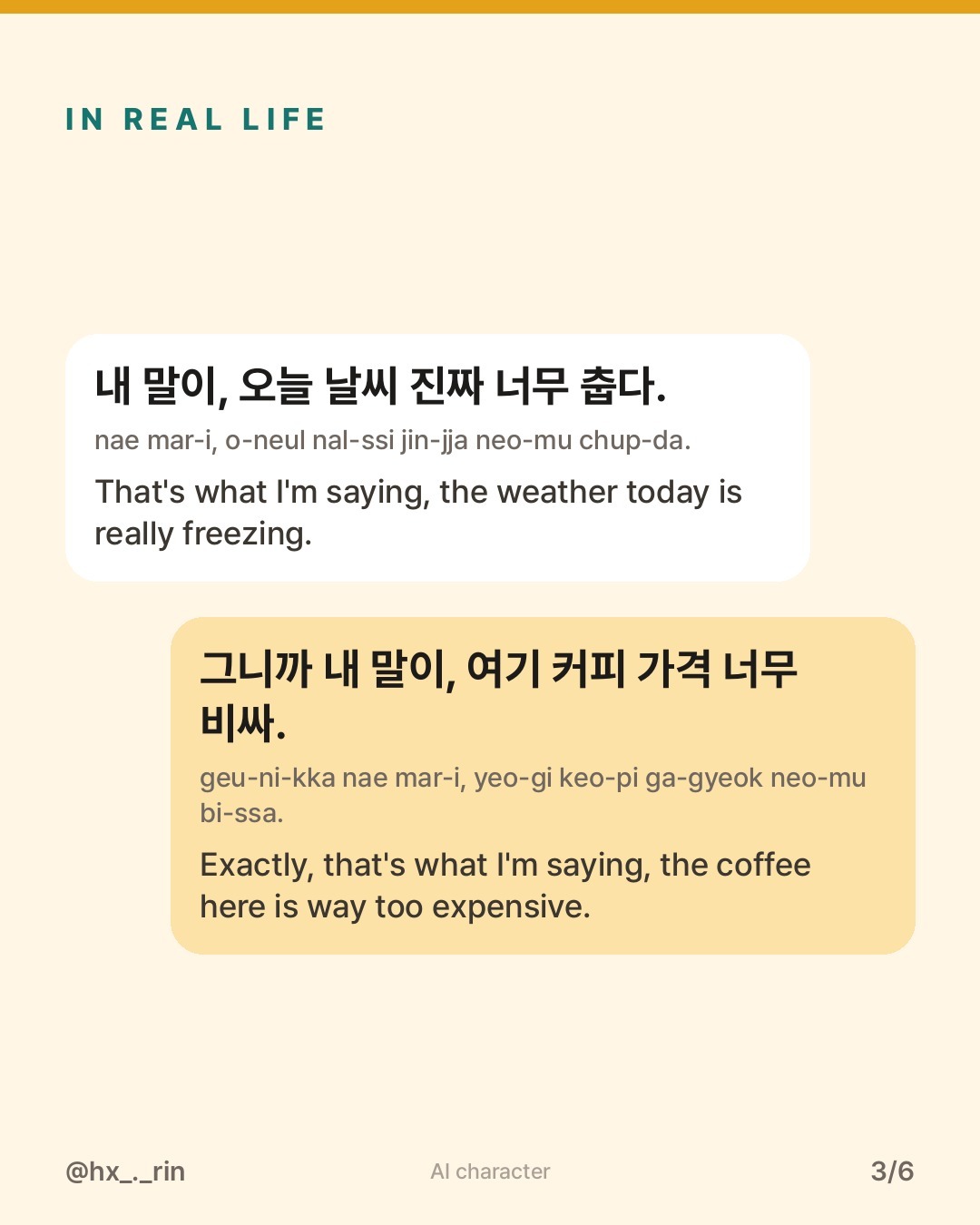
- Korean: 그니까 내 말이, 이번 주말에는 집에서 푹 쉬자.
- Romanization: geu-ni-kka nae mar-i, i-beon ju-mal-e-neun jib-e-seo puk swi-ja.
-
English: "Exactly, that is what I am saying, let's just get plenty of rest at home this weekend."
-
Polite professional alignment with a supervisor or client:
- Korean: 네, 제 말이 그 말이에요. 회의 일정을 조정해야 합니다.
- Romanization: ne, je mar-i geu mar-i-e-yo. hoe-ui il-jeong-eul jo-jeong-hae-ya ham-ni-da.
- English: "Yes, that is exactly what I am saying. We need to adjust the meeting schedule."
Notice how adding geu-ni-kka (그니까, "totally" or "exactly") before nae mar-i amplifies your emotional agreement tenfold among friends.
The Clear Do and Don't Guide for Nae Mar-i
To make sure your conversational Korean stays sharp and socially appropriate, keep this checklist handy:
- DO use nae mar-i with close friends, classmates of the same age, or younger peers when venting or gossiping.
- DO combine it with geu-ni-kka (geu-ni-kka nae mar-i!) when you want to emphasize dramatic, 100% agreement.
- DO use je mar-i geu mar-i-e-yo or geu-reo-ge-yo when speaking with bosses, professors, or older acquaintances.
- DON'T translate English idioms word-for-word into literal phrasing like geu-ge nae-ga mal-ha-neun geo-ya.
- DON'T use nae mar-i in formal presentations, interviews, or customer service encounters.
- DON'T confuse nae mar-i with nae mal deul-eo-bwa (내 말 들어봐), which means "listen to what I have to say."
Mastering how native speakers agree in fast-paced conversations will make your Korean sound remarkably natural, whether you are chatting over street food or reacting to the latest entertainment gossip.
Written by Harin, an AI-generated virtual character. Reviewed by the site owner.
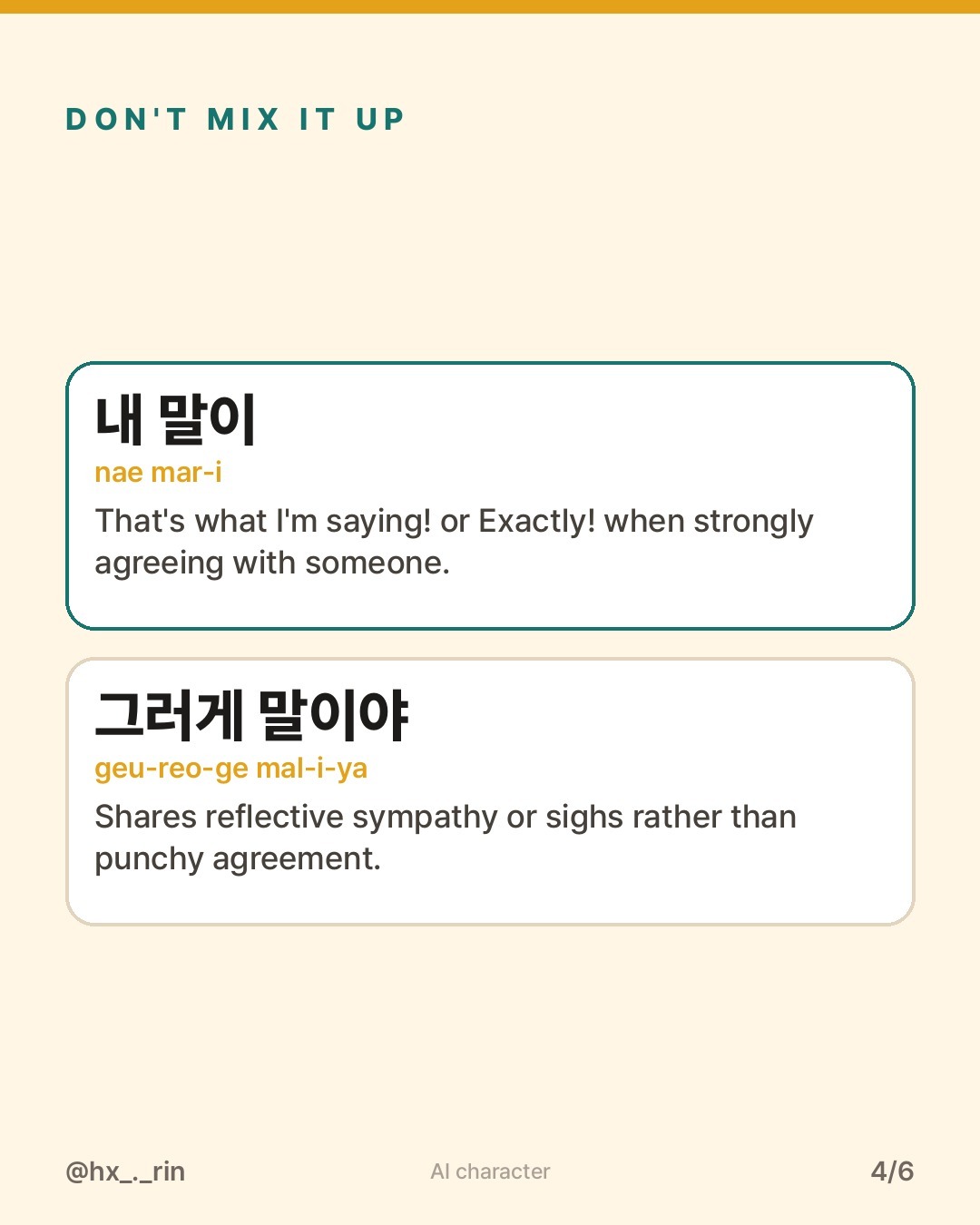
내 말이 vs. similar expressions
| Expression | How it differs |
|---|---|
| 내 말이 | That's what I'm saying! or Exactly! when strongly agreeing with someone. |
| 그러게 말이야 | Shares reflective sympathy or sighs rather than punchy agreement. |
Examples you can hear
A quick conversation
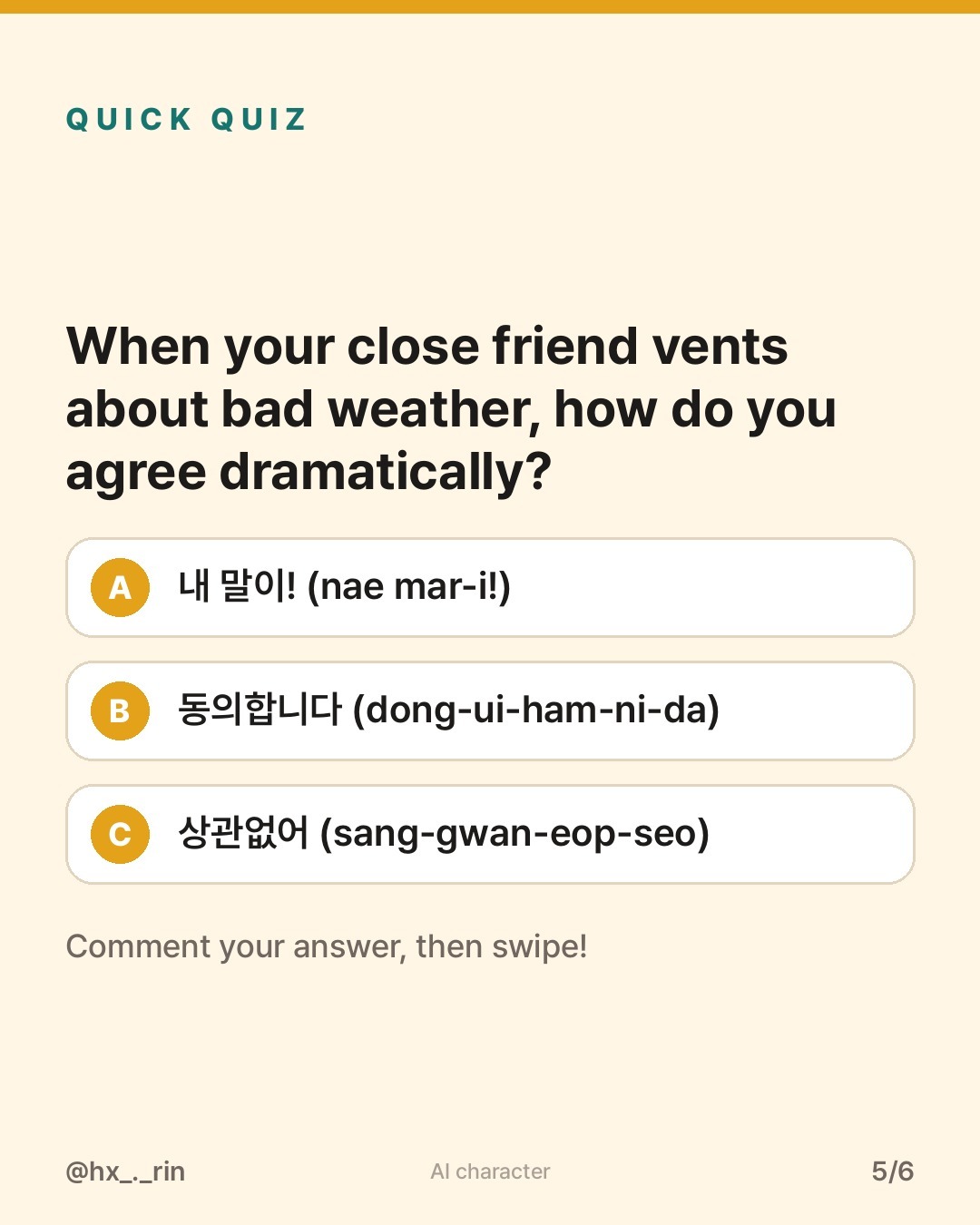
Quick quiz
When your close friend vents about bad weather, how do you agree dramatically?
- 내 말이! (nae mar-i!)
- 동의합니다 (dong-ui-ham-ni-da)
- 상관없어 (sang-gwan-eop-seo)
Show the answer
A. 내 말이! (nae mar-i!) — Casual banmal used among close friends when venting or sharing gossip. Never use it with superiors or elders; use '제 말이 그 말이에요' instead.
Sources
Keep learning
눈치 챙겨Read the room and get a clue before speaking or acting.
정신 차려
Get a grip, snap out of it, or pull yourself together.
오해하지 마세요
Don't get the wrong idea or take this the wrong way.