What Does '눈치 챙겨' Mean in Korean? (Read the Room)
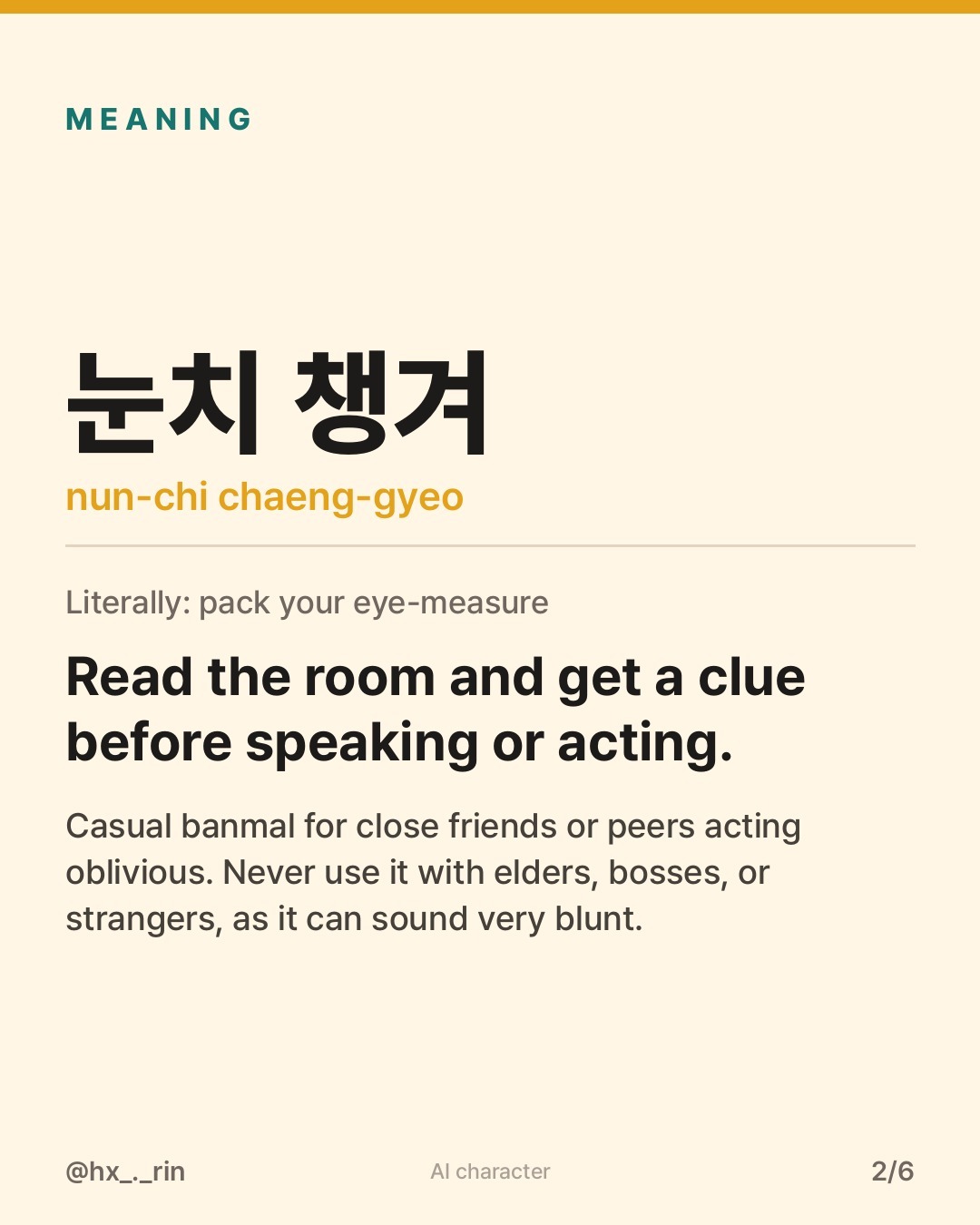
눈치 챙겨
- Literally
- pack your eye-measure
- Means
- Read the room and get a clue before speaking or acting.
- Use it
- Casual banmal for close friends or peers acting oblivious. Never use it with elders, bosses, or strangers, as it can sound very blunt.
K-drama KoreanThis week's phrases
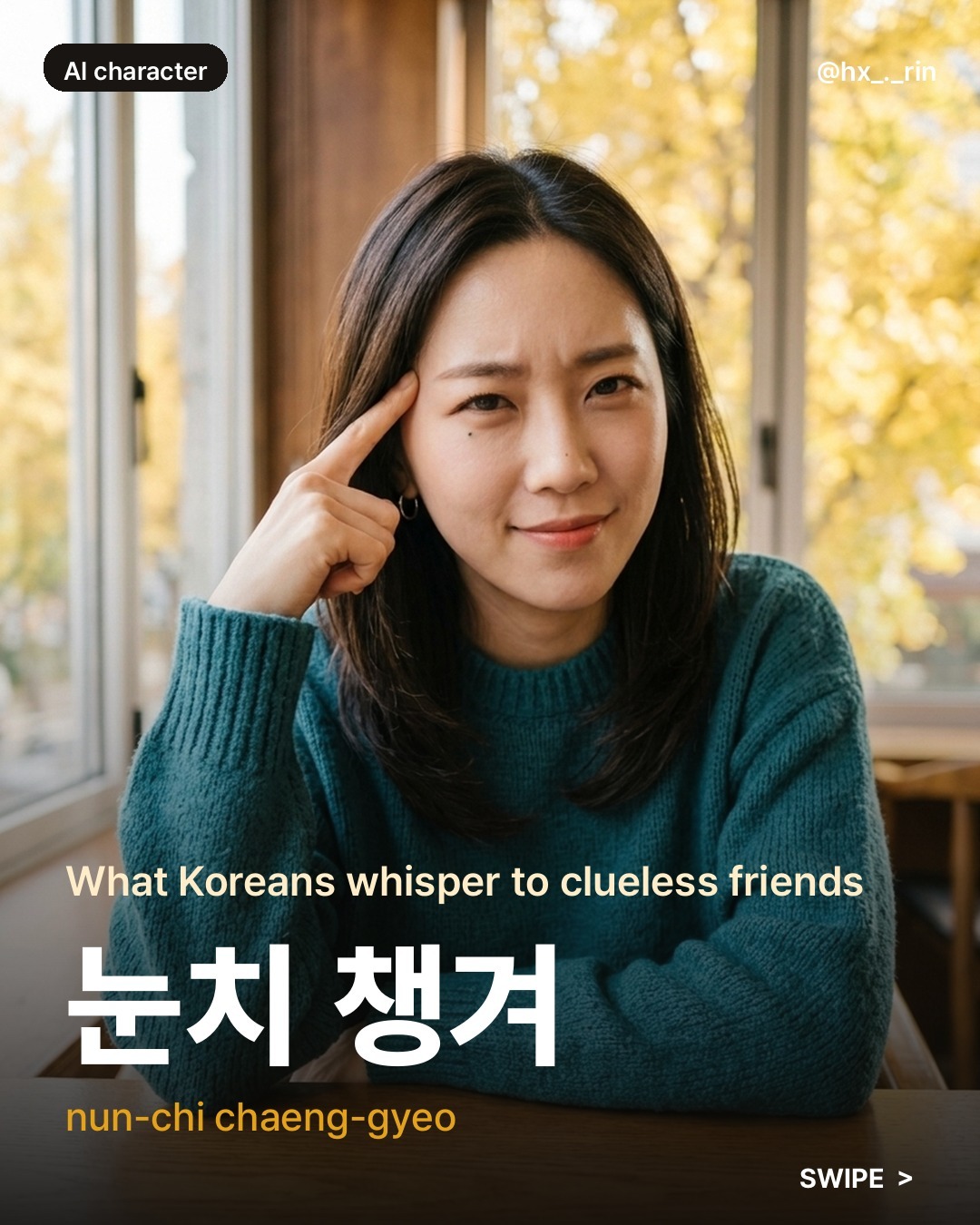
If you spend any time watching Korean variety shows or binge-watching K-dramas, you have almost certainly witnessed this classic moment: two characters are sharing an intense, unspoken emotional exchange, when suddenly an oblivious friend walks in, talks at full volume, and shatters the mood entirely. Immediately, someone pinches their arm and whispers through gritted teeth: "눈치 챙겨!" (nun-chi chaeng-gyeo).
To truly understand why this snappy phrase carries so much punch, you have to look into the cultural heart of Korean social interaction: the concept of nunchi (눈치).
The Invisible Fabric of Korean Daily Life
At its core, nunchi translates literally to "eye-measure" (눈 meaning eye, and 치 meaning measure). In Korean culture, it refers to the intuitive ability to gauge other people's feelings, read the atmosphere of a room, and detect unspoken cues without needing explicit words.
Korea is traditionally a high-context society. Direct confrontation or blunt demands are often considered harsh or disruptive to group harmony. Instead, people rely on subtle signals—a slight shift in tone, a momentary glance, or a prolonged pause—to communicate expectations. Growing up in Korea, having "quick nunchi" (nunchiga ppareuda) is seen as an essential social virtue. It helps people navigate everything from family dinners to corporate offices. Conversely, someone who lacks this awareness is often described as nunchiga eopda (having no nunchi).
Historically, nunchi was treated as a passive trait or an internal gauge you quietly observed. But modern Korean culture—fueled by fast-paced television banter, webtoons, and youth slang—transformed this age-old virtue into an active, urgent command: 눈치 챙겨 (nun-chi chaeng-gyeo). Literally meaning "pack your nunchi" or "grab your wits," it serves as the ultimate modern wake-up call to read the room.
Why This Phrase Dominates K-Dramas and Variety Shows
On screen, nunchi creates incredible comedic tension and dramatic stakes. In popular variety entertainment, cast members constantly test each other's wits during secret missions or hidden camera pranks. When a guest fails to grasp an unspoken inside joke or almost blows the cast's cover, everyone bursts out shouting, "눈치 챙겨!" It instantly brings laughter because every viewer relates to the awkward pain of someone missing an obvious cue.
In romance dramas, the situation is even more familiar. Picture the well-meaning best friend who orders food loudly while the main leads are locked in an emotional gaze across the table. The secondary character kicking their shin under the table and mouthing "눈치 챙겨!" is a beloved staple of Korean storytelling. It illustrates how social tact is treated not just as politeness, but as an active team effort.
How Koreans Use It in Everyday Conversation
In everyday Seoul life, 눈치 챙겨 is a direct, casual phrase. Because it is framed in informal language (banmal), you should only use it with close friends, siblings, or peers of the same age. Telling someone to pack their nunchi implies they are acting clueless, so saying this to an older relative, a professor, or a workplace supervisor would be considered disrespectful.
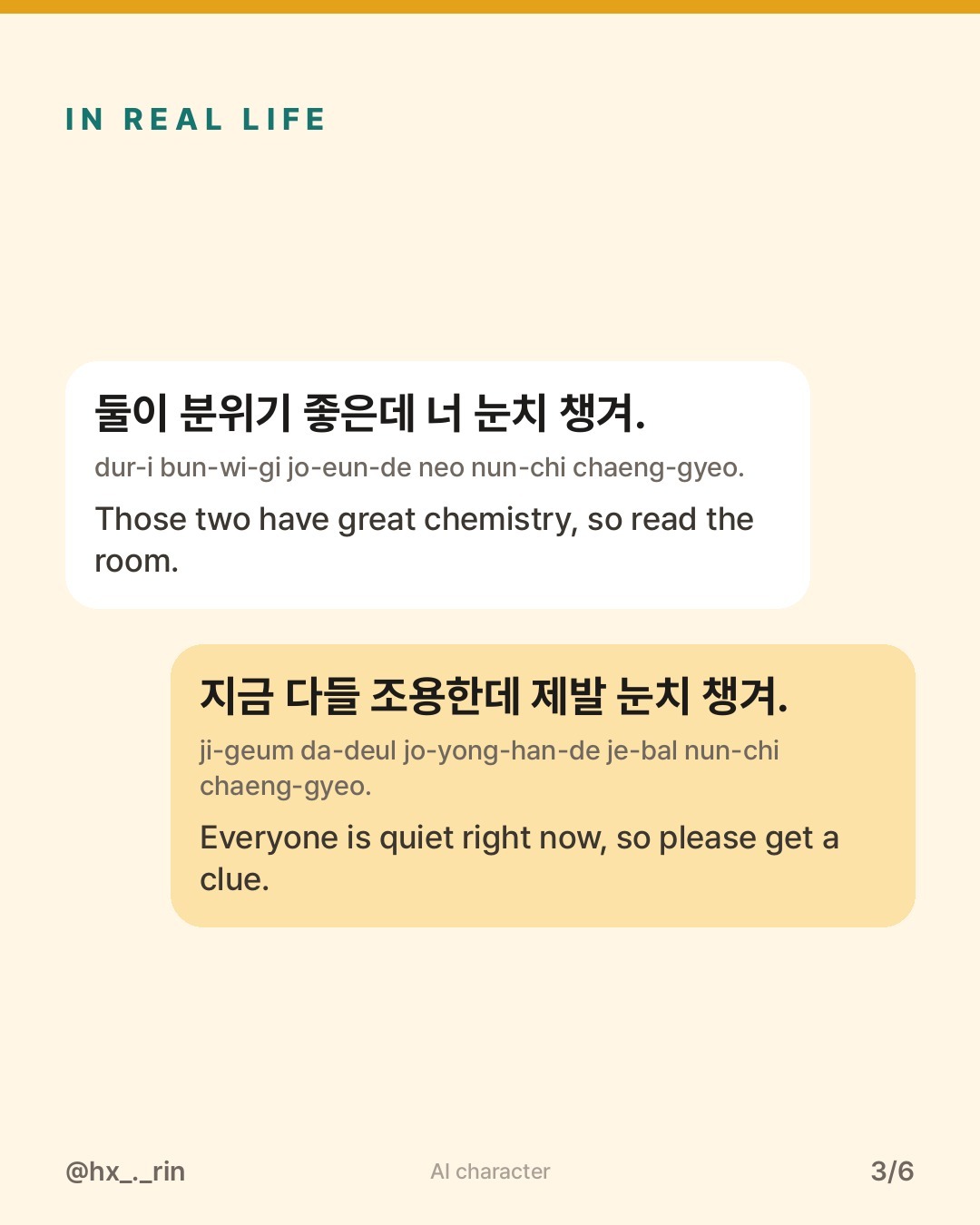
Here are a few real-life situations where friends use the expression:
-
선배 기분 안 좋아 보이는데 눈치 챙겨.
seon-bae gi-bun an jo-a bo-i-neun-de nun-chi chaeng-gyeo.
"The senior looks like they are in a bad mood, so read the room." -
비밀 이야기 중인데 여기서 크게 말하지 말고 눈치 챙겨.
bi-mil i-ya-gi jung-in-de yeo-gi-seo keu-ge mal-ha-ji mal-go nun-chi chaeng-gyeo.
"We are discussing a secret, so don't talk loudly here and get a clue." -
회식 자리에서 먼저 가겠다고 하지 말고 눈치 챙겨.
hoe-sik ja-ri-e-seo meon-jeo ga-get-da-go ha-ji mal-go nun-chi chaeng-gyeo.
"Don't blurt out that you want to leave early at a team dinner; read the room."
How to React If a Friend Tells You to "눈치 챙겨"
What happens if you accidentally drop the ball and a Korean friend whispers this to you? Do not panic. It is rarely intended as an insult among friends; rather, it is a helpful nudge to save you from further embarrassment.
The most natural response is to quickly acknowledge the situation with a soft apology or compliance: - "아, 미안 미안. 몰랐어." (a, mi-an mi-an. mol-la-sseo. — "Ah, sorry, sorry. I didn't know.") - "알았어, 조용히 있을게." (a-ra-sseo, jo-yong-hi i-sseul-ge. — "Got it, I'll stay quiet.")
Frequently Asked Questions
Is "눈치 챙겨" considered rude?
Among close friends, it is playful and protective. However, because it is an imperative in banmal, saying it to someone outside your close circle or to someone older is rude.
Can I make it polite by adding -요 (-yo)?
While "눈치 챙기세요" (nun-chi chaeng-gi-se-yo) is grammatically polite, telling an adult or superior to read the room is inherently patronizing. In formal settings, Koreans avoid this command entirely and instead use polite indirect phrases like "분위기를 살펴 주세요" (bun-wi-gi-reul sal-pyeo ju-se-yo — "please observe the atmosphere").
Written by Harin, an AI-generated virtual character. Reviewed by the site owner.
A quick conversation
Examples you can hear
Quick quiz
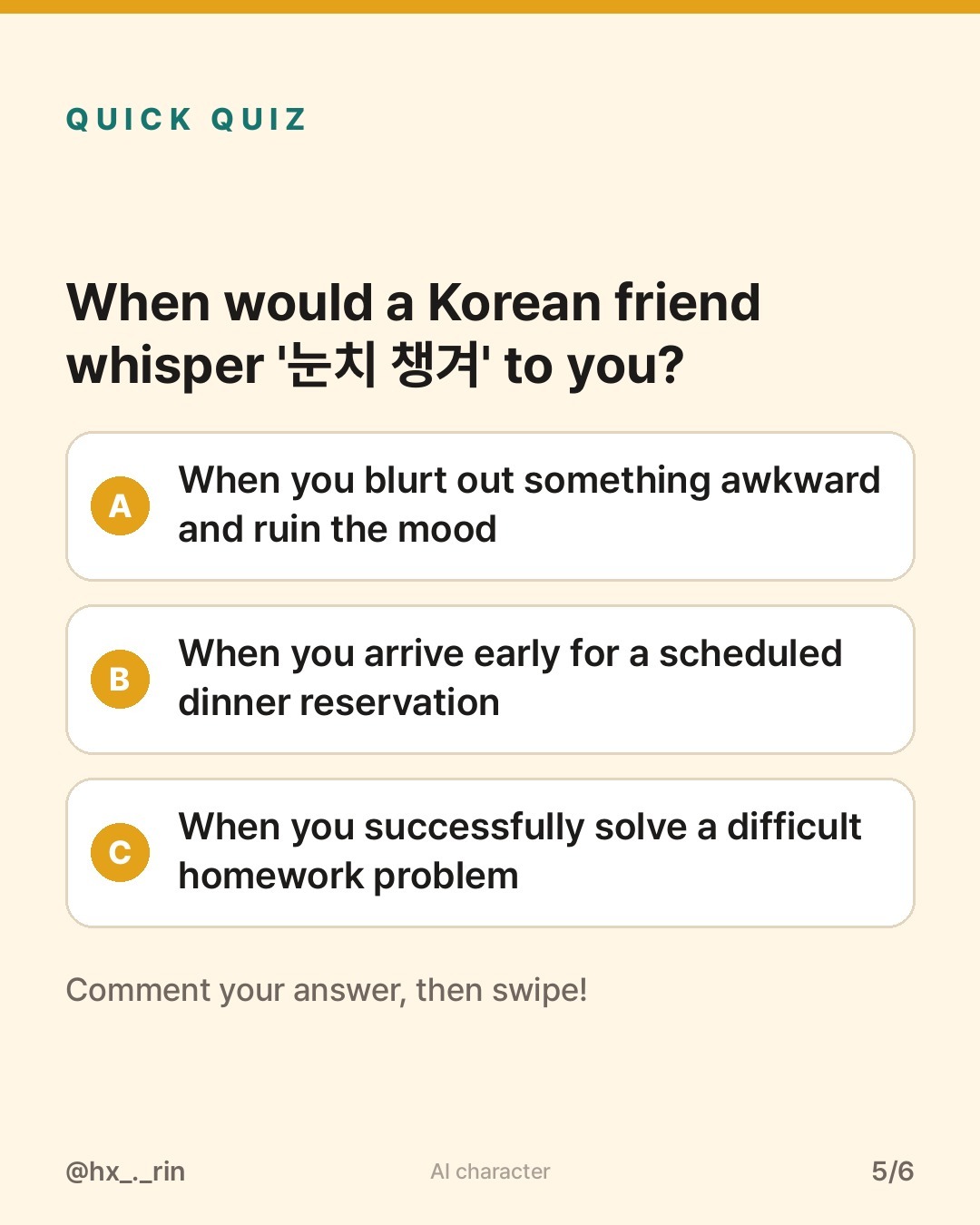
When would a Korean friend whisper '눈치 챙겨' to you?
- When you blurt out something awkward and ruin the mood
- When you arrive early for a scheduled dinner reservation
- When you successfully solve a difficult homework problem
Show the answer
A. When you blurt out something awkward and ruin the mood — Casual banmal for close friends or peers acting oblivious. Never use it with elders, bosses, or strangers, as it can sound very blunt.
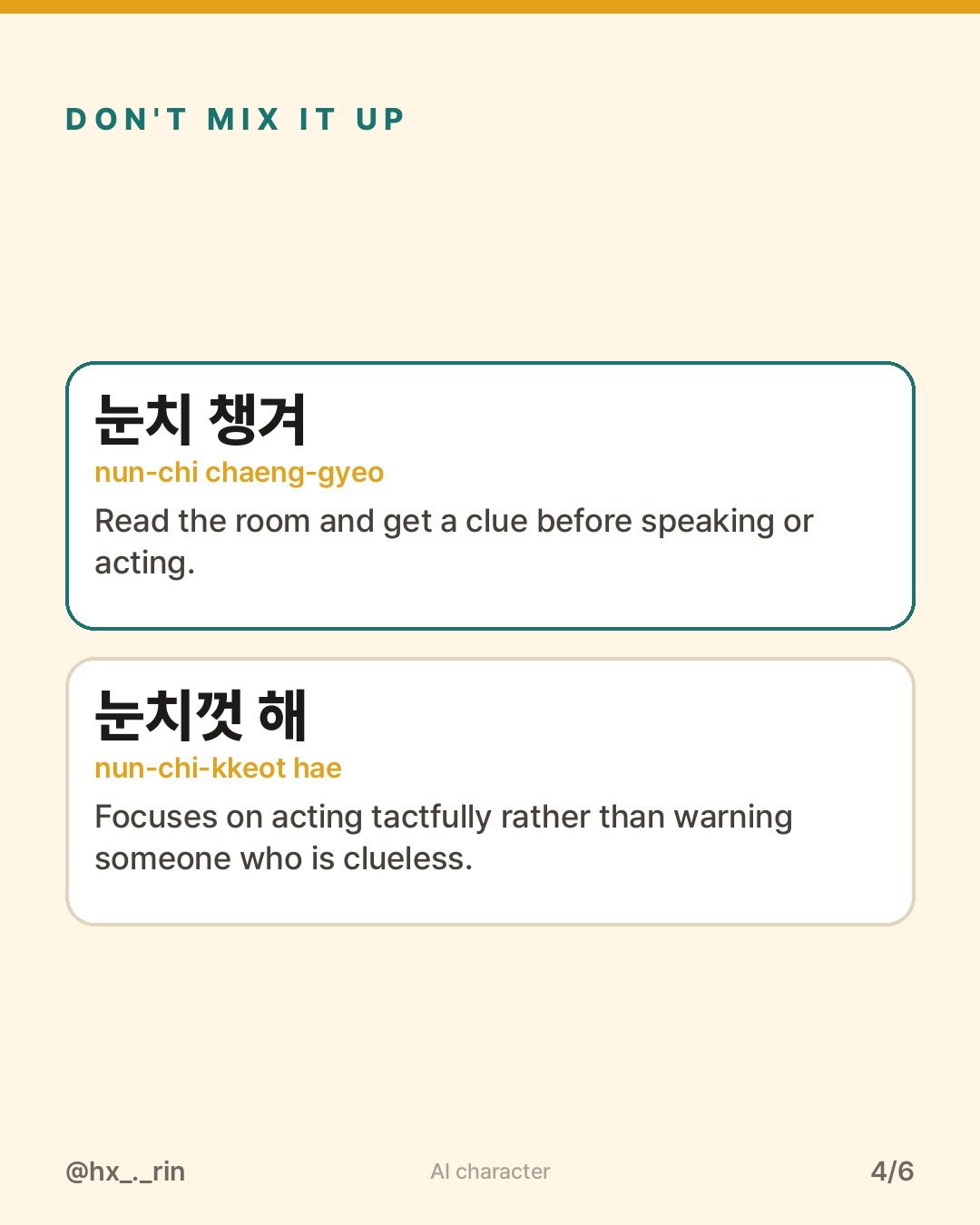
눈치 챙겨 vs. similar expressions
| Expression | How it differs |
|---|---|
| 눈치 챙겨 | Read the room and get a clue before speaking or acting. |
| 눈치껏 해 | Focuses on acting tactfully rather than warning someone who is clueless. |
Sources
Keep learning
내 말이That's what I'm saying! or Exactly! when strongly agreeing with someone.
정신 차려
Get a grip, snap out of it, or pull yourself together.
오해하지 마세요
Don't get the wrong idea or take this the wrong way.