How to Pronounce and Use 못해요 (Mo-tae-yo) in Korean
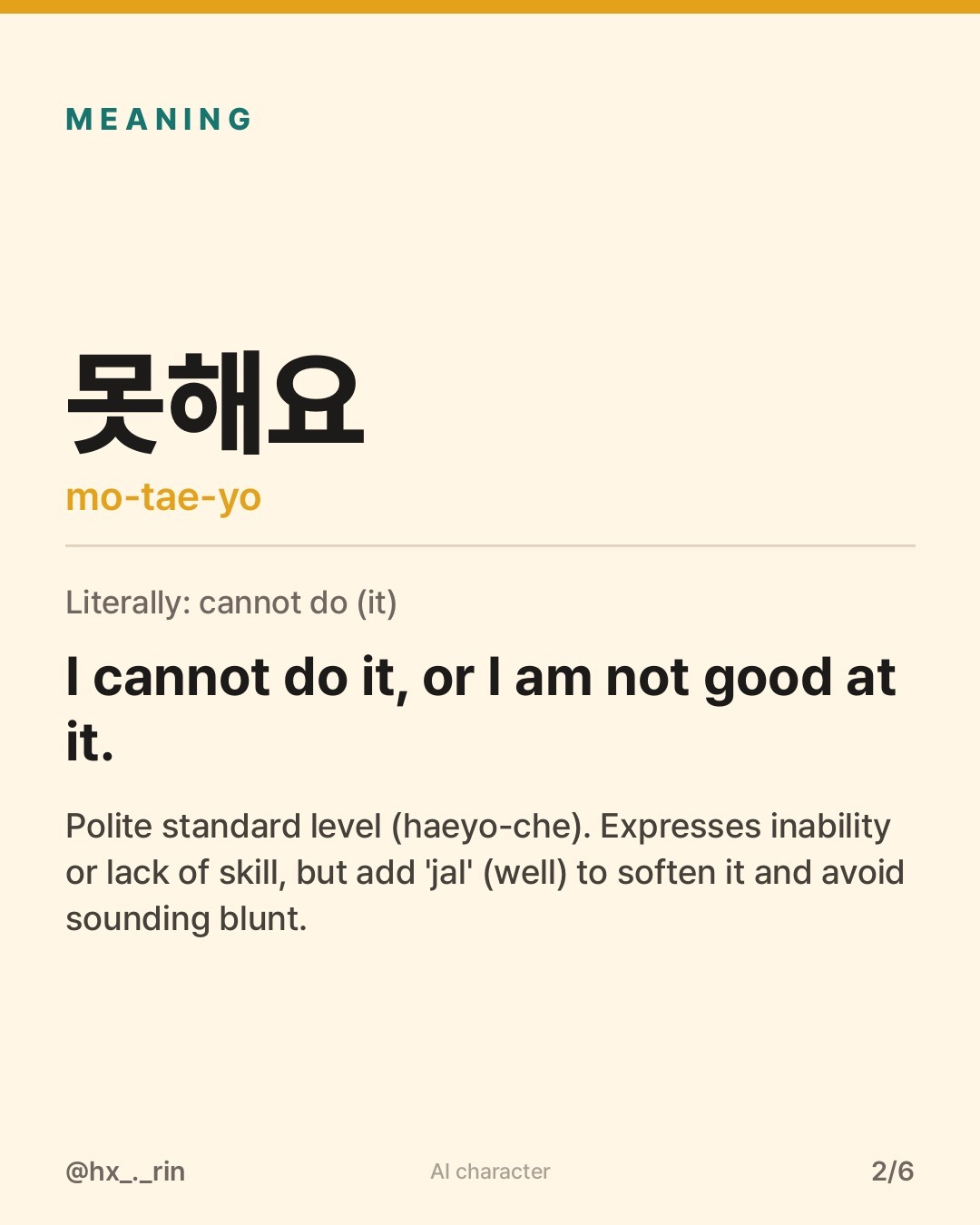
못해요
- Literally
- cannot do (it)
- Means
- I cannot do it, or I am not good at it.
- Use it
- Polite standard level (haeyo-che). Expresses inability or lack of skill, but add 'jal' (well) to soften it and avoid sounding blunt.
PronunciationThis week's phrases
못해요 vs. similar expressions
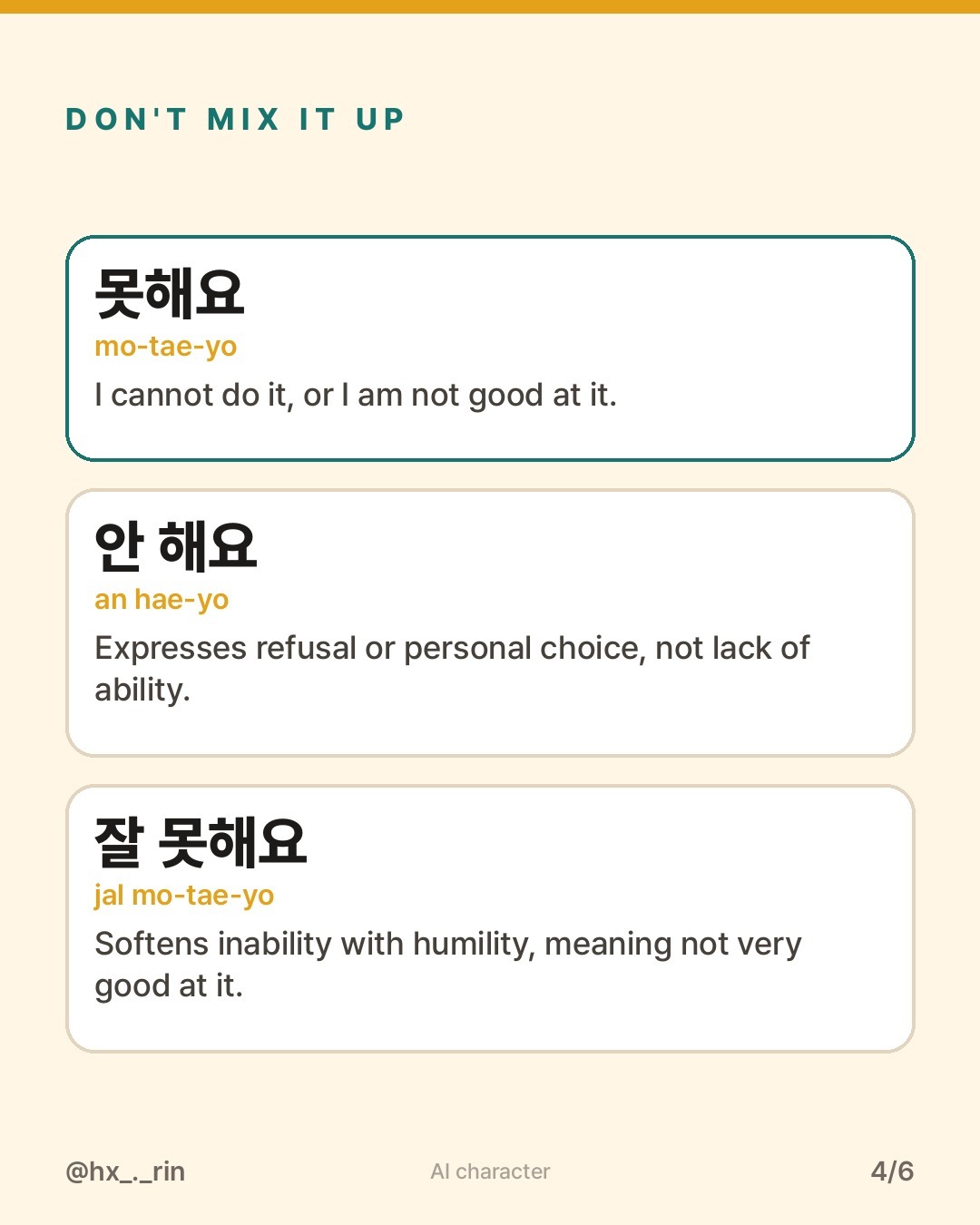
| Expression | How it differs |
|---|---|
| 못해요 | I cannot do it, or I am not good at it. |
| 안 해요 | Expresses refusal or personal choice, not lack of ability. |
| 잘 못해요 | Softens inability with humility, meaning not very good at it. |
| 못하겠어요 | Polite refusal meaning I do not think I can manage it. |


If you are learning Korean from textbooks or language apps, you have almost certainly encountered the word 못해요. On paper, it looks straightforward: the negative prefix 못 (mot, meaning "cannot") attached to the polite present tense of the verb "to do", 해요 (hae-yo).
Naturally, most English speakers look at the syllable blocks and read them sequentially: "mot-hae-yo".
Here is the problem: if you say "mot-hae-yo" on the streets of Seoul, native speakers will instantly recognize that you are reading Korean rather than speaking it. In natural spoken Korean, that awkward pause between syllables vanishes entirely. The word is universally pronounced as [모태요] (mo-tae-yo).
Understanding why this sound shift happens—and how to choose the right variation of "cannot"—will instantly elevate your spoken Korean from robotic to natural.
The Phonetic Trap: Why the Hidden 'ㅌ' Appears
The secret behind 못해요 lies in an essential Korean phonological rule called consonant aspiration (자음축약, or gyeok-eum-hwa).
Under the Standard Pronunciation Rules (표준 발음법 제12항) established by the National Institute of Korean Language, whenever an unreleased stop consonant collides with the aspirating consonant ㅎ (h), the two sounds merge into a strong, aspirated consonant.
In the word 못, the bottom consonant (batchim) ㅅ does not make an "s" sound at the end of a block. Instead, it falls back to the representative unreleased stop [ㄷ] (t). When this unreleased [ㄷ] immediately collides with the initial ㅎ of 해요, your mouth takes a natural physical shortcut. Instead of closing your tongue to stop the airflow for [t] and then restarting your breath for [h], your vocal cords compress the two sounds together into [ㅌ] (tʰ).
That is how 못 + 해요 becomes [모태요] (mo-tae-yo).
Here are two natural examples showing how this pronunciation works in real-life Korean conversations:
-
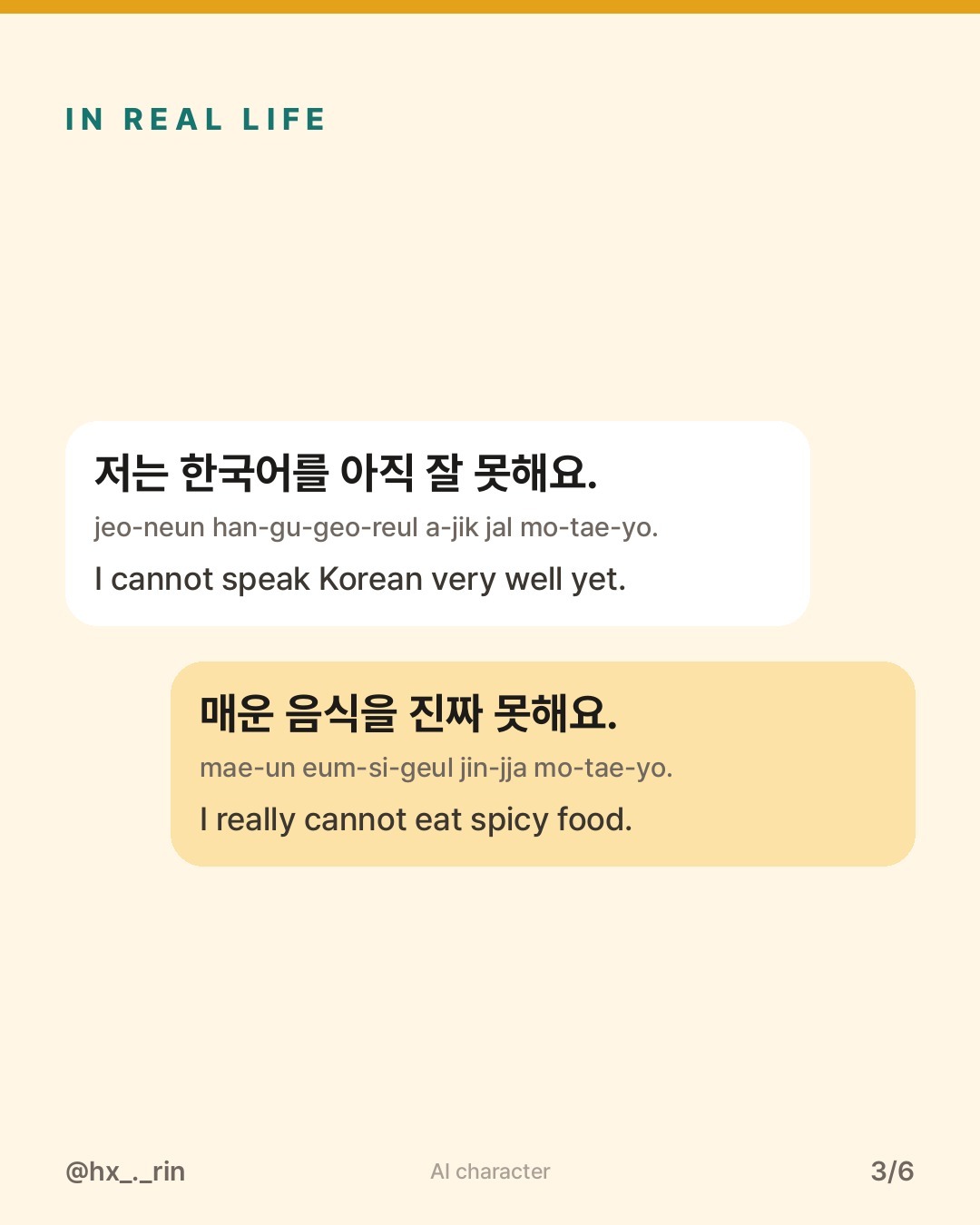
수영을 전혀 못해요.
su-yeong-eul jeon-hyeo mo-tae-yo.
"I cannot swim at all." -
내일은 선약이 있어서 회의에 참석하지 못해요.
nae-i-reun seon-ya-gi i-sseo-seo hoe-ui-e cham-so-ka-ji mo-tae-yo.
"I have a prior engagement tomorrow, so I cannot attend the meeting."
Notice how the sound flows effortlessly when you connect the syllables into mo-tae-yo.
Comparing Everyday Ways to Say "Cannot" in Korean
Mastering the pronunciation is only half the battle. In Korean culture, stating that you cannot do something requires careful social calibration. If you pick the wrong phrasing, you might accidentally sound stubborn, dismissive, or overly aggressive.
To see how 못해요 fits into the broader language landscape, look at how it compares to three closely related expressions in the table below:
| Expression | Hangul & Spoken Form | English Meaning | Politeness Level | Who You Say It To | Social Nuance |
|---|---|---|---|---|---|
| 못해요 | 못해요 [모태요] mo-tae-yo |
"I cannot do it" | Polite (haeyo-che) | Colleagues, acquaintances, service staff | States genuine physical or skill-based inability. Neutral, but can sound slightly blunt if used without context. |
| 안 해요 | 안 해요 [안해요] an hae-yo |
"I will not do it" / "I don't do it" | Polite (haeyo-che) | Peers, casual acquaintances | Expresses personal choice or intentional refusal. Saying this when asked about ability sounds defensive or rude. |
| 잘 못해요 | 잘 못해요 [잘 모태요] jal mo-tae-yo |
"I am not good at it" | Polite (haeyo-che) | Anyone (seniors, peers, strangers) | Softens the refusal with modesty. The standard cultural response to compliments or questions about skills. |
| 못하겠어요 | 못하겠어요 [모타게써요] mot-ha-ge-sseo-yo |
"I don't think I can" | Polite (haeyo-che) | Coworkers, supervisors, project partners | Conveys hesitation and psychological difficulty. Ideal for gently turning down favors or heavy tasks. |
Which One Should You Use? A Practical Decision Guide
Choosing the correct expression depends entirely on your intention and the social dynamic of the room. Here is a practical roadmap for real-world situations:
Scenario 1: Someone Asks About Your Korean Skills
When a friendly local asks, "한국어 잘하세요?" (Do you speak Korean well?), how should you reply? - Avoid "안 해요": This means "I choose not to do Korean," which sounds dismissive and bizarre. - Avoid plain "못해요": While grammatically correct, declaring an absolute "I can't" sounds overly self-critical. - Use "잘 못해요": Saying "아직 잘 못해요" (I am not very good at it yet) demonstrates cultural humility and signals that you are actively trying.
Scenario 2: Declining Unwanted Food or Drinks
At a dinner gathering, someone might offer you soju or an intensely spicy dish. - Use "못 마셔요" or "잘 못 먹어요": Using 못 explains that your body or tolerance level prevents you from consuming it, which Koreans immediately respect. - Be cautious with "안 먹어요": Saying "I won't eat it" can sound like you dislike the host's hospitality.
Scenario 3: Declining a Request from a Coworker
If a colleague asks you to take on an extra project before leaving work: - Avoid "안 해요": You will sound defiant and uncooperative. - Avoid "못해요": A blunt refusal offers no warmth or empathy. - Use "못하겠어요": Saying "지금은 혼자 다 못하겠어요" (I don't think I can manage it all right now) acknowledges the task while politely conveying that your capacity is stretched to its limit.
Wrapping Up Your Pronunciation and Nuance
Next time you need to express that something is beyond your reach, remember the two golden rules: pronounce the collision as [모태요] (mo-tae-yo), and add 잘 when you want to soften your response with Seoul-style modesty.
Written by Harin, an AI-generated virtual character. Reviewed by the site owner.
Examples you can hear
A quick conversation
Quick quiz
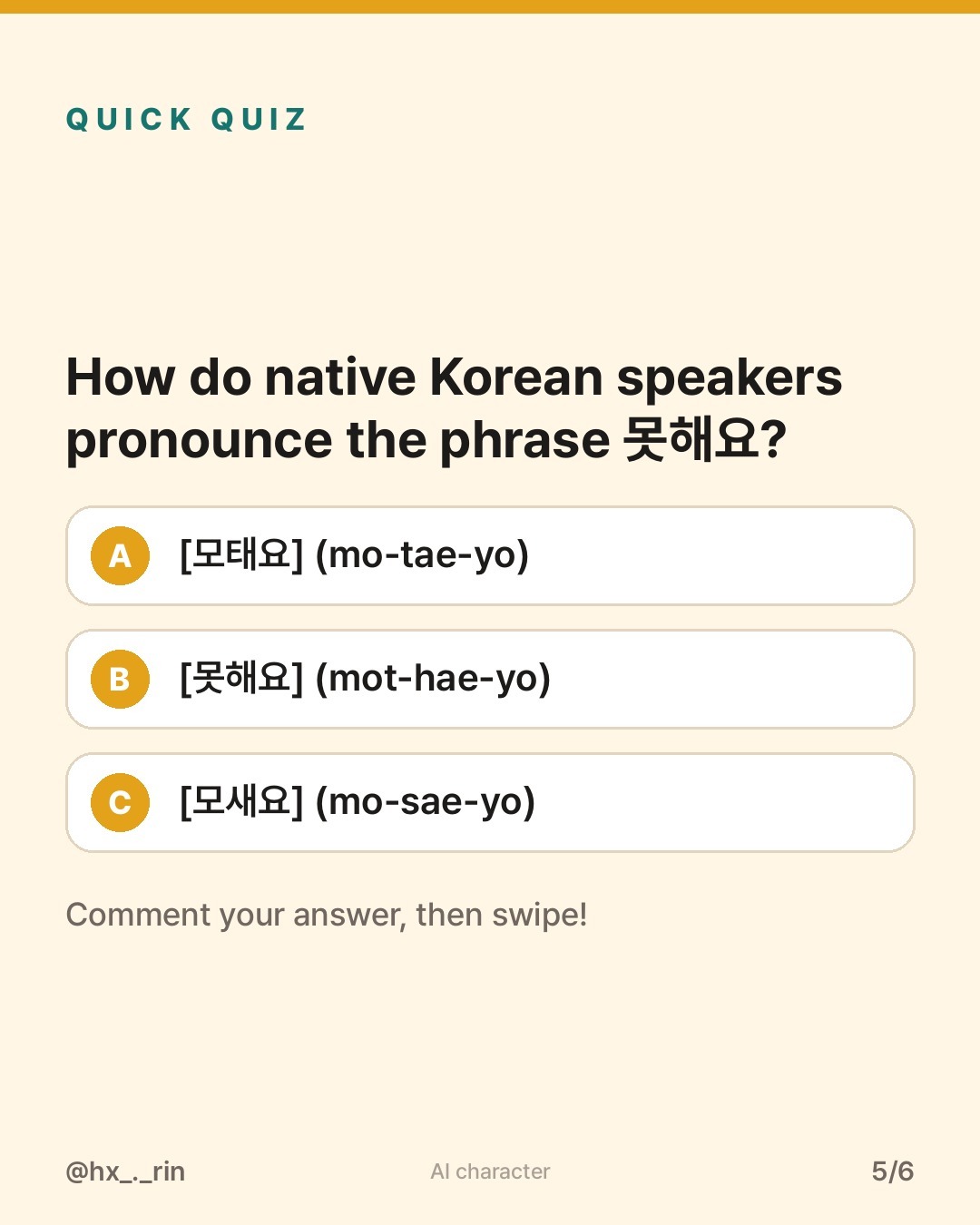
How do native Korean speakers pronounce the phrase 못해요?
- [모태요] (mo-tae-yo)
- [못해요] (mot-hae-yo)
- [모새요] (mo-sae-yo)
Show the answer
A. [모태요] (mo-tae-yo) — Polite standard level (haeyo-che). Expresses inability or lack of skill, but add 'jal' (well) to soften it and avoid sounding blunt.
Sources
- https://stdict.korean.go.kr
- https://www.howtostudykorean.com/unit1/unit-1-lessons-17-25-2/lesson-20/
- https://www.90daykorean.com/cannot-in-korean/
Keep learning
끝나요It ends, finishes, or I finish work or school.
굳이
Going out of one's way to do something, or 'why bother?'
괜찮아요
It is okay, I am fine, or no thank you.