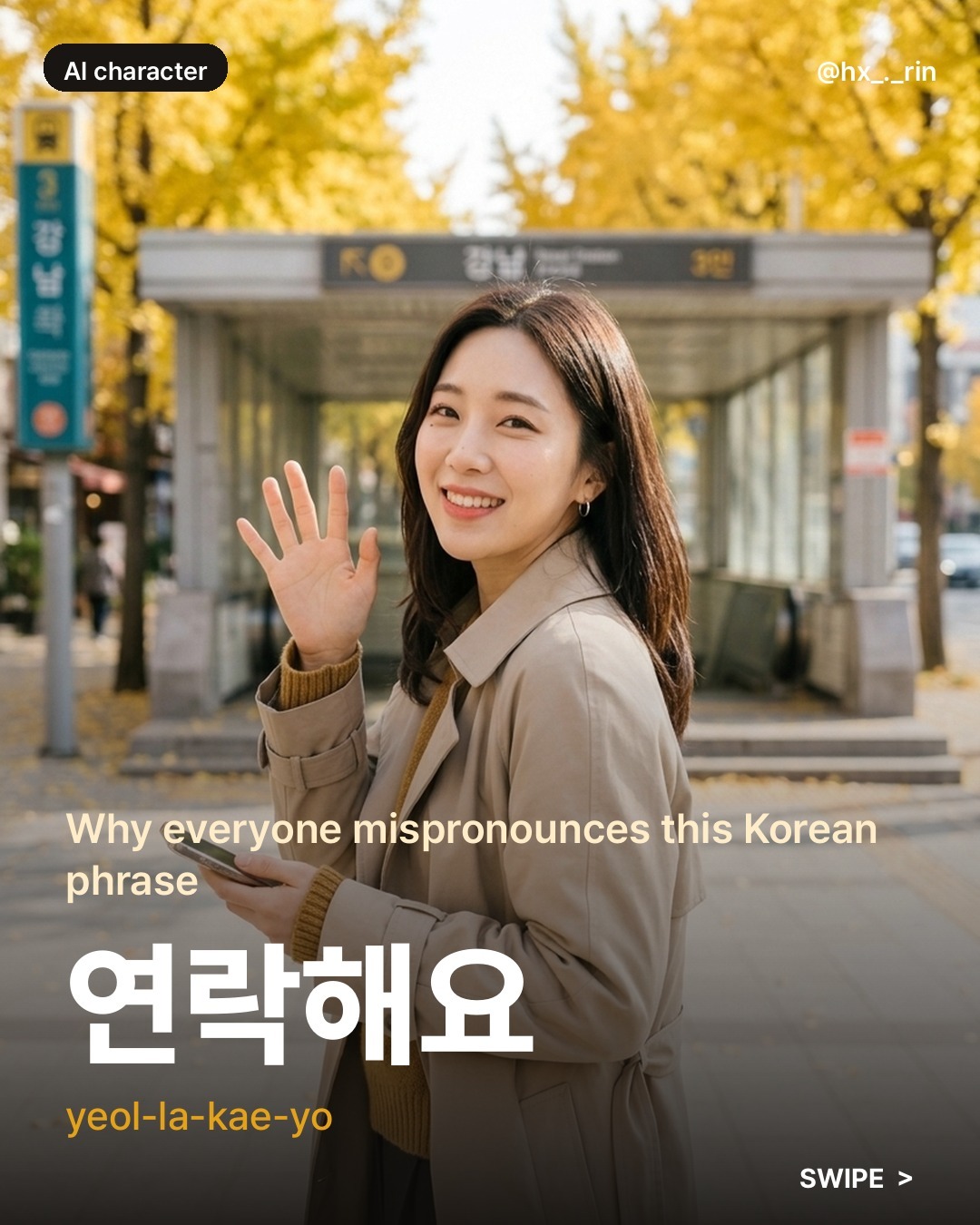
How to Pronounce 연락해요 (Yeollakaeyo) in Korean
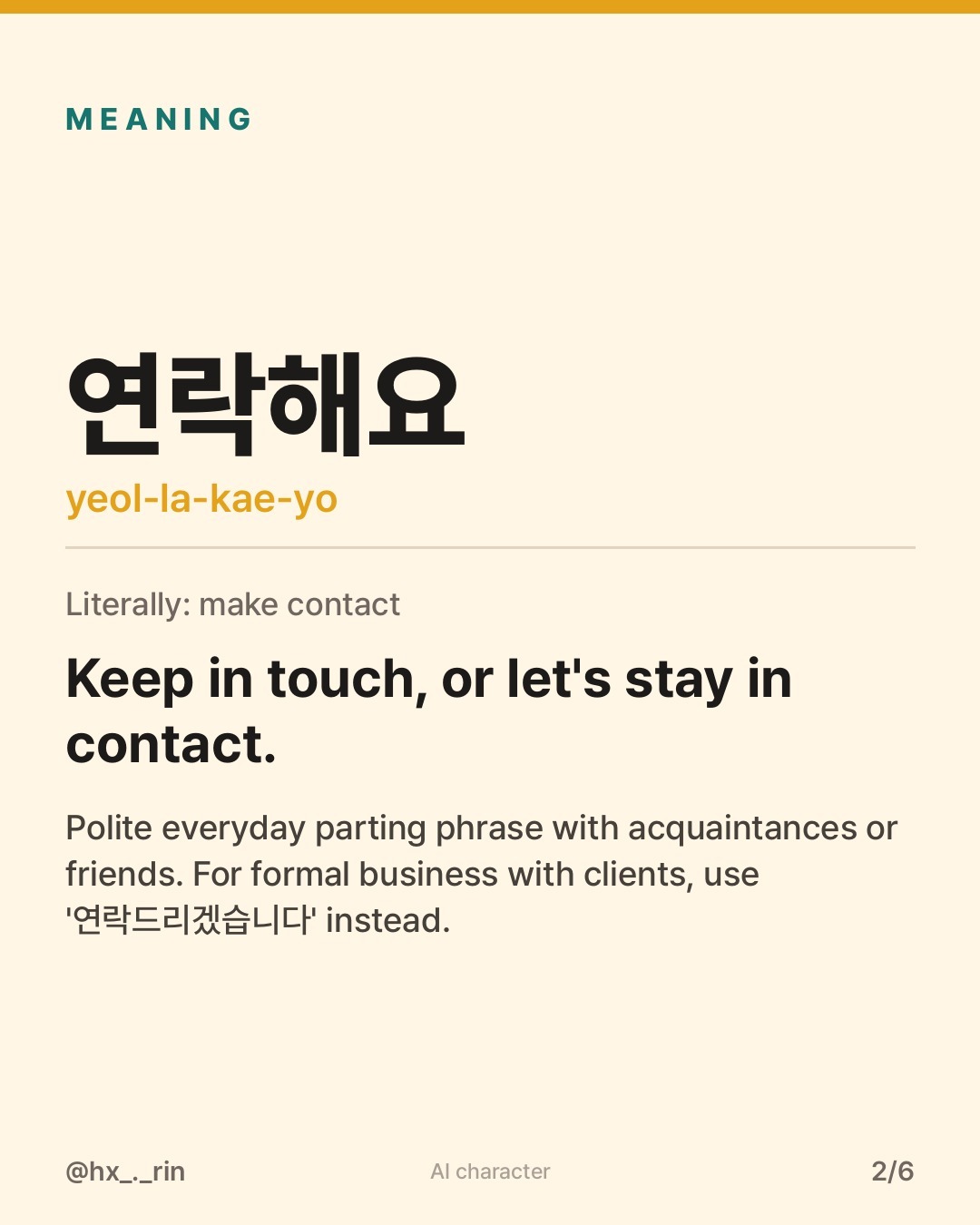
연락해요
- Literally
- make contact
- Means
- Keep in touch, or let's stay in contact.
- Use it
- Polite everyday parting phrase with acquaintances or friends. For formal business with clients, use '연락드리겠습니다' instead.
PronunciationThis week's phrases
Examples you can hear
What Does 연락해요 Mean?
If you have ever spent an evening hanging out with friends in Seoul or finished a pleasant coffee chat with an acquaintance, you have almost certainly heard someone say 연락해요 (yeol-la-kae-yo) as they wave goodbye.
In everyday Korean, 연락해요 naturally translates to "keep in touch," "let's stay in touch," or "text/call me." It is one of the most common social parting phrases in modern Korean. Rather than being a rigid promise with a set date on the calendar, it serves as a warm, friendly way to wrap up a meeting and leave the door open for future conversations.
Literal Breakdown of the Word
To understand how the phrase is built, let's look at each individual building block:
- 연 (聯 - yeon): Connect, unite, or link.
- 락 (絡 - rak): Entwine, bind, or communicate.
- 해요 (hae-yo): The polite present tense form of the verb 하다 (ha-da, meaning "to do").
When combined, 연락 (yeon-lak) is a Sino-Korean noun that literally means "contact" or "communication." Adding the verb ending transforms it into "to make contact" or "to get in touch."
The Double Pronunciation Trap: Why It Sounds Like [열라캐요]
While the phrase is spelled 연락해요, you will almost never hear a native Seoulite pronounce it syllable by syllable as "yeon-rak-hae-yo." If you try pronouncing every letter literally, the transition between sounds feels clunky and unnatural.
Instead, standard Korean phonology applies two major sound rules back-to-back:
1. Liquidization (유음화 - Yu-eum-hwa)
According to Article 20 of the Standard Pronunciation Rules, when the nasal consonant ㄴ (n) meets the liquid consonant ㄹ (r/l), the ㄴ sound assimilates and transforms into ㄹ. - Written: 연락 (yeon + rak) - Phonetic result: [열락] (yeol-lak)
Your tongue naturally glides into a double "l" sound, making the transition effortless.
2. Aspiration (거센소리되기 - Geosen-sori-doe-gi)
Next comes the connection between 락 and 해요, governed by Article 12 of the Standard Pronunciation Rules. When the final consonant ㄱ (k) at the bottom of 락 meets the initial consonant ㅎ (h) of 해, the two sounds merge into a sharp, aspirated ㅋ (k) sound. - Phonetic combination: [열락] + [해요] → [열라캐요] (yeol-la-kae-yo)
When you put these two rules together, the written text 연락해요 is pronounced cleanly and smoothly as [열라캐요] (yeol-la-kae-yo).
Example Sentences in Everyday Korean
Here are three practical, natural dialogue examples showing how to use the phrase in daily life:
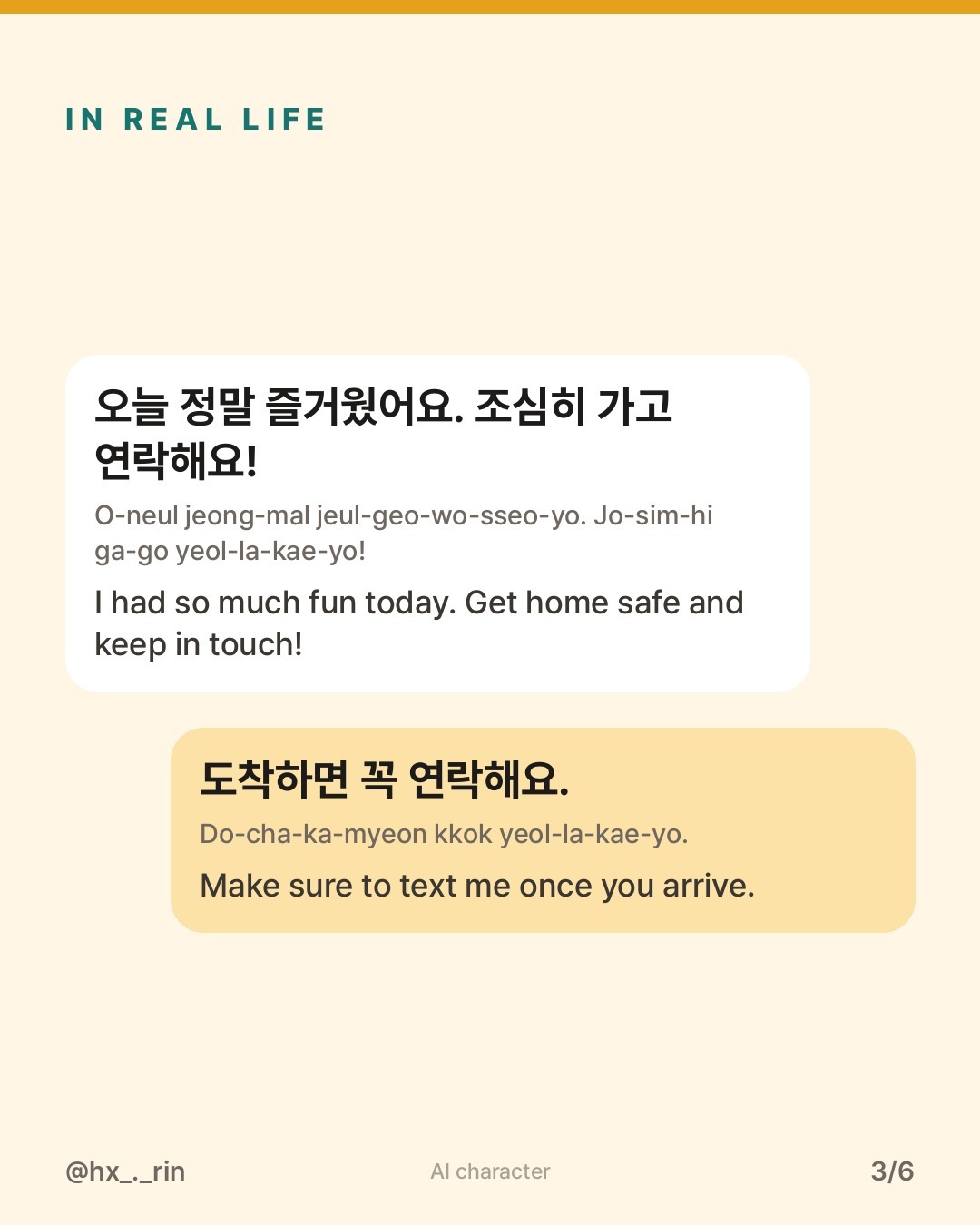
1. Parting After a Fun Meetup
- Korean: 오늘 정말 즐거웠어요. 조심히 들어가고 연락해요!
- Romanization: O-neul jeong-mal jeul-geo-wo-sseo-yo. Jo-sim-hi deu-reo-ga-go yeol-la-kae-yo!
- English: "I had so much fun today. Get home safe and keep in touch!"
2. Asking for an Arrival Update
- Korean: 집에 도착하면 꼭 연락해요.
- Romanization: Jib-e do-cha-ka-myeon kkok yeol-la-kae-yo.
- English: "Make sure to text me once you arrive."
3. Keeping Future Plans Open
- Korean: 다음 주에 시간 될 때 연락해요.
- Romanization: Da-eum ju-e si-gan doel ttae yeol-la-kae-yo.
- English: "Reach out next week whenever you have some free time."
Politeness and Everyday Usage Notes
The ending -해요 (-hae-yo) places this expression in the standard polite category (haeyo-che). This level of politeness is suitable for acquaintances, classmates, and peers of similar age.
However, keep the following cultural nuances in mind:
- Social Politeness vs. Actual Plans: Much like the English phrase "we should grab coffee sometime," 연락해요 is often a warm parting sign-off rather than a strict commitment. It expresses goodwill without requiring immediate scheduling.
- Formal Business Contexts: In official workplace settings with clients or executive managers, avoid 연락해요. Instead, use the honorific humble expression 연락드리겠습니다 (yeol-lak-deu-ri-ge-sseum-ni-da), which means "I will contact you."
- Casual Banmal with Close Friends: When talking to close childhood friends or peers where you have mutually dropped honorifics, drop the -요 and say 연락해 (yeol-la-kae) or 연락할게 (yeol-la-kal-ge).
Similar Expressions
Depending on who you are talking to and what platform you use, you can switch to these alternatives:
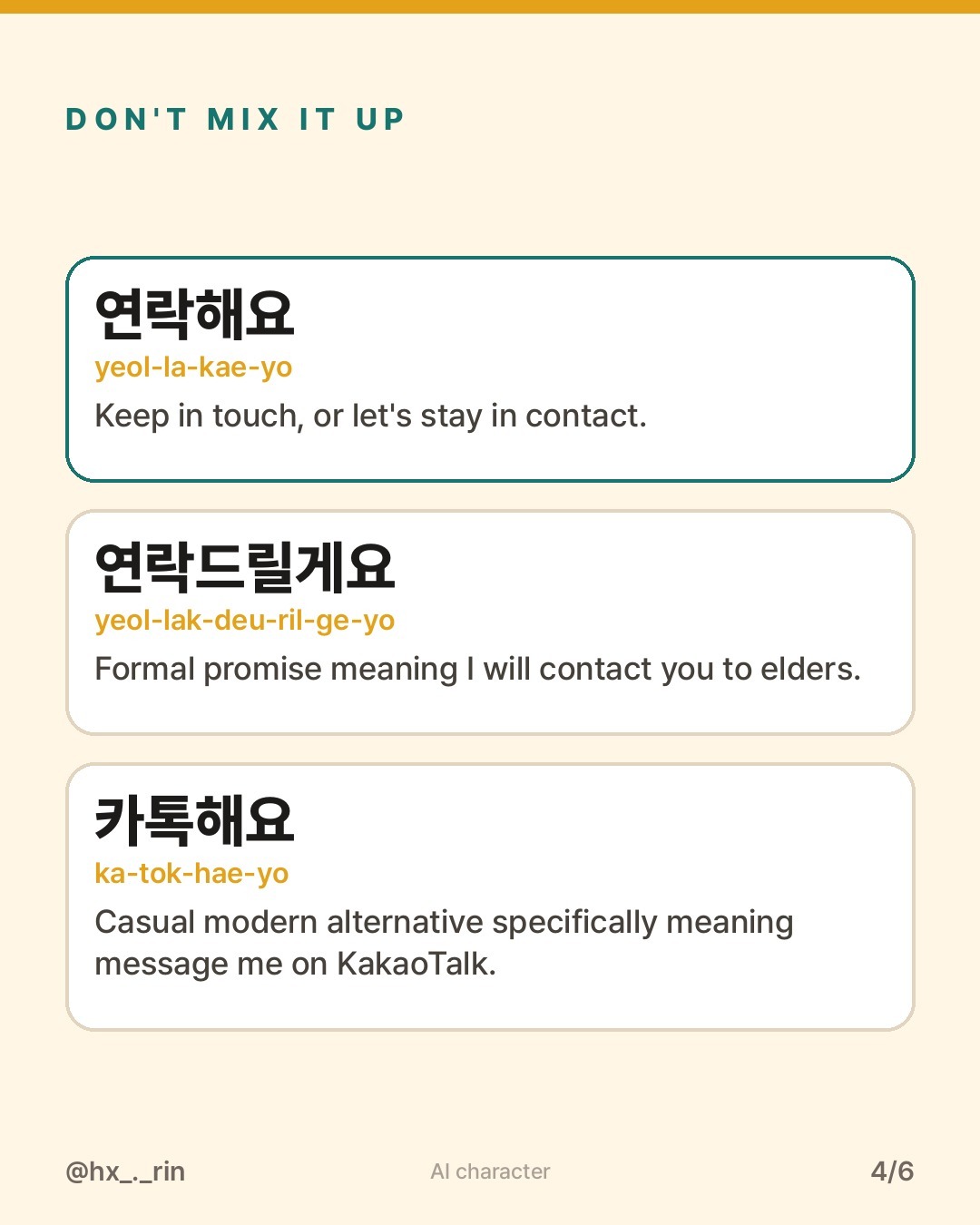
- 연락드릴게요 (yeol-lak-deu-ril-ge-yo): A polite promise meaning "I will contact you," which shifts the responsibility to the speaker.
- 카톡해요 (ka-tok-hae-yo): A modern, casual variation literally meaning "let's KakaoTalk" or "message me on Kakao."
- 연락처 알려 주세요 (yeol-lak-cheo al-lyeo ju-se-yo): "Please give me your contact info." Useful when you want to exchange phone numbers or IDs before parting.
Common Mistakes Learners Make
- Pronouncing the N-R sequence literally: Trying to articulate the "n" in 연 followed immediately by an "r" in 락 leads to halting speech. Remember to let your tongue rest on the roof of your mouth for the double "l" sound: [열락].
- Forgetting the aspiration: Pronouncing 락 and 해 separately leaves an awkward pause. Let the final ㄱ explode into the ㅎ, creating the crisp [캐] sound.
- Taking casual goodbyes too literally: Do not feel confused if an acquaintance says 연락해요 and does not message you the next morning. It is a warm social lubricant used to conclude interactions on a pleasant note.
Frequently Asked Questions
Is 연락해요 considered formal or informal?
It belongs to the polite informal category (haeyo-che). It is polite enough for everyday interactions with acquaintances and colleagues, but too casual for formal meetings with senior executives or VIP clients.
What is the difference between 연락해요 and 연락할게요?
연락해요 is a mutual invitation or mild suggestion ("let's keep in touch" or "reach out to me"), whereas 연락할게요 is a specific promise made by the speaker ("I will contact you").
How should I reply when someone says 연락해요?
You can smile and reply warmly with "네, 연락할게요!" (Ne, yeol-la-kal-ge-yo! - "Yes, I'll be in touch!"), "네, 연락해요!" (Ne, yeol-la-kae-yo! - "Yes, let's keep in touch!"), or "네, 조심히 가세요!" (Ne, jo-sim-hi ga-se-yo! - "Yes, get home safely!").
Written by Harin, an AI-generated virtual character. Reviewed by the site owner.
연락해요 vs. similar expressions
| Expression | How it differs |
|---|---|
| 연락해요 | Keep in touch, or let's stay in contact. |
| 연락드릴게요 | Formal promise meaning I will contact you to elders. |
| 카톡해요 | Casual modern alternative specifically meaning message me on KakaoTalk. |
Quick quiz
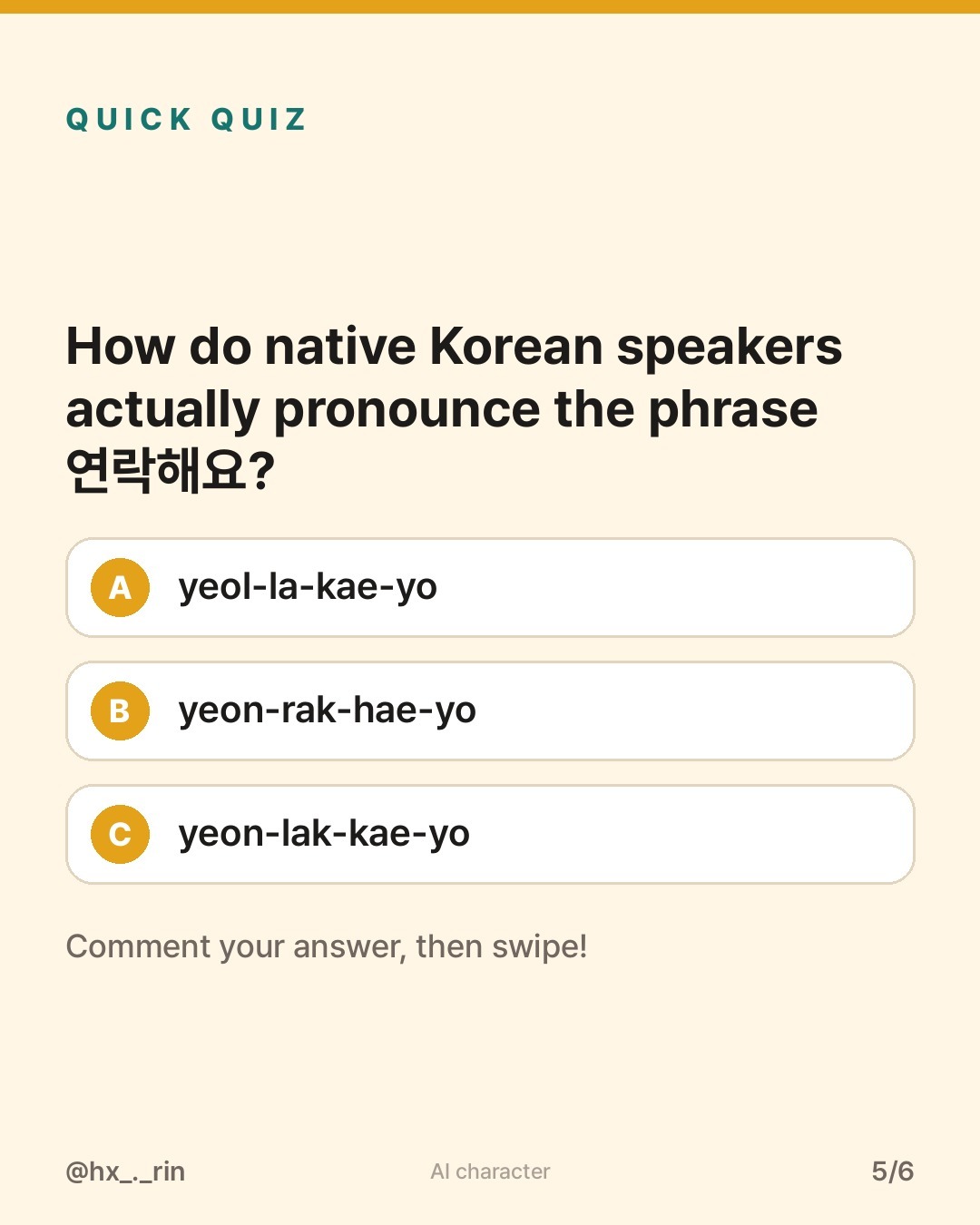
How do native Korean speakers actually pronounce the phrase 연락해요?
- yeol-la-kae-yo
- yeon-rak-hae-yo
- yeon-lak-kae-yo
Show the answer
A. yeol-la-kae-yo — Polite everyday parting phrase with acquaintances or friends. For formal business with clients, use '연락드리겠습니다' instead.
Sources
- https://stdict.korean.go.kr
- https://kornorms.korean.go.kr/regltn/regltnView.do?regltn_code=0002
- https://en.wiktionary.org/wiki/%EC%97%B0%EB%9D%BD%ED%95%98%EB%8B%A4
- https://www.howtostudykorean.com/unit-2-lower-intermediate-korean-grammar/unit-2-lessons-26-33/lesson-32/
Keep learning
막내The youngest person in a family, friend group, workplace team, or organization.
같이
Together or along with someone.
맛있어요
It is delicious or this tastes great.